
190% ROI. 13% Impact. What's Actually Going On?
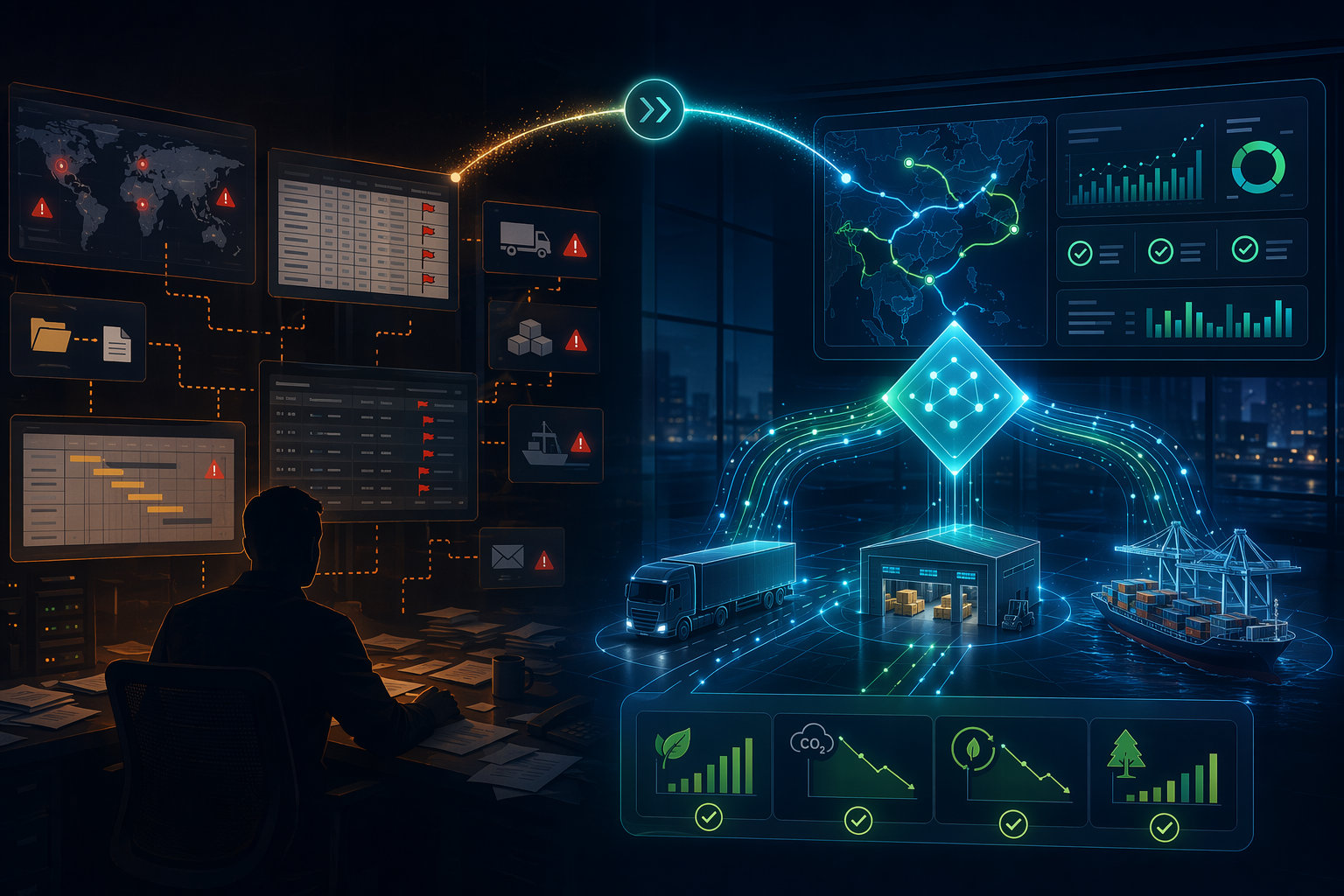
Two numbers do not want to live in the same room. The first: logistics-sector AI investments average a 190% ROI, according to Gartner’s Supply Chain Technology Report 2025 — a figure cited by multiple consultancies, most recently by The Thinking Company. The second: only 13% of logistics service providers report measurable financial impact from AI embedded in daily operations (BCG/Alpega survey of 180+ experts, January 2026). One number says the money is there. The other says almost no one is pocketing it. The gap is not about technology failure — the tools work. The gap is about how we measure, budget, and organize for them.
What That 190% Average Really Measures
That 190% average is not a single project number. It is a weighted mean of wildly different use cases. Route optimization on fleets of 500+ vehicles delivers 800–1,200% three-year ROI with a 2–4 month payback (investment EUR 80–150K, annual savings EUR 1.5–3M). That is the outlier that pulls the average up. Warehouse AI, on the other hand, sits closer to 100–150%. Orchestration and control-tower projects land somewhere in between. When you see “190% average,” ask yourself: how many route-optimization winners are in the sample?
| Use Case | Typical ROI Range | Payback Period |
|---|---|---|
| Route optimization (500+ vehicles) | 800–1200% | 2–4 months |
| Warehouse AI (slotting, robotics) | 100–150% | 12–24 months |
| Supply chain orchestration / control tower | 150–250% | 6–18 months |
Averages paper over the difference between a home run and a single. If you are the CFO signing off on a warehouse AI project and you budget for 190% ROI, you are setting yourself up for disappointment. The home run is in route optimization; the solid double is in warehouse AI. Know which one you are getting.
Who Actually Reports Impact? (The 13%)
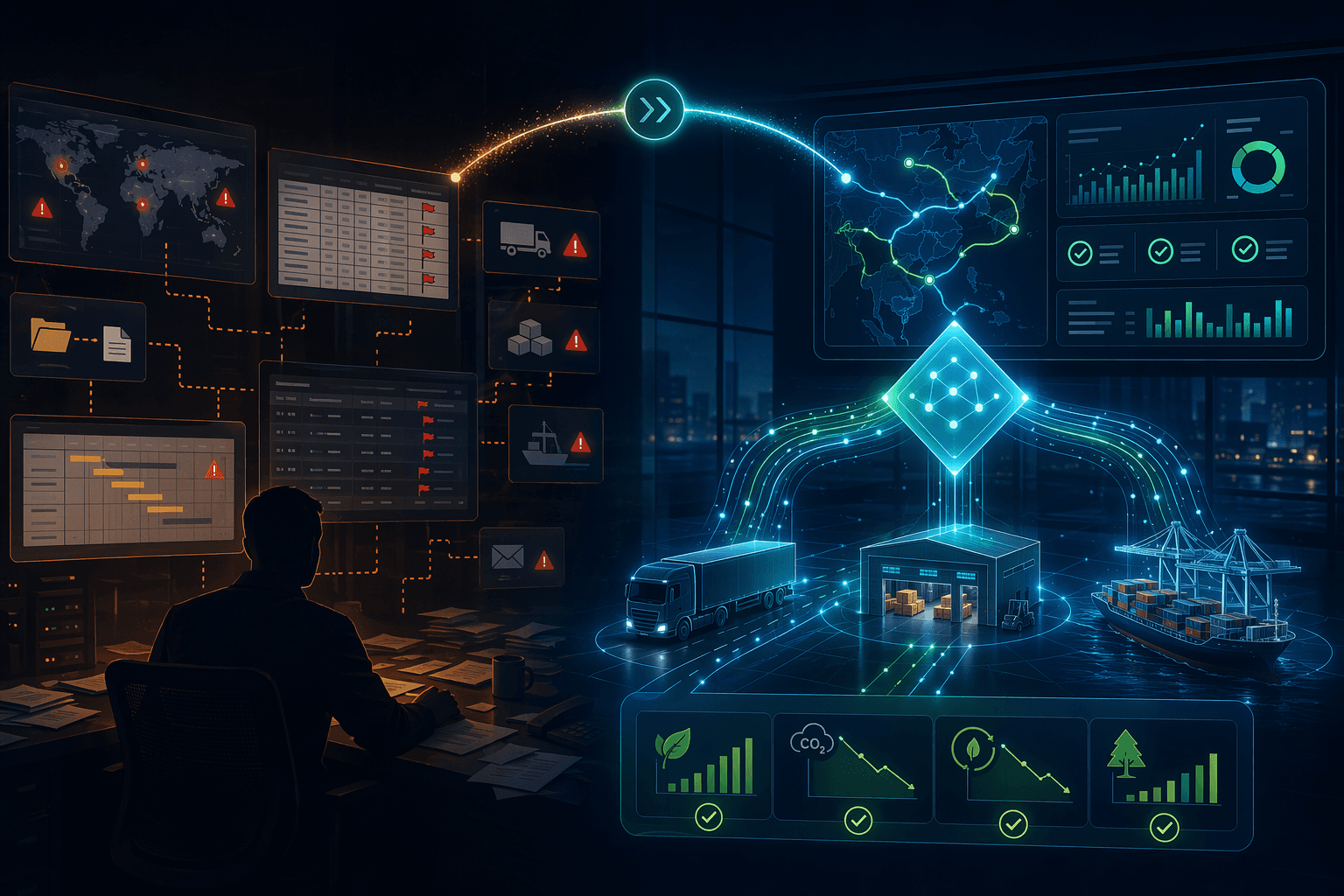
The BCG survey that found only 13% of LSPs reporting measurable financial impact also asked what was blocking the other 87%. 40% cited unclear ROI; another 40% cited internal capability gaps. The top two barriers are not technology cost or vendor immaturity. They are the two things that live inside your own organization: the inability to calculate what the project is worth and the inability to execute it. Regional differences tell the same story from another angle. 31% of LSPs in Asia-Pacific report success embedding AI across core operations, compared to 14% in North America and 6% in Europe. That is not a technology gap — the same software is available everywhere. It is a maturity gap in how organizations prepare, measure, and scale.
The “measurable financial impact” bar is also high. It does not count pilot results or projected savings. It counts actual P&L line items. Many smaller projects may show operational improvement but never make it onto the income statement as a separate line. That does not mean the AI failed. But it does mean the CFO does not see it.
The Hidden Costs That Kill ROI: Integration and People
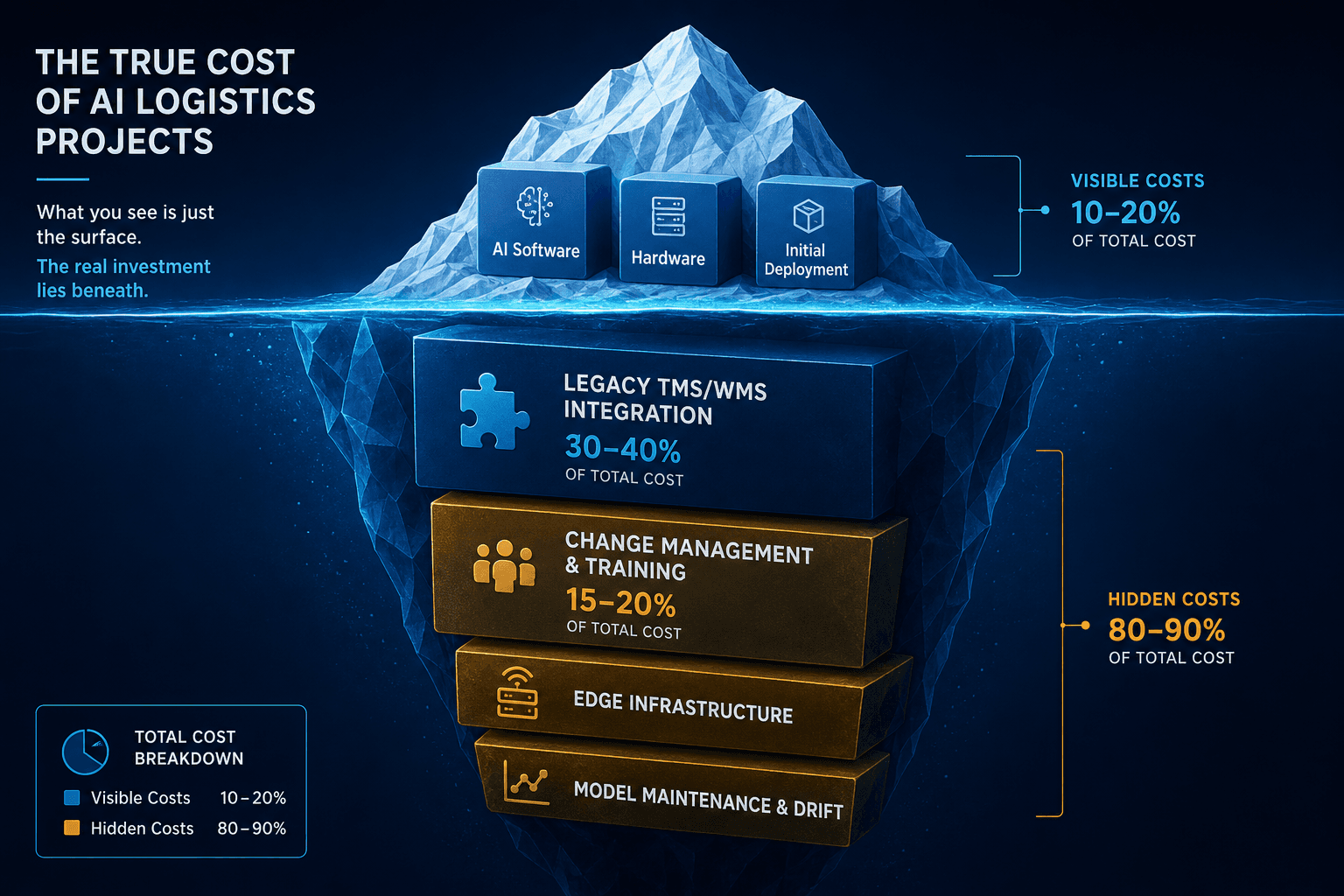
Here is a number that almost never appears in the vendor proposal: legacy TMS/WMS integration consumes 30–40% of total AI project cost. I have watched teams budget EUR 500K for software and EUR 50K for “integration,” then spend six months and EUR 300K on API rewrites, data cleaning, parallel runs, and user acceptance testing. The integration is not plug-and-play. The TMS that processes your daily freight data was not built to feed a machine-learning model. The data lives in 12 different formats across four legacy systems. This is the single largest hidden cost in AI in logistics. If you do not put it in the business case from day one, your 190% ROI project can turn into a 10% or negative one. And the industry-wide numbers do not help: 85% of AI projects fail due to poor data quality, governance, and management (Gartner via Lumenalta). That is not a logistics-specific failure rate, but logistics — with its dense operational data — has better odds than most verticals. Only if you budget for the data work.
The second hidden cost involves humans. Change management — including workflow redesign, new roles, retraining, and the inevitable months of lower throughput — typically adds 15–20% to the project cost. That line item is often included but underfunded. Consider what 68% of warehouse operators identify as the primary barrier to AI deployment: workforce digital literacy (DHL Logistics Trend Radar 2025). This is not about people resisting new tools. It is about people not having the baseline comfort with digital interfaces to trust the tool’s output. They still double-check every recommended decision by hand. That is not resistance; it is the rational response of an operator whose bonus depends on error-free shipments. ActivTrak data shows that 72% of logistics employees used AI tools in 2024 — the highest adoption rate across all industries. But daily usage averaged only 12 minutes 36 seconds. Adoption and impact are two different metrics. If your change management plan is a one-day training session and a Slack channel, you are not ready.
How Portfolio Economics Changes the Math
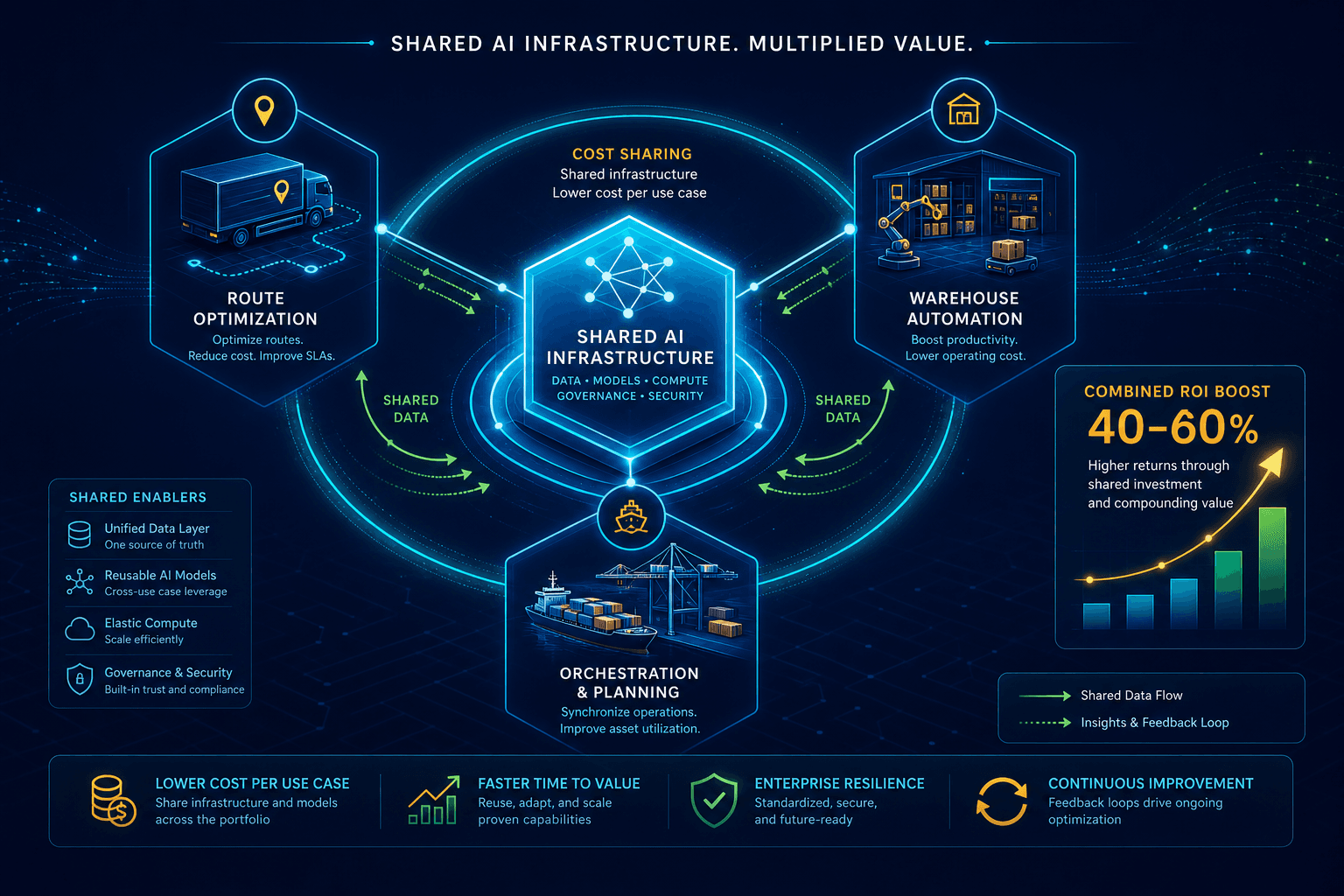
So far the picture is sobering: high potential, but real costs that can kill the business case. The answer is not to pick one use case and hope. It is to build a portfolio. When you deploy multiple AI use cases on shared infrastructure — a common data lake, the same model monitoring layer, a single integration backbone — the combined ROI improves by 40–60% versus running each project as a standalone business case. The reason is simple: the integration cost and the change management cost are shared across projects. Route optimization and warehouse AI both need clean, real-time data from your TMS and WMS. Once you have done that data work once, the second and third use cases cost half as much to deploy.
Lumenalta data confirms: organizations that build a strong data foundation and apply AI across planning, execution, and analytics achieve 2–3 times higher ROI than those using isolated point solutions. The difference is not the AI technique. It is the architecture.
Carbon Savings: A Real Bonus (Not a Core Driver)
One additional lever strengthens the business case without demanding more operations spend. Under the EU Emissions Trading System, carbon reductions from AI-optimized routing can be monetized at EUR 45–90 per tonne CO2 (2026 pricing). A fleet route optimization that cuts 10,000 tonnes adds EUR 450–900K in direct carbon value on top of the fuel savings. DHL’s AI-optimized routing across its European parcel network — 2.3 million daily stops — achieved a 14% distance reduction, EUR 180 million in annual fuel savings, and 127,000 tonnes CO2 reduction. That carbon reduction alone is worth roughly EUR 5.7–11.4 million under current carbon pricing. Treat this as a bonus, not a core ROI driver — carbon prices depend on regulation and enforcement — but a real bonus.
Building a Business Case That Survives CFO Scrutiny
Here is what I would do Monday morning. First, start with route optimization if you have a fleet of at least 50 vehicles. It has the shortest payback and the most verified ROI data. Use the figures from the AI ROI Playbook for Transportation and Logistics as a reference, but apply your own fleet data. Second, budget fully for integration and change management. Add 30-40% on top of software cost for data integration and 15-20% for organizational change. If your pilot shows positive ROI after those costs, you have a scalable case. Third, plan a portfolio, not a project. The second use case — warehouse AI, or control tower — will cost half as much to integrate because the data pipeline already exists. This is where the 40-60% portfolio ROI boost comes from. Fourth, include carbon value as a secondary metric. Use the EUR 45-90 per tonne range, but discount it by 50% in your primary case. If regulation tightens, it is upside. Finally, assume a 3-4 year payback for the overall portfolio, not the 2-4 month payback of the route optimization component alone. That conservative assumption will survive CFO scrutiny and leave room for the hidden costs that always appear.
Only 23% of supply chain organizations have a formal AI strategy (Gartner 2025). The other 77% are doing pilots without a plan. That is the main reason the 13% impact number is so low. It is not that the AI doesn’t work. It is that the business case, the budget, and the organizational readiness are not aligned.
The gap between 190% and 13% is not a reason to abandon AI in logistics. It is a reason to be honest about where the costs really live. Get the integration and the people right, and the portfolio economics will take care of the rest.
Comments
Join the discussion with an anonymous comment.