
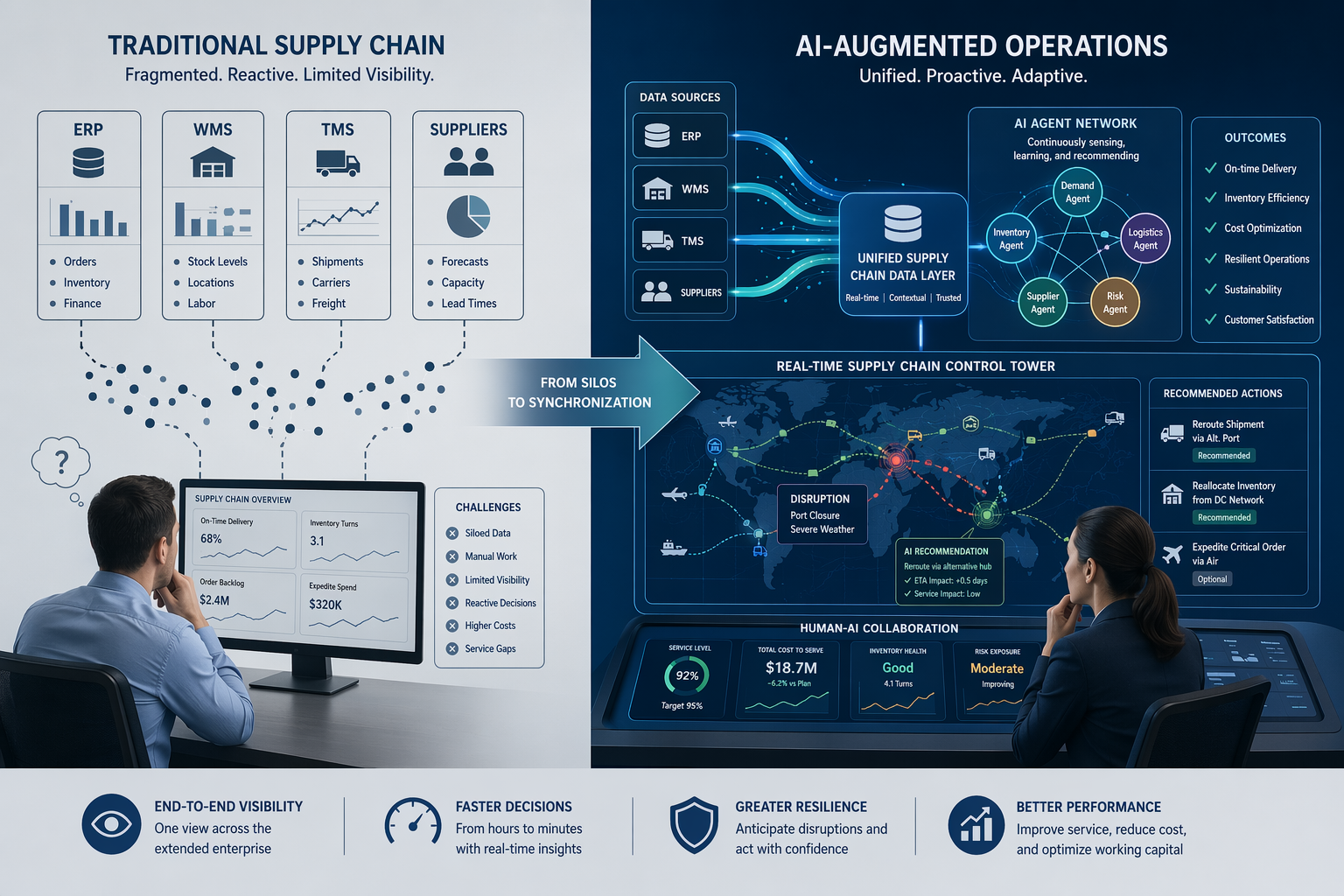
The Agentic AI Promise Meets Organizational Reality
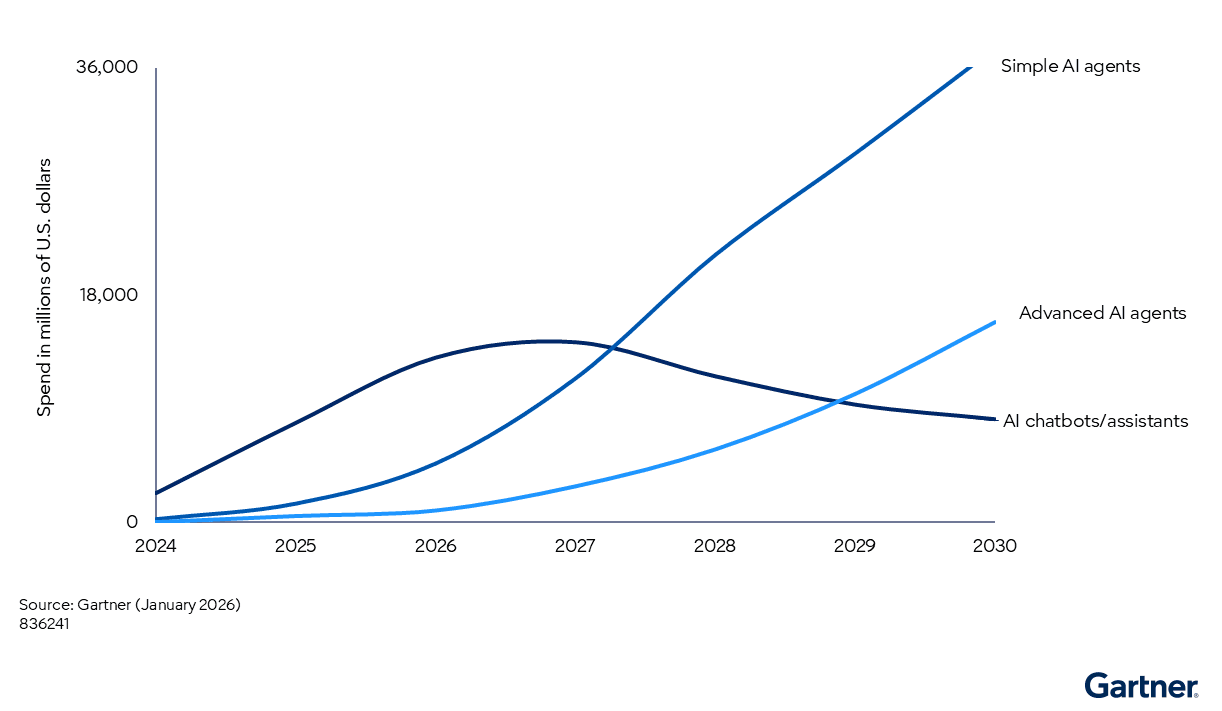
The numbers are staggering. Gartner forecasts that supply chain management software with agentic AI capabilities will grow from less than $2 billion in 2025 to $53 billion in enterprise spend by 2030. By that same year, 60% of enterprises using SCM software will have adopted agentic AI features, up from just 5% in 2025. Meanwhile, Deloitte reports that more than half of surveyed supply chain executives are already deploying AI agents to automate workflows.
These figures paint a picture of rapid, inevitable adoption. But they obscure a more uncomfortable reality: most organizations are not ready to capture the value. PwC's 2026 survey of 767 US-based operations and supply chain leaders found that 89% say their technology investments haven't fully delivered expected results, with integration complexity as the top blocker. A separate 87% report that poor data quality has directly undermined their ability to achieve value from digital initiatives.
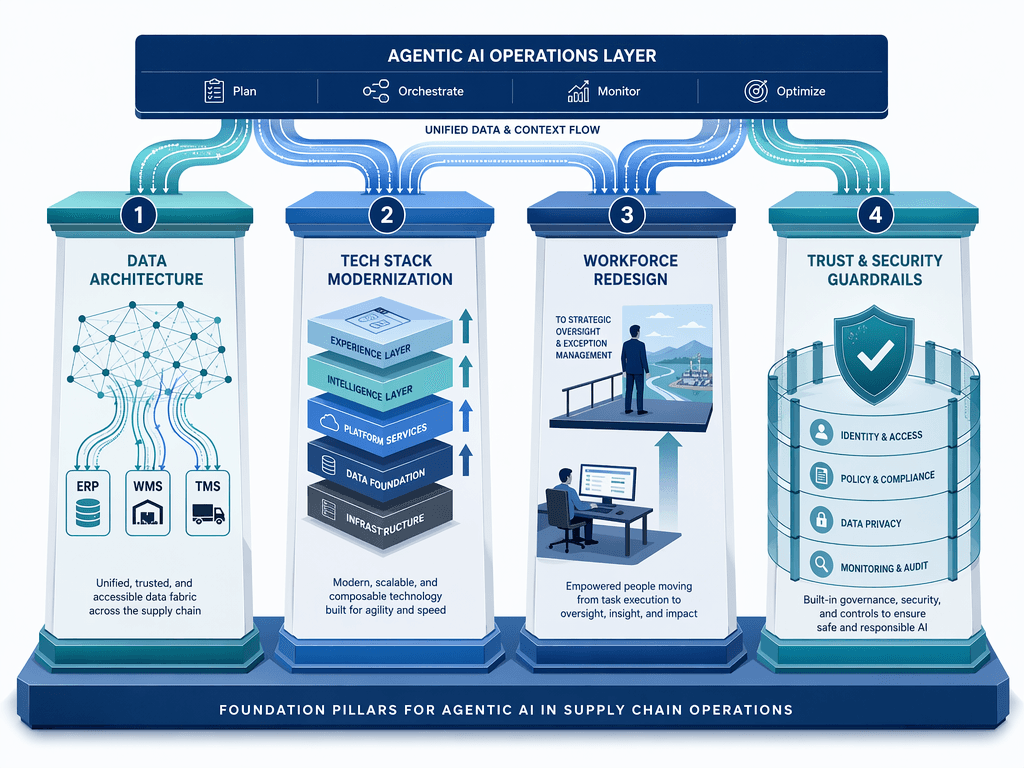
The gap between intent and outcome is not a technology problem. It is a workflow problem. The critical success factor for agentic AI in supply chain is fundamentally redesigning workflows around human-agent collaboration — not layering autonomous agents onto existing processes and expecting them to perform. This article argues that thesis and provides a four-foundations framework — data architecture, tech stack modernization, workforce redesign, and trust and security guardrails — drawn from the latest Deloitte, Gartner, BCG, and PwC research.
Defining Agentic AI in Supply Chain: Beyond Copilots and RPA
To understand why workflow redesign matters, it is necessary to distinguish agentic AI from the automation tools that supply chain organizations already use. Robotic process automation (RPA) executes predefined, rule-based tasks — extracting data from an email and entering it into an ERP, for example. Copilots and AI assistants generate recommendations or answer questions but leave execution to humans. Agentic AI does something fundamentally different: it reasons, plans, and takes autonomous action within defined boundaries.
In a supply chain context, an agentic AI system does not merely flag a supplier disruption. It evaluates the disruption against inventory positions, lead times, and service-level agreements, then re-routes shipments, re-allocates inventory, or engages alternative suppliers — all without waiting for a human to approve each step. This capability is what drives the efficiency gains that Dataiku and Deloitte describe: double-digit efficiency improvements and decision latency reduced from days to seconds.
The table below summarizes the key differences between these automation paradigms and their implications for supply chain workflows.
| Capability | RPA | Copilot / AI Assistant | Agentic AI |
|---|---|---|---|
| Decision-making | None — follows fixed rules | Generates recommendations | Reasons, plans, and acts autonomously |
| Human involvement | Human triggers and monitors | Human reviews and approves | Human sets boundaries and oversees exceptions |
| Adaptability | Breaks when process changes | Adapts within trained scope | Learns and adjusts within guardrails |
| Supply chain example | Auto-populate PO from email | Suggest optimal reorder point | Detect disruption, re-route shipments, notify partners |
| Workflow impact | Automates a task | Augments a decision | Redesigns the decision process |
The last row is the most important. RPA and copilots fit into existing workflows. Agentic AI requires those workflows to be redesigned because the human role shifts from executing decisions to setting the parameters within which agents operate autonomously. Organizations that treat agentic AI as a drop-in replacement for existing tools will encounter the same integration and trust barriers that PwC's survey data reveals.
Concrete Use Cases: Where Agentic AI Is Already Delivering
Agentic AI is not theoretical in 2026. Deloitte's research documents several production-grade use cases that illustrate the workflow redesign thesis in practice. Each case requires rethinking human roles, not just automating existing tasks.
- Always-on disruption detection and resolution. Agents continuously monitor supplier signals, weather data, and geopolitical feeds. When a disruption is detected, the agent evaluates inventory buffers, alternative sourcing options, and lead time impacts, then executes a response — re-routing a shipment or triggering a supplier switch — within seconds. The human planner is notified and can override, but the default is autonomous action within pre-set thresholds.
- Autonomous trucking brokerage and logistics coordination. Agents match loads to carriers in real time, negotiate rates within defined parameters, and adjust routing based on live traffic and weather conditions. This shifts the logistics coordinator's role from manual load matching to exception handling and carrier relationship management.
- Agentic customs filing. Customs documentation is a high-volume, rules-intensive process that varies by jurisdiction. Agentic AI can classify goods, calculate duties, and file documentation autonomously, flagging only ambiguous cases for human review. The compliance team shifts from data entry to audit and policy management.
- Continuous service-level and safety stock optimization. Rather than running periodic optimization cycles, agents continuously adjust safety stock levels based on demand variability, supplier reliability, and lead time changes. Planners move from running monthly what-if scenarios to overseeing a dynamic system and intervening only when strategic trade-offs are required.
- Procurement automation. Agents handle routine purchase order generation, supplier selection, and contract compliance checks. Procurement professionals focus on strategic sourcing, supplier development, and negotiation — the areas where human judgment adds the most value.
The Four Foundations for Sustained Agentic AI Value
Deloitte's research establishes four foundations that organizations must have in place to capture sustained value from agentic AI. These are not optional enhancements; they are prerequisites. Without them, agentic AI deployments will remain stuck in pilot purgatory — the state where 77% of enterprise AI supply chain projects currently reside, according to Value Add VC's analysis.
1. Data Architecture: The Non-Negotiable Foundation
Agentic AI cannot function without a unified, real-time data layer. Deloitte identifies three critical components: a data fabric or data mesh that connects siloed systems, a common data ontology that ensures consistent meaning across functions, and a knowledge graph that captures relationships between entities — suppliers, products, customers, locations. Without these, agents operate on incomplete or inconsistent information, producing unreliable decisions.
The PwC survey underscores this point: 87% of organizations say poor data quality has impacted their ability to achieve value from digital initiatives. For agentic AI, which acts autonomously based on data, the stakes are even higher. A safety stock agent operating on stale inventory data could just as easily trigger a stockout as prevent one.
A supply chain control tower provides the foundational visibility layer that agentic AI can act upon. It aggregates data from ERP, WMS, TMS, and external sources into a single operational picture. Without this unified view, agents cannot make informed decisions across the end-to-end supply chain.
2. Tech Stack Modernization: Extending, Not Replacing
Deloitte recommends a hybrid strategy that extends legacy systems rather than replacing them wholesale. Agentic AI platforms should sit alongside existing ERP, planning, and execution systems, consuming their data and feeding decisions back through APIs. This approach reduces disruption and accelerates time to value, but it requires that legacy systems expose clean, reliable APIs — a capability that many on-premise systems lack.
BCG's inaugural report on supply chain planning reinforces this point: organizations that attempt to leapfrog through planning maturity by means of AI alone tend to struggle, while those that layer AI deliberately onto stable planning foundations see more durable gains. The technology stack must be modern enough to support real-time data exchange but stable enough to serve as a reliable operational backbone.
3. Workforce Redesign: From Execution to Orchestration
This is the foundation most directly tied to the workflow redesign thesis. Deloitte's framework explicitly states that workforce roles must shift from routine execution to oversight and orchestration. Planners become supervisors of agentic systems, setting parameters, monitoring exceptions, and making strategic judgments that agents cannot handle.
Dataiku's analysis adds a demographic urgency to this transition. As experienced supply chain planners retire, organizations face a knowledge drain. Agentic AI offers a mechanism to capture and encode that expertise — what Dataiku describes as 'cloning senior planners' expertise' into autonomous agents. But this only works if the workforce is prepared to work alongside those agents, interpreting their outputs and stepping in when the situation exceeds the agent's training.
4. Trust and Security Guardrails: By Design, Not Afterthought
Deloitte identifies three components: zero-trust architecture, human-in-the-loop thresholds, and security-by-design principles. The human-in-the-loop thresholds are particularly important for supply chain operations, where the cost of an incorrect autonomous decision can be measured in lost revenue, stranded inventory, or broken customer commitments.
PwC's data reveals the trust gap: only 37% of executives are comfortable assigning AI agents to execute full end-to-end processes. This is not irrational caution. It reflects the reality that most organizations lack the guardrails to ensure that autonomous agents operate within acceptable risk boundaries. Establishing those guardrails — defining which decisions can be made autonomously, which require human approval, and how agents are monitored for drift — is a prerequisite for production deployment.
The Human Transition: From Execution to Orchestration
The workforce redesign foundation deserves deeper examination because it is where most agentic AI initiatives falter. The transition from execution to orchestration is not a minor role adjustment; it is a fundamental change in how supply chain professionals work.
Consider a demand planner today. Their day typically involves pulling data from multiple systems, running forecast models, adjusting for known events, and publishing a plan. With agentic AI, the planner's role shifts to defining the parameters within which agents operate — setting service-level targets, approving exception thresholds, and making strategic trade-offs when the agent flags a conflict between cost and service. The routine execution is handled by agents; the planner focuses on the cases that require human judgment.
This transition is accelerated by the demographic retirement cliff that Dataiku highlights. As experienced planners retire, their institutional knowledge — which supplier is reliable despite poor on-time delivery scores, which product families have hidden seasonality patterns, which customers are worth accommodating during capacity constraints — walks out the door. Agentic AI offers a mechanism to encode that knowledge, but only if organizations invest in capturing it before it is lost.
The PwC survey data on executive comfort levels — just 37% comfortable with full end-to-end agentic execution — suggests that most organizations are still in the early stages of this transition. The path forward is not to push for full autonomy immediately, but to define clear boundaries: which decisions are low-risk enough for autonomous execution, which require human approval, and how the organization builds confidence over time through measured, transparent deployment.
Prognosis: What 2030 Looks Like for Agentic Supply Chains
The forward-looking data from Gartner, BCG, and Deloitte provides directional targets for what agentic supply chains could look like by the end of the decade. These are not guaranteed outcomes; they depend on organizations building the four foundations discussed above.
| Metric | 2025 Baseline | 2030 Target | Source |
|---|---|---|---|
| Enterprises using SCM software with agentic AI | 5% | 60% | Gartner, April 2026 |
| Supply chain disruptions resolved without human intervention | Not tracked | 60% | Gartner, April 2026 |
| Agentic systems' share of total AI value | 17% | 29% by 2028 | BCG, via Dataiku |
| SCM software spend with agentic AI | <$2B | $53B | Gartner, April 2026 |
The Gartner projection that 60% of supply chain disruptions will be resolved without human intervention by 2030 is particularly significant. It implies a fundamental shift in how supply chain operations are staffed and managed. If the majority of disruptions are handled autonomously, the human workforce shifts from firefighting to strategic resilience planning — designing the systems and guardrails that enable autonomous response.
BCG's projection that agentic systems will reach 29% of total AI value by 2028, up from 17% in 2025, indicates that the value is shifting from predictive analytics (forecasting, demand sensing) to autonomous action. Organizations that have invested heavily in AI for prediction but not for action will need to rebalance their portfolios.
Getting Started: A Practical Roadmap for Supply Chain Leaders
For supply chain technology leaders and innovation officers who are ready to move beyond evaluation, the following roadmap is anchored in the four-foundations framework. Each step is designed to build organizational readiness incrementally, avoiding the pilot-to-production trap that has stalled 77% of enterprise AI projects.
- Audit your data architecture. Assess whether your current data infrastructure supports real-time, cross-functional data access. Identify the gaps between your existing data fabric and the requirements for agentic AI: common ontology, knowledge graph, and API accessibility. This audit will determine whether you can proceed with agentic pilots or need a data modernization phase first.
- Identify high-value, low-risk workflows for agentic redesign. Not every supply chain process is ready for agentic AI. Start with workflows that are rules-intensive, high-volume, and have clear success metrics — such as customs filing, routine purchase order generation, or safety stock optimization. These provide a controlled environment to test agentic capabilities and build organizational confidence.
- Establish governance guardrails before deployment. Define which decisions can be made autonomously, which require human approval, and how agents are monitored for drift. This is not a compliance exercise; it is an operational necessity. Without clear guardrails, the trust gap that PwC identifies — only 37% of executives comfortable with full end-to-end agentic execution — will prevent production deployment.
- Plan workforce upskilling in parallel with technology deployment. The transition from execution to orchestration requires new skills: exception management, agent oversight, and strategic judgment. Begin upskilling programs early, focusing on the roles that will be most affected. The demographic retirement cliff makes this urgent — the knowledge that senior planners hold must be captured and encoded before it is lost.
- Measure outcomes against the four foundations, not just ROI. Traditional ROI metrics (cost reduction, efficiency gains) are important, but they will not tell you whether your organization is building the foundations for sustained agentic AI value. Track progress on data architecture maturity, workforce readiness, and guardrail effectiveness alongside financial metrics.
For a deeper exploration of the pilot-to-production transition path, see our companion article on how autonomous agents are moving from pilots to production in 2026. And for a broader understanding of the agentic journey from visibility to true autonomy, our analysis of agentic AI in supply chain from visibility to autonomous action provides additional context on the capability spectrum.
Comments
Join the discussion with an anonymous comment.