
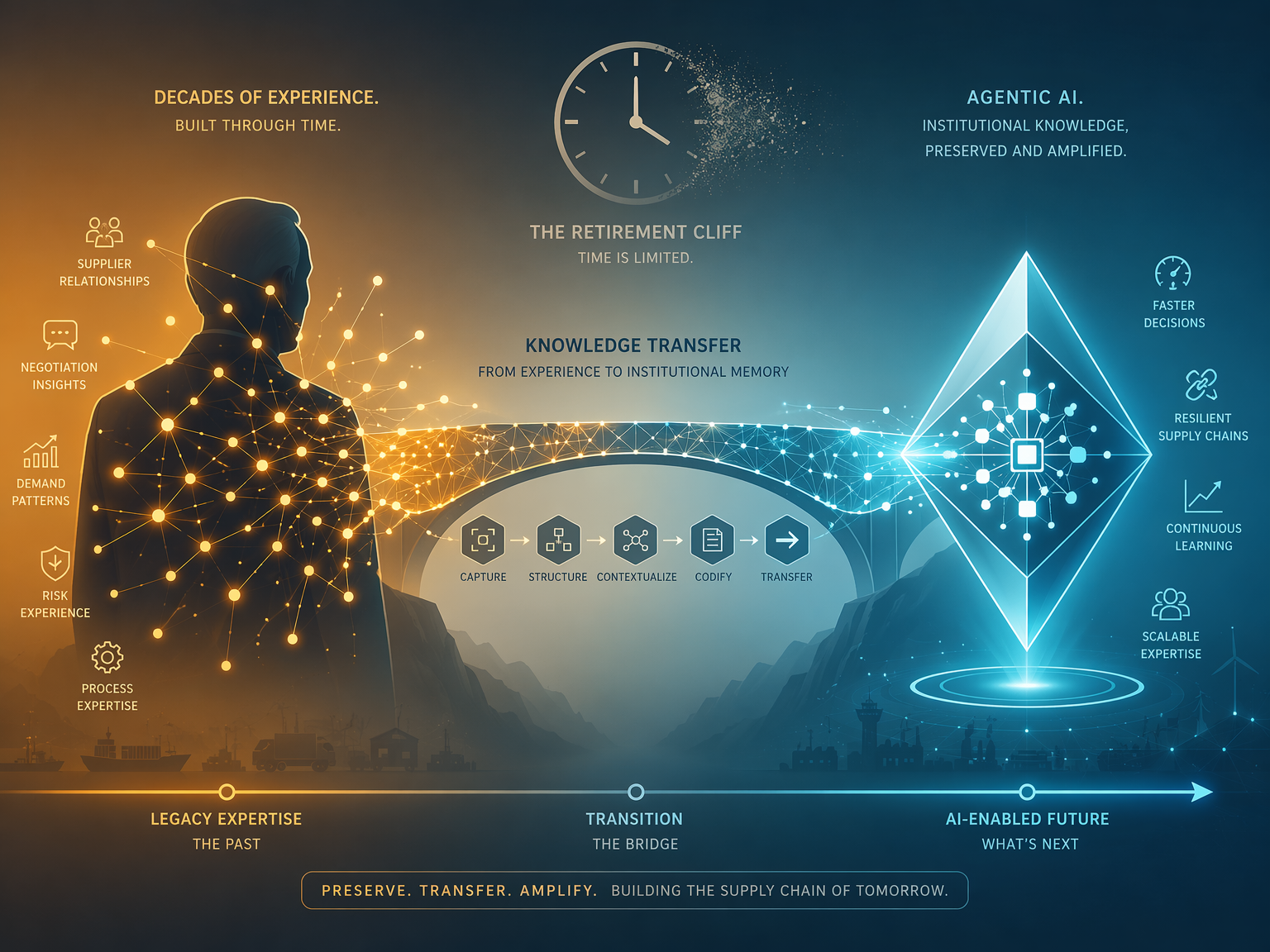
What Agentic AI Means for Supply Chain — and Why 2026 Is the Inflection Point
For the past decade, supply chain AI has been largely observational. Machine learning models forecast demand, computer vision systems inspect pallets, and analytics dashboards flag service failures. But the decision — whether to adjust a safety stock parameter, reroute a shipment, or issue a new purchase order — has remained firmly in human hands. That boundary is now dissolving.
Agentic AI refers to systems that do more than predict or recommend. They perceive a situation, reason about it using internal models and external data, decide on a course of action, and execute that action across enterprise systems — all within a defined set of guardrails. This differs from robotic process automation (RPA), which follows rigid, pre-programmed rules, and from generative AI assistants (copilots), which generate text or suggestions but stop short of executing transactions. An agentic system can detect that a supplier's lead time has slipped, query alternative sources, negotiate terms within pre-approved parameters, and update the purchase order in the ERP — without a human touching the process.
The year 2026 represents an inflection point for three converging reasons. First, the underlying models have become reliable enough for bounded autonomous action — confidence scoring, retrieval-augmented generation, and multi-step reasoning have moved from research papers into production-grade platforms. Second, the data infrastructure required to support agents (unified data lakes, composable application architectures, real-time event streams) has reached critical mass in early-adopter organizations. Third, and most urgently, the workforce that has historically managed exceptions through tacit knowledge is retiring, creating a knowledge vacuum that agentic systems are uniquely positioned to fill.
Market Signals: How Fast Is Agentic AI Moving Into Supply Chain Operations?
The adoption trajectory for agentic AI in supply chain is not hypothetical. Multiple data points from 2025 and early 2026 indicate that the technology is moving from experimental pilots into operational deployment at a pace that warrants strategic attention.
According to BCG research cited by Dataiku, agentic systems accounted for 17% of total AI value delivered in supply chain operations in 2025, with projections reaching 29% by 2028. That represents a near-doubling of the value share in three years, driven by the compounding effect of agents that can act on predictions rather than simply surfacing them in a dashboard.
Gartner's projections paint a similarly aggressive timeline. The firm predicts that 15% of daily logistics decisions will be made autonomously by AI agents by 2028, and that 60% of supply chain disruptions will be resolved without human intervention by 2031. These are not forecasts for fringe applications — they describe the core operational rhythms of logistics and disruption management being handed to autonomous systems within five to seven years.
| Metric | Source | Timeframe | Value |
|---|---|---|---|
| Share of AI value from agentic systems | BCG (via Dataiku) | 2025 (actual) → 2028 (projected) | 17% → 29% |
| Daily logistics decisions made autonomously | Gartner (via Inbound Logistics) | 2028 | 15% |
| Disruptions resolved without human intervention | Gartner (via SDC Exec) | 2031 | 60% |
| Enterprise software apps with agentic AI | Gartner (via IBM) | 2024 → 2028 | <1% → 33% |
However, organizational readiness lags behind technology capability. PwC's 2026 Digital Trends in Operations survey of 767 US operations and supply chain leaders at companies with over $100M in revenue found that only 27% have fully embedded an AI strategy across business units. More telling for agentic systems specifically: just 37% of respondents said they are comfortable assigning AI agents to execute full end-to-end processes in operations. The gap between what the technology can do and what organizations are prepared to trust it to do is the central tension of 2026.
Agentic AI in Action: Real Applications Across Planning, Procurement, Logistics, and Inventory
The shift from visibility to autonomous action is not theoretical. Across the four core domains of supply chain operations, agentic systems are already performing tasks that previously required human judgment, pattern recognition, and cross-system coordination.
Logistics: Autonomous Rerouting and Rebooking
When a weather event, port closure, or carrier disruption threatens an in-transit shipment, the traditional response involves a planner manually checking alternatives, calling carriers, and updating the TMS. Agentic systems now handle this end-to-end: they monitor real-time weather and port data, identify affected shipments, query alternative routes and carriers against contracted rates, select the optimal option within cost and service-level parameters, and execute the rebooking in the TMS. The decision latency collapses from hours to seconds.
Procurement: Supplier Disruption Response and Quote Automation
A transportation company cited in Dataiku's 2026 supply chain trends article uses AI agents to request quotes from approved suppliers and autonomously rank responses based on price, lead time, and compliance criteria. A medical device manufacturer has deployed agents for automated supplier scoring and quote validation — tasks that previously required procurement specialists to manually cross-reference supplier performance data against contract terms.
When a supplier fails to deliver, agentic systems can issue RFQs to pre-approved alternatives, collect and compare responses, and place the order — all within minutes. This capability directly addresses the chronic problem of supply-driven stockouts, where the delay between detecting a supplier failure and securing an alternative can cascade into weeks of lost production.
Inventory: Rebalancing and Parameter Adjustment
Inventory optimization has long been a stronghold of machine learning, but most systems stop at recommending new safety stock levels or reorder points. Agentic systems take the next step: they detect when forecast errors or demand shifts have rendered current parameters suboptimal, calculate the adjusted values, and update them in the ERP or inventory management system. This closes the loop between prediction and action.
For readers evaluating where to start with agentic capabilities, the autonomous reorder point optimization use case offers a bounded, high-impact entry point — it addresses a specific operational problem (inventory parameter management) with clear metrics and limited cross-system dependencies.
Planning: From Forecast to Action
In demand planning, agentic systems can detect when a forecast error exceeds a threshold, investigate the root cause (promotional activity, weather, competitor action), adjust the forecast model parameters, and propagate the revised numbers through the S&OP cycle — all without planner intervention. The planner's role shifts from manually running scenarios to auditing agent decisions and handling exceptions that fall outside the system's confidence boundaries.
A Fortune 500 manufacturer cited in Unframe's 2026 use case analysis deployed agentic AI for supplier commitment intelligence and achieved 100% visibility into supplier commitments, three weeks' advance warning of potential disruptions, and a 30% reduction in supply-driven stockouts. These outcomes were not achieved by a better dashboard — they required agents that could proactively query supplier systems, cross-reference commitments against production schedules, and flag mismatches before they became crises.
The Retirement Cliff: Why Baby Boomer Expertise Loss Accelerates the Agentic Imperative
There is a demographic dimension to the agentic AI conversation that is frequently overlooked in technology-focused analyses. The baby boomer generation — which holds a disproportionate share of senior supply chain roles — is retiring in large numbers, and the pace has not slowed in 2026.
Supply chain operations have historically relied on deep institutional knowledge that is rarely documented. The planner who knows that Supplier X always delivers three days late during monsoon season, the procurement manager who has a mental map of which alternative suppliers can ramp up production on short notice, the logistics director who can predict which ports will congest based on holiday schedules — these are not skills that can be transferred through a handover document or a training manual.
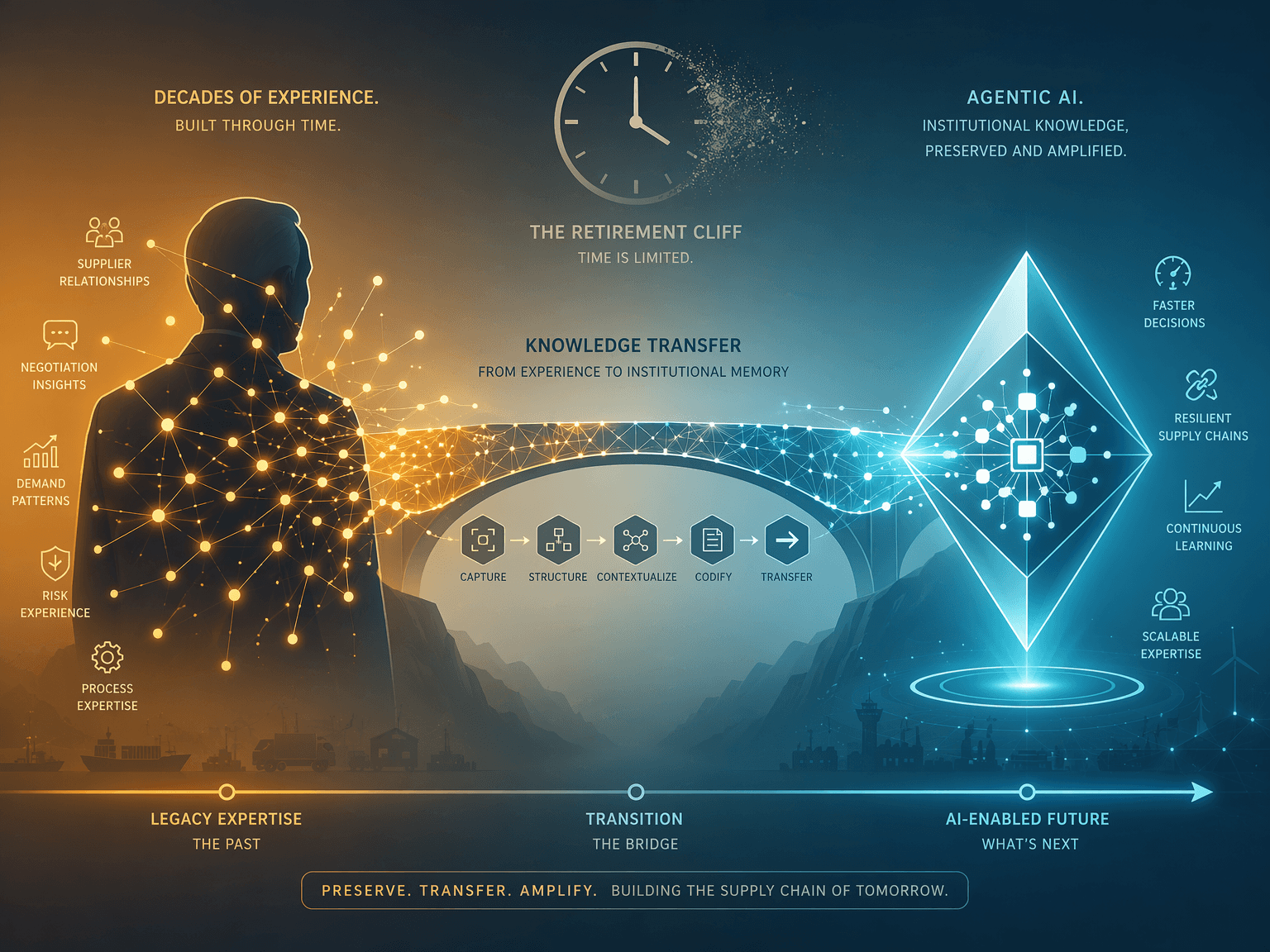
Agentic AI offers a mechanism for capturing this expertise before it is lost. By observing how experienced planners and buyers handle exceptions — which suppliers they call first, what trade-offs they accept, how they prioritize competing constraints — organizations can encode that decision logic into agentic workflows. The agent does not replace the expert; it preserves the expert's decision patterns and makes them operational after the expert has retired.
Dataiku's 2026 supply chain trends analysis explicitly identifies the retirement cliff as a driver of agentic AI adoption, noting that organizations using agentic systems can realize double-digit efficiency gains and reduce decision latency from days to seconds. But the more durable value may be in the knowledge preservation itself — creating a living archive of institutional expertise that outlasts any individual employee's tenure.
Critical Prerequisites: What Must Be in Place Before Deploying Agentic Systems
The technology to build agentic supply chain systems exists today. The binding constraints are organizational and architectural. Organizations that attempt to deploy agentic AI without addressing these four prerequisites will encounter failure modes that have nothing to do with model performance.
1. Data Foundation and Quality
Agentic systems are only as reliable as the data they consume. An agent that makes procurement decisions based on stale supplier lead times or incorrect inventory balances will make bad decisions with speed and scale — multiplying the damage rather than containing it. PwC's 2026 survey found that 87% of operations leaders say poor data quality hampers digital value. This is the single most commonly cited barrier, and it is more acute for agentic systems than for analytics tools because agents act on data rather than merely displaying it.
Organizations need to invest in data lineage, freshness monitoring, and automated data quality checks before agents can be trusted to act autonomously. This is not a one-time cleanup — it requires ongoing data governance processes that many supply chain organizations have not yet institutionalized.
2. Composable Architecture
Agents need to act across systems — ERP, TMS, WMS, supplier portals, weather data feeds, and more. If each system requires custom integration and the data flows are brittle point-to-point connections, the agent's ability to execute end-to-end processes will be severely constrained. A composable architecture, where systems expose APIs and data is accessible through a unified layer, is a prerequisite for agentic deployment at scale.
For organizations evaluating their current architecture against this requirement, the comparison of Blue Yonder, Manhattan Active, and Oracle Fusion Cloud SCM provides a structured assessment of how leading platforms support the integration and data access patterns that agentic systems require.
3. Guardrails: Confidence Scoring, Audit Trails, and Business Rule Boundaries
An agentic system without guardrails is an operational liability. Every agent action must be scored for confidence — if the confidence falls below a configurable threshold, the action should be escalated to a human rather than executed autonomously. Every action must be logged in an immutable audit trail that records what the agent did, why it did it, and what data it used. And every agent must operate within explicit business rule boundaries that define the scope of its authority: maximum order value, approved supplier lists, acceptable cost variances, and so on.
Unframe's 2026 analysis identifies confidence scoring, audit trails, human escalation paths, and enterprise-grade controls as critical requirements for agentic AI in supply chain. These are not optional features — they are the minimum bar for responsible deployment.
4. Human Escalation Paths
Even the most sophisticated agentic system will encounter situations it cannot handle — novel disruption patterns, multi-dimensional trade-offs that fall outside its training data, or decisions that require judgment calls about brand risk or customer relationships. Organizations need clearly defined escalation paths that route these decisions to the right human, with the right context, within the right time frame. Designing these escalation paths is as important as designing the agent itself.
A Governance Framework for Agentic Supply Chain AI
Governance for agentic AI is not the same as governance for analytics AI. When a forecasting model produces an inaccurate prediction, the consequence is a suboptimal plan. When an agentic system executes an incorrect action based on that prediction, the consequence is a financial loss, a service failure, or a compliance violation. The stakes are higher, and the governance model must reflect that.
IBM's 2026 analysis of AI adoption challenges notes that AI-specific governance roles grew 17% in 2025, but only 11% of businesses have responsible AI policies in place. This governance gap is particularly dangerous for agentic systems, where the speed and scale of autonomous action can amplify errors before humans can intervene.
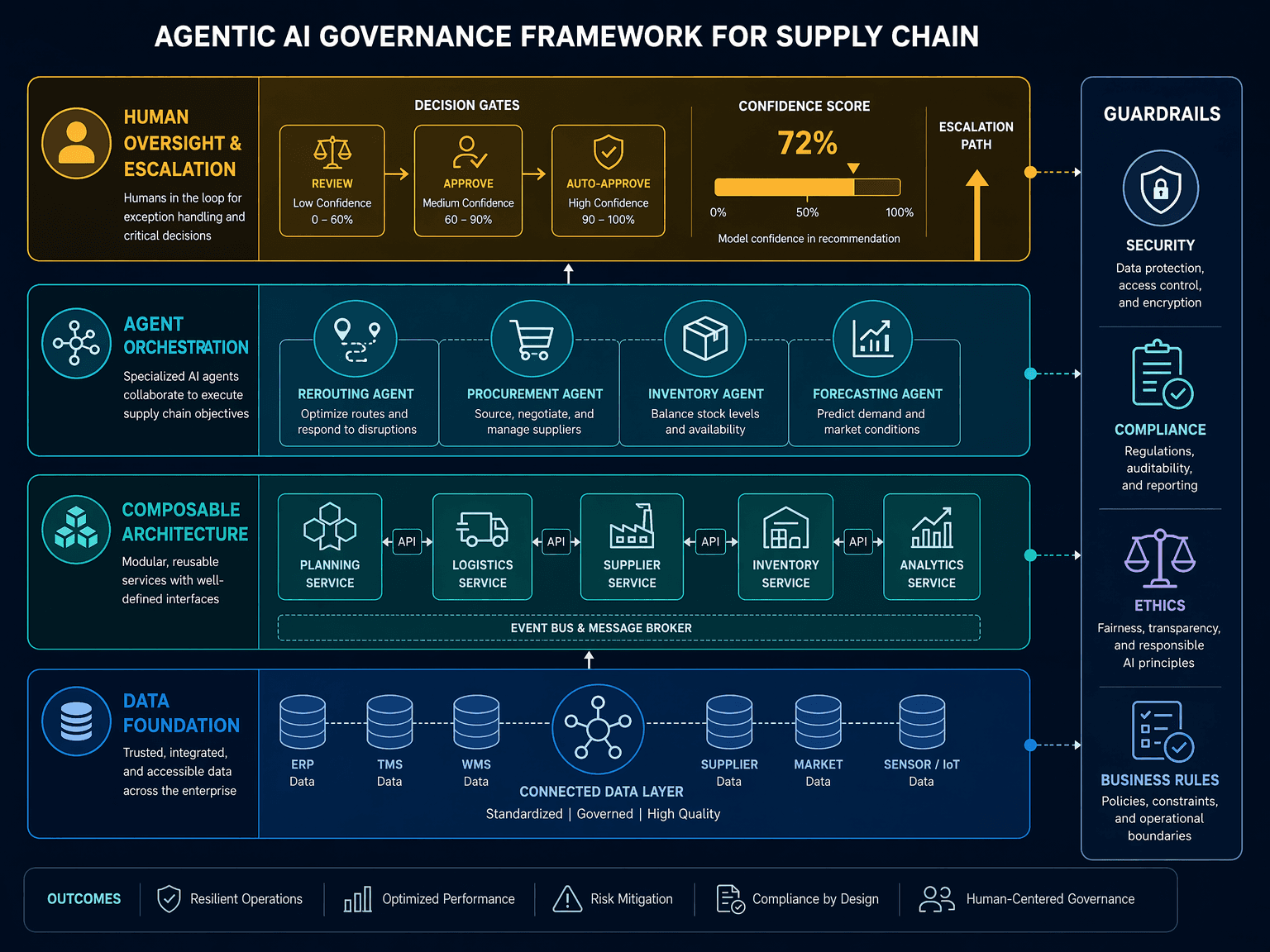
A practical governance framework for agentic supply chain AI should address five dimensions:
- Confidence scoring thresholds: Define the confidence level at which an agent may act autonomously versus when it must escalate. These thresholds should vary by decision type — a low-impact rerouting decision may have a lower threshold than a supplier change that affects a critical material.
- Audit trail requirements: Every agent action must be logged with sufficient context to reconstruct the decision. This includes the input data, the reasoning path, the confidence score, the action taken, and the outcome. Audit trails must be immutable and accessible for post-hoc review.
- Human-in-the-loop design patterns: Not all decisions should be fully autonomous. Organizations need to define, for each agentic workflow, which decisions require human approval, which can be executed with human oversight (the human can veto within a time window), and which can run fully autonomously.
- Model drift monitoring: Agentic systems that learn from their own actions face a unique risk: they can drift into suboptimal or unsafe behavior patterns without explicit retraining. Continuous monitoring of agent decision quality, with automated rollback triggers when performance degrades, is essential.
- Organizational accountability: Who is responsible when an agent makes a bad decision? This is not a technical question — it is an organizational one. Clear accountability structures, with named individuals responsible for agent oversight within each functional domain, must be established before deployment.
The governance framework should be implemented before the first agent goes into production, not retrofitted after an incident. Organizations that treat governance as an afterthought will find themselves managing agent-caused disruptions rather than managing supply chain disruptions.
The Path Forward: From Pilot to Production With Agentic Systems
For supply chain leaders evaluating their next steps, the path to agentic AI does not require a wholesale transformation. The most successful deployments follow a staged approach that builds confidence, capability, and governance in parallel.
- Start with bounded, low-risk agentic applications. Autonomous supplier data collection, exception flagging with human approval, and automated quote collection are examples of agentic workflows that deliver value without exposing the organization to significant operational risk. These applications build the data infrastructure, integration patterns, and governance processes that more ambitious deployments will require.
- Expand to autonomous execution within guardrails. Once the foundational capabilities are proven, organizations can extend agentic systems to execute decisions autonomously within clearly defined boundaries — adjusting inventory parameters within a specified range, rerouting shipments when alternatives meet cost and service criteria, or issuing purchase orders to pre-approved suppliers within budget limits.
- Scale to cross-functional agent orchestration. The most advanced stage involves agents that coordinate across planning, procurement, logistics, and inventory functions — detecting a demand signal change, adjusting the procurement plan, rerouting inbound shipments, and updating inventory targets in a coordinated sequence. This is where the compound value of agentic AI becomes visible.
PwC's 2026 survey identified a rare cohort — just 4% of respondents — who report that AI is fully embedded across their operations, that they face no significant barriers to scaling agents, and that they operate with horizontal organizational structures. These leaders show 87% integration of digital capabilities end to end and 73% report broad organizational impact from their AI investments. They are not necessarily the largest companies or the ones with the biggest AI budgets. They are the ones that invested early in data quality, composable architecture, and governance — the prerequisites that make agentic deployment possible.
The technology for agentic supply chain AI is ready. The models are capable, the platforms are maturing, and the early case studies demonstrate measurable outcomes. The binding constraints are organizational: data readiness, architectural coherence, governance frameworks, and workforce redesign. Organizations that address these constraints will be positioned to capture the compound value of autonomous action. Those that wait for the technology to mature further will find that the technology was never the bottleneck.
Comments
Join the discussion with an anonymous comment.