
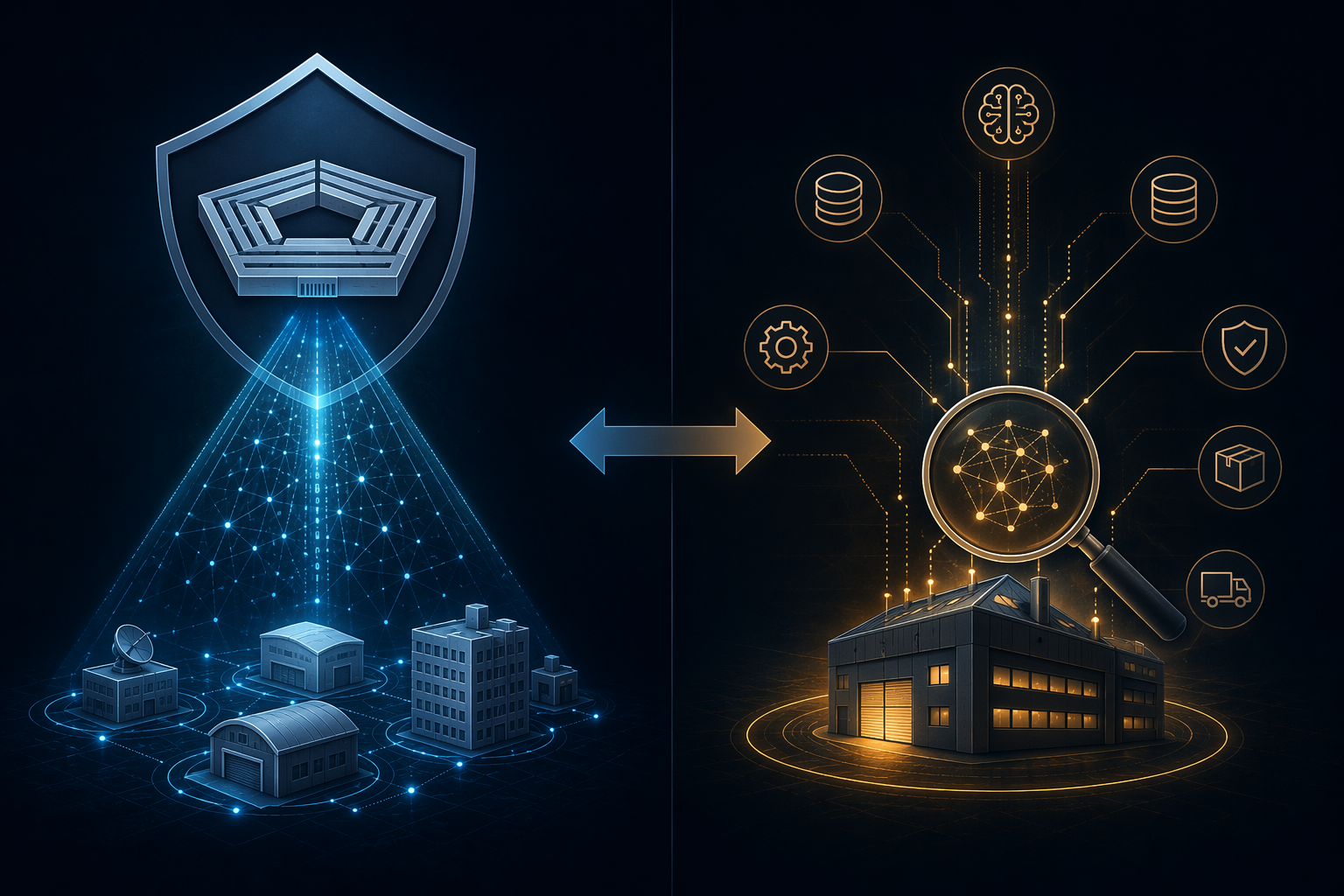
An AI defense supply chain audit under the NDAA is no longer a theoretical compliance scenario waiting for implementing guidance. The Defense Logistics Agency has already described a Big Data Analytics supplier-risk effort that screened 43,000 vendors and flagged 19,000 as high risk, a 44% high-risk rate across a vendor population large enough to matter operationally, not just experimentally.[1]
That is the part contractors should sit with before turning to statutory language. A model that can screen tens of thousands of vendors changes the audit surface. It does not wait for a contracting officer to notice one certificate in one file. It looks across vendor records, supplier attributes, transaction patterns, and risk signals, then hands human reviewers a smaller but more urgent pile.

The legal consequence is not abstract either. DLA’s account tied the analytics work to a criminal prosecution in which a supplier pleaded guilty after providing falsely certified Turkish-made parts for U.S. weapon systems, violating the Buy American Act and the Arms Export Control Act.[1] One case does not prove that every flag becomes an enforcement action. It does prove something narrower and more useful: a machine-generated supplier-risk lead can move into the evidence chain.
The Audit Has Already Moved Upstream
Traditional defense supply chain compliance has often been file-centered: a certification here, a country-of-origin representation there, a subcontractor spreadsheet that arrives late and incomplete, and a prime contract clause that someone must flow down with enough precision to survive review. Those artifacts still matter. The change is that the government can now compare them against a much wider risk picture.
The DLA example matters because of scale and timing. Screening 43,000 vendors is not a pilot that touches a few sensitive programs. Flagging 19,000 suppliers means the government has a method for sorting a large supplier population before a conventional audit team would ever open individual binders.[1] For a contractor, the uncomfortable question is no longer whether an agency might eventually ask for more supply chain proof. It is whether the contractor’s own records can explain the risk signal when the request arrives.
That distinction is easy to miss. AI does not have to replace auditors to change an audit. It only has to change who gets looked at first, which representations are challenged, and which supplier relationships become hard to defend without supporting records. A flagged vendor may still be low risk after review. But the burden shifts quickly from general assurance to specific evidence: entity ownership, manufacturing origin, beneficial influence, component traceability, subcontractor certifications, and the dates on which those facts were verified.
The FY2026 NDAA Codifies the Direction of Travel
The FY2026 NDAA should be read against that operating reality. It does not invent the Pentagon’s interest in AI-enabled supply chain auditing. It gives that interest a contractor-facing structure. The practical question is what defense suppliers must now be ready to prove about two things at once: their supplier base and their own AI systems.
Those two obligations will feel different inside a company. Supplier-risk teams will be asked to document ownership, origin, screening, and flow-downs. Cybersecurity, engineering, legal, and procurement teams will be asked to explain AI provenance, model dependencies, data exposure, and whether a tool is barred because of who developed, owns, controls, or influences it. The same contract file may need both kinds of proof.
| Audit Question | What the Contractor Needs to Be Able to Show |
|---|---|
| Who is in the supplier chain? | Current supplier identity, tiering where required, ownership exposure, country-of-origin support, screening status, and subcontractor flow-down evidence. |
| What AI is being used? | AI system provenance, developer and ownership facts, model and software components, data exposure, and evidence that restricted covered AI is not being used. |
| Can the evidence survive review? | Dated attestations, repeatable verification steps, exception handling, and records that reconcile with purchasing, engineering, export, and cyber files. |
Section 1532 Turns AI Provenance Into a Contracting Issue
Section 1532 carries the clearest immediate warning for contractors using AI in or around defense work. Analyses of the FY2026 NDAA describe it as prohibiting contractors from using covered AI developed by entities domiciled in, owned by, controlled by, or subject to the influence of China, Russia, North Korea, or Iran, as well as entities on the Consolidated Screening List.[2][3]
The provision also reaches indirect ownership, including a 20% test, and it flows down to subcontractors.[2][3] That combination is what makes the clause operationally heavy. It is not enough to ask whether an AI vendor has a familiar brand name or a U.S. sales office. Someone must identify the developer, trace ownership and control, evaluate restricted-party exposure, and decide how subcontractors will certify the same facts without turning the prime’s compliance file into a drawer full of unsupported promises.
Influence will be the hard word. Ownership can be mapped, even if it takes work. Domicile can usually be documented. Consolidated Screening List checks can be repeated. Influence analysis is messier because the statutory concern reaches relationships that may not appear as clean equity percentages. Until implementing guidance narrows the test, contractors should avoid treating a one-time vendor questionnaire as enough.
A mid-tier supplier may feel this most sharply. The prime may flow down a prohibition and demand an attestation. The AI tool may be embedded in quality inspection, code generation, logistics planning, customer support, or data analytics rather than sold as a standalone defense product. The compliance team then has to answer a basic but file-breaking question: what exactly counts as the AI being used for the covered contract?
Section 1512 Is About the Evidence Trail
Section 1512 points toward the evidence mechanism. It directs DoD to extend software bill of materials policies into AI models, systems, and software, addressing risks such as model tampering, adversarial attacks, data leakage, and supply-chain compromise.[4][5] That is usually described as an AI SBOM or AI-BOM. The name is less important than the record it implies.
A conventional SBOM helps answer what software components are present. An AI-BOM has to reach further because the risk is not only in code packages. It may sit in model weights, training or fine-tuning data exposure, third-party model APIs, retrieval sources, input-handling layers, embedded evaluation tools, or deployment pipelines. If a model is swapped, fine-tuned, wrapped, connected to new data, or exposed to a new workflow, the bill of materials can go stale even when the procurement record looks unchanged.
For audit purposes, the AI-BOM becomes the bridge between an engineering reality and a contracting representation. If a contractor says it is not using covered AI, that statement needs a map of systems, vendors, model lineage, data flows, and update controls. If a contractor says sensitive data is not exposed to a model provider, that statement needs logs, architecture, access controls, and data classification decisions that match how the tool is actually used.
What an AI-BOM Will Need to Reconcile
- The named AI system, model, provider, version, and deployment environment.
- The developer, owner, controller, and any known restricted-party or covered-nation exposure.
- The data the system can access, retain, generate, transmit, or use for tuning.
- The software, model, API, plug-in, and retrieval components that affect outputs.
- The controls for model updates, vendor changes, tampering, adversarial testing, and incident review.
Those records do not have to be beautiful. They have to be consistent. The purchasing file cannot say one thing, the cyber inventory another, and the engineering team a third. In a machine-assisted audit environment, mismatches are not harmless clerical debris. They are leads.
Section 1513 Links AI Security to the CMMC World, but Not Cleanly
Section 1513 directs DoD to develop an AI cybersecurity framework and implement it as an extension of CMMC.[6] That tells contractors where the government expects AI security controls to live administratively: near the cybersecurity assessment machinery that already shapes defense industrial base compliance.
It does not mean the AI rules are fully built. The harder implementation questions remain open: how AI systems will be scoped, which contractors will need third-party validation, how model and data controls will be assessed, and how an AI-specific framework will interact with existing CMMC levels. The statute points to the lane; it does not yet provide the lane markings.
Contractors should also keep separate two facts that are easy to blur. Reuters reported on July 13, 2026 that the Pentagon paused CMMC Phase II, a move linked to concerns about supplier exits.[7] That pause may affect timing and confusion around cyber assessments, but it does not erase the separate legislative track created by the FY2026 NDAA for AI security. DoD has not yet formally resolved how the suspension will interact with the Section 1513 timeline.[7]
Self-Attestation Is Losing Ground
The broader acquisition trend is toward fewer unsupported statements and more validation. DefenseScoop reported in May 2026 that DoD planned to use AI and automation as part of its push to achieve a clean audit.[8] That financial-audit ambition is not the same thing as a supplier-risk audit, but it shows the same institutional appetite: use machines to find inconsistencies at a scale human reviewers cannot manage alone.
The Ernst Amendment context points in the same direction. Commentary on the amendment describes a shift from self-attestation toward third-party validation, from narrow ownership checks toward influence analysis, and from point-in-time reviews toward continuous monitoring with ongoing alerts.[9] The September 30, 2026 vendor-vetting deadline is approaching, but proposed rules have not yet been published, so contractors should treat the details as unsettled rather than inventing requirements ahead of the rulemaking.[9]
The enforcement gap is also acknowledged in plain language. A January 2026 discussion of the Pentagon Zero Trust Portfolio Management Office RFI noted limited capacity to validate initial compliance and conduct continuous assessments.[10] AI-enabled monitoring is attractive precisely because the government has more suppliers, systems, clauses, and attestations than it can manually reconcile at the necessary speed.
This is where procurement paperwork becomes operational. A supplier-risk system does not need perfect knowledge to create pressure. It needs enough signal to ask why a vendor’s ownership record, country-of-origin certification, export-control statement, AI tool inventory, or subcontractor attestation does not line up with other available data. The contractor then has to answer with records, not intent.
The July 20 Executive Order Adds Pressure, Not Certainty
The White House Executive Order issued on July 20, 2026 adds momentum to the same audit architecture, but it is too new to carry more weight than the statute and the DLA example. The order calls for contractors to submit a complete indentured bill of materials tracing components back to raw material origin, mandates AI-assisted supply chain mapping by DoD, and requires foreign ownership, control, or influence screening at every tier.[11]
Two days after issuance, there are no implementing regulations to resolve the usual hard questions: contract coverage, thresholds, acceptable evidence, update frequency, exceptions, enforcement sequencing, and how far down the chain a prime must go when the lower-tier supplier has little administrative capacity. The order is best read as an accelerant. It reinforces the move toward component traceability, AI-assisted mapping, and tier-by-tier FOCI screening, but contractors should not pretend the operational rulebook is finished.
Where the Audit File Breaks First
The first failures are unlikely to look dramatic. They will look like ordinary gaps: an AI tool used by engineering but missing from the supplier-risk review; a subcontractor certification that covers ownership but not influence; a component origin file that stops at a distributor; a model provider approved by IT but never checked against the covered AI prohibition; a prime flow-down accepted by a lower-tier supplier that cannot explain how it verified the statement.
Those gaps matter because the government’s view is becoming more continuous than the contractor’s paperwork. DLA’s BDA work shows supplier-risk screening at scale. Section 1532 makes AI provenance and prohibited influence a contracting issue. Section 1512 points toward AI-BOM evidence. Section 1513 connects AI security to assessment infrastructure. The later executive order pushes component traceability and AI-assisted mapping further into the foreground.
The contractor’s answer cannot be a single annual certification assembled after the fact. It has to be a living reconciliation among procurement, legal, cyber, engineering, export, and supplier management records. The person asked to respond to the audit needs to know which system used the AI, which vendor supplied it, who owns or influences that vendor, what data the model touched, which subcontractors received the clause, and where the component or material chain stops being provable.
Defense suppliers are visible to government AI audit systems while also being asked to produce auditable evidence about their own AI stack, AI provenance, ownership exposure, subcontractor flow-downs, and component traceability. The problem is not only failing an audit. It is being unable to explain the AI, supplier, and ownership chain before the audit arrives.
References
- Utilization of Artificial Intelligence (AI) to Illuminate Supply Chain Risk, Defense Logistics Agency, May 2025.
- FY 2026 NDAA: Domestic Sourcing, Artificial Intelligence, Cybersecurity, and Acquisition Reforms, K&L Gates.
- AI supply chain and security: Congress mandates strict controls for AI acquired by the government, Freshfields.
- What the NDAA Means for AI and Cybersecurity, WilmerHale, December 19, 2025.
- AI Security in the FY26 NDAA, Manifest Cyber.
- CMMC for AI? Defense Policy Law Imposes AI Security Framework and Requirements on Contractors, Crowell & Moring.
- Pentagon pauses cyber audit rule blamed for supplier exits, Reuters, July 13, 2026.
- Pentagon plans to use AI for audits, DefenseScoop, May 2026.
- Artificial Intelligence in Defense Contracting: What Contractors Need to Know Now, Bradley, May 2026.
- AI-Enabled Continuous Monitoring Key to NDAA Compliance, COTS Journal, January 2026.
- Securing America’s Defense Supply Chains and Ensuring Domestic Acquisition of Critical Materials, The White House, July 20, 2026.
Comments
Join the discussion with an anonymous comment.