
After SpaceX’s June 2026 IPO, the practical investor question is no longer whether Starlink can fund more capacity. It is which public suppliers are now selling into a customer that has raised capital to become a future competitor. SpaceX priced its IPO at $135, with Starlink revenue estimated at about $11.8 billion and more than 9 million subscribers, giving the company a public-market currency and a revenue base large enough to make supplier substitution a board-level issue rather than an engineering curiosity.[1]
Terafab is best treated as a sourcing map, not a factory rendering. The useful question is not whether SpaceX can replace every supplier. It is which purchase orders are pointed at products Terafab explicitly wants to internalize, which suppliers are protected by qualification cycles, and which names may grow revenue while losing leverage.
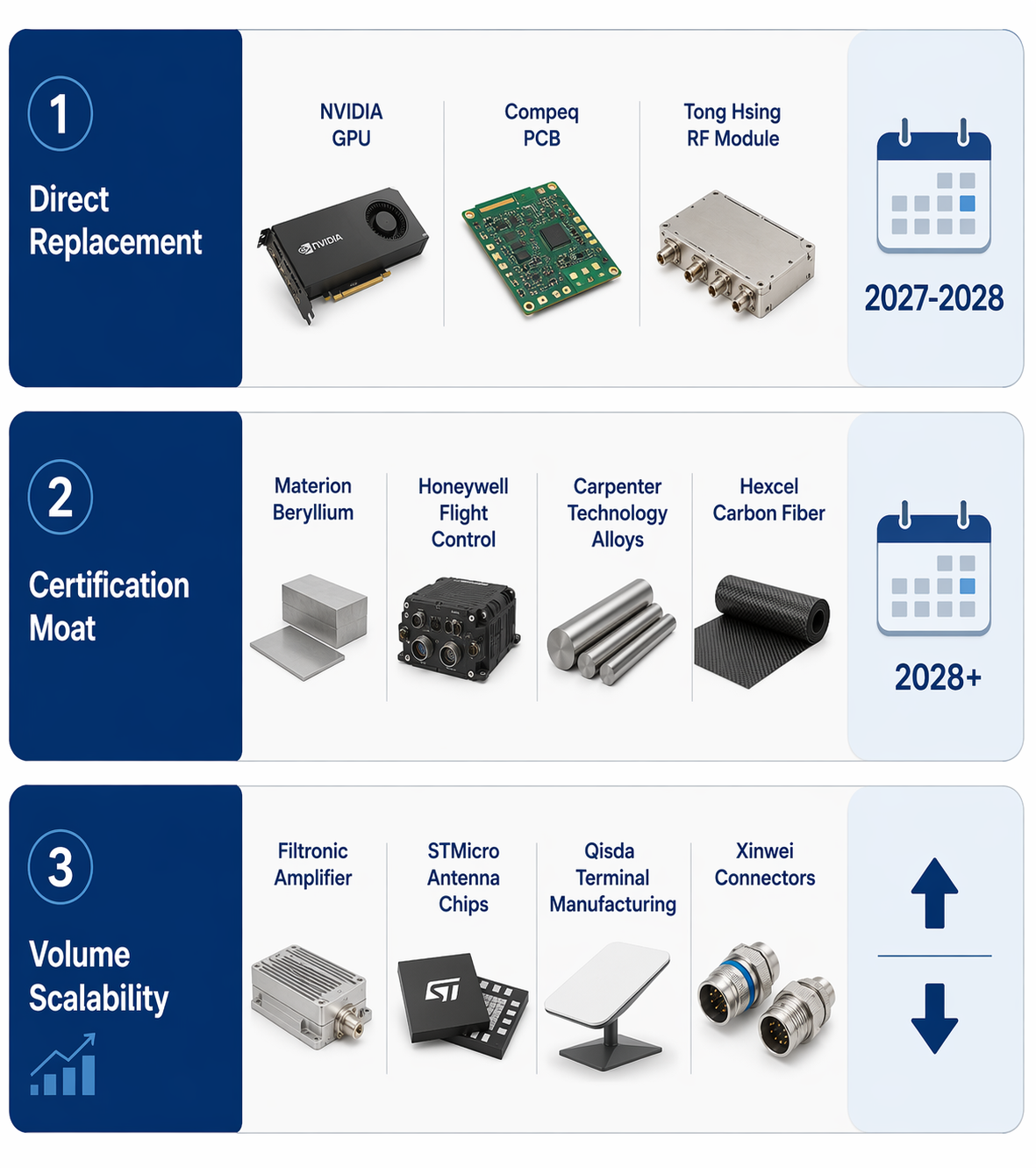
The Three Risk Tiers
The supplier universe does not move as one block. A graphics processor order, a printed circuit board, a beryllium component, and a millimeter-wave amplifier sit behind different defenses. Investors who collapse all of them into “SpaceX supplier exposure” will miss the timing.
| Risk tier | Supplier exposure type | Likely timing | Investor test |
|---|---|---|---|
| Tier 1: Direct replacement | Products Terafab explicitly targets for in-house production, including GPUs, PCBs, and RF modules | 2027-2028, if Terafab execution holds | Can SpaceX move the purchase order once internal capacity is qualified? |
| Tier 2: Certification moat | Materials, controls, alloys, and aerospace inputs protected by qualification and certification friction | 2028+ | Does the moat delay substitution, or does it also preserve pricing power? |
| Tier 3: Volume scalability | Suppliers that benefit from SpaceX volume but become dependent on one customer or one product line | Mixed; upside can precede margin pressure | Is revenue growth creating dependence that weakens future bargaining power? |
Terafab’s published outline gives the timing frame: a prototype fab in 2026, AI5 volume production in 2027, and a full-scale Grimes County facility in 2028 or later, with reported investment of $55 billion initially and up to $119 billion in total, a 10 million square meter footprint, Intel 14A process involvement, and a stated 100,000 wafer starts.[2] Those are not guarantees. Construction, process yield, packaging, test, and aerospace qualification can all slip. But investors do not need a perfect schedule to classify exposure; they need to know which risks start earliest.
Tier 1: Direct Replacement Risk Starts With Named Targets
The direct-replacement group deserves the least romantic reading. If Terafab is meant to internalize a product category, the incumbent supplier’s protection depends on speed, yield, switching cost, and qualification friction. It does not depend on the supplier having been strategically important yesterday.
The named Tier 1 set includes NVIDIA for GPUs tied to Colossus demand, Compeq for printed circuit boards, and Tong Hsing for RF modules, according to market analysis that maps Terafab intent against public-company suppliers.[3] The NVIDIA exposure is especially easy to overstate because NVIDIA does not break out SpaceX-specific revenue; the 220,000 GPU figure attached to Colossus should be treated as market-inferred exposure, not company-disclosed segment data.[3]
That distinction matters. For NVIDIA, the stock-level risk is unlikely to be existential because SpaceX would be one demand pocket inside a far broader AI accelerator business. For a PCB or RF-module supplier with narrower customer and product exposure, the same Terafab signal can carry a different valuation consequence. The relevant metric is not technological prestige; it is revenue dependency on a purchase order that SpaceX has signaled it wants to own.
Compeq and Tong Hsing sit closer to that concern because printed circuit boards and RF modules are the kind of hardware categories where internalization can move from prototype to repeatable procurement once design ownership, process control, and quality systems line up. That does not mean SpaceX can cancel outside suppliers in one step. It means investors should stop valuing those relationships as if they are structurally permanent.
A simple timeline helps. In 2026, the risk is mostly disclosure and repricing: investors start asking whether customer concentration deserves a lower multiple. In 2027, if AI5 volume production begins as stated, the risk shifts to allocation: which orders remain outside because SpaceX lacks capacity, and which begin moving inside. In 2028 and beyond, the question becomes whether external suppliers are retained for redundancy, surge capacity, or technical superiority, rather than because SpaceX has no alternative.
Tier 2: Certification Moats Delay Substitution, But They Are Not Magic
The second tier is where investors most often make the opposite mistake. They hear “SpaceX vertical integration” and assume every supplier is equally exposed. Aerospace materials, flight controls, specialty alloys, and qualified composites are harder to move than chips or board assemblies. In some cases, the supplier’s moat is not branding or capacity; it is the accumulated burden of qualification, certification, purity, traceability, and program history.
Materion is the cleanest example in the dataset. It is identified with a 56% global beryllium share and a Department of Defense certification cycle that can run more than 10 years.[4] That is a different kind of defense from being the low-cost producer. A customer that wants to substitute beryllium inputs is not only sourcing metal; it is trying to reproduce process knowledge, documentation, test history, and institutional acceptance.
That makes Materion harder to displace on a 2027 timetable. It does not make the exposure zero. A customer with enough volume can dual-source gradually, redesign around lower-dependency architectures, or reserve certified incumbents for the highest-criticality applications while moving adjacent demand elsewhere. The moat changes the slope of the risk curve. It does not erase the curve.
Honeywell, Carpenter Technology, and Hexcel fit the same broad tier for different reasons. Honeywell brings Apollo-era flight-control heritage; Carpenter is tied to Raptor alloy needs and parts where purity specifications can reach parts-per-million levels; Hexcel is associated with aerospace carbon fiber and a partnership history exceeding 10 years.[3][4] These are not interchangeable protections, but they share one feature: SpaceX cannot treat them like ordinary catalog components without absorbing qualification risk.
The investor error would be to translate “hard to replace” into “safe at any price.” Certification moats are valuable because they buy time, preserve continuity, and force engineering justification for substitution. They also attract attack precisely because they sit on constrained, high-value inputs. If Terafab expands from chips into adjacent component control, these suppliers may face a slower negotiation squeeze before they face direct volume loss.
Tier 3: Volume Scalability Can Look Like Good News Until It Becomes Dependence
The third tier is the easiest to misprice because the first reported effect can be revenue growth. A supplier that scales with Starlink terminals, satellite production, or ground infrastructure may show stronger orders before investors notice that one customer has become the path to scale. When that happens, volume is no longer just upside. It becomes leverage for the buyer.
Filtronic is the sharpest example. Market analysis identifies 83% of Filtronic revenue as SpaceX-related through millimeter-wave amplifiers, making it the highest concentration risk in the supplied dataset.[4] Even if SpaceX demand continues to rise, that concentration changes the quality of the revenue. A supplier with one dominant customer may win scale benefits, but it has less room to resist pricing pressure, design changes, inventory demands, or eventual insourcing.
The point is not that Filtronic must lose SpaceX business in the near term. The more immediate concern is bargaining power. When one customer accounts for the overwhelming majority of revenue, the supplier’s public-market multiple can become hostage to procurement decisions that investors cannot observe until after terms change. Before making a stock judgment, investors should verify the 83% figure against Filtronic’s own filings and segment disclosures, because the number comes from market analysis rather than a SpaceX confirmation.[4]
STMicroelectronics, Qisda, and Xinwei show the same mixed logic in different forms. STMicro is associated with more than 5 billion antenna chips, Qisda with terminal contract manufacturing, and Xinwei with high-frequency connectors and about $1.05 billion in orders.[4] Those exposures can be attractive while unit volumes expand. They become more fragile if SpaceX uses Terafab to control more silicon, more module architecture, or more manufacturing know-how internally.
For these suppliers, the key question is not simply “Will SpaceX replace them?” It is whether revenue growth is coming with durable technical dependence or merely with temporary capacity dependence. Capacity dependence is a weaker moat. It lasts until the buyer builds, buys, or qualifies another route.
Why Existing AI Supplier-Risk Models Miss This Signal
Most supplier-risk systems are better at mapping distress than ambition. They can flag weak balance sheets, geographic clustering, sanctions exposure, single-source risk, cyber events, and logistics disruption. Terafab exposes a different variable: customer vertical integration intent. A financially healthy supplier can still be at risk if its largest customer is raising money to manufacture the supplier’s product category.
Interos has published satellite supply-chain concentration work and describes a risk platform with more than 800,000 suppliers mapped, while Exiger and Resilinc operate in the same broader supply-chain risk management field.[5] Those capabilities are useful, but the SpaceX case shows why multi-tier visibility is not enough on its own. The system also needs to detect whether a buyer’s capital plan, hiring pattern, patent activity, factory buildout, or joint venture points at supplier displacement.
That is where AI supplier scoring has to become more event-sensitive. A procurement risk model can already combine revenue concentration, part criticality, geography, and financial health. The missing feature is a forward-looking customer-intent score: whether the customer is likely to internalize the supplier’s component, how soon capacity could arrive, and whether qualification friction changes the timing. ChainSignal’s guides to AI supplier risk scoring in procurement automation and multi-tier supply chain visibility through knowledge graphs are useful background for how that architecture would be built, but Terafab adds a sharper requirement: the graph has to understand competitive intent, not only dependency.
A practical model would not assign one generic SpaceX-risk score. It would separate product target, qualification barrier, customer concentration, revenue materiality, and substitution timeline. NVIDIA and Materion should not be scored the same way. Filtronic should not be treated as low risk merely because demand is strong. A supplier can be operationally important and economically vulnerable at the same time.
How To Read Public Supplier Exposure From Here
Investors do not need to predict the full Terafab buildout to act with more discipline. They need to ask the same three questions across every public supplier named in the SpaceX ecosystem.
- Is the supplier’s product category explicitly inside Terafab’s target zone? If yes, the first repricing risk can arrive before revenue declines.
- Does aerospace qualification create a real moat? If yes, estimate how long it delays substitution and whether it preserves margins.
- Is SpaceX-driven growth increasing customer concentration? If yes, higher sales may be paired with weaker future negotiating power.
The uncertainty is real. Some supplier links are market-inferred. Some SpaceX relationships are not confirmed directly by SpaceX. Terafab’s construction and production milestones could slip, and a delay would extend the earning window for exposed suppliers. But waiting for perfect disclosure is not neutral. Public markets tend to reprice supplier quality when the buyer’s intent becomes visible, not when the last purchase order moves.
Terafab is therefore a staged risk shockwave. Direct replacement risk begins earliest for suppliers whose products SpaceX has targeted for internal production. Certification moats delay the hit for specialized aerospace inputs, but they do not make those suppliers immune. Volume-scalability names can enjoy the strongest near-term demand while quietly giving up future pricing power. That is the distinction investors should keep in front of them as SpaceX’s public filings, supplier disclosures, and factory milestones become easier to verify.
References
- SpaceX IPO: 18 Key Investor Takeaways, Forbes
- Terafab, Wikipedia
- SpaceX's $75 Billion Raise Is a Supplier Risk Event, Ex Terra Media
- SpaceX's Supply Chain and Key Suppliers in 2026, KuCoin/MarsBit
- Satellite Supply Chain Concentration Risk, Interos
Comments
Join the discussion with an anonymous comment.