
A labor shortage in supply chain does not usually arrive as one dramatic failure. It shows up as late trailers waiting for a dispatcher who is covering too many lanes, a picking team stretched across a peak-volume day, a planner who has no time to investigate exceptions because the morning is already gone to spreadsheet cleanup. That is why the useful question is not whether AI can “replace labor.” The better question is whether AI can take enough low-value work out of warehouse, planning, and transportation operations to let scarce people cover more complexity without breaking service.
The pressure is not small. In a Descartes survey reported by SupplyChainBrain, 76% of supply chain and logistics leaders said they faced notable workforce shortages, with transportation cited by 61% and warehouse operations by 56%; the same reporting tied understaffed facilities to operating costs running 15% to 25% above industry averages.[1] Globally, the International Road Transport Union has reported more than 3 million unfilled truck driver positions and expects that shortage to double by 2028.[2] In the U.S., industry estimates point to nearly 500,000 unfilled logistics jobs and average warehouse turnover of 36%, which is the sort of churn that makes “just hire more people” sound less like a plan than a wish.
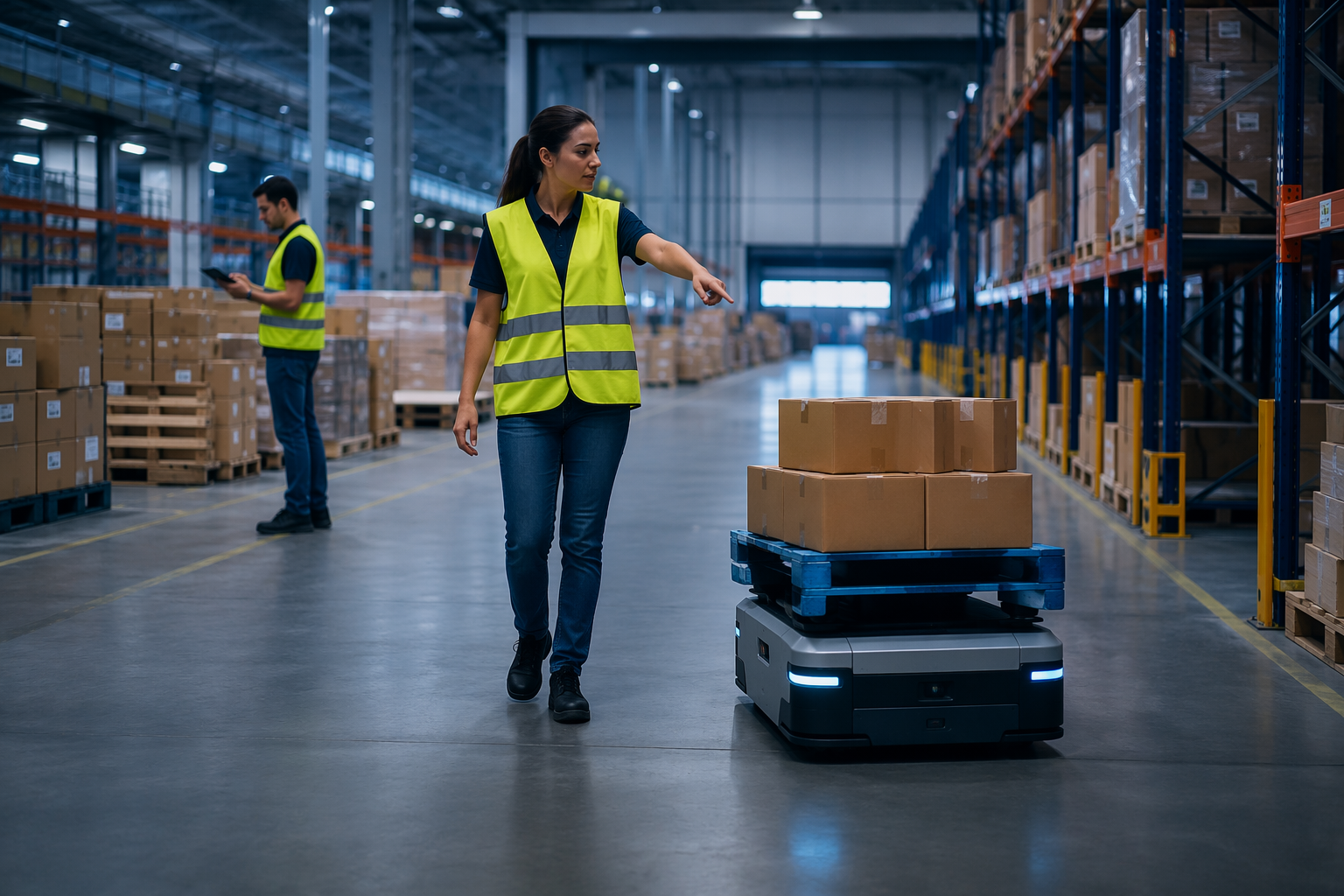
AI for supply chain labor shortage relief is most credible when it is attached to a specific piece of work: walking a pick path, rekeying order data, checking inventory exceptions, sequencing routes, or deciding which late load needs attention first. It becomes less credible when it is sold as a clean labor-saving layer that somehow leaves the operating model untouched.
Where AI Actually Removes Work From the Day
The strongest supply chain AI cases do not begin with the model. They begin with the motion, delay, or decision loop that is consuming human capacity. In warehouses, that often means travel. In planning, it means repetitive analysis and reconciliation. In transportation, it means dispatch triage and route adjustment. Each function has a different labor problem, so the same “AI efficiency” claim should not be treated as one uniform benefit.
| Function | Labor pressure | Where AI can help | What still needs people |
|---|---|---|---|
| Warehouse operations | Walking time, picking congestion, turnover, peak volatility | AMR tasking, slotting support, workflow orchestration, exception alerts | Supervision, safety judgment, maintenance coordination, exception handling |
| Planning and forecasting | Manual data cleanup, repetitive forecast review, inventory tradeoff analysis | Demand sensing, replenishment recommendations, scenario analysis, exception prioritization | Commercial judgment, supplier coordination, override decisions, service-risk tradeoffs |
| Transportation | Driver scarcity, dispatcher overload, appointment constraints, late-load triage | Route optimization, ETA prediction, dispatch support, load sequencing | Customer-specific constraints, carrier relationships, disruption management |
Warehouse: less walking is real relief, but not a labor strategy by itself
Autonomous mobile robots are a good test of whether a labor-saving claim is grounded in operations. If an AMR reduces associate travel, it removes one of the most tiring and least valuable parts of the picking day. ABI Research has reported that AMRs can reduce manual travel time by 30% to 40%, and that 77% of supply chains are considering mobile automation.[3] Those figures matter because travel time is not an abstract cost bucket; it is hours of walking that do not pick, pack, check, train, or solve a problem.
The caution is just as practical. Automation does not make the warehouse stop needing people. Capstone Logistics argues that automation changes labor needs far more than it eliminates them, creating demand for maintenance, systems coordination, and exception-management skills that can be harder to find than traditional warehouse labor.[4] A site that removes walking but adds robot downtime, weak task interleaving, and confused handoffs has not solved a labor shortage; it has moved the bottleneck to a smaller group of people with more specialized work.
This is where the supervisor’s Friday afternoon matters. If the AMR fleet keeps pickers in the zone and stabilizes throughput, it is a labor-capacity tool. If the same supervisor is now also chasing dead batteries, task exceptions, and half-trained temporary workers because the implementation team has left, the labor story is incomplete. The walking may be gone, but the work has reappeared somewhere else.
Planning: better forecasts only help if planners get time back
Planning teams are often short-staffed in a quieter way. They may not have open dock doors or visible order backlogs, but they have hundreds of SKUs, supplier changes, promotion noise, late purchase orders, and service targets that do not wait for a clean dataset. AI can help when it reduces repetitive review and pushes planners toward the exceptions that deserve human judgment.
The reported outcome estimates are attractive, but they need careful handling. Deposco and Fulfillment IQ cite AI adopters reporting 15% logistics cost reductions, 35% inventory reductions, and 65% service-efficiency improvements; these figures are also cited across industry sources, though the original primary study with full methodology was not available.[5] That makes them useful as directional benchmarks, not guaranteed results for a planning organization with messy master data and unclear decision rights.
The operational mechanism is still sound. A planner should not spend half the day reconciling demand files, hunting for outliers, or manually refreshing the same replenishment views. Machine learning can rank anomalies, expose forecast drift, recommend reorder changes, and simulate inventory-service tradeoffs. For readers who need the technical foundation, ChainSignal’s machine learning in supply chain management guide covers the underlying methods. The labor question is whether those recommendations actually change the planner’s day, or whether leadership simply adds more SKUs because the software appears to make the old workload manageable.
Agentic AI is likely to enter this conversation more often, especially for workflows where systems monitor conditions, propose actions, and trigger bounded tasks. BCG projects agentic systems will rise from 17% to 29% of total AI value by 2028.[6] That forecast supports attention, not overconfidence. In supply chain planning, the near-term value is less about autonomous planning replacing planners and more about narrowing the queue of decisions that require a person.
Transportation: route optimization helps until the real world adds a constraint
Transportation labor shortages create a double squeeze: fewer drivers and more pressure on dispatchers to make each available hour count. AI route optimization can reduce miles, improve stop sequencing, and adjust plans as traffic, appointment windows, and capacity change. Industry estimates cited for transportation point to cost reductions of 5% to 10%, delivery reliability improvements of up to 20%, and 54% adoption of route optimization.
Those numbers are most useful when tied to dispatcher workload. A route engine that prevents avoidable miles is valuable. A predicted ETA that gives customer service an earlier warning is valuable. A load board that surfaces the highest-risk shipments before the phone starts ringing is valuable. But there is always a customer with a receiving rule the model does not know, a driver who cannot take a certain backhaul, or a facility that is technically open but functionally backed up. Dispatch work is full of these exceptions.
The honest target is not a dispatcher-free transportation desk. It is a desk where dispatchers spend less time building routine routes and more time managing the exceptions that actually require relationships, judgment, and escalation authority.
The ROI Claims Need an Operations Filter
There is enough positive evidence to take supply chain AI seriously, and enough sourcing ambiguity to avoid treating every benchmark as a promise. Prologis and Harris Poll found that 77% of organizations reported positive ROI from AI within 12 months, based on a vendor-sponsored survey of 1,800 executives.[7] That is a useful market signal, but it is still a self-reported survey from an interested market participant.
The same discipline should apply to warehouse robotics announcements and network automation claims. DHL deploying more than 1,000 robots and Ryder automating 40% of its warehouse network show that large operators are putting capital behind automation. They do not prove that every facility, product profile, labor market, or WMS environment will get the same result. Scale shows momentum; it does not erase implementation work.
This is also why ROI comparisons should be read by use case, not as a single AI average. A warehouse AMR deployment, a forecasting model, and a transportation optimizer all change different work. ChainSignal’s AI applications in supply chain ROI comparison is a better frame than a generic payback claim because it forces the investment back into operating context.
Why Some AI Deployments Add Capacity and Others Add Work
The difference is rarely the algorithm alone. It is the work design around the algorithm. Deposco and Fulfillment IQ found that integrated data foundations yield 2 to 3 times higher ROI, and that organizations pairing AI deployment with upskilling see 3.5 times higher adoption rates.[5] Those two findings deserve more attention than most glossy automation claims because they explain why the same category of tool can feel transformative in one operation and burdensome in another.
A warehouse team with clean item data, reliable location logic, trained floor leads, and a defined exception path can absorb automation differently from a site where inventory accuracy is disputed every morning. A planning team with clear override rules can use recommendations differently from a team that is blamed for both excess inventory and stockouts without being given decision rights. A transportation desk with accurate appointment, carrier, and customer-constraint data can trust route optimization more than one that keeps critical rules in dispatchers’ heads.
The broader market still has a large execution gap. SPS Commerce and Modern Materials Handling reported that only 10% of companies use automation effectively, while 34% are taking a wait-and-see approach.[8] That does not mean automation is failing as a category. It means many organizations have not done the organizational work required to turn tools into capacity.
That work is not glamorous. It includes deciding who owns exceptions, which recommendations can be auto-approved, which require review, how supervisors are trained, how maintenance is staffed, how new roles are paid, and what happens when the model is wrong. It also includes telling the truth about the labor that appears after go-live: robot technicians, data stewards, systems coordinators, process trainers, and supervisors who can manage both people and software-driven workflows.
For warehouse leaders, this is the pattern behind many disappointing deployments. The technology removes touches, but the operation has not redesigned the surrounding work. ChainSignal’s warehouse AI deployment failure guide goes deeper on that execution gap, but the short version is simple: automation does not rescue an unclear process. It usually exposes it faster.
Upskilling Is Not a Soft Add-On
In labor-short operations, upskilling can sound like a long-term HR initiative competing with this week’s backlog. That is a mistake. If AI changes the work, training is part of the operating model. A picker working with AMRs needs to understand task flow, exception screens, safety boundaries, and when to stop the line. A planner using AI recommendations needs to know how confidence levels, demand anomalies, and override rules affect service. A dispatcher using route optimization needs to know when to trust the plan and when a customer constraint should overrule it.
This is the practical meaning of augmentation. It is not a softer synonym for replacement. It is a management decision to move people away from repetitive, high-volume work and toward judgment-heavy work, while giving them the training, authority, and data needed to do that work well. Without that shift, AI can make an understaffed team feel more exposed, not less.
There is a cost to ignoring this. Capstone’s warning about automation creating specialist gaps is easy to recognize on the floor: the old labor shortage becomes a shortage of people who can troubleshoot the workflow, maintain the system, interpret alerts, and keep production moving when the software meets the messy edge of operations.[4] That is still a labor shortage. It is just wearing a more technical uniform.
So, Can AI Solve the Labor Shortage?
AI can help solve a supply chain labor shortage when the problem is defined as labor capacity, not headcount disappearance. It can reduce warehouse travel, stabilize throughput, prioritize planning exceptions, improve transportation reliability, and let experienced workers supervise more complexity. Those are real gains, especially when hiring pipelines are thin and turnover remains high.
It underdelivers when leaders buy it mainly to avoid hiring, training, or process redesign. The work does not vanish. Some of it is removed, some is compressed, and some moves into new roles that require better data, better supervision, and more skilled operators. That is not a reason to reject AI. It is a reason to budget and manage it honestly.
The dividing line is clear enough for an executive decision. If the AI investment comes with workforce strategy, data integration, upskilling, and redesigned exception management, it is a labor-capacity strategy. If it is bought mostly as a substitute for people the organization does not want to recruit or train, it is likely another technology project that will overpromise before it hands the work back to the same understaffed team.
References
- Automation's Role in Alleviating Labor Shortage Pressures, SupplyChainBrain / Descartes
- Global Driver Shortage Report, International Road Transport Union
- Supply Chain Disruptions 2026, ABI Research
- Why Automation Alone Won't Solve Warehouse Labor Problems, Capstone Logistics
- AI Adoption Already Achieving Breakthrough ROI, Deposco / Fulfillment IQ
- Agentic AI Value Projection, BCG
- Prologis / Harris Poll AI ROI Survey, Prologis / Harris Poll
- 2026 Supply Chain Trends, SPS Commerce / Modern Materials Handling
Comments
Join the discussion with an anonymous comment.