
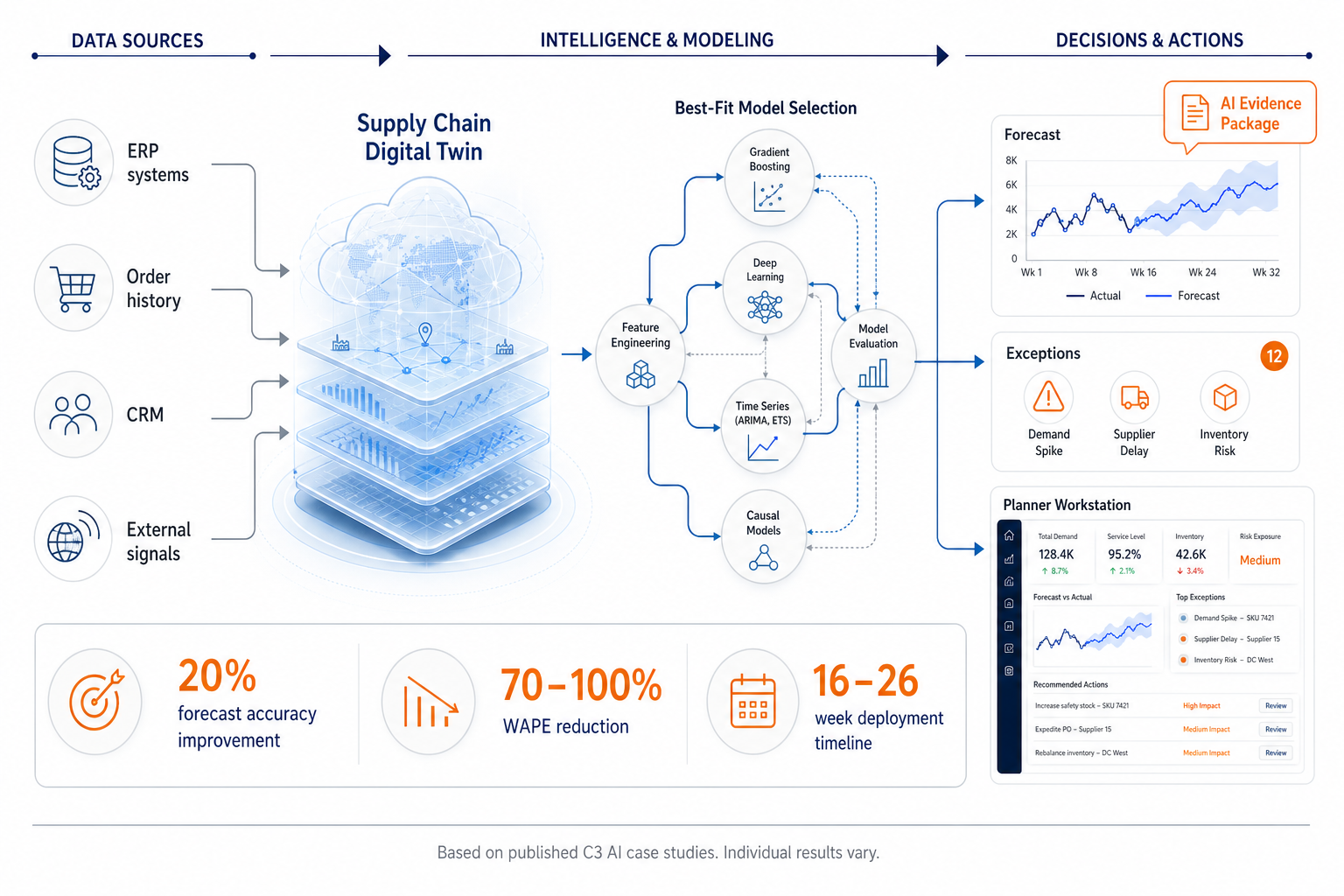
Executive Summary: What This Evaluation Covers and Who It Is For
This evaluation is written for supply chain planning directors, VP-level operations leaders, and enterprise procurement teams who have identified C3 AI Demand Forecasting as a potential candidate and are now in the shortlisting stage. The article provides a structured assessment of the platform's technical architecture, documented capabilities, quantified results from three public case studies, pricing and deployment model, and competitive positioning against supply-chain-native specialists.
The core thesis is straightforward: C3 AI Demand Forecasting is a technically real enterprise AI application with strong documented results — including a 20% forecast accuracy uplift in a biopharma deployment and a 70–100% WAPE reduction in a high-tech hardware deployment — but it must be understood as a horizontal-platform play rather than a supply-chain-native specialist. This distinction matters because it determines whether the platform is a good fit for your organization's AI strategy, budget, and timeline.
The article is organized into nine sections: platform overview and supply chain suite context, technical architecture, documented capabilities, quantified case study results, pricing and deployment model, competitive positioning, strengths and limitations, a decision framework for enterprise buyers, and key takeaways with recommended next steps.
What Is C3 AI Demand Forecasting? Platform Overview and Supply Chain Suite Context
C3 AI Demand Forecasting is one application within the broader C3 AI Supply Chain Suite, which the company describes as an end-to-end family of enterprise AI applications for supply chain planning and execution. The full suite includes applications for sourcing optimization, demand forecasting, production schedule optimization, inventory optimization, and supply network risk. This breadth is both a differentiator and a signal of the company's positioning: C3 AI is a horizontal enterprise AI platform that happens to have supply chain applications, not a supply-chain-native specialist.
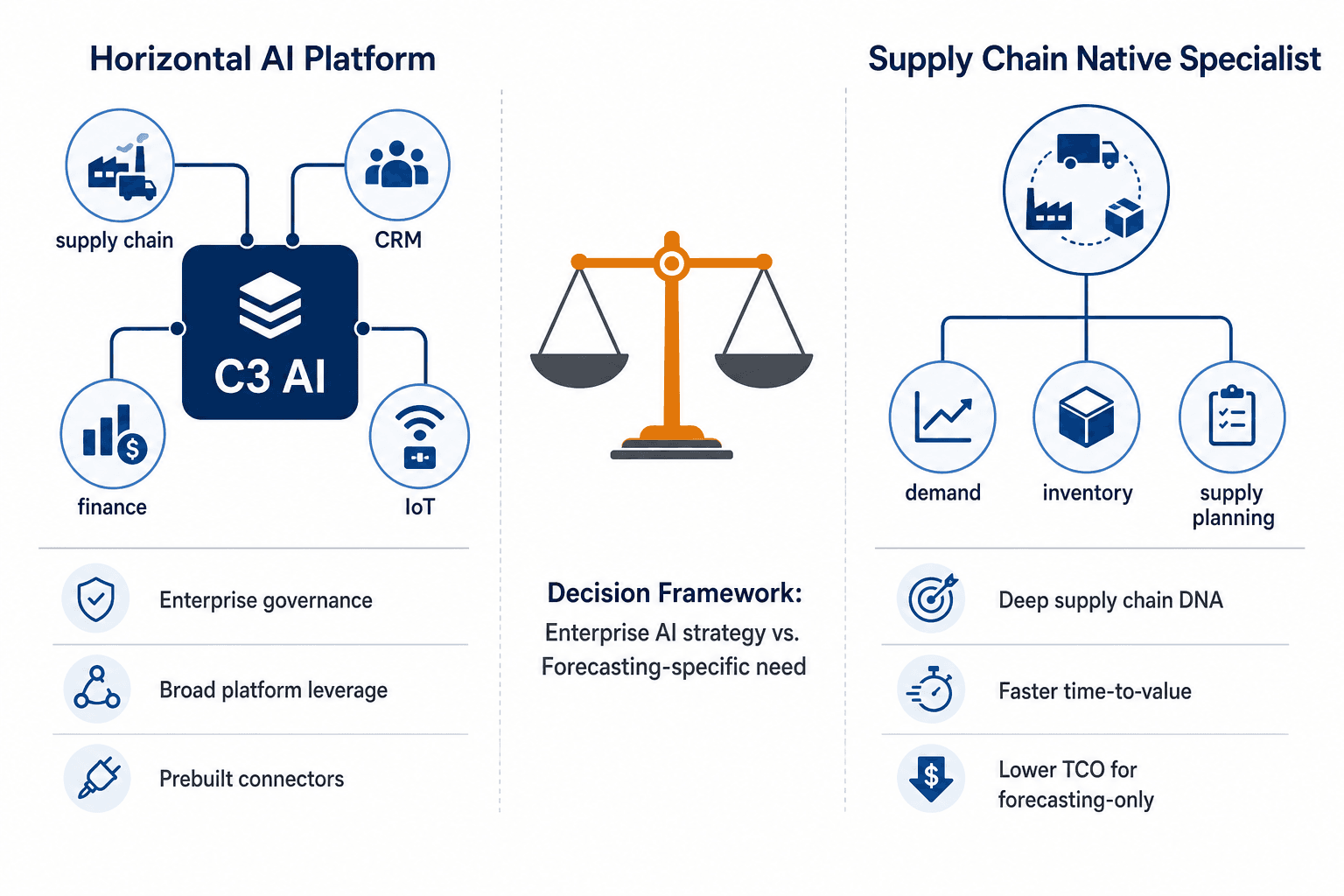
This distinction is critical for evaluators. When you license C3 AI Demand Forecasting, you are not buying a purpose-built demand planning tool in the tradition of Blue Yonder, o9 Solutions, or Kinaxis. You are buying into a broader platform architecture that can also serve use cases in customer relationship management, finance, IoT analytics, and other domains. For organizations already investing in a broad enterprise AI platform strategy, this can be an advantage. For organizations that need a forecasting-specific solution with minimal overhead, it can be a liability.
- C3 AI Demand Forecasting: AI-powered demand forecasting at any granularity with automated best-fit model selection
- C3 AI Production Schedule Optimization: AI-driven production scheduling with shift-level granularity
- C3 AI Inventory Optimization: Multi-echelon inventory optimization across the supply network
- C3 AI Supply Network Risk: AI-based supplier risk scoring and disruption prediction
- C3 AI Sourcing Optimization: AI-driven strategic sourcing and procurement optimization
The platform's positioning as a horizontal AI platform with supply chain applications is reflected in its customer base, which spans industries including biopharma, high-tech hardware, agribusiness, oil and gas, and government. This cross-industry breadth is unusual among supply chain planning vendors, most of which have deep roots in specific verticals like retail, CPG, or automotive.
Technical Architecture: C3 AI Type System, Supply Chain Digital Twin, and Model-Driven Approach
The technical architecture underlying C3 AI Demand Forecasting is one of its most distinctive features and a key differentiator from specialist tools. Three architectural components are particularly relevant for enterprise evaluators: the C3 AI Type System, the supply chain digital twin, and the model-driven approach with automated best-fit model selection.
The C3 AI Type System is a metadata-driven abstraction layer that maps data from disparate source systems — Oracle, SAP, Salesforce, and others — into a unified semantic model. Instead of writing custom ETL pipelines for each data source, the Type System allows the platform to ingest and normalize data from multiple ERP systems, order management systems, CRM platforms, and external data feeds into a common schema. For enterprises with complex, heterogeneous IT landscapes — the kind that result from decades of M&A activity — this abstraction layer can significantly reduce the integration burden.
The supply chain digital twin is the second architectural pillar. As described by C3 AI Vice President Lila Fridley, the digital twin "integrates disparate ERP systems, whether that's Oracle, SAP or other systems, and unifies them into a common digital view of all your data across your supply chain." This digital twin serves as the single source of truth for all supply chain AI applications within the suite, ensuring that demand forecasting, inventory optimization, and production scheduling all operate on the same unified data layer. For readers unfamiliar with the concept, the ChainSignal glossary entry on digital twin supply chain provides a detailed definition and operational context.
The model-driven approach is the third component. Rather than requiring data scientists to manually select and tune forecasting models, C3 AI Demand Forecasting automatically evaluates multiple algorithms — the platform documentation references 13+ model segments — and selects the best-fit model for each forecasting scenario. This automation is designed to reduce the dependency on scarce data science talent and to enable faster deployment cycles. The platform also supports custom model development for organizations with specific methodological requirements.
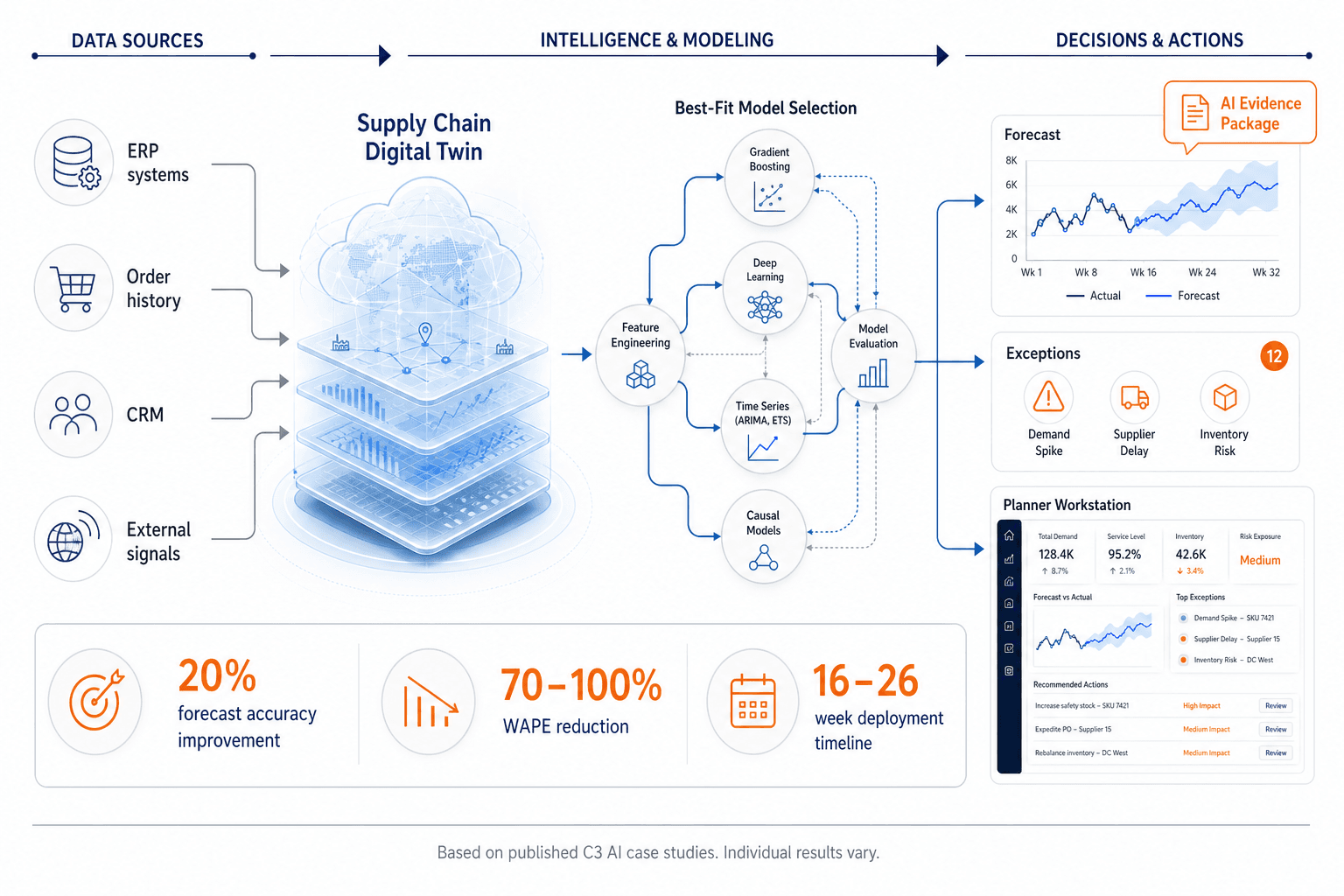
Documented Capabilities: Forecasting, Explainability, Hierarchical Forecasting, and Exception Management
C3 AI Demand Forecasting offers a set of capabilities that are broadly comparable with other enterprise AI forecasting platforms, with several features that stand out as differentiators against both traditional statistical forecasting and other AI platforms.
The platform supports AI-powered forecasting at any granularity — product, product family, geography, channel, customer, or any combination thereof — with configurable forecast horizons. The automated best-fit model selection evaluates multiple algorithms across 13+ model segments and selects the optimal model for each forecasting scenario, reducing the manual effort typically required for model selection and tuning.
One of the most distinctive capabilities is the AI Evidence Package, which provides explainability artifacts for each forecast. These evidence packages document the key drivers behind a forecast — which data sources, features, and model parameters contributed most to the prediction — enabling planners to understand, validate, and challenge AI-generated forecasts. In the high-tech hardware case study, these evidence packages were cited as a factor that increased user trust and adoption among planners who were initially skeptical of AI-generated forecasts.
Hierarchical forecasting is another core capability. The platform supports forecast reconciliation across product, geography, and channel hierarchies, ensuring that bottom-up and top-down forecasts are consistent. This is particularly important for large enterprises with complex product portfolios and multi-channel distribution networks.
Exception management workflows allow planners to interact with AI-generated forecasts through a planner workstation interface. When the platform detects significant deviations from expected patterns or when forecast confidence intervals exceed configured thresholds, it generates exception alerts that prompt planner review and intervention. This human-in-the-loop design is consistent with best practices for AI-assisted planning and addresses a common concern among supply chain planners about being replaced by AI.
| Capability | Description | Differentiator vs. Statistical Forecasting | Differentiator vs. Other AI Platforms |
|---|---|---|---|
| AI-powered forecasting at any granularity | Supports product, geography, channel, customer, and combination hierarchies with configurable horizons | Handles non-linear patterns, seasonality, and external drivers that statistical models miss | Comparable to other AI platforms; differentiation is in the Type System integration |
| Automated best-fit model selection | Evaluates 13+ model segments and selects optimal algorithm per forecasting scenario | Eliminates manual model selection and tuning required for statistical methods | Most AI platforms offer some automation; C3 AI's 13+ segment approach is broader than many |
| AI Evidence Packages | Documented explainability artifacts showing forecast drivers and feature importance | Statistical models offer limited explainability (e.g., decomposition of additive components) | Stronger than most AI platforms; a key differentiator for regulated industries |
| Hierarchical forecasting | Reconciliation across product, geography, and channel hierarchies | Statistical hierarchical forecasting exists but requires manual configuration | Comparable to o9 and Kinaxis; stronger than DataRobot and AutoML platforms |
| Exception management workflows | Planner workstation with exception alerts, forecast review, and override capabilities | Statistical systems typically lack dedicated planner interaction workflows | Comparable to supply-chain-native platforms; stronger than general AI platforms |
Quantified Results: Three Public Case Studies with Different Baselines and Outcomes
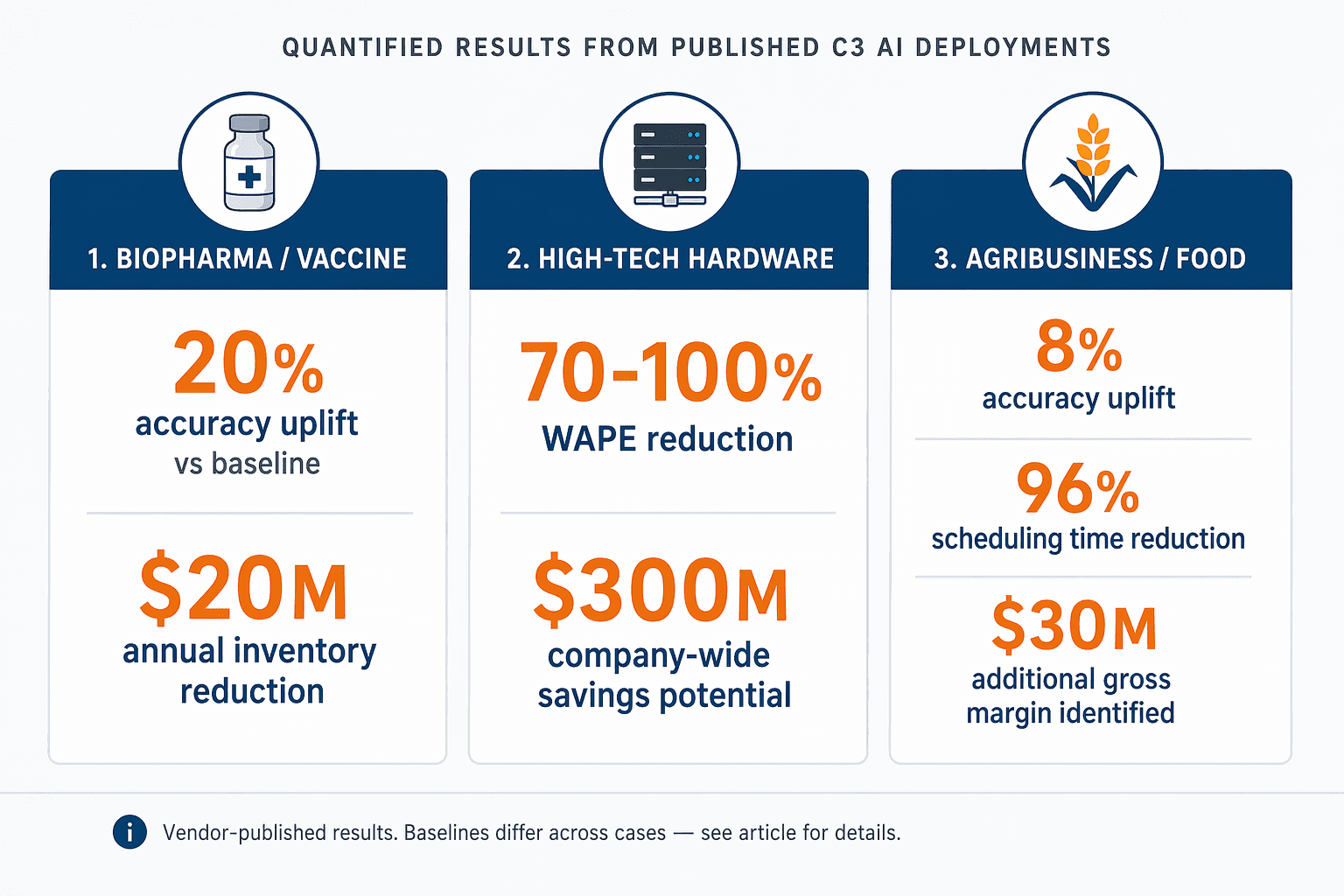
C3 AI has published three detailed case studies that provide quantified results from enterprise deployments of its Demand Forecasting application. These case studies span different industries, use different baselines, and report different metrics — which makes them individually informative but not directly comparable. The following table summarizes the key figures from each deployment.
| Dimension | Biopharma / Vaccine | High-Tech Hardware (HPE) | Agribusiness / Food (Cargill) |
|---|---|---|---|
| Company profile | Leading global biopharma company | HPE, $30B annual revenue | Cargill, $100B+ annual revenue, ~1,400 sites |
| Scope | 450+ SKUs, top 3 markets, ~50% of vaccine revenue | 900 SKUs, High-Performance Computing division, $4B+ annual sales | 88 product codes, 44 raw materials, 8 production lines |
| Data volume | 10+ internal and external data sources | 20M+ rows across 6 enterprise systems | 72M rows from 18 data sources |
| Forecast accuracy improvement | 20% increase vs. statistical baseline; 4% increase vs. SME-adjusted forecasts | 70–100% WAPE reduction vs. prior commercial forecasting solution | 8% uplift vs. prior forecasting approach |
| Financial impact | $20M potential annual inventory reduction | $300M company-wide savings potential at full scale; 7% potential inventory reduction | $30M additional gross margin identified from increased order fill rate |
| Implementation timeline | 26 weeks to production-ready application | Not explicitly stated in published case study | Economic value demonstrated in 16 weeks |
| Additional outcomes | Best-fit AI models across 13+ segments for up to 12-month horizon | AI evidence packages increased user trust and adoption | 96% reduction in scheduling time; $1.5M savings from reduced changeovers |
Despite these caveats, the case studies provide meaningful evidence of the platform's capabilities in production environments. The biopharma case demonstrates that C3 AI can improve upon both statistical baselines and human-adjusted forecasts — a meaningful result given that many AI forecasting tools struggle to beat experienced planners in stable demand environments. The HPE case shows dramatic improvement over a clearly inadequate prior solution, though the >200% WAPE baseline suggests the prior system was particularly poorly suited to the use case. The Cargill case is notable for its breadth — combining demand forecasting with production schedule optimization across 72 million rows of data — and for the speed with which economic value was demonstrated (16 weeks).
Pricing and Deployment Model: Entry Costs, Consumption Pricing, and Implementation Timelines
C3 AI's pricing model is consumption-based with a significant upfront entry cost, which has important implications for enterprise buyers evaluating total cost of ownership. The following table summarizes the pricing structure based on data from third-party aggregators and cloud marketplace listings.
| Cost Component | Details | Estimated Range |
|---|---|---|
| Pilot entry | $250K for 3-month Generative AI Pilot; $500K for 6-month Initial Production Deployment | $250K – $500K |
| Ongoing consumption | $0.55 per vCPU-hour; unlimited seats model (no per-user licensing) | Varies by deployment scale |
| Year-1 total cost (estimated) | Includes software, cloud infrastructure (AWS, Azure, or GCP), professional services, and internal staffing | $685K – $2.45M (pilot scenarios); $1M – $4M+ (production scenarios) |
| Post-pilot annual steady-state (estimated) | Ongoing software consumption, cloud infrastructure, and support | $526K – $3.44M depending on deployment scale |
| Implementation timeline | Based on documented case studies | 12 – 26 weeks |
| Cloud deployment options | Customer cloud account on AWS, Azure, or GCP | Included in infrastructure costs |
Several aspects of this pricing model are worth highlighting for enterprise evaluators. First, the unlimited seats model means that once the platform is deployed, there is no per-user licensing cost — a significant advantage for organizations with large planning teams or those planning to scale the platform across multiple business units. Second, the consumption-based pricing ($0.55/vCPU-hour) means that costs scale with actual usage, which can be an advantage for organizations with variable forecasting workloads but can also lead to unpredictable costs if usage patterns are not well understood.
The implementation timeline of 12–26 weeks is worth contextualizing. This is faster than traditional ERP-based forecasting implementations, which can take 12–18 months, but slower than specialist point solutions that can often be deployed in 4–8 weeks. The biopharma case study reported a 26-week timeline from kick-off to production-ready application, while the Cargill case study demonstrated economic value in 16 weeks — suggesting that the timeline varies significantly based on data complexity, integration requirements, and organizational readiness.
Competitive Positioning: How C3 AI Compares to o9 Solutions, Blue Yonder, Kinaxis, RELEX, and DataRobot
C3 AI Demand Forecasting competes in a crowded market that includes both supply-chain-native planning platforms and general-purpose AI/ML platforms. The following comparison table positions C3 AI against the major alternatives across key evaluation dimensions.
| Dimension | C3 AI | o9 Solutions | Blue Yonder | Kinaxis Maestro | RELEX | DataRobot |
|---|---|---|---|---|---|---|
| Platform type | Horizontal enterprise AI platform | Integrated supply chain planning platform | Supply chain planning platform (retail/CPG heritage) | Supply chain planning platform (concurrent planning) | Supply chain planning platform (retail/CPG heritage) | AutoML platform |
| Supply chain depth | 4.8/10 (Lokad independent assessment) | High — purpose-built for supply chain | High — purpose-built for supply chain | High — purpose-built for supply chain | High — purpose-built for supply chain | Low — general-purpose ML |
| Deployment model | SaaS on customer cloud (AWS/Azure/GCP) | SaaS | SaaS | SaaS | SaaS | SaaS |
| Target company size | Enterprise (large) | Enterprise (mid-to-large) | Enterprise (large, especially retail/CPG) | Enterprise (large, especially complex manufacturing) | Mid-market to enterprise (retail/CPG) | Enterprise (data science teams) |
| Integration ecosystem | Prebuilt connectors to Oracle, SAP, Salesforce, and others via Type System | Prebuilt connectors to major ERP systems | Deep SAP and Oracle integration | Deep SAP and Oracle integration | Prebuilt connectors to major ERP and POS systems | Broad ML framework integrations |
| Pricing model | Consumption-based ($0.55/vCPU-hour); $250K–$500K pilot entry | Subscription-based; contact for pricing | Subscription-based; contact for pricing | Subscription-based; contact for pricing | Subscription-based; contact for pricing | Subscription-based; contact for pricing |
| Key strength | Platform breadth, enterprise governance, explainability features | Integrated business planning, demand sensing, digital twin | Promotion engine, retail/CPG domain expertise, Gartner Peer Insights presence (284 reviews) | Concurrent planning for complex manufacturing, multi-echelon inventory optimization | Retail/CPG specialization, unified planning platform | AutoML for time-series forecasting on flat tables |
| Key limitation | Not supply-chain-native; high TCO for forecasting-only; vendor strategic drift risk | Higher complexity and cost than point solutions | Primarily retail/CPG focused; less suited for other verticals | Steep learning curve; best for complex manufacturing | Limited outside retail/CPG | Limited supply chain domain expertise; requires data science team |
The comparison reveals a clear pattern: C3 AI occupies a unique position as the only horizontal enterprise AI platform among the major demand forecasting vendors. This positioning has both advantages and disadvantages. On the positive side, C3 AI offers enterprise governance features, prebuilt connectors to major ERP systems via its Type System, and explainability capabilities that are stronger than most competitors. On the negative side, the platform scores lower on supply chain depth — Lokad's independent assessment gives C3 AI a supply chain score of 4.9/10, with a sub-score of 4.8/10 on supply chain depth — compared to purpose-built supply chain platforms.
For readers evaluating specific competitors, ChainSignal maintains detailed vendor profiles for Kinaxis Maestro, Blue Yonder, and o9 Solutions, as well as a broader AI demand planning vendor landscape snapshot that provides market context for the full vendor ecosystem.
Strengths and Limitations: A Balanced Assessment for Enterprise Buyers
A balanced assessment of C3 AI Demand Forecasting requires acknowledging both its genuine strengths and its significant limitations. The following analysis draws on the documented case studies, independent assessments, and market context to provide an honest evaluation for enterprise buyers.
Strengths
- Platform breadth: C3 AI's horizontal platform approach means that organizations can deploy demand forecasting, inventory optimization, production scheduling, and supply network risk applications on a unified architecture. For enterprises already investing in a broad AI platform strategy, this reduces the number of vendors to manage and enables cross-functional AI use cases.
- Enterprise governance and security: The platform is designed for enterprise-grade security, compliance, and governance requirements. This is particularly relevant for regulated industries such as biopharma, where the AI Evidence Packages provide audit-ready explainability for forecast-driven decisions.
- Explainability features: The AI Evidence Packages are a genuine differentiator. Most AI forecasting platforms provide limited explainability, which creates trust barriers with planners and compliance risks in regulated environments. C3 AI's approach to documenting forecast drivers is more mature than most competitors.
- Prebuilt connectors: The C3 AI Type System provides prebuilt connectors to major ERP systems including Oracle, SAP, and Salesforce. For enterprises with complex, heterogeneous IT landscapes, this can significantly reduce integration effort compared to platforms that require custom ETL pipelines.
- Cross-industry applicability: Unlike supply-chain-native platforms that are optimized for specific verticals (retail/CPG for Blue Yonder and RELEX, complex manufacturing for Kinaxis), C3 AI has demonstrated deployments across biopharma, high-tech hardware, agribusiness, and other industries. This breadth is valuable for diversified conglomerates.
Limitations
- Not supply-chain-native: This is the most important limitation. Lokad's independent assessment gives C3 AI an overall supply chain score of 4.9/10, with sub-scores of 4.8/10 on supply chain depth and 4.4/10 on decision and optimization substance. As Lokad concludes, "C3.ai is an enterprise AI platform vendor with credible supply chain applications, not a supply-chain-native decision engine." For organizations that need deep supply chain domain expertise — such as promotion-driven demand sensing in retail or multi-echelon inventory optimization in complex manufacturing — specialist platforms may be better suited.
- High total cost of ownership: The $250K–$500K pilot entry cost, combined with consumption-based pricing and the need for professional services and internal staffing, means that Year-1 total cost typically ranges from $1M to $4M+. For organizations that only need demand forecasting — without the broader platform capabilities — this is significantly more expensive than specialist point solutions.
- Operational heaviness: Multiple independent reviews note that C3 AI has longer implementation cycles than specialist forecasters, high program complexity, and significant stakeholder dependency. The 12–26 week implementation timeline is faster than traditional ERP implementations but slower than specialist point solutions that can be deployed in 4–8 weeks.
- Vendor strategic drift risk: C3 AI underwent a CEO transition in September 2025, with Stephen Ehikian succeeding founder Thomas Siebel. The company also withdrew its fiscal outlook, which is a signal of uncertainty that enterprise buyers should factor into their risk assessment. As noted in the ChainSignal analysis of supply chain AI funding and M&A activity, corporate stability is a critical factor for long-horizon supply chain transformations.
- Limited supply chain-specific peer validation: Gartner Peer Insights data for C3 AI in supply chain planning has limited review volume (2–4 reviews in SCPM) compared to established vendors like Blue Yonder (284 reviews) and o9 Solutions (168 reviews). This makes satisfaction comparisons less statistically robust and means that enterprise buyers have fewer peer references to consult.
Decision Framework: When C3 AI Makes Sense vs. When a Specialist Tool Is Better
The following decision framework is designed to help enterprise buyers self-qualify: determine whether C3 AI Demand Forecasting is a strong fit for their organization or whether a supply-chain-native specialist is the better choice.
| Decision Criteria | C3 AI Is a Strong Fit When... | A Specialist Tool Is Better When... |
|---|---|---|
| Enterprise AI platform strategy | Your organization is already investing in a broad enterprise AI platform and wants to leverage that investment across multiple use cases (supply chain, CRM, finance, IoT) | Your organization needs a forecasting-specific solution and has no broader AI platform ambitions |
| Data complexity and integration | You have complex, heterogeneous IT landscapes with multiple ERP systems (Oracle, SAP, Salesforce) that need to be unified | You have a single ERP system or a relatively simple data environment that can be integrated with standard ETL tools |
| Organizational readiness | You have executive sponsorship for a platform-level investment and a team that can manage the implementation complexity | You need a solution that can be deployed quickly (4–8 weeks) with minimal organizational disruption |
| Timeline and budget | You have a 12–26 week implementation timeline and a Year-1 budget of $1M–$4M+ for the forecasting use case | You need a faster deployment (4–8 weeks) and a lower total cost of ownership |
| Regulatory and compliance requirements | You operate in a regulated industry (biopharma, financial services) that requires audit-ready explainability for forecast-driven decisions | Your regulatory requirements are standard and can be met with less sophisticated explainability features |
| Cross-industry operations | You are a diversified conglomerate operating across multiple industries and need a platform that can serve different verticals | You operate in a single industry (retail, CPG, manufacturing) and need deep domain-specific capabilities |
| Vendor risk tolerance | You have a high tolerance for vendor strategic drift risk and are comfortable with the recent CEO transition and withdrawn fiscal outlook | You need a stable, predictable vendor relationship with a long track record in supply chain planning |
The decision framework makes clear that C3 AI is not the right choice for every organization. It is best suited for large enterprises that are already investing in a broad enterprise AI platform strategy, have complex data environments with multiple ERP systems, operate in regulated industries that require explainability, and have the budget and organizational readiness to manage a platform-level implementation. For organizations that need a forecasting-specific solution with faster deployment, lower cost, and deeper supply chain domain expertise, specialist platforms like o9 Solutions, Blue Yonder, or Kinaxis are likely better choices.
Conclusion: Key Takeaways and Next Steps for Evaluators
C3 AI Demand Forecasting is a technically capable enterprise AI application with documented results that include a 20% forecast accuracy improvement in a biopharma deployment, a 70–100% WAPE reduction in a high-tech hardware deployment, and an 8% accuracy uplift combined with $30 million in additional gross margin identified in an agribusiness deployment. The platform's technical architecture — particularly the C3 AI Type System, supply chain digital twin, and AI Evidence Packages — is genuinely differentiated from both traditional statistical forecasting and other AI platforms.
However, the platform must be evaluated on its own terms: as a horizontal enterprise AI platform with supply chain applications, not as a supply-chain-native specialist. This distinction has practical implications for implementation complexity, total cost of ownership, and organizational readiness. For enterprises already investing in a broad AI platform strategy, C3 AI offers a compelling value proposition. For organizations that need a forecasting-specific solution with deep supply chain domain expertise, specialist platforms are likely the better choice.
For enterprise buyers who decide to proceed with evaluation, the following next steps are recommended:
- Map your internal AI platform strategy before shortlisting. Determine whether your organization is pursuing a horizontal platform strategy or a best-of-breed approach for each function. This decision should drive your vendor evaluation criteria.
- Request a proof-of-concept with your own data. The C3 AI pilot program ($250K–$500K) is designed for this purpose. Use the pilot to validate the platform's ability to ingest and model your specific data, and to assess the quality of the AI Evidence Packages for your use case.
- Compare total cost of ownership against specialist alternatives. Request detailed pricing proposals from C3 AI and at least two specialist vendors (o9 Solutions, Blue Yonder, or Kinaxis) based on your specific deployment scope. Include all costs: software, cloud infrastructure, professional services, internal staffing, and ongoing maintenance.
- Assess vendor risk factors. The September 2025 CEO transition and withdrawn fiscal outlook are material events that should be factored into your risk assessment. Review the ChainSignal analysis of supply chain AI funding and M&A activity for broader market context.
- Consult peer references. Given the limited Gartner Peer Insights review volume for C3 AI in supply chain planning, request direct customer references from C3 AI and speak with organizations that have deployed the platform in production environments similar to yours.
For broader market context, the ChainSignal AI demand planning vendor landscape snapshot provides a comprehensive overview of the major vendors, their positioning, and key evaluation criteria for enterprise buyers.
Comments
Join the discussion with an anonymous comment.