
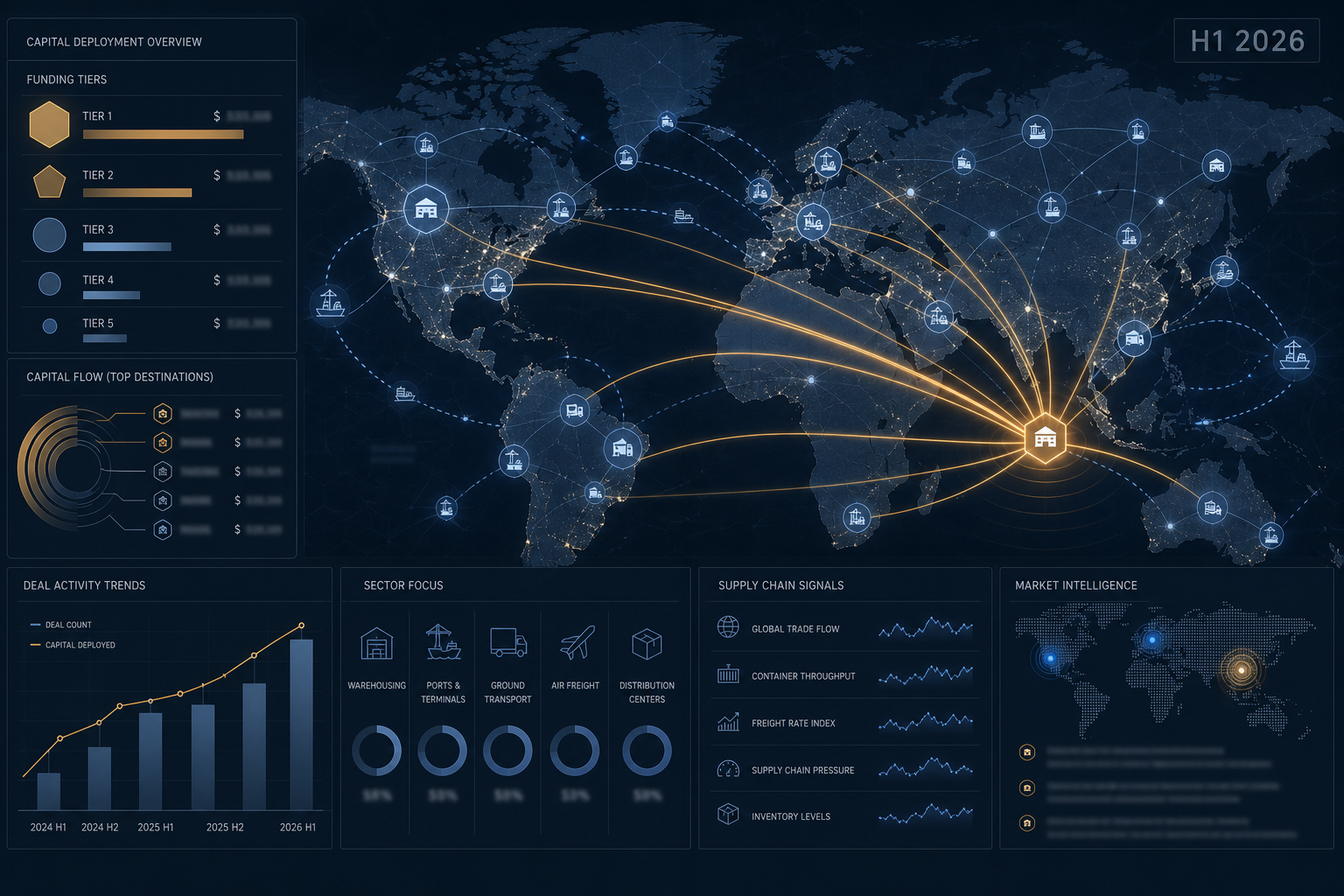
H1 2026 in Review: Character of the Market, Not Just the Volume
The first half of 2026 — January through June — produced a set of supply chain AI funding events that, taken together, are more coherent than the sum of their dollar amounts. The review window here is explicitly H1 2026: the Aptean/OpsVeda acquisition closed January 16, ORO Labs' Series C closed March 12, and Stord's Series F closed May 26. Framing this as Q2 alone would misrepresent the timing of two of the most practitioner-relevant deals in the period.
What distinguishes H1 2026 from prior supply chain AI funding cycles is not the aggregate capital deployed — it is the investor pedigree and the convergence of thesis. Goldman Sachs Alternatives Growth Equity, Brighton Park Capital, Kleiner Perkins, Founders Fund, J.P. Morgan Growth Equity, Strike Capital, and Valor Equity Partners are not speculative early-stage funds chasing a trend. Their co-presence across multiple supply chain AI rounds in a single six-month window signals category conviction from institutions that underwrite long-duration positions.
The period also produced a deliberate two-step acquisition from Aptean — first Logility, then OpsVeda — that reveals a vendor consolidation strategy more legible than most M&A activity in this space. And alongside the nine-figure platform rounds, seed investments in Mandel AI ($3.9M) and Conduit ($6M) signal that practitioners are still experiencing pain in supplier communication automation and dock/yard management that established platforms have not resolved.
Named Funding Rounds: Editorial Framing for Each Deal
The following deals are covered in sequence from largest to smallest by round size, with practitioner-relevant interpretation for each. Primary-source verification status is noted where it differs.
Stord — $250M Series F (May 26, 2026)
Led by Strike Capital with Kleiner Perkins, Founders Fund, Franklin Templeton, Baillie Gifford, G Squared, Bond, and Lux, Stord's $250M Series F at a $3B valuation is the largest supply chain AI software round of the period. The company reports over 10x revenue growth in four years and processes $15B in gross merchandise value annually across nearly 100 fulfillment locations.
The practitioner-relevant signal is the launch of Stord Labs alongside the raise: a development environment where agentic AI, robotics, and advanced automation are tested against real orders on the same live operating system powering Stord's production network. This is a meaningful capability claim — AI trained on live operational data at scale — but practitioners should note that $15B GMV is a gross merchandise value metric, not net revenue or ARR. These are not equivalent measures of business scale.
ORO Labs — $100M Series C (March 12, 2026)
Led by Brighton Park Capital and Growth Equity at Goldman Sachs Alternatives, with continued participation from Norwest Venture Partners, B Capital, XYZ Capital, and Felicis, ORO Labs' $100M Series C came with a disclosed 300% year-over-year revenue growth figure — the only named company in this period to disclose a revenue growth rate with that specificity. The platform is deployed across 100+ countries and counts 15 of the top 25 life sciences companies among its users.
Named enterprise clients confirmed in independent editorial coverage include Pfizer, Danone, The Coca-Cola Company, Stellantis, Bayer, and Booking.com — a cross-industry roster that spans pharma, food and beverage, automotive, financial services, and CPG. This breadth is operationally significant: it indicates that ORO's orchestration model is not vertical-specific, which matters for procurement leads evaluating category fit.
Loop — $95M Series C (April 17, 2026)
Led by Valor Equity Partners and the Valor Atreides AI Fund, with 8VC, Founders Fund, Index Ventures, and J.P. Morgan Growth Equity, Loop's $95M Series C funds a platform that ingests unstructured data — PDFs without OCR, handwritten sheets, digital messages — and structures it to automate tasks via a multi-model AI harness. The platform integrates with ERP systems, transportation management systems, supplier data, and warehouse feeds.
The investor framing from Valor founder Antonio Gracias positions Loop as a candidate for 'the intelligence layer of the entire supply chain.' Practitioners should treat this as investor thesis, not independently verified capability. Loop has not disclosed ARR or revenue figures publicly. The deal is primary-source verified via TechCrunch.
Doss — $55M Series B (March 24, 2026)
Led by Madrona and Premji Invest, Doss raised $55M for an AI-native inventory management layer that integrates with existing accounting systems rather than replacing them. The positioning is notable: Doss is explicitly not an ERP replacement, which lowers integration barrier claims but also raises questions about data ownership and workflow authority in mixed-system environments. This deal is aggregator-confirmed via ProjectStartups; practitioners should independently verify before citing in vendor evaluations.
Gather AI — $40M Series B (February 9, 2026)
Led by Smith Point Capital Management, Gather AI's $40M Series B funds drone-based physical AI for warehouse inventory intelligence. The company is expanding to hundreds of additional facilities and enhancing predictive inventory management capabilities. This is a warehouse operations signal, not a planning software signal — relevant primarily for practitioners evaluating autonomous inventory visibility in distribution environments. Deal is corroborated by multiple press sources cited in aggregator coverage.
Afresh — $34M (April 21, 2026)
Backed by Just Climate and High Sage Ventures, Afresh raised $34M for its AI platform focused on grocery supply chain optimization — a vertical with acute demand volatility and perishability constraints that generic demand planning tools handle poorly. Aggregator-confirmed; primary press release not independently read for this record.
Canals — $35M (Q1 2026)
Backed by Base10 Partners, Canals raised $35M for an AI workflow suite targeting wholesale distribution — a $8.2T market segment that has historically been underserved by enterprise software. The company reports 100+ distributor customers processing 8M+ sales orders and $5B in payables, with customers reporting 96% touchless invoice processing. Confirmed via MapCo deal analysis; practitioners should independently verify the invoice processing figure before using it in evaluation contexts.
BackOps — $26M Series A (March 12, 2026)
Backed by Theory Ventures and Gradient, BackOps raised $26M for what it positions as an AI-native operating system for supply chain operations. The 'supply chain OS' framing signals a horizontal ambition — not a point solution — which raises both the ceiling on potential utility and the floor on implementation complexity. Aggregator-confirmed via ProjectStartups.
Conduit — $6M Seed (March 24, 2026)
Backed by Innovation Endeavors and Y Combinator, Conduit raised $6M for AI-powered dock and yard management — automating warehouse shipping and receiving workflows. Dock scheduling and yard visibility are operational pain points that most WMS platforms address only partially. A seed investment here signals that the problem is real and unresolved at scale, not that Conduit has solved it. Aggregator-confirmed.
Mandel AI — $3.9M Seed (March 25, 2026)
Backed by Y Combinator and Category Ventures, Mandel AI raised $3.9M for AI-driven supplier communication automation — automating the coordination work between buyers and suppliers that currently falls on procurement coordinators and email. This is the smallest round in the H1 2026 dataset and the most diagnostic: YC-backed seed rounds in a specific operational problem signal that the problem is painful, common, and not yet well-served by existing tools. Aggregator-confirmed via ProjectStartups.
| Company | Round | Amount | Close Date | Lead Investor(s) | Segment | Source Verification |
|---|---|---|---|---|---|---|
| Stord | Series F | $250M | May 26, 2026 | Strike Capital, Kleiner Perkins, Founders Fund | Fulfillment / Physical AI | Primary (Stord newsroom) |
| ORO Labs | Series C | $100M | Mar 12, 2026 | Goldman Sachs Alternatives, Brighton Park Capital | Procurement Orchestration | Primary (ORO newsroom) |
| Loop | Series C | $95M | Apr 17, 2026 | Valor Equity Partners, Founders Fund, J.P. Morgan Growth Equity | Full-Stack Supply Chain AI | Primary (TechCrunch) |
| Doss | Series B | $55M | Mar 24, 2026 | Madrona, Premji Invest | Inventory Management | Aggregator (ProjectStartups) |
| Canals | Undisclosed | $35M | Q1 2026 | Base10 Partners | Wholesale Distribution AI | Aggregator (MapCo) |
| Afresh | Undisclosed | $34M | Apr 21, 2026 | Just Climate, High Sage Ventures | Grocery Supply Chain AI | Aggregator (ProjectStartups) |
| Gather AI | Series B | $40M | Feb 9, 2026 | Smith Point Capital Management | Warehouse Physical AI | Corroborated (MapCo + press) |
| BackOps | Series A | $26M | Mar 12, 2026 | Theory Ventures, Gradient | Supply Chain OS | Aggregator (ProjectStartups) |
| Conduit | Seed | $6M | Mar 24, 2026 | Innovation Endeavors, Y Combinator | Dock & Yard Management | Aggregator (ProjectStartups) |
| Mandel AI | Seed | $3.9M | Mar 25, 2026 | Y Combinator, Category Ventures | Supplier Communication AI | Aggregator (ProjectStartups) |
Key M&A: Aptean's Planning-Execution Consolidation and Logistics Sector Context
The most practitioner-relevant M&A event of H1 2026 is not the largest by dollar value — it is Aptean's sequential acquisition strategy. Having acquired Logility in April 2025, Aptean then acquired OpsVeda on January 16, 2026 to add a real-time agentic execution layer to Logility's planning capabilities. The stated design: OpsVeda continuously observes live operational data, reasons over changing conditions, and takes or recommends actions aligned with business goals — closing the gap between what planning systems project and what execution systems encounter.
This is a deliberate two-step strategy, not coincidental timing. Allan Dow, EVP at Aptean and former Logility CEO, framed the OpsVeda acquisition as enabling end-to-end AI supply chain orchestration by aggregating data from enterprise systems and LLMs in real time to drive intelligent actions. OpsVeda's patented command center covers order fulfillment, supply, manufacturing, logistics, inventory, assets, and retail channels.
Two logistics asset acquisitions provide sector-context framing without constituting AI software signals. Werner Enterprises acquired FirstFleet for approximately $283M including real estate, adding over $615M in annual revenue and strengthening grocery and food vertical exposure. Echo Global Logistics agreed to acquire ITS Logistics, creating a combined platform generating approximately $5.4B in pro forma revenue across brokerage, intermodal, drayage, and asset-based fleet capabilities. These are asset-layer consolidations — relevant as evidence that the logistics sector broadly is concentrating, but not as signals about AI software capability or vendor roadmap.
Three Thematic Signals Extracted from the Deal Patterns
Across the H1 2026 funding and M&A dataset, three practitioner-relevant themes emerge from the deal rationales, investor framing, and product positioning — not from the dollar amounts alone.
Signal 1: Agentic AI Is the Dominant Investment Framing Thesis
The term 'agentic AI' appears explicitly in the ORO Labs Series C announcement, the Aptean/OpsVeda acquisition rationale, the BackOps Series A positioning, and the Stord Labs launch narrative. For the purposes of interpreting these deals: agentic AI refers to systems that can plan, make decisions, and execute actions toward specific goals — not systems that produce recommendations for humans to act on. The operational distinction matters because it changes the governance requirements, integration depth, and human-in-the-loop design of any deployment.
When investors fund agentic AI framing across multiple supply chain software categories in a single six-month period, it signals that the market has moved past debating whether autonomous execution is viable and toward competing on which platforms can deliver it reliably at enterprise scale. Practitioners should treat this as a category maturation signal, not a product readiness guarantee.
Signal 2: Procurement Orchestration Is Validated as a Standalone Software Category
ORO Labs' $100M round — led by Goldman Sachs Alternatives, at 300% YoY revenue growth, with named Fortune 500 clients across pharma, financial services, CPG, and automotive — is the clearest evidence in the H1 2026 dataset that procurement orchestration has crossed from emerging category to validated standalone software market. This is not an ERP module competing on feature parity with SAP Ariba or Coupa. ORO's positioning as an orchestration layer that integrates with existing systems rather than replacing them has evidently resonated with enterprise buyers who have already invested in incumbent procurement infrastructure.
For procurement leads evaluating AI tools: the ORO round signals that the market has accepted the premise that a standalone orchestration layer adds value above and beyond what ERP-embedded procurement modules provide. It does not validate any specific capability claim. Evaluate ORO — and its competitors — on data prerequisite readiness, ERP integration depth, and production deployment evidence, not on round size.
Signal 3: Physical Intelligence Infrastructure at Scale Creates a New 3PL Evaluation Reference Point
Stord's $250M Series F introduces a category that did not have a named reference point at this scale before: a vertically integrated fulfillment platform where the physical network, the software operating system, and the AI layer are developed and validated together on live production data. Stord Labs — testing agentic AI and robotics against real orders across nearly 100 facilities — represents a development environment that pure-software vendors cannot replicate without physical infrastructure.
For practitioners evaluating AI-enabled 3PL platforms or outsourced fulfillment partners: Stord's round creates a new benchmark question. When a 3PL vendor claims AI-driven fulfillment optimization, ask what operational data volume their AI is trained on, whether that training occurs on live production orders or synthetic data, and whether the AI system is the same one running their network or a separate demonstration environment.
Practitioner Selection Implications: What Funded Status Means and Does Not Mean
The H1 2026 deal pattern has four direct implications for practitioners who are actively evaluating AI vendors, managing renewal decisions, or assessing consolidation risk in their current tool stack.
- The mid-market vendor landscape is bifurcating. Well-capitalized platforms with multi-year runways — ORO Labs, Loop, Stord — are pulling away from undercapitalized point solutions in terms of product development velocity and integration investment. Point solutions that have not raised in 18+ months, or that raised at smaller amounts from less-established investors, carry elevated acquisition probability or sunset risk. This is not a reason to avoid them, but it is a variable that belongs in your vendor evaluation scorecard alongside capability claims.
- Acquisition probability is now a vendor evaluation variable. Aptean's two-step acquisition of Logility and then OpsVeda illustrates the risk clearly: a practitioner who began evaluating OpsVeda as a standalone execution layer in Q4 2025 was, by January 2026, evaluating a product whose roadmap, pricing, and integration dependencies had materially changed. Ask any point-solution vendor directly: have you received acquisition interest, and what is your product roadmap under a potential acquisition scenario?
- Funding depth and investor pedigree are relevant but insufficient signals. Goldman Sachs Alternatives backing ORO Labs does not validate ORO's ERP integration depth for your specific SAP or Oracle environment. Strike Capital backing Stord does not confirm that Stord's AI layer is production-ready for your SKU mix and fulfillment velocity. Funding signals category conviction from investors — it does not substitute for your own data prerequisite assessment, integration testing, and reference checks with production deployments comparable to your environment.
- Early-stage seed investments signal unmet practitioner pain points. Mandel AI ($3.9M, supplier communication automation) and Conduit ($6M, dock and yard management) are diagnostic signals about where established platforms are failing practitioners. If you are experiencing friction in supplier communication workflows or dock scheduling visibility, the fact that YC-backed companies are raising seed rounds in those exact areas tells you that the problem is real and widespread — and that your incumbent platform may not resolve it on a near-term roadmap.
| Evaluation Variable | What the H1 2026 Data Tells You | What It Does Not Tell You |
|---|---|---|
| Funding round size | Investor conviction in the category and the platform's ability to compete long-term | Whether the product is ready for your data environment and integration stack |
| Investor pedigree | Institutional validation of market size and business model | Product stability, ERP integration maturity, or deployment success rate |
| Revenue growth rate (ORO: 300% YoY) | Real enterprise demand for the category; not a speculative market | Whether the product will perform in your specific procurement context |
| Acquisition activity (Aptean) | Consolidation strategy is deliberate; standalone product roadmaps will change | Production integration timelines or feature parity post-close |
| Seed-stage investment (Mandel AI, Conduit) | Practitioner pain point is real and not yet addressed by platforms | Whether the early-stage product is production-ready at enterprise scale |
| GMV metrics (Stord: $15B GMV) | Scale of physical operations the AI is trained against | Net revenue, margin profile, or financial sustainability of the business |
Caveats and Counterpoints: Where the Signal Has Noise
The H1 2026 dataset contains several places where the signal is weaker than the deal announcements suggest. Practitioners who use this record in vendor evaluation should account for the following.
Funding Does Not Equal Deployment Maturity
No ARR or independently verified revenue figures are publicly available for Loop. The TechCrunch coverage of the Series C describes investor thesis and platform capabilities but contains no verified performance metrics. Stord's $15B GMV figure is a gross merchandise value measure — a volume metric that reflects the value of goods flowing through the network, not Stord's net revenue. GetLatka estimated Stord's 2025 revenue at approximately $150M, which is a materially different scale than GMV implies. Practitioners should not conflate these metrics when benchmarking Stord against software-only competitors.
Post-Acquisition Integration Lag Is the Default, Not the Exception
Aptean's agentic execution layer — the OpsVeda capability — is announced but not yet documented as production-integrated with Logility's planning platform. The acquisition closed January 16, 2026. As of this record (Q2 2026), production integration timelines have not been publicly disclosed. Practitioners who are evaluating the combined Aptean/Logility/OpsVeda platform should request a current integration architecture document and a roadmap with committed delivery dates, not marketing materials describing the intended combined capability.
Aptean's sequential acquisitions of Logility and OpsVeda within months demonstrate that leading supply chain software vendors recognize that customers increasingly prefer integrated platforms over best-of-breed point solutions requiring custom integration. This consolidation trend creates opportunities for mid-market systems integrators who can implement and customize unified platforms while challenging independent supply chain software vendors who lack resources to build end-to-end capabilities autonomously.
That framing, from independent editorial analysis of the Aptean/OpsVeda deal, captures the structural dynamic accurately — but it also implies that the integration work has been done. It has not, at least not publicly. The opportunity for integrators and the challenge for point solutions are both real; the production-ready combined platform is not yet documented.
Tariff and Geopolitical Volatility Creates Signal Noise in Investment Rationale
Several H1 2026 vendor announcements explicitly cite supply chain resilience, disruption detection, and volatility management as investment rationale. This framing is partially legitimate — tariff uncertainty and geopolitical disruption are real planning variables in 2026 — but it also inflates the apparent urgency of any supply chain AI investment. Practitioners should evaluate whether a vendor's disruption-detection capability is an independently verified product feature or a positioning response to macro conditions. Ask for documented examples of the system detecting and acting on a specific disruption event, with the data source, the action taken, and the outcome measured.
Aggregator-Confirmed Deals Require Independent Verification
The four deals with primary-source verification in this record — Loop (TechCrunch), ORO Labs (ORO newsroom and Supply Chain Digital), Aptean/OpsVeda (Aptean press release and ERP Today), and Stord (Stord newsroom and FreightWaves) — can be cited with higher confidence. The investor names, round amounts, and capability claims from those sources are directly read and editorially framed here, not passed through an aggregation layer.
Comments
Join the discussion with an anonymous comment.