
What 'AI Demand Planning' Actually Means in 2026
The term "AI demand planning" has become a catch-all label applied to everything from simple moving-average adjustments to relational deep learning models that ingest multi-table data. For a supply chain leader building a shortlist, the first step is understanding that the technical capability underneath the label varies dramatically — and that mismatch between claimed capability and actual need is the most common source of failed evaluations.
In 2026, the market has converged around four distinct technical capability types that vendors may implement individually or in combination:
- ML model selection and ensembling: Platforms automatically test multiple algorithms (ARIMA, Prophet, XGBoost, LightGBM, neural networks) per SKU and select or weight the best performer. This is the baseline for any tool claiming AI capability. Ensemble approaches — where the system picks the best method per demand pattern — deliver more consistent results across heterogeneous portfolios than any single model.
- Neural networks for causal demand: Deep learning models that ingest external causal factors — promotions, weather, competitor pricing, macroeconomic indicators — and learn non-linear relationships between those drivers and demand. These models are essential for businesses where demand is heavily influenced by events rather than historical patterns alone.
- Probabilistic forecasting: Rather than a single point estimate, probabilistic methods output a distribution of possible outcomes, enabling planners to assess confidence intervals and set safety stock based on service-level targets. This is a meaningful differentiator for inventory optimization use cases.
- Anomaly detection and automated intervention: Models that flag outliers in real time — a sudden demand spike, a data feed failure, a supplier disruption — and either alert planners or automatically adjust forecasts. This capability is increasingly table stakes for enterprise-grade platforms.
For a deeper technical breakdown of how these models work in practice, see our guide to AI demand planning techniques and implementation patterns.
Market Overview: Enterprise, Mid-Market, and Specialist Tiers
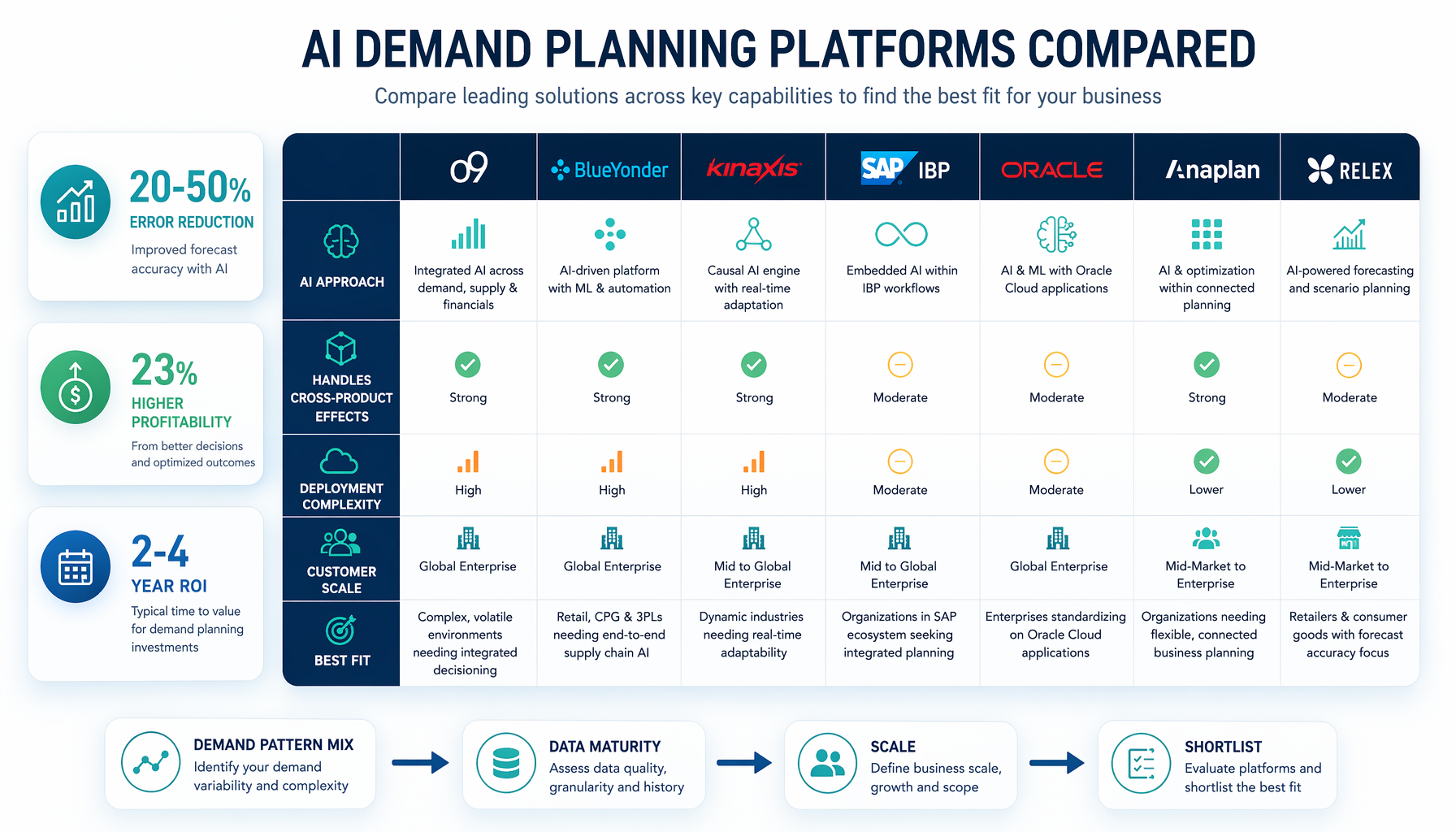
The AI demand planning market in 2026 is mature enough to segment cleanly into three tiers. Each tier serves a different scale of operation, demand complexity, and implementation budget. Trying to evaluate a specialist tool against an enterprise suite without accounting for these structural differences leads to misleading conclusions.
| Tier | Typical Customer Scale | Representative Vendors | Key Characteristics |
|---|---|---|---|
| Enterprise | $3B+ revenue, 10,000+ SKUs, global operations | o9 Solutions, Kinaxis, SAP IBP, Blue Yonder, Oracle SCM | Full-suite planning with integrated S&OP/IBP; multi-echelon inventory optimization; high deployment complexity; $1M+ annual license costs |
| Mid-Market Integrated | $100M–$3B revenue, 500–10,000 SKUs, regional or multi-national | RELEX Solutions, Logility, Horizon Solutions, Anaplan | Purpose-built for specific verticals (retail, CPG); faster deployment; ensemble ML methods; $100K–$500K annual costs |
| Specialist | Any scale, specific demand pattern or industry focus | Flowlity, ToolsGroup, Kumo.ai | Deep capability in one area (intermittent demand, cross-product effects, retail promotion planning); often used alongside a broader planning platform |
Comments
Join the discussion with an anonymous comment.