
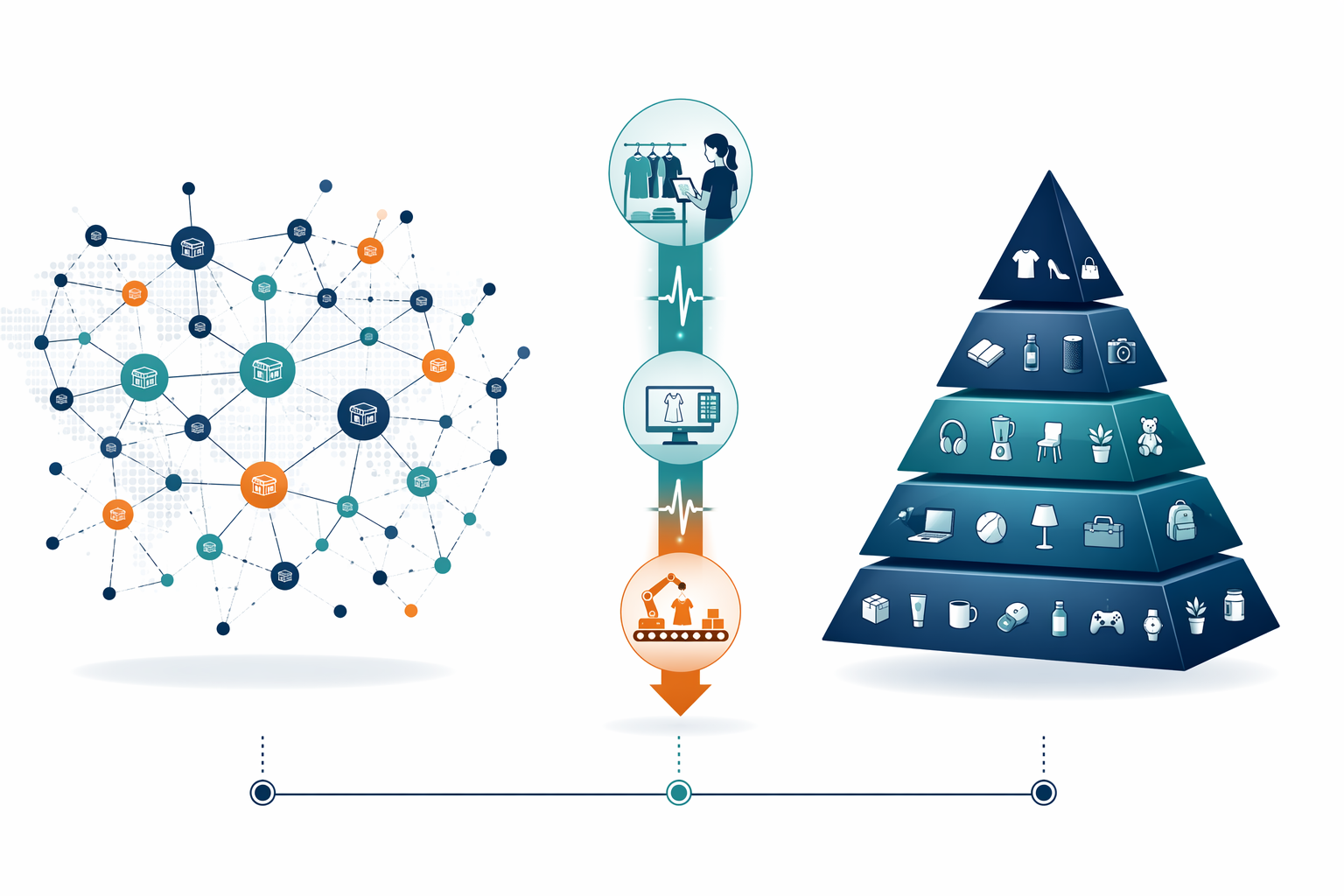
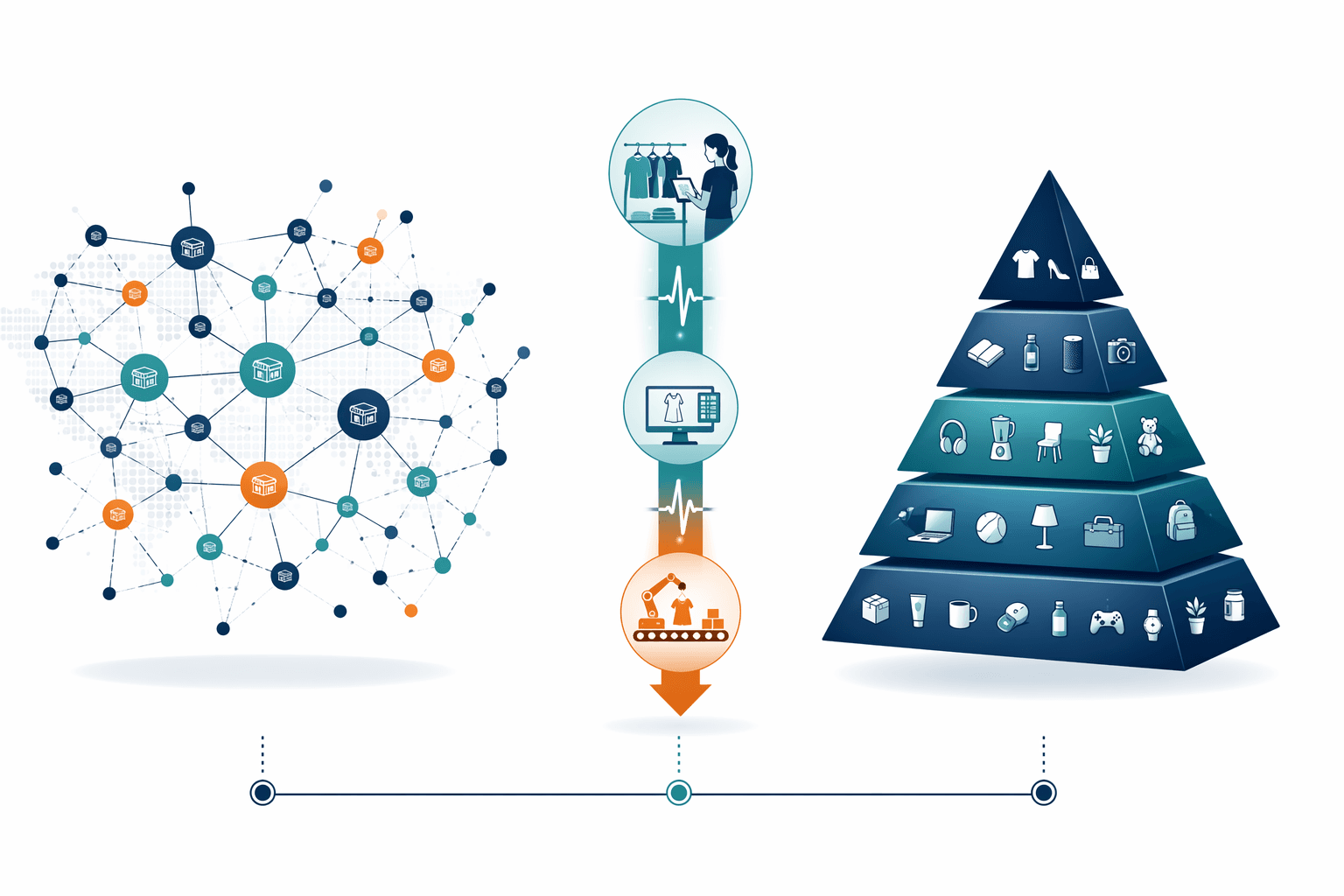
The useful question in retail supply chain predictive analytics is not which retailer has the “best AI.” Walmart, Zara, and Amazon are solving different demand problems. Walmart has to predict demand across an enormous physical footprint, where the hard part is breadth: store by store, SKU by SKU, day after day. Zara’s advantage depends on speed: detecting what is selling quickly enough to change production decisions. Amazon’s problem is catalog depth: forecasting across hundreds of millions of products and positioning inventory before demand becomes visible in an order.
That distinction matters because an architecture that looks brilliant in one operating model can become overbuilt, slow, or simply misdirected in another. A retailer trying to improve replenishment for stable consumables does not need to copy a fast-fashion sensing loop. A marketplace with a sprawling long tail cannot treat store-level replenishment logic as the whole answer. The demand pattern comes first; the model architecture follows.
| Retailer | Primary demand problem | Predictive analytics pattern | Publicly reported outcome or signal |
|---|---|---|---|
| Walmart | Breadth across store-SKU combinations | Neural forecasting tied to replenishment across stores, distribution centers, and local demand signals | Walmart reported a 16% stockout reduction and an auto-replenishment layer managing 70M+ SKUs across 7,000+ stores and 16 distribution centers [1] |
| Zara | Speed from sell-through signal to production decision | RFID-enabled real-time sensing that informs manufacturing choices | AI Expert Network reports that real-time sales data informs 85% of manufacturing decisions and supports a 1-week design-to-shelf cycle [2] |
| Amazon | Catalog depth across hundreds of millions of products | Daily updated foundational forecasting model and inventory positioning logic | AWS and Kearney reported 10% improvement in national deal-event forecasts and 20% improvement in regional forecasts [3] |
Walmart: breadth is the planning problem
Walmart’s predictive analytics architecture is easiest to misread if it is reduced to a single accuracy number. The more important fact is the operating surface area. Walmart describes an AI-powered inventory system that forecasts demand at the store-SKU level across more than 4,700 stores, using signals such as historical sales, online searches, weather, and local demographics [1]. That is not a lab forecasting problem. It is a replenishment system living inside a physical network where a weak forecast becomes an empty shelf, excess backroom stock, or avoidable distribution center churn.
The architecture is built for breadth because the same national sales trend can mean different things in different stores. Weather matters differently by region. Search behavior can move before store demand. Demographics change the baseline. The point of the model is not to produce one clean enterprise demand number; it is to generate many localized expectations that can feed replenishment decisions.
One detail in Walmart’s account is especially important: anomaly management. Walmart says its system uses patent-pending anomaly detection to identify unusual demand patterns and “forget” COVID-era distortions that would otherwise pollute future forecasts [1]. That is the kind of unglamorous feature planning teams notice. Forecast models do not fail only because they lack data; they also fail because they remember the wrong data too faithfully.
The replenishment layer shows where the forecast has to land. Walmart says its auto-replenishment system manages more than 70M SKUs across more than 7,000 stores and 16 distribution centers [1]. A forecast that cannot trigger, prioritize, or constrain replenishment actions is still a planning artifact. In Walmart’s case, the analytics architecture is connected to the operating mechanism that decides what moves through the network.
The strongest quantified outcome available from Walmart’s own technology blog is a 16% reduction in stockouts [1]. A 90% demand prediction accuracy figure is also circulated in secondary coverage, but VusionGroup attributes that claim to a LinkedIn post rather than to Walmart’s own published technology disclosure [4]. It may be directionally interesting, but it does not deserve the same evidentiary weight as Walmart’s own stockout reduction statement.
Zara: speed is the architecture
Zara’s predictive analytics story is not about forecasting the next season from a long planning cycle. It is about shortening the distance between what shoppers are doing now and what the company chooses to make next. AI Expert Network reports that real-time sales data from RFID-tagged inventory informs 85% of Zara’s product manufacturing decisions [2].
The RFID layer matters because it turns store activity into a manufacturing signal. In a slower apparel model, the planning organization absorbs sell-through data after commitments have already hardened. Zara’s system is valuable because the signal reaches the part of the business that can still change the assortment. The analytics are embedded in the loop from store demand to production choice, rather than treated as a reporting layer after the fact.
The reported cycle time explains why the architecture looks different from Walmart’s. AI Expert Network describes Zara’s design-to-shelf cycle as 1 week, compared with an industry average of 3–6 months [2]. In that environment, the forecast does not need to be a perfect long-range prediction of a fashion season. It needs to sense early demand, separate a real trend from noise, and help the business decide whether to produce, replenish, modify, or move on.
There is a reported 17% sales boost within 6 months across more than 2,000 stores, cited in a Cybit webinar and in AI Expert Network’s case study coverage [2]. That claim should be handled as a reported case-study result, not as if it were a line item verified in Inditex financial reporting. It is still useful as a directional outcome because it matches the operating logic: when production can respond quickly to real-time selling signals, analytics can affect assortment availability while demand is still active.
Amazon: catalog depth changes the forecasting burden
Amazon’s supply chain predictive analytics problem is neither Walmart’s store-SKU breadth nor Zara’s fashion-speed loop. Its burden is depth across an enormous catalog. AWS and Kearney describe a foundational AI forecasting model updated daily across hundreds of millions of products [3]. At that scale, the forecasting architecture has to handle sparse demand, fast-moving products, promotional events, regional variation, and long-tail items that do not behave like high-volume staples.
The reported improvement figures are specific enough to be useful. AWS and Kearney reported a 10% improvement in national deal-event forecasts and a 20% improvement in regional forecasts [3]. Those are not generic claims that AI makes forecasting better. They are tied to deal-event forecasting, where demand can spike sharply and where regional misreads can turn into poor inventory placement.
Amazon’s anticipatory shipping patent points to the same strategic direction: inventory can be positioned near likely demand before the customer places the order [3]. The patent is well documented, but the publicly available material does not independently measure the operational scale of deployment. It is safer to treat it as evidence of Amazon’s inventory-positioning logic than as proof of a specific network-wide operating result.
For a retailer with a deep catalog, the hard question is not only what total demand will be. It is where demand will appear, which items are worth pre-positioning, how promotional events will distort normal patterns, and how often the forecast must refresh before yesterday’s signal becomes stale. A daily updated model makes sense when the catalog itself is too broad and too dynamic for slower planning cadences.
What transfers, and what does not
The transferable lesson is architectural fit, not enterprise imitation. Walmart’s system is instructive for retailers whose planning pain sits in store-level replenishment across broad assortments. Zara’s model is instructive when the business can still change supply decisions after early demand appears. Amazon’s approach is instructive when catalog scale and regional variation make daily model refresh and inventory positioning central to service performance.
The non-transferable part is just as important. A mid-market retailer cannot assume that a 70M-SKU replenishment layer, a 1-week design-to-shelf cycle, or a foundational model across hundreds of millions of products is the right investment target. Those numbers describe the environments that justified the architectures. They do not prove that the same architecture will pay back in a smaller, slower, or less integrated operating model.
Consumer expectations add pressure, but they do not choose the architecture. UPS cites CapitalOne Shopping Research indicating that 74% of consumers expect 2-day delivery [5]. That kind of expectation explains why retailers care about better forecasting and inventory positioning. It does not tell a retailer whether the next investment should be store-SKU neural forecasting, RFID-based sensing, a catalog-scale model, or a cleaner ERP integration layer.
Consulting ROI ranges can be useful for building a business case, but they are weak substitutes for operating diagnosis. The first executive question should be more concrete: where does the current planning system lose money or service? If the answer is localized stockouts and overstock across stores, Walmart is the more relevant benchmark. If the answer is missed trend response, Zara is more relevant. If the answer is poor forecast quality across a deep and volatile catalog, Amazon is the better comparison.
A benchmark for senior leaders
A retailer evaluating AI-driven demand planning should start with the demand behavior it is trying to predict. Breadth, speed, and catalog depth create different data requirements, integration burdens, and operating decisions. They also create different failure modes. A broad replenishment model fails when local signals are too coarse or replenishment constraints are disconnected. A fast sensing loop fails when the organization cannot act before the trend decays. A catalog-depth model fails when product hierarchy, event data, or regional allocation logic cannot support the forecast.
That is where case studies should become diagnostic tools rather than aspiration decks. For a practical execution path after the benchmark, ChainSignal’s Retail Supply Chain Predictive Analytics: The 2026 Implementation Playbook is the natural next read. Teams still testing whether their source data can support forecasting should begin with a data readiness assessment for AI demand forecasting. Teams worried about whether forecasts can actually flow into planning and replenishment decisions should look at ERP integration readiness for AI demand planning.
Vendor selection belongs after that diagnosis, not before it. A retailer that has clarified its demand pattern can use ChainSignal’s AI sales forecasting software vendor landscape or compare platforms such as Kinaxis, o9, and Blue Yonder with a sharper view of what the system must actually do.
Walmart, Zara, and Amazon are not three versions of the same AI success story. They are three different answers to three different demand problems. Copying the most admired retailer is less useful than matching predictive architecture to demand behavior, data readiness, and the operating model that has to act on the forecast.
References
- Decking the aisles with data: How Walmart's AI-powered inventory system brightens the holidays — Walmart Tech Blog.
- Case Study: Zara's Comprehensive Approach to AI and Supply Chain Management — AI Expert Network.
- AWS/Kearney report — AWS and Kearney.
- Predictive Analytics for Retail Inventory Optimization — VusionGroup.
- How Retail Supply Chain Predictive Analytics is Reshaping Retail — UPS.
Comments
Join the discussion with an anonymous comment.