
Two supply chain teams can receive the same hurricane warning and live very different mornings. One is still assembling the status call: who has the supplier list, which inbound containers are exposed, whether the carrier has capacity, whether finance will approve premium moves before the port authority makes anything official. The other has already drawn the storm cone over its network, pulled the named suppliers, ports, distribution centers, open orders, shipment lanes, and carrier commitments inside that geofence, and started working through approved alternatives.
That is the useful test for AI storm-disruption planning use cases in 2026. The point is not whether the dashboard can detect that a storm is dangerous. Everyone can see the cone. The point is whether the system compresses the distance between warning and action: from a weather signal, to supply chain exposure, to a risk-ranked scenario, to a playbook someone is already authorized to execute.
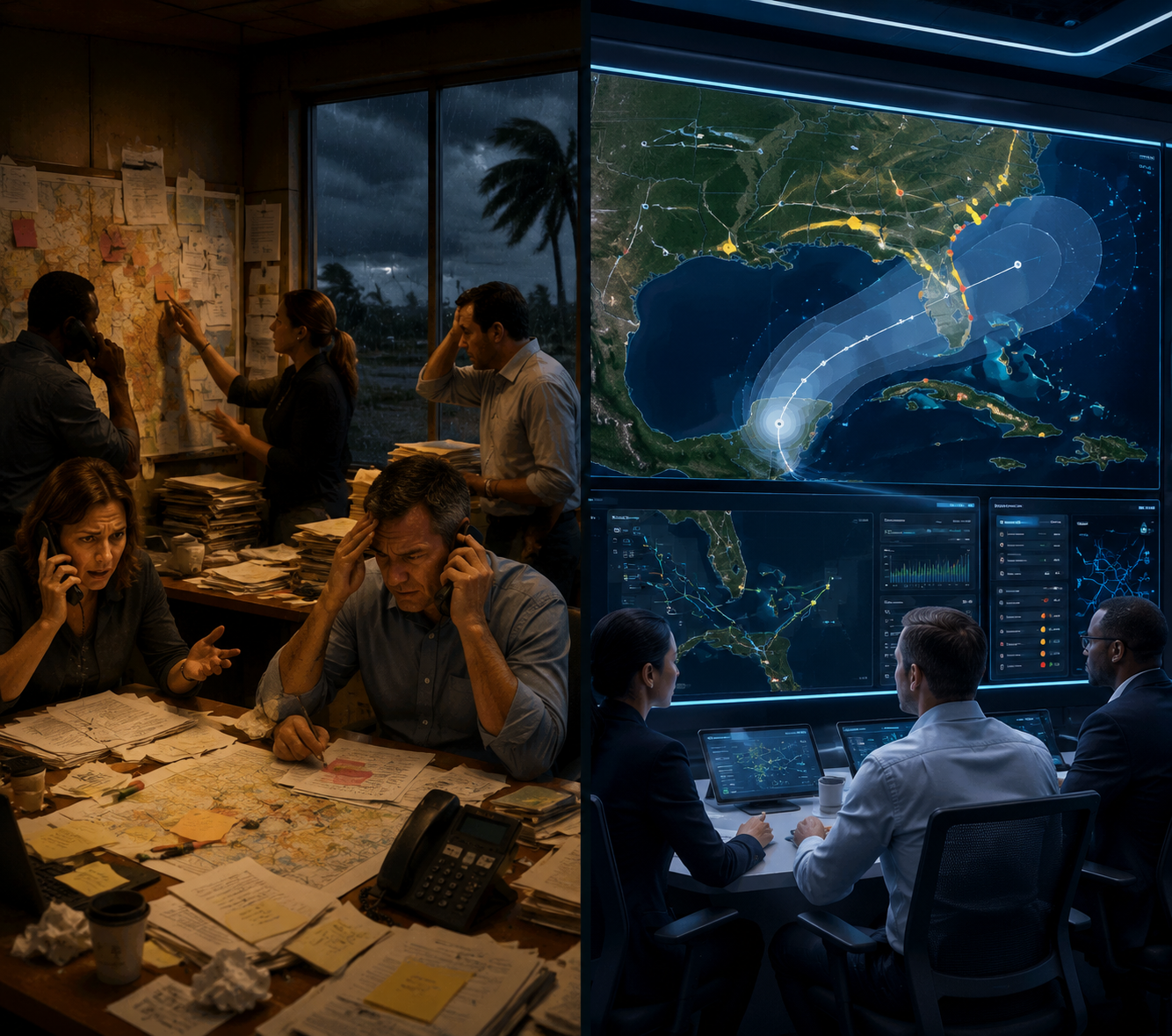
The urgency is not theoretical. Interos reported that 94.5 million businesses were at risk of extreme weather in 2025, a 48% year-over-year increase, and that financial impact exceeded $182 billion in the U.S. alone in 2024.[1] In a Dataiku and DP World survey, 78% of supply chain leaders said they expect disruptions to intensify over the next two years, while only 25% said they feel prepared.[2] Those numbers do not prove that AI fixes the gap. They do explain why storm planning that waits for certainty is already late.
The Real Workflow Starts With Exposure, Not Prediction
A storm forecast becomes operational only when it is translated into exposure. That translation is where AI-enabled scenario planning earns attention. Everstream describes scenario planning tools that geofence storm impact zones and visualize affected facilities in a single view, color-coded by incident risk severity.[3] That is a practical mechanism: draw the likely impact area, match it to the company’s actual network, and separate the sites that need action from the sites that only need monitoring.
A useful storm scenario does not stop with facilities. It should connect the geofence to supplier sites, ports, warehouses, distribution centers, in-transit shipments, open purchase orders, customer commitments, available inventory, and contracted carrier capacity. If the model can only say “Gulf Coast risk elevated,” planners still have to do the real work by hand. If it can say “these supplier locations, these inbound containers, these store replenishment orders, and these lanes are inside or adjacent to the storm impact zone,” the escalation call changes.
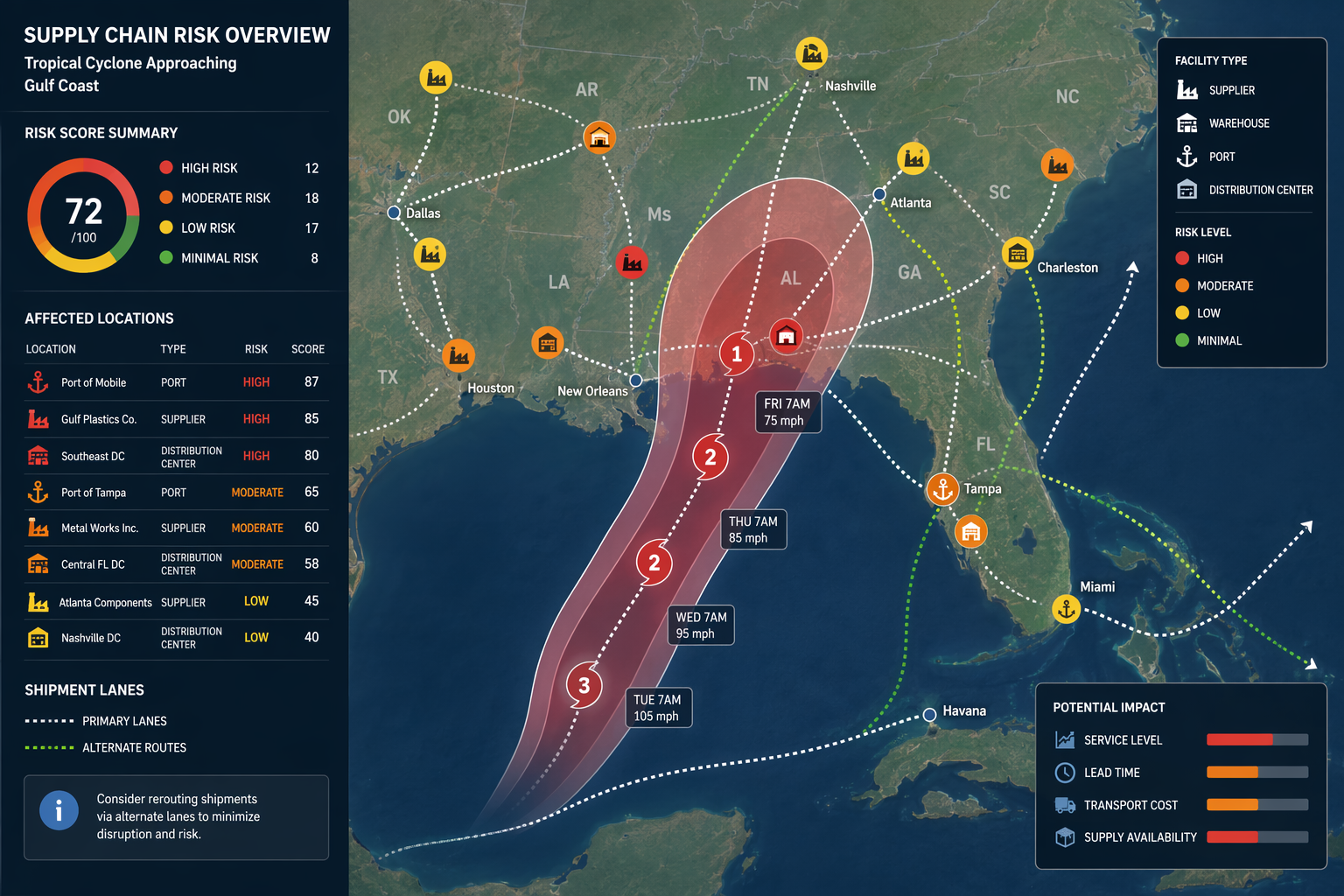
The first decision is often not dramatic. It is whether to pull forward appointments, protect capacity, stage inventory, redirect inbound freight, or wait. The value of the geofenced view is that it gives those choices a named object: a supplier, a port, a DC, a lane, an order, a customer. Without that object, “visibility” becomes another word for watching a problem mature.
What Belongs Inside a Storm Scenario
A credible pre-storm scenario is built in layers. The weather event is only the trigger. The supply chain model has to decide what the event can touch, how severe the exposure is, and which business commitments will feel it first.
| Scenario Layer | What It Adds | Operational Question It Should Answer |
|---|---|---|
| Storm geofence | Projected impact area overlaid on the network | Which locations and lanes fall inside or near the risk zone? |
| Facility and supplier master data | Named sites, ownership, criticality, and dependencies | Which exposed sites matter most to supply continuity? |
| Shipment and order visibility | Open loads, in-transit freight, customer commitments, and timing | What gets trapped, delayed, or shorted if no action is taken? |
| Inventory and capacity view | Available stock, alternate nodes, carrier options, and constraints | What can be moved, reserved, or reallocated before the market tightens? |
| Approval logic | Cost thresholds, service priorities, escalation rights, and playbook triggers | Who is allowed to act before the disruption is confirmed? |
This is where many programs expose their weak seams. Facility names are duplicated. Supplier addresses point to headquarters rather than plants. Port routings are buried in freight forwarder messages. Contracted capacity exists in one system, while shipment status lives in another. AI can correlate messy signals, but it cannot responsibly authorize a premium reroute if the underlying network map is wrong.
Risk Scoring Turns the Map Into a Queue
Once the exposed network is visible, the next task is prioritization. Everstream says its risk assessment scores cover more than 40 location-based risks and are weighted to a supply chain’s commodity and geography profile.[3] For storm planning, that matters because equal distance from the cone does not mean equal business risk.
A packaging supplier near the storm path may be replaceable for one business unit and a single-source failure point for another. A DC with three days of outbound cover may be less urgent than a port drayage lane with containers due to ground the day before landfall. A plant outside the direct storm area may still depend on inbound components moving through the affected port. A flat red-yellow-green map can miss those differences unless the scoring logic understands dependency, timing, commodity criticality, and recovery options.
The output should be a working queue, not a wall of alerts. High-priority items are the exposures where early action preserves options: shipments that can still be diverted, inventory that can still be repositioned, capacity that can still be booked, and customer commitments that can still be protected. Lower-priority items may need monitoring, supplier confirmation, or customer communication, but not the same level of immediate intervention.
A Simple Example of the Difference
Consider a hypothetical manufacturer with two exposed inbound lanes. One shipment is low-value replenishment with alternate stock already available in another region. The other contains a constrained component tied to customer orders due shortly after the storm window. A weather alert treats both as exposed. A useful scenario ranks the constrained component first, checks whether an alternate port is still viable, shows the cost of diversion, and routes the approval to the person who can authorize the exception before carrier capacity is gone.
That last clause is the operational heart of the use case. The model’s ranking is only valuable if it reaches someone with the authority, budget, and playbook to act.
Scenario Simulation Has to Show Trade-Offs Before the Storm Locks Them In
A storm scenario should let the team test options while the options still exist. If the port closes, if a carrier embargo appears, if a supplier loses power, if a lane becomes unavailable, what happens to service, cost, inventory, and capacity? The answer does not need to be perfect. It needs to be good enough to support a decision earlier than the rest of the market.
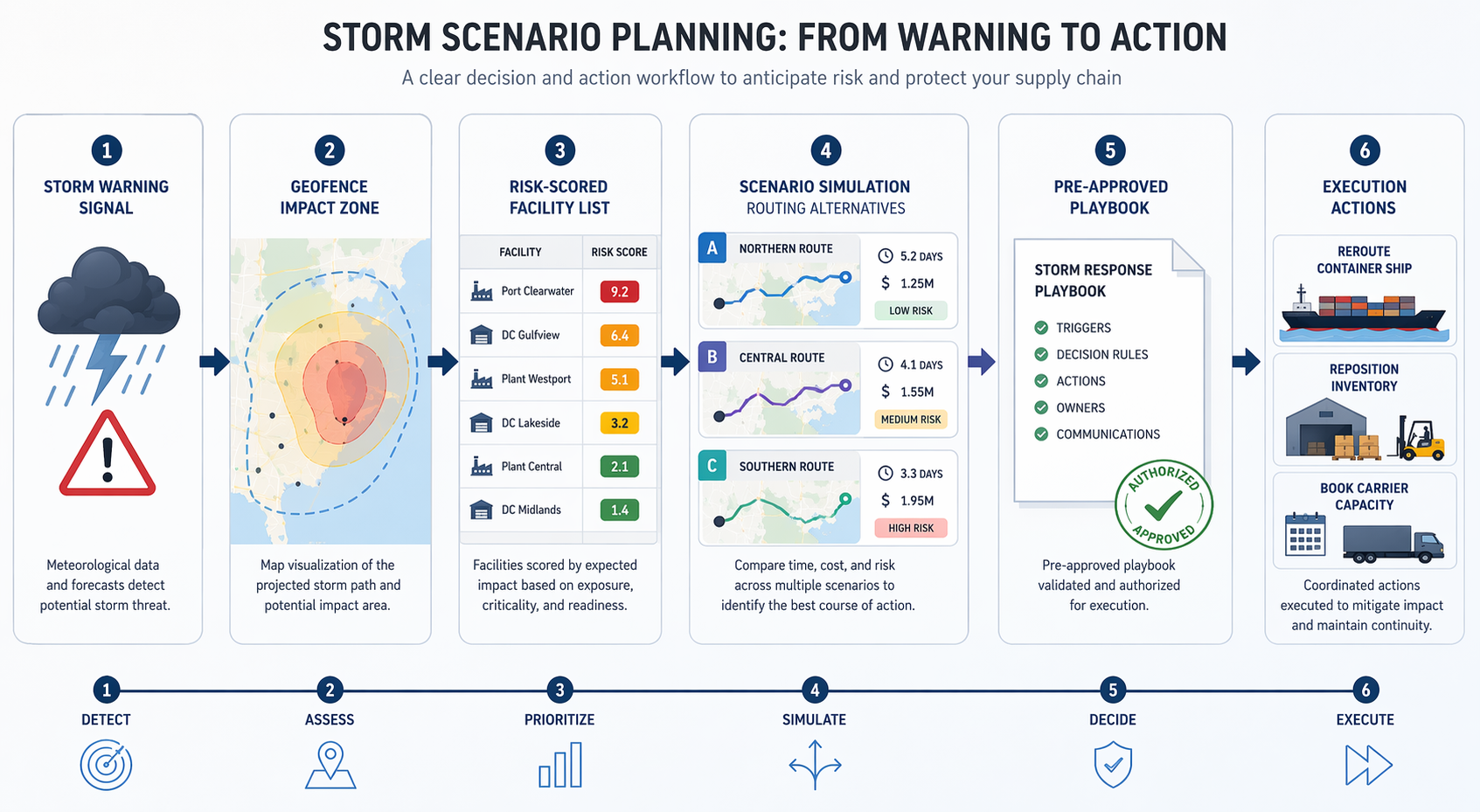
In practice, the simulation layer should compare a small number of executable choices. For example: hold the original plan and monitor; divert inbound freight through an alternate port; expedite a subset of orders; reposition inventory from a less exposed DC; pre-book spot capacity for a defined lane; or protect scarce supply for priority customers. Each option changes the pain profile. One protects service and raises cost. One saves cost and accepts late deliveries. One protects a strategic customer while forcing allocation somewhere else.
Blue Yonder’s logistics control tower material is useful here because it moves past alerting. Its Supply Chain Command Center is described as using AI and machine learning to recommend specific actions, such as expediting by air freight to save a customer order, with cost and penalty trade-offs. In the hurricane example Blue Yonder gives, teams can instantly see affected shipments and reroute them to a different port before they get trapped.[4]
That is the bridge from scenario planning to execution: not “storm risk detected,” but “here are the affected shipments, here is the alternative, here is the cost-service trade-off, and here is the decision path.” It still leaves humans in the loop. For most companies evaluating 2026–2027 storm readiness, that is a feature, not a limitation. The goal is not a self-driving supply chain making premium freight decisions in the dark. The goal is a prepared team acting from a shared, risk-ranked fact base.
The First-Mover Edge Comes From Pre-Approval
Storm response gets expensive when every exception is negotiated after the event is obvious. Everstream warns that when large disruptions hit, thousands of companies compete for the same carrier capacity and supplies at the same time, and argues that pre-approved mitigation plans create a first-mover edge.[5] That matches how capacity markets feel during a major weather event: by the time the risk is safe enough for consensus, the best alternatives may already be priced up, committed, or unavailable.
Pre-approval is not a paperwork nicety. It is what turns a scenario into an action. A planner who has to ask finance for every premium move, legal for every alternate supplier, transportation for every route deviation, and sales for every allocation choice is not really empowered by AI. They are better informed while still stuck in the same queue.
The playbook should make the hard choices before the storm clock starts. It should define which triggers open which actions, which costs can be approved locally, which customer segments receive priority protection, which suppliers require immediate confirmation, which lanes can be rerouted without executive review, and when leadership must be pulled in. The point is not to eliminate judgment. It is to reserve judgment for the exceptions that actually deserve it.
| Trigger | Pre-Approved Action | Why Timing Matters |
|---|---|---|
| High-severity score for a critical supplier site inside the storm geofence | Confirm production status, check alternate source readiness, and reserve available inventory | Waiting for outage confirmation may leave no time to protect downstream orders |
| Inbound containers projected to arrive at an exposed port during the storm window | Evaluate diversion, hold-at-origin, or alternate port routing within approved cost thresholds | Port disruption can turn a manageable diversion into trapped freight |
| Priority customer orders tied to exposed inventory or lanes | Allocate protected supply and approve premium transport up to a defined limit | Service recovery is harder once scarce capacity is already claimed |
| Regional DC at risk of downtime or outbound lane blockage | Reposition selected inventory to an alternate node before conditions deteriorate | Inventory that remains in the wrong node becomes visible but unusable |
This is also where procurement, transportation, planning, customer service, and finance need one operating model. A transportation manager may be ready to lock capacity, but if the cost threshold is unclear, the decision waits. A planning director may know which inventory should move, but if the DC transfer rule is unresolved, the transfer waits. A risk team may see the storm exposure early, but if escalation rights are vague, the organization waits for confirmation instead of using the warning.
What Execution Looks Like When the Playbook Is Real
When the playbook is real, the storm meeting is shorter and sharper. The team is not debating whether the hurricane matters. It is reviewing the ranked exposure list, confirming which triggers have fired, checking which actions are already authorized, and assigning owners for the exceptions.
- Transportation reviews exposed lanes and books or reserves capacity where the trigger and cost threshold are already approved.
- Planning checks inventory coverage by node and moves stock only where the scenario shows a service or continuity risk.
- Procurement contacts critical suppliers inside the geofence first, rather than broadcasting generic status requests.
- Customer service receives a prioritized view of orders that may need proactive communication or allocation decisions.
- Executives see the few choices that exceed pre-approved authority, with cost and service consequences attached.
Severe weather can disrupt transportation, warehousing, ports, and inventory flows, as Maersk notes in its discussion of weather-related supply chain disruption.[6] That broad point is familiar. The operational difference is whether the company can identify its specific exposure early enough to take a scarce action: secure a carrier slot, pull forward a shipment, shift a customer order, or move inventory out of the wrong node.
AI-enabled resilience research also tends to point toward faster sensing, analysis, and response. ABI Research frames AI and automation as part of building resilience against 2026 supply chain disruptions.[7] For storm scenario planning, the useful interpretation is narrower: AI can help organize the signals and recommend actions, but the organization still needs the governance to decide which recommendations become execution.
The Readiness Problems AI Will Not Hide
The fastest way to overbuy this use case is to confuse adoption with readiness. A company can license a capable platform and still fail the storm if its master data is unreliable, its suppliers are mapped to billing addresses, its logistics milestones are delayed, or its approval process requires three departments to bless a move that was obvious yesterday.
The minimum readiness bar is not exotic, but it is often unfinished. Facility master data needs location accuracy. Supplier records need to distinguish offices from plants and warehouses. Shipment data needs enough timeliness to support rerouting decisions. Inventory visibility needs to show what is available, where it is, and whether it can actually be used. Playbooks need named owners, not just functional labels. Cost thresholds need to be agreed before the storm, not discovered during the escalation.
There is also a vendor-material caveat. Everstream and Blue Yonder describe capabilities from commercial platforms, and their examples are naturally written to emphasize what the tools can do. That does not make the mechanisms unhelpful. It does mean buyers should test them against their own data and decision rights: Can the tool geofence the event against real network locations? Can it rank exposure in a way planners trust? Can it connect recommendations to cost and service trade-offs? Can it route an action to someone authorized to approve it?
A pilot that only proves the map lights up is not enough. A stronger pilot starts with a past storm or a plausible 2026 scenario, loads the actual supplier and logistics network, defines the trigger thresholds, and measures whether the team can move from warning to approved action in hours rather than days. If the answer is no, the next investment may be data cleanup or governance design before more model sophistication.
Where Storm Scenario Planning Fits
Storm scenario planning sits before and beside real-time execution. Before landfall, it helps teams simulate exposure, rank risk, and approve mitigation. During the event, weather alerts, shipment tracking, carrier updates, and control tower workflows keep adjusting the plan. Those are complementary layers. Pre-storm planning decides what the organization is ready to do; in-storm execution decides how the plan changes as facts arrive.
The same planning pattern can apply beyond hurricanes: earthquakes, infrastructure attacks, labor disruptions, and other events where location, dependency, and timing determine the response. Storms are a useful proving ground because the warning window is short, the cone is visible, and the cost of waiting is easy to feel. They expose whether a company has true readiness or only better situational awareness.
For the 2026–2027 storm season, AI-powered scenario planning can create a real first-mover advantage when it links geofenced exposure, risk scoring, simulation, and pre-approved playbooks. The advantage is conditional. It belongs to organizations whose data is clean enough for the model to identify what matters, and whose risk governance is mature enough to turn a recommendation into authorized action before the weather becomes everyone’s emergency.
References
- Protecting Your Supply Chain from Extreme Weather: Steps to Minimize Risk, Interos
- Supply chain AI trends 2026: building resilient operations, Dataiku
- Scenario Planning for Supply Chain Risk Management, Everstream Analytics
- What is a Logistics Control Tower?, Blue Yonder
- Are You Prepared for the Supply Chain Disruptions of 2026?, Everstream Analytics
- 5 ways severe weather disrupts supply chains, Maersk
- Supply Chain Disruptions 2026: How to Build Resilience with AI and Automation, ABI Research
Comments
Join the discussion with an anonymous comment.