
The first problem in an oil price shock is not the invoice from the carrier. It is the timing mismatch. Transportation is repriced quickly, resin and fertilizer exposure starts moving through procurement conversations, customer demand forecasts become less trustworthy, and finance wants to know why the margin bridge still assumes last quarter’s cost structure. For teams evaluating ai supply chain disruption planning oil price surge capabilities, the useful question is whether the planning system can connect those effects before the next cycle locks in the wrong plan.
The current shock has already supplied a hard lesson in propagation speed. The New York Fed’s Global Supply Chain Pressure Index rose 1.3 points to 1.8 standard deviations above its historical average within two months of the Strait of Hormuz closure, a move that turns a geopolitical event into a measurable supply chain strain faster than many companies can complete a formal replan.[1] McKinsey reported Brent crude at $102–119 per barrel in March 2026 and noted that supply chain disruptions lasting one month or more now occur every 3.7 years on average.[2]

That is the window planning teams have to work inside: weeks, not quarters. The old habit of waiting for enough clean historical data is comforting in a stable market and punishing in a shock. By the time the actuals are visible in ERP, the company may already have purchased the wrong materials, booked the wrong lanes, or promised service levels that now depend on a cost structure no one believes.
Why an Oil Shock Breaks More Than the Freight Budget
Oil price surges are awkward planning events because they do not stay in one column of the model. Fuel moves line-haul and ocean costs. Crude-linked feedstocks affect plastics, packaging, specialty chemicals, and industrial inputs. Energy inflation can reduce discretionary demand just as suppliers begin asking for cost relief. The plan is squeezed from both sides.
E2open’s analysis of oil shocks describes that double hit directly: higher oil prices raise supply costs while weakening consumer demand, with CPI at 3.8% and wholesale inflation at 6% in the cited environment.[3] Those figures do not mean every category behaves the same way. They do show why a forecast built from stable-period averages can fail at the same time in procurement, logistics, and demand planning.
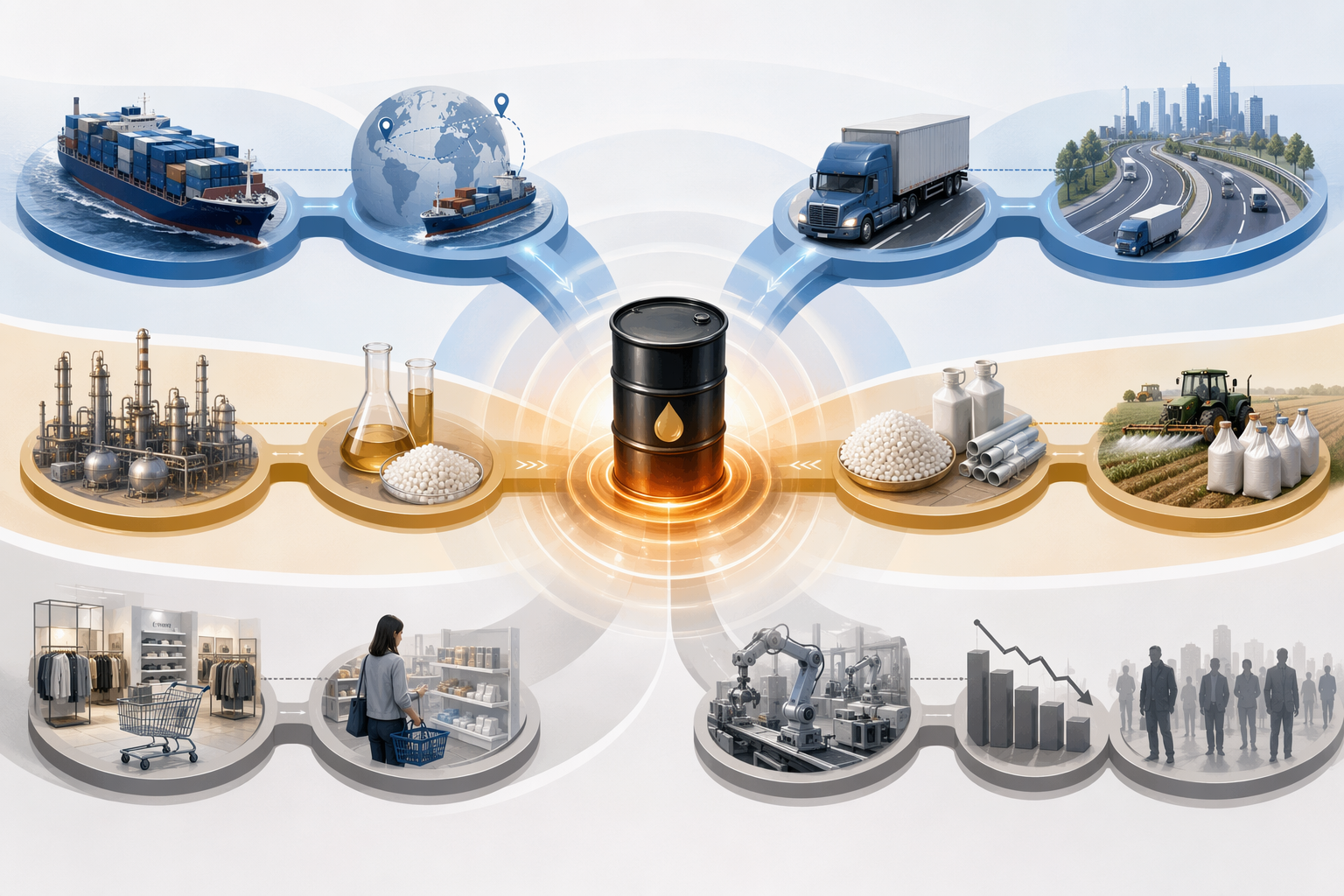
The macro context adds pressure without explaining the operating plan by itself. The WTO projected global trade growth slowing from 4.6% to 1.9%, according to reporting by The Guardian.[4] That matters because a company dealing with a fuel surcharge or a resin increase may also be selling into a slower trade environment. It does not tell a planner which supplier to qualify or which lane to reroute. It tells the planner that the cost shock is arriving in a market where buffer capacity and demand certainty are both less reliable.
Hormuz Shows the Entanglement Problem
The Strait of Hormuz is a useful current example because it is not only an oil transit story. The New York Fed noted that roughly 20% of global crude, about 25% of LNG, around one-third of helium supply, and substantial volumes of naphtha and fertilizer pass through the chokepoint.[1] That mix is what turns a lane disruption into a planning problem across transport, production inputs, and upstream tiers. A closer Hormuz-specific planning discussion belongs in AI disruption planning for Hormuz tanker crises, but the operating lesson is broader: the exposed variable is rarely just fuel.
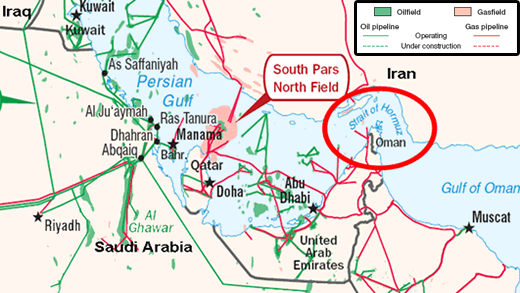
This is also where overgeneralizing becomes dangerous. The helium, naphtha, LNG, and fertilizer exposure is specific to this chokepoint and this conflict geography. A different oil price surge might propagate through refinery outages, sanctions, port congestion, insurance premiums, currency exposure, or trucking capacity. The planning capability should be event-agnostic; the scenario variables should not be copy-pasted from one crisis to the next.
What AI Scenario Planning Actually Has to Connect
A useful AI planning workflow starts before anyone asks for a heroic forecast. The first job is signal intake: market prices, chokepoint alerts, supplier risk indicators, transportation cost changes, inventory positions, open orders, customer commitments, and contract terms. The second job is mapping those signals to affected nodes: which suppliers, lanes, plants, materials, finished goods, and customer segments are exposed.
The digital twin is the working model for that mapping. In this context, it is not a glossy 3D representation of a warehouse. It is a computational version of the supply network: suppliers and sub-suppliers where known, bills of material, sourcing rules, capacity constraints, inventory buffers, logistics routes, lead times, service commitments, and cost assumptions. When the oil shock enters the model, the system can test how a cost or availability change moves through that network instead of treating it as a single surcharge line.
| Planning question | Variables the model needs to connect | Decision it can support |
|---|---|---|
| Which products are exposed first? | BOM dependencies, supplier geography, petrochemical inputs, current inventory | Prioritize allocation, expedite substitute qualification, protect constrained SKUs |
| Which lanes become uneconomic or unreliable? | Fuel cost, carrier capacity, port exposure, transit time, service commitments | Reroute shipments, shift mode, rebalance regional fulfillment |
| Which purchases should move now? | Contract terms, indexed commodities, supplier lead times, working-capital limits | Pull forward buys, delay exposed categories, renegotiate with evidence |
| Where does demand soften? | Customer segment sensitivity, price pass-through, macro indicators, order changes | Adjust forecast, reduce overbuild, protect margin on constrained supply |
The table is simple; the hard part is keeping the relationships current. Static MRP can tell a planner what the plan believed when master data was last maintained. During an oil shock, the question is what has changed since then and whether the company still has enough time to act.
From Warning Signal to Workable Options
The sequence matters. A real-time risk monitor may flag rising exposure around a chokepoint, a supplier tier, or a commodity index. The planning model then identifies affected nodes and planning variables. Scenario simulation compares options: hold more inventory near demand, shift sourcing to a secondary supplier, reroute through a different port, change mode, pre-buy a critical input, or reduce production of low-margin SKUs that absorb the most exposed materials.
The value is not that the system produces thousands of scenarios. A planning team can drown in thousands of scenarios. The value is ranking a small set of operationally credible choices by cost, service, feasibility, and risk. A reroute that protects customer service but consumes scarce carrier capacity has to be visible as a trade-off. A pre-buy that lowers commodity exposure but ties up working capital has to survive finance review. A supplier switch that looks cheaper but depends on unqualified material is not a plan yet.
That is where human planners remain central. AI can compress the search space and expose consequences. Procurement still knows which supplier has failed audits before. Logistics still knows which carrier commitments are soft. Finance still decides how much working capital can be tied up in protective inventory. Sales still understands which customers will accept a substitution or a delivery change. Scenario planning is useful when those functions argue over the same model rather than over separate spreadsheets.
Scale Is the Manual Monitoring Problem
Large enterprises do not lack people who understand disruption. They lack enough people to watch the network at the level where disruption actually enters. Interos.ai has stated that the average S&P 500 enterprise has 1,700 direct suppliers and 1.5 million buyer-supplier relationships.[5] That is vendor-published analysis, not an independent census of every company’s network, but it captures the planning-room reality: the direct supplier list is only the visible edge.
Manual monitoring tends to privilege the suppliers everyone already knows are strategic. Oil shocks do not always respect that hierarchy. A low-spend packaging resin, a fertilizer-linked agricultural input, a helium-dependent process, or a regional carrier constraint can become the variable that holds up a product family. If the system cannot connect lower-tier exposure to revenue, margin, or service impact, the alert arrives as noise.
This is one reason AI risk monitoring is more convincing when it is tied to planning data rather than presented as a news feed. A geopolitical alert by itself asks someone to interpret relevance. A mapped alert says which suppliers, SKUs, plants, and customers may be affected, then gives planners a place to test responses. Similar pattern recognition appears in other disruption categories, from air quality supply chain alerts to earthquake disruption planning and flash flood planning: the disruption differs, but the planning burden is still to identify exposed nodes quickly enough to change the configuration.
Where Legacy Averages Fail
Historical averages are not useless. They are a poor guide when relationships among variables change at the same time. A transportation model based on last year’s fuel range may understate the new cost of long-haul replenishment. A demand model trained on ordinary price changes may not capture the effect of an energy shock on household or industrial buying behavior. A procurement model may know the contracted supplier but not the supplier’s exposure to upstream naphtha, fertilizer, or LNG constraints.
The weakness is not only latency. It is structure. ERP and MRP systems are built to execute a plan and record transactions. They are less comfortable asking what happens if a chokepoint disruption pushes a commodity input higher, a supplier asks for relief, a carrier reprices a lane, and demand softens in the same region. Those are cross-functional questions, and they are usually answered by stitching together procurement files, logistics bids, inventory reports, and finance assumptions after the shock is already underway.
AI scenario planning is not inherently better because it is AI. It is better when it changes that structure: more current signals, more connected variables, faster scenario generation, and clearer assumptions for humans to challenge. If those conditions are missing, the company has only automated a weak planning process.
The Business Case, Without Pretending the ROI Is Universal
Vendor and industry figures can help frame the investment case, but they should not carry it alone. C3 AI’s guide reports that companies using AI-driven risk monitoring reduced supply disruption losses by 35% and improved decision-making efficiency by 50%.[6] Supply Chain Management Review has cited industry survey findings that companies using AI are 60% more likely to weather major disruptions.[7] Those are indicators of potential value, not a guarantee that a given manufacturer, retailer, or distributor will reproduce the same result.
A better internal business case starts with avoided decision latency. How many days pass between an oil shock signal and a revised sourcing or logistics recommendation? How many exposed SKUs can be mapped to suppliers and lanes without manual reconciliation? How quickly can procurement, logistics, finance, and demand planning compare the same scenarios? How often does the company discover the margin impact only after purchase orders, carrier bookings, or customer commitments are already fixed?
The strongest case will usually combine resilience metrics with operating discipline. The team should know which data feeds update the digital twin, which assumptions are user-adjustable, which constraints are hard, and which recommendations are merely mathematically attractive. A model that proposes a supplier shift without qualification lead time, capacity limits, contract terms, or quality risk is not ready for a board-level resilience claim.
What Good Implementation Looks Like in the Planning Cycle
In practice, the workflow should be built around decisions rather than dashboards. When a signal arrives, the system should make exposure visible: affected suppliers, materials, lanes, facilities, open orders, inventory positions, and revenue at risk. Planners then need a manageable set of scenarios, not an impressive count of possible futures. The comparison has to show service impact, cost impact, timing, feasibility, and assumption sensitivity.
- Signal: oil price, chokepoint, supplier, carrier, or commodity stress enters the monitoring layer.
- Mapping: the digital twin identifies exposed nodes, products, customers, and financial variables.
- Simulation: the planning engine tests sourcing, inventory, production, mode, and routing alternatives.
- Comparison: teams evaluate cost, service, working capital, lead time, and execution constraints.
- Decision: human planners approve changes that are operationally realistic and financially defensible.
One oil shock may justify pulling inventory forward for constrained inputs. Another may make that the wrong move because demand is weakening faster than supply is tightening. The model’s job is not to prefer inventory, rerouting, supplier shifts, or demand shaping in the abstract. It is to show which option works under the current constraints and how the answer changes when assumptions move.
The Assumptions Need to Be Visible
Opacity is expensive in a disruption. If finance cannot see the cost assumptions, procurement cannot inspect supplier constraints, or logistics cannot challenge transit-time estimates, the scenario output becomes another artifact to debate. The better implementation lets each function stress-test the model from its own angle without breaking the shared planning view.
That visibility also keeps AI from being treated as a resilience credential. A company is not more resilient because it owns a planning platform. It is more resilient if the platform shortens the time from signal to decision, connects the variables that would otherwise sit in separate systems, and leaves enough time to change sourcing, inventory, production, or logistics before the cost is locked in.
The Conditional Payoff
AI scenario planning does not prevent oil shocks. It does not make supplier qualification instant, create carrier capacity, or remove the judgment calls that planning leaders still have to defend. Its value is narrower and more useful: it gives teams a faster, more connected way to test what changes when oil, petrochemical inputs, transport costs, supplier risk, and demand start moving together.
For an oil price surge, that can be enough to change the outcome. Not because the model knows the future, but because it helps the business see the propagation path while there is still time to choose a different configuration.
References
- Will Mounting Supply Chain Strains Hamstring the AI Investment Boom? — Liberty Street Economics, New York Fed, May 2026.
- Snapshot of global oil supply and demand: March 2026 — McKinsey & Company, March 2026.
- War, Oil Shock, and the End of Predictable Supply Chains — Supply & Demand Chain Executive / E2open.
- Prolonged high oil prices could 'crimp' AI boom, WTO warns — The Guardian, March 2026.
- Global Economic Ripple Effects of War: Supply Chain Disruptions to the US Economy — interos.ai.
- AI Supply Chain Resilience and Growth: A Guide — C3 AI.
- How AI is shifting global supply chains from reactive to predictive — Supply Chain Management Review.
Comments
Join the discussion with an anonymous comment.