
The military supply chain problem that makes AI drone logistics worth tracking is not that convoys are old-fashioned. It is that, in a contested battlespace, the ordinary act of moving a box becomes visible, targetable, and dependent on systems the enemy is trying to break: roads, radios, GPS, depots, trucks, drivers, and the people assigned to protect them.
That is why Ukraine matters so much to the current debate over AI drone logistics in military supply chains. The evidence is not just a procurement claim that drones can carry supplies. It is an operating pattern under fire: units requesting materiel closer to the front, warehouses pushed outward or dispersed, drones taking on exposed last-mile movements, and autonomous navigation reducing the need for a clean operator link when electronic warfare is active.
The strongest reported performance shift comes from autonomous navigation. CSIS reported, based on Ukrainian military sources, that manually operated drones reliant on continuous operator links had mission strike success rates of 10–20%, while drones using autonomous navigation reached 70–80%. The same reporting says the required number of drones per target fell from 8–9 to 1–2.[1]
For logisticians, the second number may be the more important one. A success-rate jump is impressive; a drop from 8–9 drones to 1–2 changes consumption planning. It affects how many airframes a unit must hold forward, how many batteries and spares have to move with them, how often replacement stock must arrive, and how much production volume is needed before drone resupply becomes a repeatable method rather than a one-off emergency workaround.
Ukraine turns drone logistics into an operating pattern
The clearest Ukrainian logistics case is not framed around a single drone type. It is a delivery chain. Breaking Defense reported in December 2025 that Ukrainian troops could order supplies through tablets, send blockchain-secured orders to local warehouses, and receive drone deliveries within 24 hours; one description of the model was “no warehouses anymore.”[2]
That phrase should not be read literally as the end of storage. Ammunition, batteries, medicine, and repair parts still have to sit somewhere before they move. The operational point is that the storage and approval pattern changes. Instead of a unit waiting for a truck movement from a more fixed rear-area depot, the request can move digitally, the stock can be held closer or in more distributed nodes, and the final exposed leg can be handled by a drone.
The 24-hour cycle matters because tactical resupply is often damaged by waiting. A platoon waiting on batteries, a medic waiting on a specific item, or a repair team waiting on a small component does not necessarily need a full convoy. It needs a delivery method that is fast enough, small enough, and survivable enough to justify using it repeatedly.
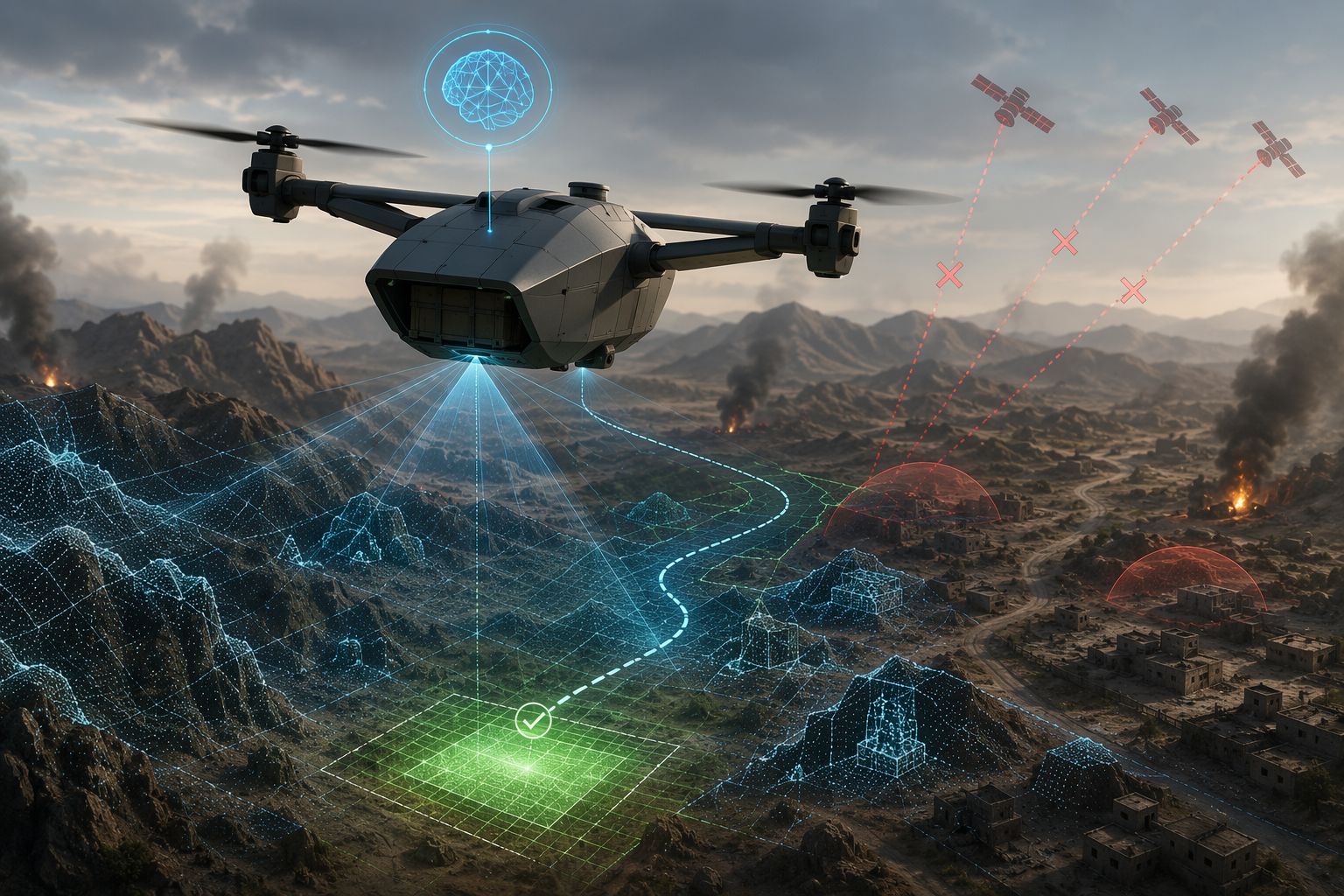
Autonomy changes that calculation under jamming. A remotely piloted drone still depends on a communications path between operator and aircraft. When that link is jammed, spoofed, or interrupted, the mission can fail even if the aircraft and payload are intact. Autonomous navigation gives the drone more ability to continue toward a target area, follow a route, or complete a terminal action when the operator cannot maintain stable control.
This does not make electronic warfare irrelevant. It shifts part of the burden from the radio link to onboard sensing, navigation software, preloaded mission data, and the drone’s ability to interpret its environment. In logistics terms, that is the difference between a delivery method that collapses whenever connectivity degrades and one that can still be planned into a contested resupply schedule.
Production volume is part of the capability
Ukraine’s drone evidence is also tied to scale. CSIS reported that Ukraine produced about 2 million drones in 2024, that 96.2% were domestically manufactured, and that roughly 10,000 were AI-enhanced units.[1]
Those figures keep the conversation grounded. A drone resupply concept does not become militarily useful because one aircraft can fly one impressive mission. It becomes useful when commanders can spend drones without exhausting the inventory, replace losses, train operators and maintainers, and keep the associated payload systems, batteries, motors, sensors, and navigation modules flowing.
Low-cost autonomy also changes the threshold for adoption. The Economist reported that The Fourth Law’s AI navigation module for FPV drones cost $50–100, could be installed on common drone configurations, and was already in serial production and frontline use; CSIS later cited the same development in its assessment of Ukrainian autonomous warfare capabilities.[3][1]
A cheap module does not solve the whole logistics problem, but it matters because contested resupply burns through equipment. If autonomy is limited to expensive, scarce platforms, it may remain a special-mission tool. If autonomy can be added to common configurations at low cost, it becomes easier to imagine repeated tactical use, including missions where the payload is more important than recovering the airframe.
What the AI is actually doing
In military drone logistics, “AI” is useful only when it removes a constraint on delivery. The important techniques are not abstract; each one unlocks a specific action that a supply unit cares about.
| Capability | What it unlocks for resupply |
|---|---|
| Autonomous navigation | Keeps a mission moving when the operator link is degraded or unavailable. |
| Computer vision | Helps identify terrain, obstacles, landing zones, and terminal approach cues. |
| GPS-denied operation | Reduces dependence on satellite navigation in jamming or spoofing environments. |
| Fleet orchestration | Coordinates multiple small aircraft so delivery capacity is not limited to one operator managing one drone. |
| BVLOS operation | Allows deliveries beyond visual line of sight, which is essential if drones are replacing part of the tactical transport network. |
Computer vision is especially relevant at the last few meters. A supply drone that reaches the general area but cannot find a safe landing or drop point still leaves someone exposed. The more the aircraft can recognize landing-zone conditions, avoid obstacles, and execute a terminal delivery without constant operator correction, the more useful it becomes to the unit waiting for the payload.
Fleet orchestration is the next practical problem. A single drone carrying a small payload can solve a narrow emergency. A logistics method requires multiple aircraft, repeatable tasking, charging or battery replacement, maintenance, airspace management, and prioritization between units. That is where drone logistics starts to resemble a supply network rather than a collection of flights.
Commercial operators provide useful engineering parallels, but they are not proof that military resupply is solved. Manna, Meituan, and Zipline have helped mature autonomy, battery management, routing, and beyond-visual-line-of-sight delivery practices in civilian settings, according to Army Technology’s coverage of autonomous delivery drones.[4] The transfer is real, but a commercial last-mile route does not face the same jamming, targeting, camouflage, or attrition assumptions as a battlefield delivery route.
For readers comparing this use case with planning-layer AI, drone resupply is a different layer of the same contested-logistics problem. Forecasting demand, optimizing routes, and assessing suppliers help decide what should move and where; autonomous drones affect whether the item can physically reach the unit. A companion discussion of those planning applications is covered in How AI Is Being Used in Military Supply Chain Logistics.
The US is trying to formalize the last-mile resupply mission
Ukraine shows the operating pressure. US programs show what a formal military requirement starts to look like once that pressure is translated into acquisition language.
The US Army’s Joint Tactical Autonomous Aerial Resupply System, or JTAARS, is aimed at autonomous aerial resupply for the tactical edge. Public descriptions and related coverage point to containerized autonomous drones, roughly 50-lb payload capacity, GPS-denied navigation, and beyond-visual-line-of-sight operation as central requirements.[4]
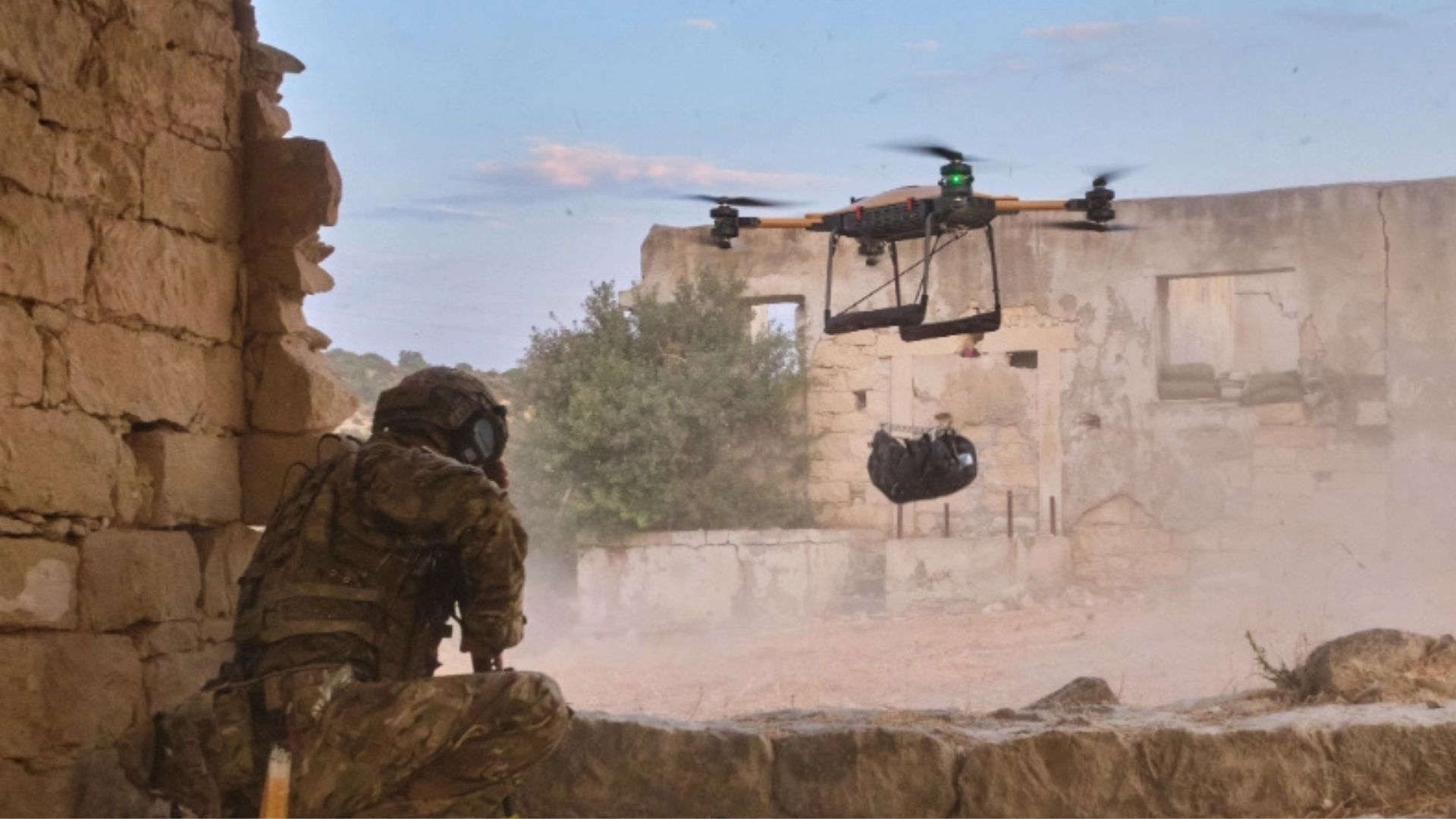
The Defense Innovation Unit’s Containerized Autonomous Drone Delivery System solicitation, issued in 2026, pushes in the same direction: package the drone resupply capability so it can be deployed as a system, not improvised as a one-aircraft demonstration.[5] Containerization sounds mundane, but it is a serious logistics requirement. It affects how equipment is transported, stored, protected, maintained, and handed from one unit to another.
The approximate 50-lb payload class is also telling. This is not a replacement for heavy theater lift. It is the weight range where small urgent items become operationally meaningful: ammunition, water, medical supplies, batteries, communications equipment, sensors, tools, or repair parts. If a drone can move those items without committing a vehicle and escort, it can remove some of the most exposed movements from the tactical supply chain.
GPS-denied navigation and BVLOS operation are not optional add-ons in that setting. A resupply drone that works only within line of sight and only under clean satellite navigation is a training-range tool. A useful contested-logistics system must keep operating when the aircraft cannot be watched directly and when the navigation environment is deliberately degraded.
Supporting programs show the same direction of travel
The UK’s Autonomous Last Mile Resupply program points to a similar requirement: move supplies across the final tactical leg without assuming that a truck route is available or worth the risk.[4] Project Convergence Capstone 5 has included autonomous ship-to-shore logistics work, extending the same question from land routes to littoral movement.[4]
The US Army’s Autonomous Transport Vehicle System adds a ground-robotics counterpart for the last tactical mile, while Skyfoundry reflects the production side of the problem. DefenseScoop reported that the Army aimed to manufacture 10,000 drones per month by 2026.[6] That target matters because resupply drones will not be judged only by technical elegance; they will be judged by availability.
The program list should not be mistaken for proof of mature deployment. JTAARS, CADDS, ALMRS, and related systems are still best understood as prototype, solicitation, or early-fielding efforts. They show institutional commitment and requirements clarity. They do not yet show that Western forces can sustain drone-based resupply at Ukraine-like tempo across multiple theaters.
China’s Himalayan case shows the use case is not only Ukrainian
Ukraine dominates the evidence base because the war has produced high-volume, high-pressure drone adaptation. But it is not the only case showing why autonomous or semi-autonomous aerial resupply appeals to militaries.
IISS reported in June 2026 that China used 10 UAVs to resupply troops in the Himalayas, replacing a mission that previously required 120 soldiers over 2–3 days.[7]
That comparison is valuable because it is not about a dense drone battlefield. It is about terrain, labor, altitude, and exposure. In mountainous logistics, the cost of moving a load is often paid in people: porters, drivers, escorts, and troops pulled into a support mission instead of their primary task. If a small UAV team can replace a large foot movement for some classes of supply, the benefit is not just speed. It is fewer people committed to a dangerous and physically expensive delivery route.
The case should still be kept narrow. It does not prove that drones can replace all high-altitude sustainment. It does show that militaries facing difficult terrain are already testing the same substitution logic: use uncrewed aircraft where the human movement requirement is disproportionate to the payload.
Market attention is rising, but budgets do not equal maturity
The market signals are large enough to explain why vendors and defense organizations are moving quickly. MarketsandMarkets estimated the military drone market at $18.2B–$34.85B for 2026 depending on scope, a wide range that reflects differing definitions rather than a settled consensus.[8] DefenseScoop also reported that the US Department of Defense FY2026 budget included billions for uncrewed systems.[9]
Those figures are useful as evidence of attention and funding. They do not prove that autonomous resupply is operationally mature. A market estimate can include surveillance drones, strike drones, maritime systems, counter-drone technology, and support equipment. A budget line can fund experimentation, procurement, software, test ranges, and industrial-base work. Neither number answers whether a brigade can depend on drone delivery for routine contested resupply.
Where AI drones can replace convoys, and where they cannot
The better question is not whether AI drones replace military convoys. It is which convoy tasks they can remove, shrink, or delay.
- They can replace some exposed last-mile deliveries when the payload is small, urgent, and dangerous to move by vehicle.
- They can augment convoy logistics by moving critical items ahead of a larger shipment or filling gaps after a route is interdicted.
- They can reduce the number of personnel exposed on repeat supply runs in difficult terrain or heavily observed areas.
- They cannot replace bulk fuel, heavy ammunition stocks, armored recovery, engineering equipment, or large-volume sustainment.
- They cannot eliminate the need for depots, maintenance, packaging, inventory control, or prioritization of scarce supplies.
This is still a meaningful shift. Many battlefield logistics failures are not caused by the inability to move tons of cargo in theory. They happen because a small item is missing at the wrong time, a unit cannot be safely reached, or the cost of sending a vehicle is too high for the payload. Drone logistics is strongest in that gap.
The Shield AI V-BAT case reported by CSIS illustrates the adjacent value of autonomy in contested environments. The aircraft flew 40 km behind Ukrainian front lines and then 95 km into contested territory to locate a Buk surface-to-air missile battery for a HIMARS strike, operating in a GPS-denied environment.[1] That was not a resupply mission, but it demonstrates why GPS-denied autonomy attracts logistics planners: the same navigation problem appears when the payload is medicine instead of a sensor package.
The constraints are material, not just doctrinal
The biggest caveat is geographic and operational concentration. The best evidence for AI-enabled drone performance in contested logistics comes from Ukraine, under wartime conditions that include compressed approval cycles, high tolerance for equipment loss, rapid field modification, and a threat environment that has forced constant adaptation. NATO peacetime acquisition, safety, airspace, and sustainment rules may slow or reshape the same model.
Electronic warfare also remains a live constraint. Autonomous navigation can reduce dependence on a control link, but it does not make a drone immune to jamming, spoofing, detection, kinetic attack, battery limits, weather, or landing-zone denial. A logistics system that assumes autonomy has solved EW will overpromise.
Hardware supply chains may be the harder scaling problem. CSIS identified structural vulnerabilities in carbon fiber, neodymium magnets, lithium and graphite refining, specialty semiconductors, and opaque tier-2 and tier-3 suppliers; it also noted that roughly 90% of neodymium magnets are Chinese.[10]
Those are not background procurement details. Carbon fiber affects airframes. Neodymium magnets affect motors. Lithium and graphite refining affect batteries. Specialty semiconductors affect sensors, control systems, and onboard compute. Opaque lower-tier suppliers make it harder to know which chokepoint will appear when demand spikes.
This is where the 8–9 drones versus 1–2 drones figure returns with practical force. Better autonomy reduces the number of drones consumed per successful mission, but a military still has to build, source, repair, and replace the drones it uses. Software performance and industrial resilience are now linked parts of the same logistics equation.
AI drones can already augment and, in some missions, replace traditional tactical resupply methods in contested environments. The evidence is strongest where the payload is small, the route is dangerous, the unit cannot wait, and the drone can operate despite degraded communications or navigation. In 2026, that makes drone-based autonomous resupply a real military logistics use case to track. It does not make it a settled replacement for convoys everywhere.
References
- Ukraine's Future Vision and Current Capabilities for Waging AI-Enabled Autonomous Warfare, CSIS, 2025.
- 'No warehouses anymore': Ukrainian troops get drone deliveries to the front, Breaking Defense, Dec. 2025.
- The drone operators who halted Russian troops headed for Kyiv, The Economist, Dec. 2024.
- Autonomous delivery drones revolutionise military logistics, Army Technology.
- Containerized Autonomous Drone Delivery System, Defense Innovation Unit, 2026.
- Army aims to manufacture 10,000 drones a month by 2026, DefenseScoop, Oct. 2025.
- Delivery by drone: the future of force sustainment, IISS, June 2026.
- Military Drone Market, MarketsandMarkets.
- Pentagon's FY2026 budget includes billions for uncrewed systems, DefenseScoop, June 2025.
- Drone Supply Chains: The Critical Role of the United States and Its Allies, CSIS, Dec. 2025.
Comments
Join the discussion with an anonymous comment.