
ServiceNow’s Q1 2026 earnings are useful evidence for its supply chain AI platform story, but only if they are handled with some restraint. The company reported about $3.12 billion in subscription revenue, up 22.5% year over year, total revenue of about $3.40 billion, remaining performance obligations of about $23.11 billion, up 31%, and current RPO of about $12.05 billion, up 28%.[1][2] Those are not decorative AI numbers attached to a workflow story; they show enterprise demand still moving through the platform.
The catch is just as important: ServiceNow does not disclose supply-chain-specific AI revenue or ACV. Its FY 2025 AI ACV achievement of $1 billion, raised FY 2026 AI ACV target of $1.5 billion, and 130%+ growth in customers with $1 million or more in Now Assist ACV are corporate AI signals, not a clean supply chain line item.[1] They can support a platform-orchestration reading. They cannot be honestly converted into “supply chain AI revenue.”
That distinction matters for procurement, manufacturing, and supply chain leaders because the real buying question is not whether ServiceNow can win a new category label. It is whether the platform can sit above ERP, SCM, QMS, finance, and commercial systems and make work move across the seams without becoming a second planning stack.

The Earnings Signal Is Platform Adoption, Not Supply Chain Proof
The stronger evidence in Q1 is not any single supply chain announcement. It is the shape of ServiceNow’s expansion. In the quarter, 17 of its top 20 deals included seven or more products, the company counted 630 customers with $5 million or more in ACV, and non-seat-based pricing represented 50% of new business.[1] Those details say more than a broad transformation claim would.
Seven-plus-product deals suggest customers are not only buying a help desk workflow and leaving the rest alone. Non-seat pricing matters because many supply chain and manufacturing workflows are not naturally priced by named users. Supplier onboarding, warranty claims, order exceptions, quality investigations, and accounts payable escalations often involve systems, events, documents, approvals, and external parties. A per-seat model can fit poorly when the value comes from reducing handoffs rather than giving every participant a new application login.
This is where ServiceNow’s AI monetization becomes relevant to supply chain without becoming supply-chain-specific proof. Now Assist growth shows enterprises are paying for AI inside workflow execution.[1] If those AI skills help summarize cases, triage requests, draft responses, route exceptions, generate next steps, or support agents inside a process, they fit the operational work that procurement and manufacturing teams actually struggle to coordinate. But the earnings data does not tell us how much of that AI ACV came from source-to-pay, quality, order operations, or manufacturing.
Investors were not entirely convinced by the broader SaaS setup. Fortune reported that ServiceNow beat across every metric but the stock still fell 14% after earnings and was down about 45% over six months amid “SaaSpocalypse” concerns.[3] That reaction is useful context, not the center of the operational analysis. A supply chain leader does not buy workflow software because a multiple expanded or compressed. They buy it because too many exceptions are trapped between systems that each believe the other one owns the next step.
Where ServiceNow Actually Fits in Supply Chain Work
The credible supply chain story starts in source-to-pay. ServiceNow has been building around Sourcing and Procurement Operations, Supplier Lifecycle Operations, and Accounts Payable Operations: areas where the problem is often less “which supplier should the optimization engine choose?” and more “why is this request waiting on legal, tax, vendor master data, or invoice exception review?”
Dropbox gives that point a procurement shape. ServiceNow-published customer material reports a 50% reduction in procurement cycle time.[1] The number should not be treated as an independent benchmark for every buyer, but the type of outcome is exactly the kind ServiceNow is built to chase: fewer stalled approvals, clearer request ownership, and less manual coordination across purchasing, finance, and business stakeholders.
Nomura Research Institute points to a related supplier-lifecycle problem. ServiceNow has cited 50% faster supplier onboarding for NRI.[1] Again, this is vendor-published evidence, not an audited industry average. Still, the workflow target is precise. Supplier onboarding commonly breaks across procurement intake, risk review, compliance documentation, master data setup, and finance validation. A platform that can orchestrate those steps may create value even when the ERP remains the system of record.
FedEx Intelligent Source-to-Pay is the more explicitly supply-chain-specific example. The co-innovation embeds logistics intelligence into procurement workflows, extending ServiceNow’s finance and supply chain process automation story beyond generic ticket routing.[4] The important word is “workflow.” FedEx is not evidence that ServiceNow has become a freight planning optimizer. It is evidence that supply chain context can be pulled into procurement decisions and exception handling inside a workflow platform.
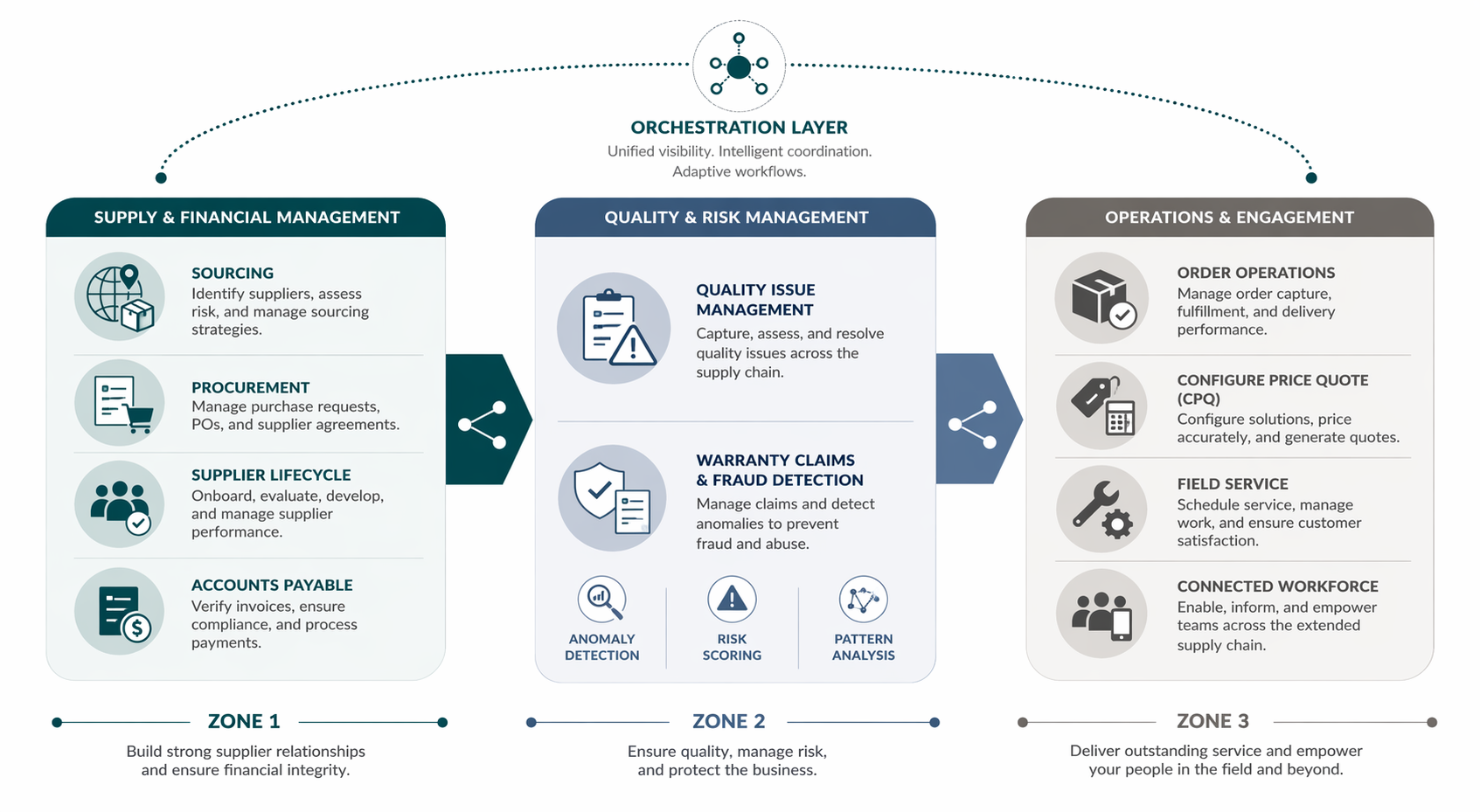
Manufacturing Broadens the Map, With a Depth Caveat
ServiceNow’s April 2026 manufacturing launch widened the supply chain conversation. The company introduced six AI-native manufacturing solutions: Quality Issue Management, Warranty Claims with AI Fraud Detection, Order Operations with Voice AI Agents, CPQ with Configuration AI Agent, Field Service Management with Parts Agent, and Industrial Connected Workforce.[5] That is a serious amount of surface area to bring to market at once.
| Workflow zone | ServiceNow role | What it should not be mistaken for |
|---|---|---|
| Source-to-pay | Orchestrates sourcing, procurement requests, supplier lifecycle, and accounts payable handoffs | A full procurement optimization or commodity forecasting engine |
| Quality and warranty | Routes issues, supports defect investigation, manages claims, and applies AI to fraud signals | A replacement for every specialist QMS or product engineering system |
| Manufacturing commercial operations | Coordinates order operations, CPQ, field service parts work, and connected workforce tasks | A production planning, inventory optimization, or network design platform |
Club Car is the cleanest example from that manufacturing push. ServiceNow said the company reduced reorder time from five days to under one day using ServiceNow CPQ.[5] That is not a grand claim about reshaping supply chain planning. It is a narrower and more useful claim about compressing a commercial operations workflow that sits close to parts, configuration, service, and customer response.
Quality 360 adds another layer to the manufacturing case. ERP Today described ServiceNow’s Quality 360 acquisition as bringing AI-powered quality management capabilities into the platform, including AI-driven defect detection cited at 90% accuracy and structured root cause methods such as 8D and 5 Whys.[6] That matters because quality work is often a handoff problem as much as an analysis problem. A defect may begin on the factory floor, move through engineering review, trigger supplier follow-up, affect warranty exposure, and require customer communication.
The caveat is not small. Quality, warranty, CPQ, field service, order operations, and connected workforce each have established point-solution incumbents. Launching across all six areas signals commitment, but it does not prove equal depth in every category. For a buyer, the evaluation should turn on the specific workflow: how many systems are involved, where the current handoffs fail, what AI is actually doing, and whether ServiceNow is coordinating work or trying to own a process that another system already handles better.
The Boundary: Orchestration Above ERP and SCM
ServiceNow’s best supply chain fit is above the systems of record. ERP holds financial and transactional authority. SCM systems manage planning and execution logic. QMS systems may hold quality records. Finance systems may own payables controls. ServiceNow is most convincing when it connects the work that cuts across those systems: requests, exceptions, approvals, investigations, escalations, claims, and service actions.
That positioning is different from competing as a core planning engine. Demand forecasting, inventory optimization, supply planning, replenishment optimization, and network design are not where the current evidence is strongest. Planning specialists such as Blue Yonder, Kinaxis, and o9 are typically evaluated for those functions. ServiceNow should not be judged by pretending it is trying to solve the same mathematical planning problem.
The practical distinction is simple. If the problem is that planners lack a statistical forecast, ServiceNow is probably not the first call. If the problem is that forecast exceptions, supplier responses, quality holds, order changes, invoice blocks, and warranty claims keep falling between systems and departments, ServiceNow belongs in the conversation.
This is also where AI should be judged carefully. AI inside ServiceNow can be valuable when it reduces the human burden of reading, classifying, summarizing, routing, and responding inside complex workflows. That is different from claiming that ServiceNow AI optimizes inventory or redesigns a supply network. The former is supported by the platform’s workflow direction and monetization signals. The latter would require evidence that the earnings release does not provide.
How a Buyer Should Read the Earnings
The Q1 numbers justify taking ServiceNow seriously as an enterprise AI workflow platform. Subscription growth, RPO expansion, larger AI ACV targets, Now Assist adoption, seven-plus-product deals, and non-seat pricing all point toward broader platform use rather than isolated departmental experimentation.[1][2] For supply chain functions, that supports a shortlist conversation, not a blank check.
- Put ServiceNow high on the list when the target process crosses procurement, legal, finance, supplier management, service, quality, or manufacturing operations.
- Ask for workflow evidence tied to cycle time, onboarding speed, exception aging, claims handling, or approval reduction, not generic AI productivity claims.
- Keep ERP, SCM, QMS, and finance ownership explicit so the workflow layer does not quietly become an overlapping system of record.
- Treat customer outcomes as useful but vendor-published unless an independent audit or your own pilot confirms comparable results.
- Do not evaluate ServiceNow as a replacement for demand planning, inventory optimization, supply planning, or network design platforms.
The most defensible reading of ServiceNow’s Q1 2026 earnings is that supply chain AI is becoming a meaningful beneficiary of the platform strategy, especially in source-to-pay, quality, warranty, order operations, CPQ, field service, and connected workforce. It is not yet a separately measurable supply chain AI business in the company’s disclosures. That is enough to justify serious evaluation where fragmented work is the problem. It is not enough to recast ServiceNow as a supply chain planning replacement.
References
- ServiceNow Reports First Quarter 2026 Financial Results, ServiceNow, 2026.
- ServiceNow Q1 FY 2026 Results Raise Full-Year Subscription Outlook, Futurum Group.
- ServiceNow earnings forecast blistering growth in AI product sales, Fortune, April 23, 2026.
- ServiceNow expands finance, supply chain process workflow automation, Constellation Research.
- ServiceNow puts AI to work across the manufacturing value chain, helping close the gap between the factory floor and front office, ServiceNow, 2026.
- ServiceNow expands AI-powered manufacturing solutions with Quality 360 acquisition, ERP Today.
Comments
Join the discussion with an anonymous comment.