
Search for “oracle supply chain control tower” and two different Oracle stories tend to collapse into one. On the Fusion side, Oracle’s strategic enterprise offer is the Supply Chain Command Center, embedded in Oracle Fusion Cloud SCM. In NetSuite, Oracle has a separate Supply Chain Control Tower for mid-market inventory visibility, order tracking, and exception management. They are not the same product, and treating them as interchangeable makes the architecture harder to judge than it needs to be.
The naming distinction matters because Oracle is not merely rebranding a visibility dashboard. Its Fusion-side argument is that a conventional control tower detects issues and escalates them, while a command center should detect, decide, and execute inside the system where supply chain work actually happens. Oracle makes that distinction explicitly in its “Control Tower vs. Command Center” positioning, and it is the right place to start evaluating the offer rather than jumping straight to agent counts or market-size charts.[1]

The Product Name Problem
Oracle’s enterprise supply chain architecture is centered on Fusion Cloud SCM. The Command Center sits inside that suite as a decision and action layer, using Fusion data, workflows, and application objects rather than operating as an external pane of glass. Oracle describes it as combining real-time visibility, AI-driven alerts, scenario evaluation, and execution capabilities across Fusion Applications.[2]
NetSuite’s Supply Chain Control Tower belongs in a different conversation. It is natively embedded in NetSuite and aimed at NetSuite customers who need inventory visibility, order tracking, and exception management within that mid-market ERP context.[3] It may answer a similar business instinct — “show me what is going wrong before the customer calls” — but it does not make the Fusion Command Center an interchangeable NetSuite feature.
That separation keeps the evaluation honest. A Fusion enterprise asking whether Oracle can reduce control-tower integration burden is asking a different question from a NetSuite customer looking for embedded supply chain visibility. A non-Oracle ERP shop looking for a neutral orchestration layer is asking a third question altogether.
What Oracle Means by Command Center
Oracle’s strongest claim is architectural: the Command Center is meant to close the loop from exception to action. The three useful verbs are detect, decide, and execute. They sound generic until you ask where the data lives and what system gets changed after a recommendation is accepted.
| Layer | What It Does | Why It Matters in Fusion |
|---|---|---|
| Detect | Surfaces real-time visibility, alerts, and AI anomaly detection | Exceptions are tied to Fusion supply chain transactions rather than only mirrored in an outside dashboard |
| Decide | Supports what-if simulation, scenario modeling, and AI-agent recommendations | Planners and operators can evaluate trade-offs against the same operational data used by the suite |
| Execute | Writes actions back into Fusion Applications, including updates to orders, creation of purchase orders, or task assignment | The system can move from “someone should fix this” to an application-level change in the system of record |
The execute layer is where Oracle’s version becomes materially different from many traditional control-tower deployments. A dashboard that flags a late inbound shipment still leaves a planner, buyer, warehouse supervisor, or customer service analyst to decide which system to open next. If the corrective action requires a purchase order, order update, task assignment, or fulfillment change, the practical value depends on whether the control tower can operate inside the application landscape or only point toward it.
Oracle says its Command Center can support autonomous write-back to Fusion Applications, including updating orders, creating purchase orders, and assigning tasks.[2] That does not remove the need for governance, approval design, master-data discipline, or role security. It does change the buying question. The comparison is no longer only “which screen has better visibility?” It becomes “which architecture can change operational objects with the least integration drag and the least ambiguity about the system of record?”
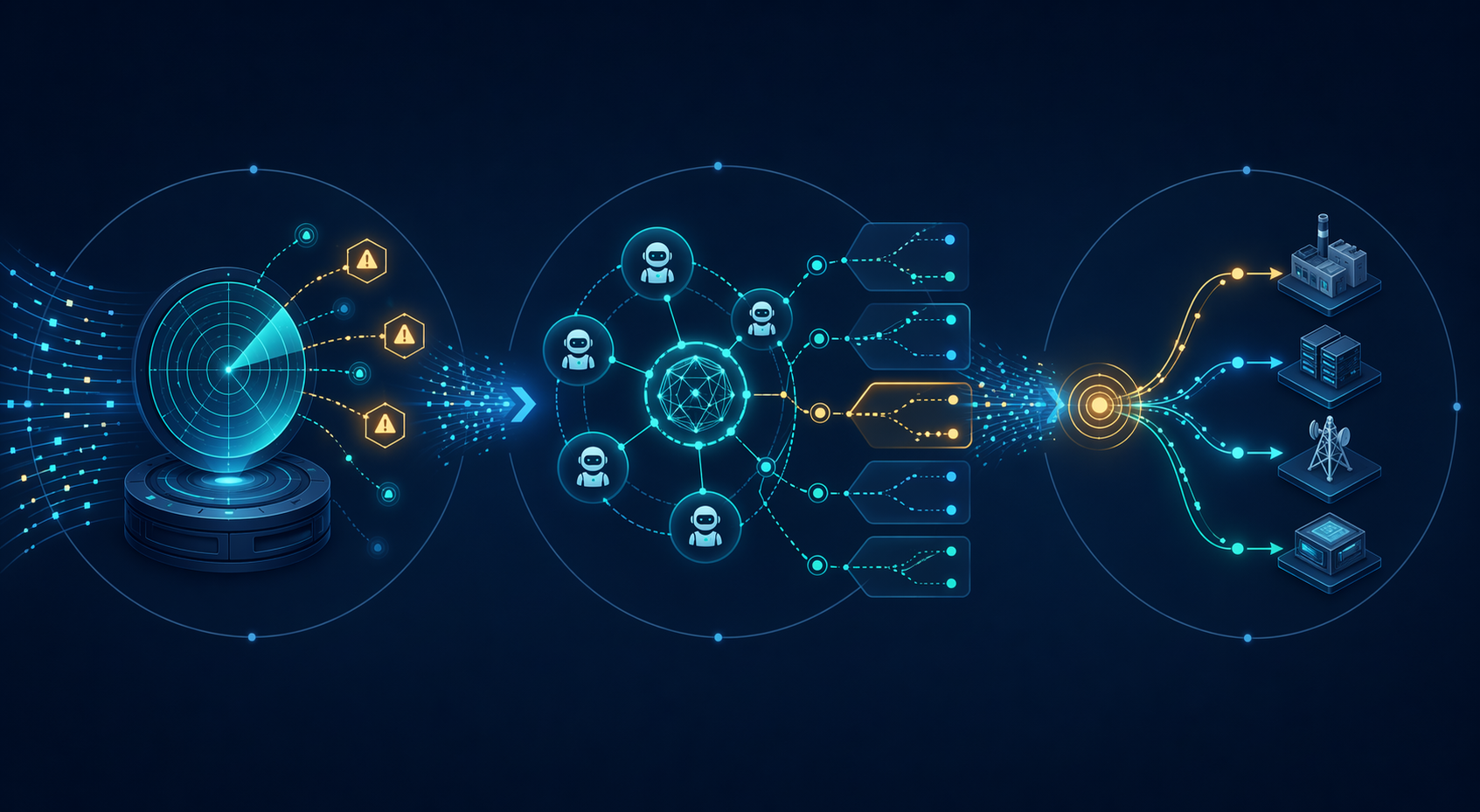
For a Fusion-heavy enterprise, that native loop is the appeal. The same thing can become a constraint elsewhere. If planning, procurement, manufacturing, logistics, and order management already run through a mixed estate, the Command Center’s cleanest value proposition may be diluted by the very integration work it was supposed to reduce.
Why Native Write-Back Changes the Evaluation
Control towers often look impressive in executive demos because exceptions are visually tidy. Late order. Supplier delay. Inventory imbalance. Transportation disruption. The harder work starts after the red indicator appears. Someone has to determine whether the exception is material, whether the recommendation is feasible, whether another function will be harmed, and which transaction needs to change.
That is where a native command-center model earns attention. If the alert, scenario comparison, recommendation, and action all sit near the Fusion process they affect, fewer handoffs are required between visibility tooling and execution tooling. The benefit is not just fewer interfaces on a diagram. It is fewer places where ownership becomes unclear: whether IT owns the integration, whether operations owns the exception, whether planning owns the simulation, and whether the transaction was actually changed in the system of record.
The practical test is simple: trace one exception until it becomes a durable operational change. If a supply risk affects a planned production run, does the system merely notify a planner, or can it help evaluate alternatives, recommend a component replacement, trigger sourcing activity, and update the relevant Fusion object under the right controls? Oracle’s Command Center is designed around that second pattern. Whether a customer implements it that way is a separate matter.
The 2026 AI-Agent Layer
Oracle’s 2026 agent announcements are not a decorative AI overlay on top of the Command Center story. They are the clearest sign of where Oracle wants supply chain work to move: from human interpretation of dashboards toward embedded agents that monitor, recommend, and in some cases help execute across Fusion workflows.
In February 2026, Oracle announced AI agents for supply chain at Oracle AI World, embedded within Fusion Cloud SCM and described as available at no extra subscription cost. The announced agents span planning, procurement, manufacturing, logistics, and order management, with examples including a Planning Cycle Agent, Component Replacement Agent, Autonomous Sourcing Agent, Inventory Tasking Agent, Wave Research Advisor Agent, and Service Parts Advisor Agent.[4] Oracle’s AI for SCM catalog provides the broader product framing for these embedded capabilities.[5]
The useful way to read that list is not as a shopping catalog. It is a map of Oracle’s direction.
- Cross-functional orchestration: agents are spread across planning, sourcing, inventory, warehousing, service parts, logistics, and order processes rather than confined to one planning workbench.
- Embedded recommendations: the agents are positioned inside Fusion Cloud SCM workflows, so the recommendation is closer to the transaction that may need to change.
- Potential autonomous execution: Oracle’s Command Center framing emphasizes the ability to create, update, or assign operational work, not only summarize a situation.
The May 2026 SCM 26B release pushed that direction further with four agentic workspaces: Design-to-Source Workspace, Warehouse Operations Workspace, Sales Order Command Center, and Sourcing Command Center. Oracle described these as built-in AI capabilities that reason across multiple modules, which is more significant than adding another exception tile to a homepage.[6]
The Sales Order Command Center is a useful example because order exceptions rarely stay inside order management. A promising AI workspace has to see availability, fulfillment constraints, sourcing implications, warehouse status, and customer commitments. The value is in the cross-functional read and the controlled write-back, not in a prettier list of delayed lines.
There is also a June 2026 proof-of-concept worth noting, but it should not be mistaken for packaged product capability. Oracle published an architecture blog showing an AI Supply Chain Tower built in under 8 hours using EBS data, OCI services, and agentic patterns.[7] That is a direction-of-travel signal for legacy Oracle estates and OCI-based experimentation. It is not evidence that every EBS customer now has the same packaged Command Center experience as a Fusion Cloud SCM customer.
Included AI Is Not the Same as Free Transformation
Oracle’s cost argument is attractive because it speaks to a real enterprise scar: best-of-breed flexibility often becomes a standing middleware, data harmonization, and release-management budget. Oracle says its Fusion SCM AI agents are included at no additional subscription cost, and its comparison page contrasts that with competitor models that may require separate AI subscriptions, data clouds, or pilot-stage capabilities.[8]
That statement should be read with its source label attached. It is Oracle’s comparison page, not an independent total-cost benchmark. “Included” can be meaningful at the software-subscription line and still leave real costs in configuration, process redesign, data readiness, security review, testing, change management, partner services, and governance. Anyone who has implemented a suite module knows the license line is not the finish line.
The same caution applies to competitive scores. Oracle’s comparison page cites Gartner Critical Capabilities for Supply Chain Planning scores in which Blue Yonder Luminate leads Oracle in E2E Enterprise Planning, 4.39 to 4.17, and Demand Planning, 4.37 to 4.22.[8] Those numbers are useful because they cut against a simplistic “Oracle beats everyone” reading. Oracle may offer a broader embedded suite-and-agent story while another vendor scores higher in specific planning capability categories.
Oracle has also been named a Leader in the 2026 Gartner Magic Quadrant for Supply Chain Planning Solutions for both Discrete and Process Industries, and it references WMS leadership recognition for the 11th consecutive year.[9] That recognition supports Oracle’s enterprise credibility, but it does not answer the fit question by itself. A Magic Quadrant position will not tell an implementation owner whether the order exception can be resolved without building another brittle interface.
Where Oracle Sits Among Control Tower Models
The control-tower market is noisy partly because the label is used for different jobs. A visibility-led tower emphasizes shipment, inventory, and event monitoring. A planning-led tower emphasizes scenario modeling and decision support. An execution-led tower emphasizes operational dispatch, workflow, and action. For a broader taxonomy, see How to Pick the Right Supply Chain Control Tower Model.
Oracle’s Command Center tries to occupy the space between planning-led and execution-led models, with visibility as an input rather than the final product. That makes it different from transportation visibility specialists such as Project44, different from planning-first platforms such as Kinaxis or Blue Yonder, and different from a pure WMS- or TMS-centered operational control room. SAP sits closer to Oracle in suite logic, though each suite carries its own data model, workflow assumptions, and AI packaging choices.
The buyer’s question is not whether a unified platform is morally superior to best-of-breed. It is whether the business value of native workflow and lower integration burden outweighs the value of modular vendor choice. For a broader enterprise comparison, see Blue Yonder vs. Manhattan Active Supply Chain vs. Oracle Fusion Cloud SCM: Enterprise Comparison, 2026.
Market sizing does not settle this. Estimates vary sharply because some firms count transportation visibility, some count planning towers, some count broader supply chain orchestration, and some blend software and services. Business Research Insights estimated the global supply chain control tower market at $8.75 billion in 2026, while Grand View Research and Future Market Insights used wider scopes that produced estimates of $13.6 billion and $17.86 billion respectively.[10][11][12] The variance says more about category fuzziness than about Oracle’s specific value.
Fit by Enterprise Situation
Strong Fit: Fusion-Native Enterprises
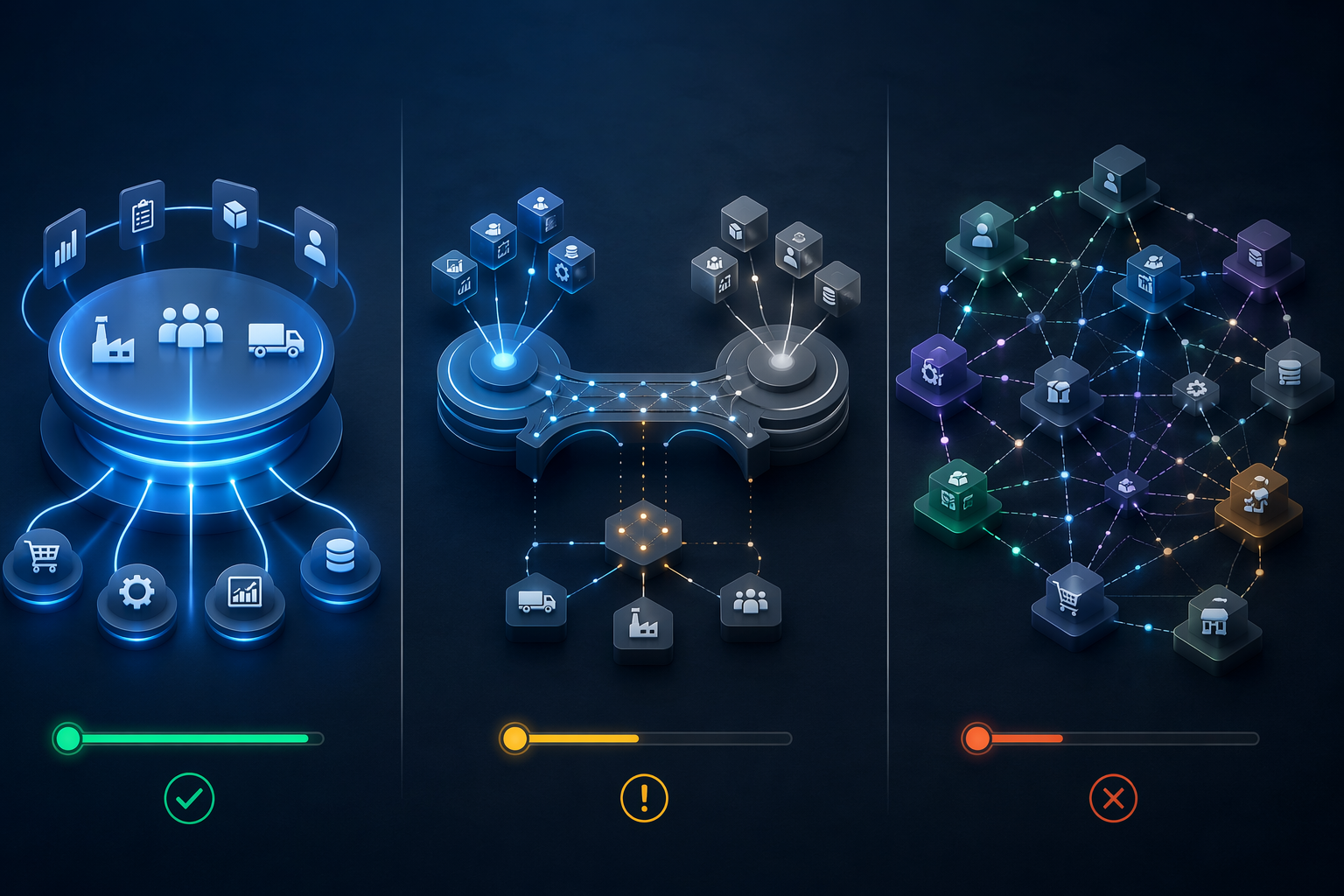
Oracle’s Command Center is most compelling when Fusion Cloud SCM already carries the operating model. In that setting, the buyer can value native data access, embedded workflow, common security, application-level write-back, and AI agents that are packaged inside the suite. The fewer systems that need to be reconciled before action, the more the command-center logic holds.
This is also where “included AI” has the cleanest meaning. A Fusion customer still has implementation work to do, but the software entitlement argument is easier than it is in a stack where each AI capability sits in a different vendor contract or data platform.
Conditional Fit: Legacy EBS or Mixed-ERP Estates
For Oracle E-Business Suite customers, the answer is more conditional. The June 2026 proof-of-concept shows that agentic supply chain patterns can be built around EBS data using OCI services, but that is not the same as buying a mature packaged Fusion Command Center experience.[7] The work shifts toward architecture: which data moves, which processes stay in EBS, which capabilities move to Fusion or OCI, and where write-back is allowed.
Mixed-ERP enterprises face a similar trade-off. Oracle can still be valuable if Fusion owns enough of the planning, procurement, manufacturing, logistics, or order-management footprint. If Fusion is only one node among several major systems of record, a neutral control tower may give the organization better cross-platform reach, even if it adds integration work.
Weak Fit: Non-Oracle ERP Shops Seeking Neutrality
For non-Oracle ERP shops, Oracle’s strongest differentiator becomes harder to monetize. If the system of record is SAP, Microsoft, Infor, or a heavily customized industry platform, the buyer may not get the same native write-back advantage that makes the Command Center interesting in Fusion. In that environment, a visibility-led or execution-led specialist may be a cleaner choice because neutrality is the requirement, not a drawback.
That does not mean Oracle lacks capability. It means the architecture is doing less of the work for the buyer. The more Oracle has to behave like an external control tower over someone else’s transaction backbone, the less differentiated the Command Center becomes.
The Decision Boundary
Oracle’s Supply Chain Command Center is genuinely different from a traditional visibility dashboard when it is evaluated on architecture rather than naming. It is embedded in Fusion Cloud SCM, designed around detect-decide-execute workflows, and increasingly tied to prebuilt AI agents and agentic workspaces that can operate closer to the transaction layer.
The boundary is just as important as the promise. The available materials do not provide verifiable customer ROI for the Command Center specifically, and much of the competitive framing comes from Oracle’s own pages. The strongest case is therefore not “Oracle proves better outcomes for everyone.” It is narrower and more useful: for enterprises already committed to Fusion Cloud SCM, Oracle may reduce the distance between visibility, decision, and action in a way standalone control towers struggle to match. Outside that ecosystem, the advantage becomes conditional, and sometimes it disappears.
References
- The future of supply chain decision-making: Control Tower vs. Command Center, Oracle Blog
- Enable your supply chain with a command center, Oracle
- NetSuite Supply Chain Control Tower, NetSuite Help Center
- Oracle AI Agents Help Supply Chain Leaders Boost Efficiency and Strengthen Resiliency, Oracle, February 10, 2026
- AI for SCM, Oracle
- Oracle Fusion Cloud SCM 26B: Advancing Autonomous Supply Chains with Built-In AI, Oracle Blog, May 2026
- From Visibility Gaps to Agentic Operations, Oracle Blog, June 2026
- Oracle vs. the competition, Oracle
- Supply Chain Management, Oracle
- Supply Chain Control Tower Market, Business Research Insights
- Supply Chain Control Tower Market Size, Share & Trends Analysis Report, Grand View Research
- Supply Chain Control Tower Market Outlook, Future Market Insights
Comments
Join the discussion with an anonymous comment.