
The hard part of AI chip supply chain planning is not finding a second logo to put beside the first one. It is deciding which dependency is actually being reduced. In Google's TPU program, the useful signal is not that Broadcom, MediaTek, Marvell, and Intel all appear around the same buyer. It is that each name is tied to a different planning problem: training capacity, inference cost, memory-processing options, and infrastructure support.
That distinction matters for anyone planning around Google's Gemini AI chip supply chain in 2026. The supply base is being shaped around workloads and bottlenecks, not around a generic desire to have more suppliers. Broadcom is reported as the long-running custom TPU partner for training chips, MediaTek as the partner for a lower-cost inference path known as Zebrafish, Marvell as a possible memory-processing addition still under negotiation, and Intel as part of the supporting infrastructure layer.[1][2]
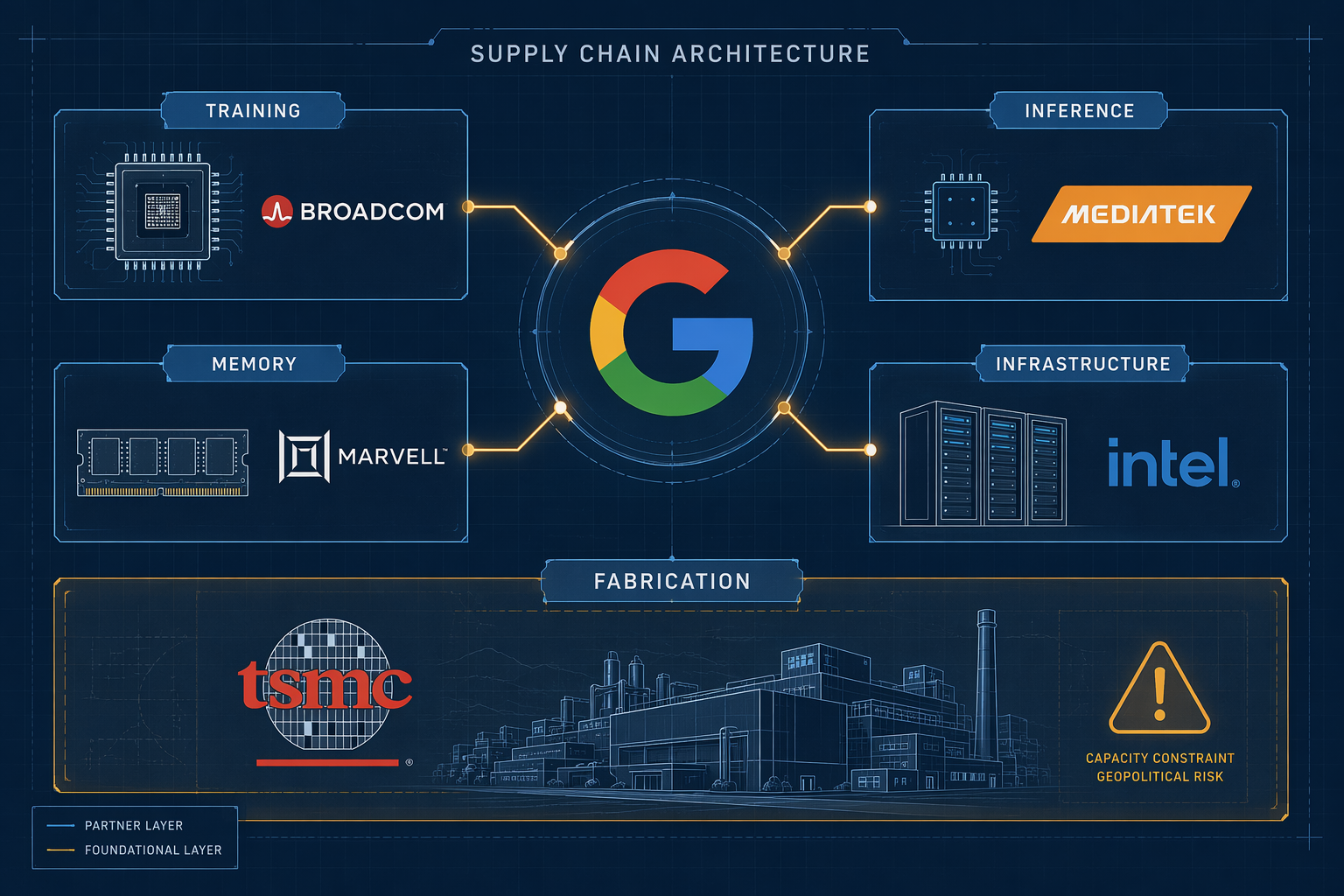
That is a more disciplined form of diversification than the version procurement teams often get sold. A dual-source plan can still leave the buyer exposed if both suppliers depend on the same scarce capacity, the same process node, the same packaging bottleneck, or the same engineering release gate. Google's model deserves attention because it separates some of those layers. It also deserves restraint, because it does not separate all of them.
The Supplier Map Only Makes Sense By Workload
Training and inference should not be treated as two purchasing descriptions for the same part. Training workloads reward large-scale throughput, high memory bandwidth, and aggressive performance targets. Inference workloads reward cost per query, power efficiency, and predictable fleet economics once a model is already deployed. If the buyer uses the same supplier logic for both, the sourcing discussion tends to collapse into a familiar trade-off: pay for the highest-performance path, then hope utilization justifies it.
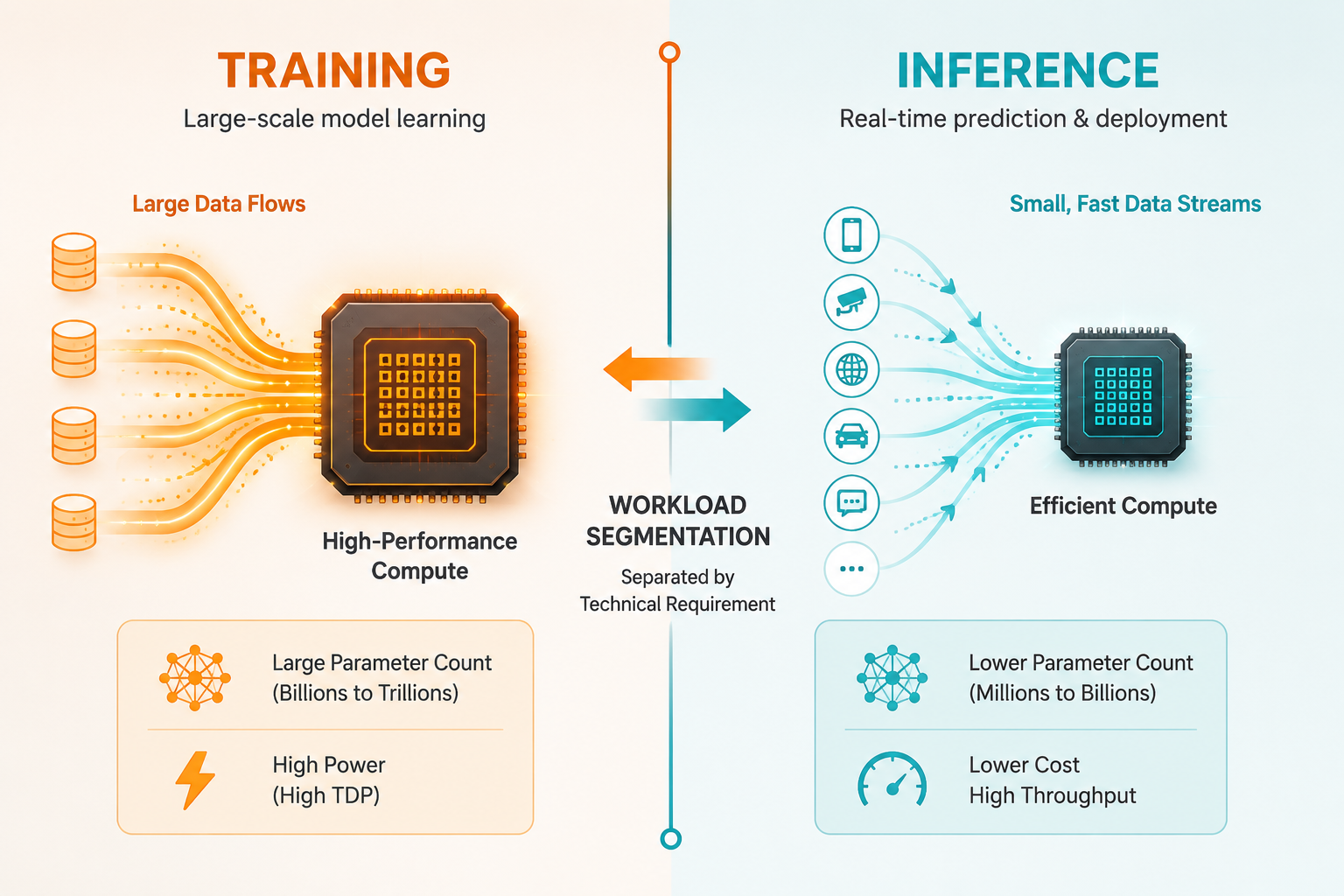
The reported MediaTek role is interesting precisely because it gives planners a cost reason to diversify, not just a resilience reason. Supply chain reports have described MediaTek's Zebrafish inference chip, built on TSMC 2nm, as targeting a cost level 20% to 30% below the training variant.[1] That figure should be handled carefully: it is not an official Google announcement, and it is not proof of delivered field economics. But as a planning signal, it changes the conversation. A second design partner is easier to defend to finance when it is attached to a different workload with a different cost curve.
Broadcom's role sits on the other side of that split. Reports describe Broadcom as locked into Google's TPU program through 2031, with a $73 billion AI backlog and more than 70% share of the custom AI accelerator market.[3] Those numbers do not make Broadcom replaceable; they explain why Google would not casually disrupt the training-chip path. When the workload is capital-intensive and performance-sensitive, continuity can be part of the risk control.
| Partner | Reported role | Planning logic | Status to treat carefully |
|---|---|---|---|
| Broadcom | Training TPU design partner | Protects continuity for high-performance training capacity and long-cycle platform planning | Reported as locked through 2031 |
| MediaTek | Inference chip path for Zebrafish | Creates a workload-specific cost benchmark for deployed AI services | Reported 20%-30% lower-cost target is based on supply chain sources, not an official Google announcement |
| Marvell | Possible memory-processing unit addition | Could address memory and data-movement pressure without treating inference and training as the only design categories | Reported as under negotiation, not confirmed |
| Intel | Infrastructure support | Keeps the accelerator strategy connected to the wider server and platform layer | Not interchangeable with the custom TPU design roles |
Marvell is the name that should be held with the most conditional language. The reported role is not another generic TPU slot; it is a possible memory-processing unit design relationship, and supply chain sources describe it as still under negotiation.[2] That makes it useful for understanding Google's direction, but weak evidence for claiming a completed four-way design handoff. A sourcing lead would not count that as secured capacity yet.
Intel's reported role belongs in a separate bucket as well. Infrastructure support does not solve the same problem as inference silicon or training silicon. Treating Intel as one more chip-design partner would overstate the symmetry of the map. In supply chain terms, the point is not that four suppliers perform the same job. The point is that the buyer has divided the system into pieces that can be planned, benchmarked, and negotiated differently.
Why Volume Makes The Model Work
Multi-sourcing costs money before it protects anything. Engineering teams must qualify more than one path. Procurement has to negotiate terms without promising identical demand to everyone. Finance sees duplicate work, higher management overhead, and possible loss of volume leverage. The model only becomes credible when the buyer has enough demand to keep specialized partners engaged without fragmenting the program into uneconomic slices.
Google appears to have that scale. Reports project Google's TPU shipments at 4.3 million units in 2026, rising to more than 35 million units by 2028. Anthropic has committed to up to 1 million TPUs, adding external demand visibility beyond Google's own internal workloads.[3] These are not small qualification runs. They are the kind of volumes that can justify parallel engineering tracks and still give each supplier a defined business case.
Alphabet's capital spending reinforces the timing pressure. Data Gravity, citing CNBC, reported Alphabet capex of $91.4 billion in 2025 and a planned $175 billion to $185 billion for 2026, alongside an $80 billion equity raise described as its first since 2004.[2] Capex at that level does not automatically prove a chip strategy is right. It does show why allocation certainty, supplier roadmaps, and milestone discipline become board-level issues rather than commodity purchasing details.
The broader server market is moving in the same direction. TrendForce and DigiTimes Research figures cited by FPX AI forecast ASIC server shipments growing 64.2% in 2026, compared with 43.8% growth for GPU servers.[3] That is not evidence that custom chips defeat GPUs in every use case. It is evidence that enough buyers are putting custom silicon into real infrastructure plans for the supply base to respond.
Competition Happens At The Design Layer
The cleanest procurement move in Google's reported structure is that competition is being introduced where it can be measured without multiplying every manufacturing variable. Broadcom and MediaTek can be compared against workload-specific milestones: training performance and platform continuity on one side, inference cost and efficiency on the other. Marvell, if the relationship matures, would be judged against memory-processing needs rather than forced into an inference-chip scorecard.
That is different from telling four suppliers to bid the same component. A same-spec bid can produce a lower unit price while hiding qualification risk, tooling differences, software porting work, and schedule exposure. A segmented bid gives each supplier a problem that matches its likely contribution. It also gives the buyer a sharper escalation tool: missed milestones can be discussed against a defined workload promise, not against vague claims of strategic partnership.
The contract structure matters because suppliers respond to committed horizons. Broadcom's reported lock through 2031 gives the training path a planning runway.[3] MediaTek's reported inference target gives Google a cost benchmark that can put pressure on the incumbent economics of custom accelerators.[1] A Marvell negotiation, even before confirmation, can still create signal in the memory-processing layer if other suppliers believe the buyer is serious about separating that bottleneck.[2]
This is where the usual "Nvidia challenger" framing is too blunt. Google is not merely trying to buy or build a rival chip. It is designing leverage inside its own demand profile. If inference can be routed to a lower-cost architecture, training capacity can be planned around a different performance and supply curve. If memory movement becomes a separate design problem, it does not have to wait behind the same negotiation used for compute. That is supply architecture, not just chip competition.
The TSMC Layer Is Still The Brake
The most important limit is also the easiest one to understate: the design partners may diversify, but fabrication remains concentrated. Reports on Google's TPU supply chain describe the partner map as still relying on TSMC fabrication.[1][2] That means the buyer can reduce dependence on one design partner without eliminating dependence on the advanced manufacturing and packaging ecosystem underneath the program.
Forbes has described TSMC as holding more than 90% of advanced fabrication, and the same supply chain context notes severe pressure around advanced packaging capacity, including CoWoS.[4] The implication is straightforward: if the bottleneck sits in wafer starts, advanced nodes, or packaging allocation, four design partners do not create four independent supply paths. They may create better bargaining power and better workload fit, but they still converge on a shared constraint.
That does not make the strategy cosmetic. A buyer can gain real value by avoiding single-partner design dependence even while accepting foundry concentration. But those are different risks, and they should be reported separately. A planner who merges them into one resilience score will overstate the protection.
The Gemini Inference Question Is Still Moving
There is also a live tension in the inference story. Reuters reported on July 20, 2026, citing The Information, that Google plans a new chip to run Gemini models more efficiently.[5] That report should not be turned into a dramatic reversal. It may point to more in-house control over inference design, or it may coexist with external design partnerships as Google refines which workloads deserve internal ownership.
For procurement planning, the question is not whether Google will always keep the same supplier lineup. The question is whether the operating logic persists: separate workloads, attach suppliers to defined technical and economic targets, and keep enough competitive tension to prevent any single design path from becoming unchallengeable. A reported in-house Gemini inference chip could tighten that logic rather than abandon it, depending on how Google allocates work between internal teams and external partners.
What Planners Can Actually Take From It
The transferable lesson is not to copy Google's supplier list. Most buyers do not have Google's volume, capex appetite, engineering depth, or leverage with advanced semiconductor partners. A smaller buyer trying to imitate the surface pattern could easily end up with higher complexity and no meaningful risk reduction.
The transferable lesson is the order of analysis. Start by separating the demand into workloads or use cases that genuinely behave differently. Then decide whether those differences justify separate supplier benchmarks. Only after that should procurement ask whether a second source reduces a real dependency or merely adds another commercial relationship on top of the same technical bottleneck.
- Separate training, inference, memory, infrastructure, and fabrication as different dependency layers before counting suppliers.
- Attach each supplier to a measurable workload outcome, such as cost per inference path, training performance, or memory-processing capability.
- Use multi-year commitments only where demand visibility is strong enough to justify parallel engineering and qualification work.
- Create milestone-based competition at the design layer without assuming it solves foundry or packaging concentration.
- Treat unconfirmed supplier roles and reported cost targets as planning signals, not secured outcomes.
Google's TPU strategy is a strong template for reducing single-supplier risk at the design and component-planning layer. It is not a complete resilience solution. The model works because workloads are segmented, contracts appear to stretch across meaningful planning horizons, and suppliers can be benchmarked against different jobs. The remaining vulnerability is just as important: when those paths still run through the same fabrication and packaging base, diversification has stopped one layer short.
That is the planner's lesson. Do not claim diversification until the dependency layers have been separated.
References
- Google assembles four-partner chip supply chain with Broadcom, MediaTek, Marvell to challenge Nvidia in inference - TNW
- Google's TPU Supply Chain - Data Gravity
- Google's TPU Supply Chain Playbook: The Underestimated Threat to Nvidia's AI Dominance - FPX AI
- Why Google's Custom AI Chip Strategy Can't Dethrone Nvidia - Forbes
- Google plans new chip to run Gemini models more efficiently - Reuters - July 20, 2026
Comments
Join the discussion with an anonymous comment.