
The awkward part of AI infrastructure planning in 2026 is that a purchase order can be ready before the project it depends on is politically real. A company may reserve compute, a developer may talk about megawatts, and an electrical equipment supplier may be asked to hold production space. But if the site still has to clear a zoning hearing, a utility interconnection review, a water-use fight, or a state large-load proceeding, that capacity is not yet capacity in the supply chain sense. It is an exposure with a date attached.
That is why data center moratoriums are not just a policy story. More than 100 local communities have enacted data center moratoriums, and Data Center Watch figures cited by Data Center Knowledge identified 36 projects delayed or blocked between May 2024 and June 2025, disrupting about $162 billion in investment.[1] The date range matters. It is not a live census of every project as of Q3 2026. But it is enough to show that regulatory delay has moved from anecdote to planning variable.
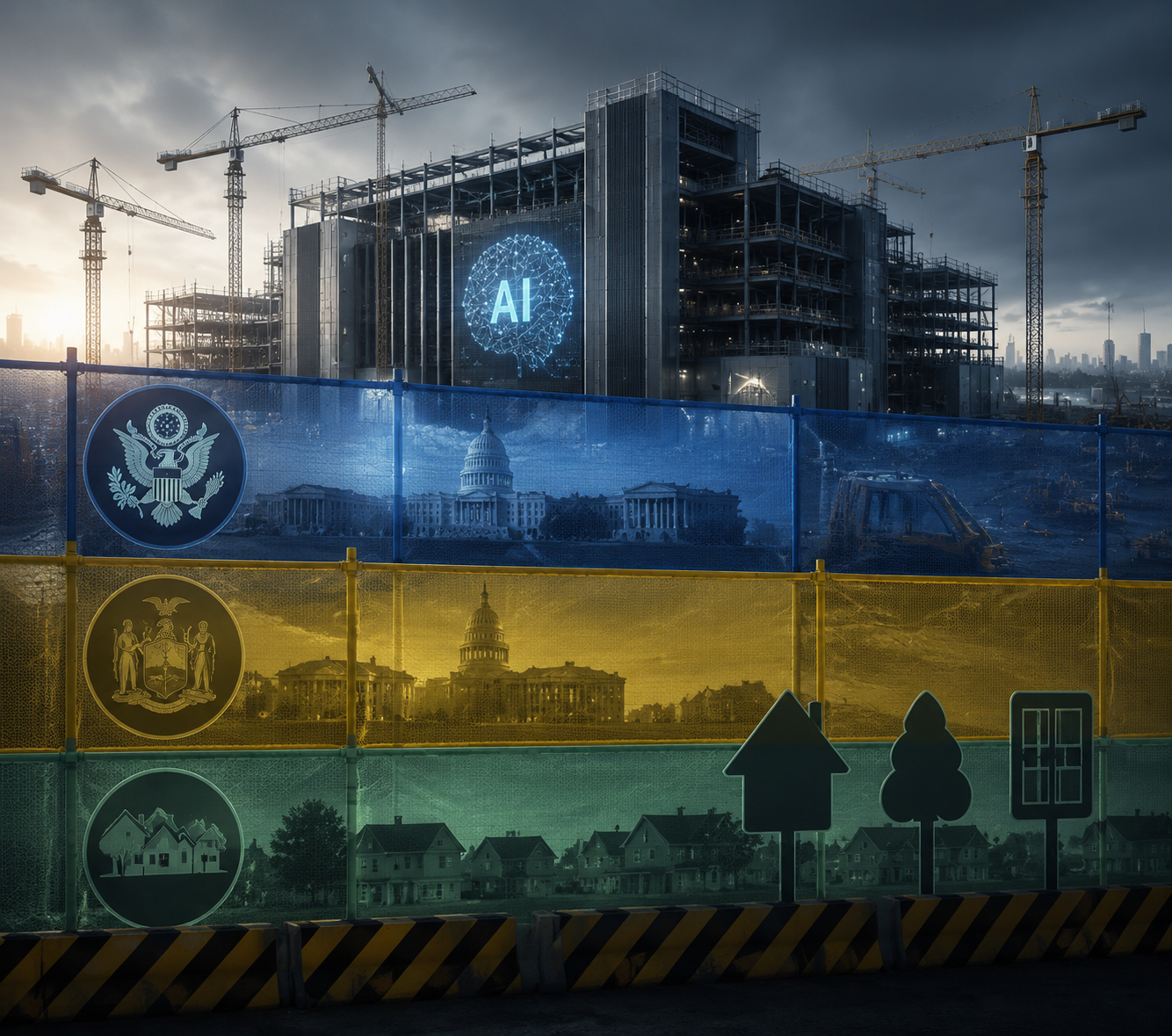
The supply chain problem is not that every proposed data center will be stopped. It is that procurement teams now have to make decisions under overlapping jurisdictions that can move in different directions at the same time. A federal agency may be trying to accelerate AI infrastructure. A state legislature may be debating who pays for new grid capacity. A county board may be freezing approvals while it rewrites zoning rules. A utility may be unwilling to commit to an interconnection schedule until load, ratepayer, and transmission questions are clearer.
The Moratorium Risk Is Layered, Not Singular
At the federal level, the Artificial Intelligence Data Center Moratorium Act, introduced by Senator Bernie Sanders and Representative Alexandria Ocasio-Cortez on March 25, 2026, would halt construction of data centers with power demand of 20 megawatts or more until federal safeguards are passed.[2] As of July 2026, it is proposed legislation, not enacted law. For procurement planning, that distinction is essential. A proposed federal moratorium does not by itself stop a transformer order or cancel a lease. It does, however, send a signal that large-load data centers are no longer being treated as ordinary real estate projects.
State action is closer to the operating surface. MultiState reported that 27 states are considering large-load energy cost legislation, while California, Ohio, and Utah have already enacted laws. Maine, according to the same analysis, was poised to become the first state with a statewide construction moratorium, pausing construction until November 2027.[3] These measures do not all do the same thing. Some are about cost allocation. Some are about construction timing. Some are about utility obligations. But for a buyer trying to forecast when compute capacity becomes usable, the common feature is that the approval path has more gates than it did when many projects were first announced.
Local pauses are often the most immediate. A municipal moratorium may not make national headlines, but it can freeze the next step in a development sequence: rezoning, site plan approval, building permits, water agreements, road improvements, or noise mitigation. When more than 100 communities have used that tool, it becomes difficult to treat local land-use risk as a one-off problem for developers rather than a structural input into infrastructure availability.[1]
| Regulatory Layer | Planning Consequence |
|---|---|
| Proposed federal moratorium | Risk signal for large-load projects; not an enacted constraint as of July 2026 |
| State large-load laws and bills | Uncertainty over utility cost allocation, construction timing, and interconnection economics |
| Local construction pauses | Near-term friction in zoning, permitting, site approvals, and community negotiation |
| Tax incentive reversals | Site economics volatility after a location has already entered the shortlist |
Tax policy adds another moving part. Thirty-eight states offer data center tax incentives, while 28 are considering ending or curtailing them, according to Politico reporting cited by Troutman Pepper Locke.[2] That does not create the same kind of hard stop as a moratorium. It changes the economics of a site after developers, utilities, and anchor customers may already have invested months in evaluation. For procurement teams, that can alter which campuses are prioritized, deferred, resized, or quietly dropped from capacity assumptions.
Where Policy Becomes Lead Time
The cascade is straightforward enough to model, but easy to understate. Permitting uncertainty stretches the date at which a project can credibly lock its power path. Interconnection uncertainty then stretches the date at which the project can commit to major electrical equipment with confidence. Those stretched equipment windows change supplier negotiations, because suppliers do not allocate scarce manufacturing slots around a project that may not reach notice-to-proceed on schedule.
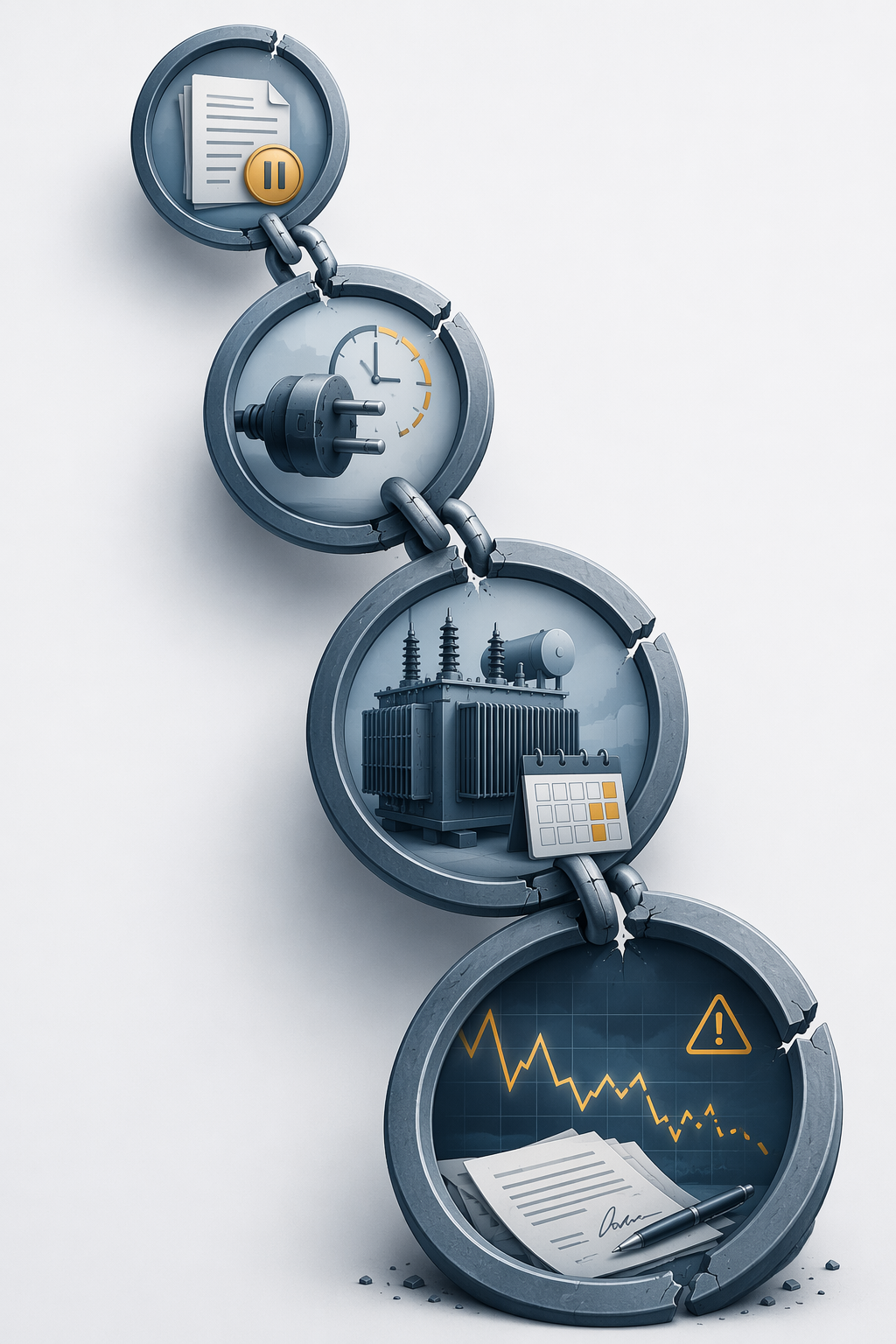
This should not be overstated into a claim that a particular moratorium caused a particular equipment shortage. The public materials support a narrower but still important conclusion: regulatory fragmentation and infrastructure bottlenecks now interact inside the same planning calendar. A data center delayed by zoning or utility review does not simply wait in isolation. Its equipment reservations, engineering work, contractor sequencing, and customer capacity commitments all have to be adjusted or hedged.
That distinction matters because announced capacity has become a poor substitute for buildable capacity. Sightline Climate data cited by Bloomberg and Tom's Hardware found that only one-third of the 12 gigawatts of data center capacity expected online in 2026 was under active construction.[4] For an AI-dependent company, the practical question is not how much capacity appears in a market forecast. It is how much has cleared enough land, power, equipment, and construction risk to be treated as available within the procurement window.
The weakest planning assumption is that equipment procurement can begin once a developer announces a campus. In reality, the high-value commitments sit downstream of several unstable dates: utility studies, transmission upgrades, substation schedules, environmental review, local approvals, and political tolerance for new load. If one of those dates moves, the buyer may still need compute, the developer may still want the project, and the supplier may still have demand from other customers. The constraint does not disappear. It is reallocated.
Supplier Contracting Gets More Volatile When the Site Is Not Settled
A procurement team does not need to own the data center to inherit the volatility. If its AI roadmap depends on a cloud region, colocation expansion, or private capacity reservation, the upstream developer's uncertainty can become the buyer's uncertainty. Contract language may promise service availability or future capacity, but the physical chain still has to pass through steel, switchgear, transformers, generators, cooling systems, utility work, and labor scheduling.
When permitting confidence is low, suppliers face a familiar problem: whether to hold capacity for a project whose start date may slip. A supplier can price that uncertainty into terms, require stronger cancellation protections, favor customers with clearer notices to proceed, or redirect production slots to projects with cleaner regulatory paths. The result is not always a visible shortage. Sometimes it appears as narrower validity windows, tougher escalation clauses, higher deposits, or a refusal to treat an announced megawatt target as bankable demand.
For site-selection teams, the same uncertainty changes the meaning of a low-cost location. A site with strong tax incentives but unresolved local opposition may be less useful than a more expensive site with a clearer utility and zoning path. A state that is reviewing large-load cost allocation may still be attractive, but its economics need to be modeled as provisional. A county that pauses approvals for six months may be manageable for a long-dated project and unacceptable for capacity meant to support a near-term AI deployment.
Community Pressure Is a Supply Input, Too
The political pressure behind these pauses is not abstract. Rabobank, citing Ceres, pointed to regions where sentiment was negative by a 6:1 ratio and noted projected water consumption growth from 385 million gallons a year to 3.7 billion gallons a year, an 870% increase.[5] Those figures do not prove that every community will oppose data center construction, or that water will be the binding constraint in every market. They do explain why local officials are unlikely to treat large-load campuses as routine industrial development.
Power and water concerns also travel differently through the approval process. Power constraints can appear in utility interconnection queues, transmission upgrade requirements, ratepayer proceedings, and state legislation over cost shifting. Water concerns may surface in local hearings, environmental review, cooling design, and drought-risk evaluation. Noise, land use, backup generation, and tax treatment add still more points of review. The supply chain consequence is a wider spread of possible completion dates, not merely a higher probability of rejection.
That spread is what procurement models often handle poorly. A binary site status — approved or not approved, contracted or not contracted, announced or not announced — misses the operating risk in the middle. A project can be commercially attractive and still too unstable to support firm component assumptions. It can have political support at the state level and still face a local pause. It can benefit from federal streamlining and still wait on utility authority that federal action does not preempt.
Federal Support Does Not Remove State and Local Friction
The federal picture is not uniformly restrictive. Trump executive orders seek to streamline federal permitting and support AI infrastructure, including efforts around AI data center leasing on federal lands, but Troutman Pepper Locke notes that those actions do not preempt state zoning or utility authority.[2] That is the planning tension in one sentence: federal pro-build signals may improve parts of the path while leaving other gates firmly in state or local hands.
The Ratepayer Protection Pledge sits in a similar category. It can add transparency, but the pledge is voluntary and unenforceable.[2] Transparency helps a buyer understand risk; it does not bind a utility commission, compel a locality to issue a permit, or guarantee that a developer's interconnection timeline survives a contested proceeding. It is useful information, not a substitute for an enforceable schedule.
This is why the current environment is harder to plan around than a simple national yes or no. A procurement leader can monitor the federal moratorium bill and still miss the county moratorium that affects a specific campus. A site-selection team can track state incentives and still misprice a utility cost-allocation bill. A cloud buyer can see headline capacity growth and still face delays because the underlying project has not moved from expected capacity to active construction.
What Changes in the Planning Model
The first change is in lead-time forecasting. Regulatory milestones now belong beside equipment lead times, not in a separate legal appendix. A transformer delivery date is only as useful as the interconnection and construction sequence that can receive it. A generator package or cooling system ordered against a slipping permit path can become stranded inventory, a renegotiation trigger, or a reason to reshuffle scarce supplier capacity.
The second change is in component availability assumptions. Suppliers serving data center projects are not just responding to total demand; they are responding to demand quality. Projects with clearer permits, stronger utility commitments, and firmer construction schedules are easier to serve. Projects exposed to moratorium risk may still proceed, but they carry timing uncertainty that can make suppliers cautious about allocating scarce slots without stronger commercial protection.
The third change is in site screening. The old hierarchy of cheap power, tax incentives, land availability, and network proximity is no longer enough. Those factors still matter, but they need to be read through the approval environment: local moratorium history, state large-load legislation, utility queue transparency, water politics, ratepayer proceedings, and the durability of incentives. The best site on paper can be the wrong site for a capacity commitment if its path to construction is politically brittle.
None of this means procurement teams can neutralize moratorium risk. They cannot make a state legislature finish a large-load bill, make a locality reopen approvals, or make a utility absorb new load on a buyer's preferred timetable. What they can do is stop treating regulation as a background condition.
The operating judgment is narrower than a prediction about whether the AI buildout wins or stalls. Regulatory fragmentation has become a direct planning variable. It belongs inside lead-time forecasts, component availability assumptions, supplier negotiations, and site-selection criteria, because the capacity that matters is not the capacity announced. It is the capacity that can clear land, power, water, permits, and equipment in the same calendar.
References
- AI Data Center Moratorium: Balancing Energy, Community, and Growth Risks, Data Center Knowledge
- Policymakers Consider Temporary Pause on AI Data Center Construction: What Stakeholders Need to Know, Troutman Pepper Locke
- Federal AI Data Center Policy Meets Resistance from State Lawmakers, MultiState, April 14, 2026
- Half of planned US data center builds have been delayed or canceled — growth limited by shortages of power, infrastructure, and parts from China: The AI build-out flips the breakers, Tom's Hardware
- Supply chain constraints are curbing US data center development, Rabobank
Comments
Join the discussion with an anonymous comment.