
For defense and homeland security supply chains, the 2026 AI security shift is not just another round of AI policy. It changes what has to be inventoried, screened, represented to the government, protected under cyber controls, and pushed down to subcontractors. The June 2 AI Executive Order creates classified benchmarking for covered frontier models and an AI cybersecurity clearinghouse co-led by Treasury, NSA, and CISA; NSPM-11 reorganizes national security AI around adoption, adaptation, assurance, and accountability; and the FY 2026 NDAA moves AI/ML security directly into contractor-facing supply chain obligations through CMMC-related controls and prohibitions on certain foreign-origin AI tools.[1][2]
Taken together, these actions make AI an auditable supply chain security object. A model is no longer only a productivity tool selected by a business unit or an engineering dependency buried in a software stack. For covered contractors and adjacent suppliers, it can become a controlled technology, a prohibited source risk, a CMMC-adjacent security boundary, a subcontractor representation issue, and a feed into incident response.

One Operating Regime, Not Three Announcements
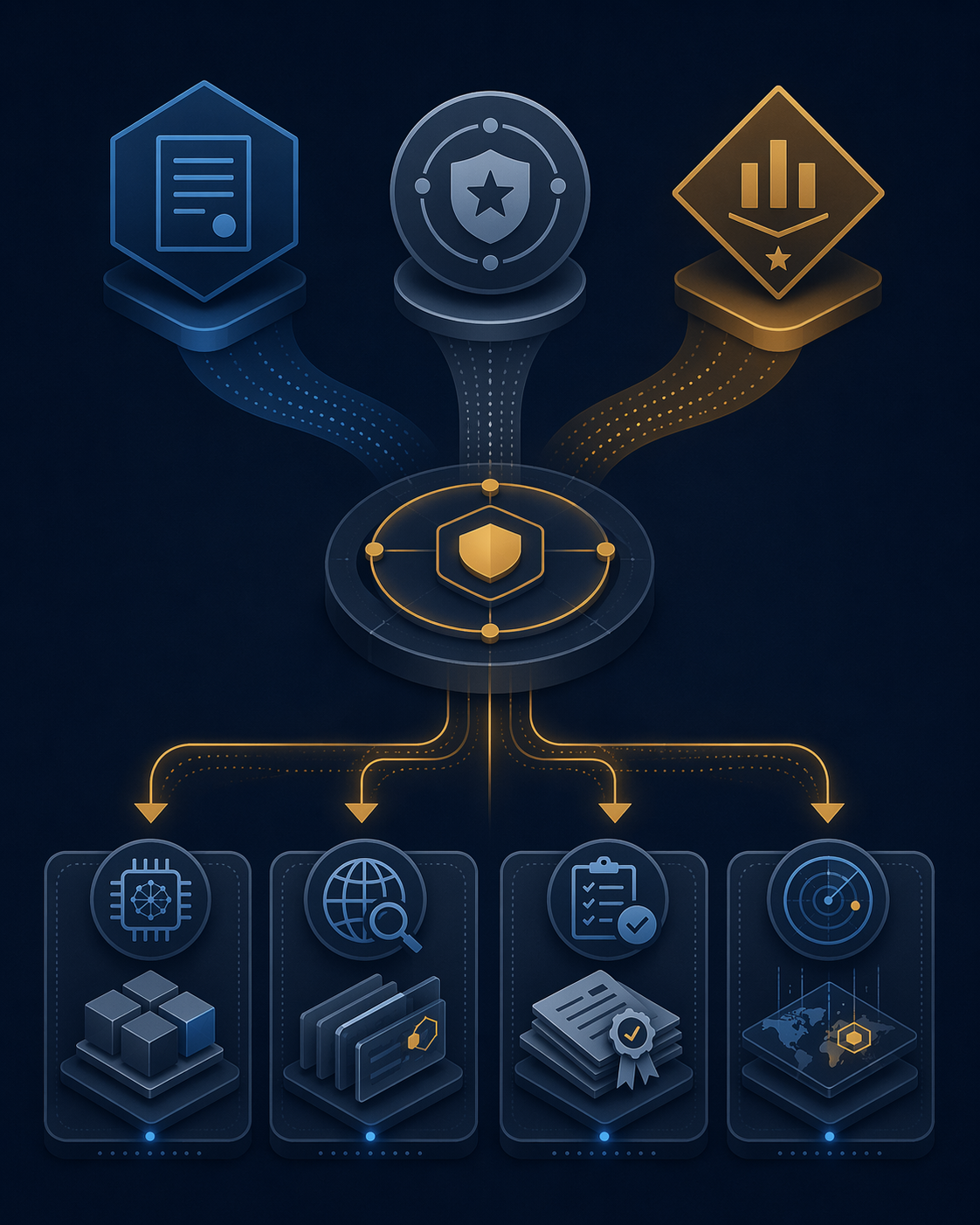
The useful way to read the 2026 actions is by the control functions they create, not by the order in which Washington issued them.
| Policy action | Government mechanism | Contractor-facing consequence |
|---|---|---|
| June 2 AI Executive Order | Classified benchmarking for covered frontier models; AI cybersecurity clearinghouse co-led by Treasury, NSA, and CISA | Contractors should expect AI threat intelligence, vulnerability coordination, and model-risk signals to become part of security intake and escalation workflows |
| NSPM-11 | National security AI framework organized around adoption, adaptation, assurance, and accountability; DoD autonomy-policy update within 90 days | AI use in national security contexts moves closer to documented assurance, accountability, and mission-risk governance |
| FY 2026 NDAA provisions | AI/ML security framework tied to CMMC; restrictions on Covered AI from specified foreign-linked sources | AI tools, model providers, data flows, and subcontractor AI use become procurement and compliance questions |
The Executive Order matters because it puts the federal government in the middle of AI threat intelligence and model assurance. It directs classified benchmarking for covered frontier models and establishes an AI cybersecurity clearinghouse co-led by Treasury, NSA, and CISA.[1] The classified piece should be read carefully: public materials do not disclose the thresholds or methods behind that benchmarking, and contractors should not build compliance programs around guessed model cutoffs. The operational signal is narrower but still important. If the government is centralizing AI cybersecurity information, contractors need a place in their own architecture to receive, triage, and act on that information.
NSPM-11 supplies the national security governance frame. It rescinds NSM-25, establishes four pillars for AI in the national security enterprise, and requires the Department of Defense to update DoD Directive 3000.09 on Autonomy in Weapon Systems within 90 days.[2] For most contractors, the immediate point is not whether they build autonomous weapons. It is that assurance and accountability are being written into the national security AI operating model. That tends to travel through acquisition language, security reviews, program requirements, and documentation demands before it appears as a neat standalone checklist.
The NDAA provisions are where the contractor burden becomes hardest to avoid. Section 1513 directs DoD to develop an AI/ML security framework as an extension or augmentation of CMMC, with risks such as data poisoning, adversarial tampering, and unintended data exposure called out in the legal analysis of the provision.[3] Section 1532 separately targets Covered AI, including references to DeepSeek, High Flyer, and entities in covered nations, and raises the stakes by connecting compliance representations to False Claims Act exposure across subcontractor tiers.[4]
Section 1513 Moves AI/ML Security Into the CMMC Orbit
Section 1513 is the part that should change work plans inside security and contracts teams. Crowell & Moring describes the provision as directing DoD to develop an AI/ML security framework as an extension or augmentation of CMMC.[3] That phrasing matters. It does not treat AI security as a voluntary best-practices appendix. It points toward the same kind of managed control environment contractors already associate with federal cyber requirements: scoping, assessment, documentation, remediation, and evidence.
The risks named in the analysis are also different from ordinary software asset management. Data poisoning raises questions about training data, fine-tuning data, retrieval sources, and feedback loops. Adversarial tampering pushes teams to think about model inputs, prompt pathways, embedded agents, plugins, APIs, and the environments where model outputs trigger action. Unintended data exposure brings the familiar controlled unclassified information problem into AI systems that were often adopted first for convenience and only later reviewed for security.
A contractor that already has a CMMC program should not assume the existing system security plan answers these questions. It may identify endpoints, cloud environments, identity controls, and CUI repositories, while saying little about which AI services ingest contract data, which model vendors retain prompts, whether retrieval-augmented generation touches controlled repositories, or whether a subcontractor is using an unapproved model to generate engineering, logistics, or proposal content.
The timing caveat is real. Crowell & Moring notes a July 13, 2026 CMMC Phase II suspension memo that could affect the implementation timeline for the Section 1513 AI security framework.[3] That caveat should not be hidden, because timing affects budgets, assessment planning, and contract commitments. But a suspension memo is not a reason to leave AI outside the control boundary. It is a reason to separate two tracks: what must be certified by a specific date, and what needs to be inventoried now so the organization is not reconstructing model usage under pressure later.
What Belongs in the AI/ML Control Inventory
The first practical gap is usually inventory. Most organizations can list laptops, cloud accounts, and major SaaS platforms faster than they can list every model dependency in use by engineering, HR, finance, software development, security operations, and capture teams. The inventory does not need to solve every policy question on day one, but it should capture enough detail to support procurement decisions and future representations.
- AI application or service name, including embedded AI features inside broader SaaS products
- Model provider, hosting location, reseller, and any known downstream model dependencies
- Business owner, security owner, contract or program connection, and user population
- Types of data submitted, including whether CUI, export-controlled data, source code, vulnerability data, or supplier information may be involved
- Retention, training, logging, human review, and output-use terms provided by the vendor
- Subcontractor or supplier use of the same tool when supporting a covered program
This inventory should sit close to the CMMC environment, not in a detached innovation register. If a tool can receive controlled data or influence deliverables under a federal contract, it belongs in the same governance conversation as access control, logging, configuration management, incident response, supplier risk, and contract flow-downs.
Section 1532 Makes Origin and Ownership a Procurement Issue
Section 1532 is where casual language about “banning foreign AI” becomes too blunt to be useful. King & Spalding describes the provision as prohibiting Covered AI, with references to DeepSeek, High Flyer, entities in covered nations, and compliance risk that can cascade through subcontractor tiers.[4] The compliance problem is not only whether a prime contractor knowingly buys a named AI tool. It is whether AI capability enters the supply chain through software components, subcontractor workflows, managed services, research support, or cloud-based productivity tools that no one thought to classify as supply chain risk.
The False Claims Act angle is what gives the issue its force. If a contractor represents compliance while prohibited AI is present in a covered activity, the question can move beyond internal policy violation into claims, certifications, and payment risk. King & Spalding’s analysis specifically flags False Claims Act liability cascading through subcontractor tiers.[4] That means the prime contractor’s AI due diligence cannot stop at its own approved tool list.
The difficult work is not writing a one-line prohibition. It is making the prohibition operational. Procurement needs vendor questions that distinguish model provider, application provider, reseller, hosting environment, and beneficial ownership where relevant. Security needs technical discovery where possible, because a vendor’s front-end brand may not reveal every model or API dependency. Contracts teams need representations that can be updated when a supplier changes model providers. Program teams need an escalation path when a subcontractor says it uses an AI assistant but cannot explain which model is underneath it.
A workable supplier representation should avoid pretending that every small subcontractor can produce a mature AI bill of materials immediately. But it should require enough information to identify covered exposure: whether the supplier uses AI in contract performance, whether any AI service is provided by or routed through a covered-nation entity, whether named prohibited tools are used, whether controlled data is submitted, and whether the supplier will notify the prime before changing material AI dependencies.
The Government Is Building AI Threat Intelligence Channels Contractors Must Design Around
The Executive Order’s clearinghouse is easy to describe at a high level and harder to absorb inside a company’s operating model. A clearinghouse co-led by Treasury, NSA, and CISA suggests that AI-related cyber intelligence will not stay confined to conventional software vulnerability advisories.[1] It may touch model abuse, adversarial techniques, financial-sector threat patterns, national security reporting, and CISA-style coordination. The contractor consequence is that AI threat intelligence needs an owner before the feeds mature.
For a defense supplier, that owner cannot be only the AI product team. Security operations may need to triage model-specific indicators. Vulnerability management may need to track AI service advisories. Legal and contracts teams may need to understand whether a new government warning affects representations or approved supplier lists. Program managers may need to pause a tool used in contract performance. If those handoffs are not mapped, the first serious advisory will create a conference call instead of a control process.
NSPM-11 reinforces the same direction from the national security side. Its adoption, adaptation, assurance, and accountability pillars are not a contractor checklist, but they tell agencies what kind of AI environment they are supposed to build.[2] Contractors that support those agencies should expect procurement language and oversight questions to follow the same vocabulary: how AI is approved, how it is adapted to mission use, how its risks are assured, and who is accountable when it affects mission outcomes.
Homeland Security Supply Chains Are Moving in the Same Direction
The homeland security side is not limited to formal defense procurement. DHS’s Supply Chain Resilience Center says it is partnering with the DHS AI Corps on an AI tool for critical product supply chain decomposition, black swan forecasting, and course-of-action recommendations.[5] That is a meaningful signal for critical product and homeland security supply chain work, but it should not be overstated. The public DHS page describes capabilities; it does not provide deployment timelines, performance metrics, or enough detail to treat the tool as an operational baseline.
The sensible reading is that DHS is moving toward AI-assisted supply chain analysis, not that contractors can rely on a mature federal tool to solve their own supplier visibility problem. If an organization supports homeland security missions, critical infrastructure programs, emergency response supply chains, or critical product availability, it should expect AI to appear both as a risk factor and as an analytic method in government conversations about supply chain resilience.
For homeland security supply chains, the signal worth acting on is not general enthusiasm for AI in supply chain management. It is the convergence of AI governance, cyber assurance, foreign-source restrictions, and government threat intelligence inside the same supply chain security environment.
What Contractors Should Do Before Every Rule Is Final
There is enough uncertainty to avoid overpromising and enough direction to justify work now. The classified benchmarking process under the Executive Order does not disclose its thresholds. NSPM-11 still has to be translated into agency practice and updated DoD policy. Section 1513 implementation may be affected by the July 13 CMMC Phase II suspension memo. DHS has not published operational metrics for the SCRC AI Corps tool.[1][2][3][5] None of that prevents a contractor from building the basic control surfaces.
| Compliance task | Why it matters now | Likely owner |
|---|---|---|
| Inventory AI tools and model dependencies | Section 1513 points toward AI/ML security controls connected to CMMC; Section 1532 requires visibility into prohibited AI exposure | CISO, IT asset management, procurement |
| Screen foreign-origin and covered AI exposure | Covered AI restrictions can reach tools, vendors, and subcontractor tiers | Supply chain security, legal, contracts |
| Update supplier and subcontractor representations | Prime contractors need evidence that AI restrictions and data-use limits flow into the performance chain | Contracts, procurement, program management |
| Map AI data flows against CUI and sensitive program data | Unintended data exposure is one of the risks identified in the Section 1513 discussion | Security architecture, data governance |
| Prepare intake for government AI threat intelligence | The Executive Order creates a clearinghouse co-led by Treasury, NSA, and CISA | SOC, vulnerability management, incident response |
| Align AI approval with CMMC evidence practices | Future AI/ML controls will be easier to absorb if approval, logging, exceptions, and remediation are already documented | Compliance, CISO, system owners |
The approved tool list is usually the fastest place to start, but it should not be treated as the whole program. An approved list tells employees what they may use. It does not prove that suppliers are complying, that embedded AI features are disabled where necessary, that model vendors are not changing underneath a product, or that controlled data is staying out of systems with unacceptable retention or training terms.
A stronger intake process asks different questions at different points. At purchase request, it asks what the tool does, what data it will receive, and whether it affects contract performance. At security review, it asks about model provider, hosting, logging, retention, training, access control, vulnerability management, and incident notification. At contracts review, it asks whether the tool or vendor creates Covered AI exposure, whether flow-downs are required, and whether the supplier can support future certification or representation language. At renewal, it asks whether the model, ownership, subprocessors, or data terms have changed.
The same logic applies to subcontractors. A prime contractor does not need to micromanage every internal experiment at every supplier. It does need to know when AI is used to perform covered work, handle controlled or sensitive data, generate deliverables, support cybersecurity operations, analyze supply chain dependencies, or make recommendations that affect mission execution. Those are the points where AI stops being a convenience tool and becomes part of the performance and risk environment.
Do Not Wait for a Perfect AI Bill of Materials
Many organizations will eventually want something like an AI bill of materials, but waiting for a perfect format is a good way to lose the thread. Start with decisions the organization already has to make: approve or block a tool, allow or prohibit certain data, accept or reject a supplier representation, pause a subcontractor workflow, escalate a government advisory, or update a contract clause. The inventory should support those decisions first.
A hypothetical example shows the distinction. Suppose a subcontractor uses an AI coding assistant to help generate software for a defense program. The immediate questions are not philosophical questions about AI authorship. They are whether controlled data or nonpublic vulnerability information entered the assistant, whether the assistant relies on a prohibited model or covered-nation provider, whether generated code is reviewed for security issues, whether the tool appears in the subcontractor’s representation, and whether the prime has any contractual right to require remediation if the answer changes.
Another hypothetical example: a logistics supplier uses a generative AI system to analyze alternative sources for a critical component. If the system is trained or prompted with sensitive supplier information, uses a restricted foreign model, or produces recommendations that drive sourcing decisions for a homeland security mission, it belongs in the supply chain security review. If it is a segregated internal drafting tool with no covered data and no role in contract performance, the risk posture is different. The point is to classify use, data, origin, and consequence rather than treat every AI mention as equal.
Where the Compliance Architecture Has to Connect
The hardest failures will come from seams between teams. Legal may track Section 1532 alerts while procurement keeps buying AI-enabled SaaS through ordinary intake. The CISO may prepare for AI/ML controls while contracts teams lack supplier language. Program managers may approve a subcontractor’s analytic workflow without knowing the model provider. The SOC may receive AI-related threat intelligence without a list of internal systems that use the affected model or service.
The operating model has to connect at least five records: AI tool inventory, supplier inventory, contract requirements, data classification, and threat intelligence. When one changes, the others should be checked. A new government advisory should map to affected AI services. A supplier’s change in model provider should trigger covered-source screening. A new CUI data flow should trigger AI-use restrictions. A contract clause should update supplier questionnaires. This is not elegant, but it is how the policy becomes manageable.
It also keeps AI adoption from freezing unnecessarily. A contractor can still approve useful tools, pilot AI-assisted supply chain analysis, and automate low-risk workflows. The difference is that approval now needs conditions: permitted data types, prohibited uses, logging expectations, vendor change notice, human review where outputs affect deliverables, and a path to suspend use if government intelligence or ownership screening changes the risk profile.
The 2026 overhaul does not provide every implementing detail. It does provide enough signal to begin treating AI systems, AI vendors, model data flows, subcontractor AI use, and AI threat intelligence as parts of the same supply chain security control plane. For organizations touching defense or homeland security supply chains, that is the baseline shift.
References
- Promoting Advanced Artificial Intelligence Innovation and Security, The White House, June 2, 2026.
- National Security Presidential Memorandum NSPM-11, The White House, June 2, 2026.
- CMMC for AI: Defense Policy Law Imposes AI Security Framework and Requirements on Contractors, Crowell & Moring.
- FY 2026 NDAA: Domestic Sourcing, Artificial Intelligence, Cybersecurity, and Acquisition Reforms, King & Spalding.
- Supply Chain Resilience Center, U.S. Department of Homeland Security.
Comments
Join the discussion with an anonymous comment.