
§ 41 — Use-case analysis
Where AI Actually Delivers in Disruption Planning
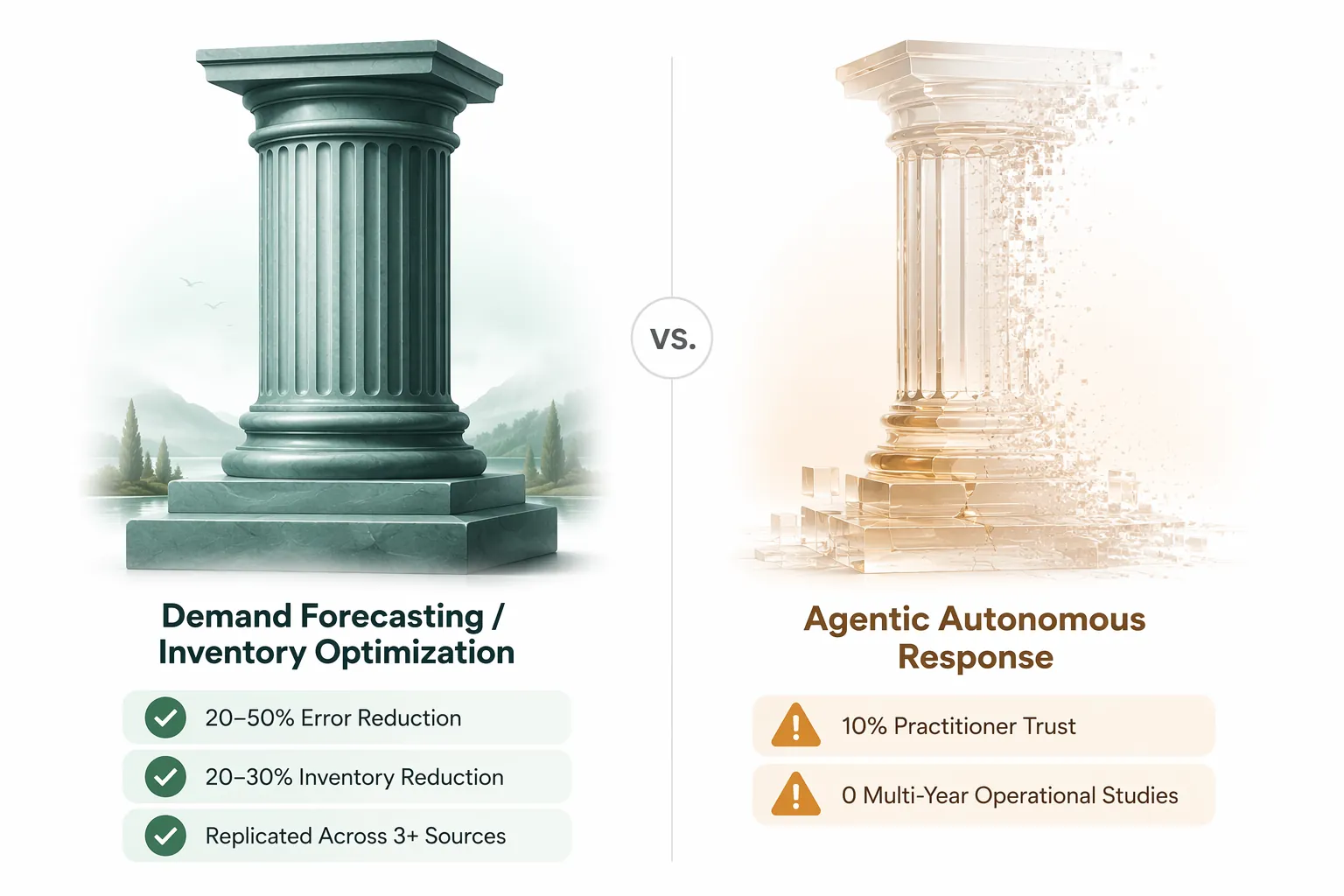
Demand forecasting and inventory optimization AI consistently produce measurable cost reductions, while agentic autonomous disruption response — despite vendor enthusiasm — lacks multi-year evidence and commands only 10% practitioner trust. This function-level comparison provides independent outcome ranges and data-readiness prerequisites to prioritize your AI pilot.
- Function
- demand forecasting
- AI technique
- forecasting
- Failure pattern
- data inaccuracy and trust gap
- Evidence source
- Unframe AI (Apr 2026) and RELEX Solutions (Jun 2026)
The quickest way to weaken an AI disruption-planning business case is to let five different functions borrow the same ROI claim. A forecast model that lowers error in S&OP, an inventory optimizer that changes safety-stock policy, a risk monitor that flags a supplier event earlier, a routing engine that avoids a late lane, and an agent that proposes autonomous recovery actions are not the same bet. They touch different data, different approvals, and different failure modes.
A useful vendor demo should survive a function-level question: which outcome are you claiming, what evidence supports that specific function, and what data condition must already be true before the number is believable? The comparison starts there.
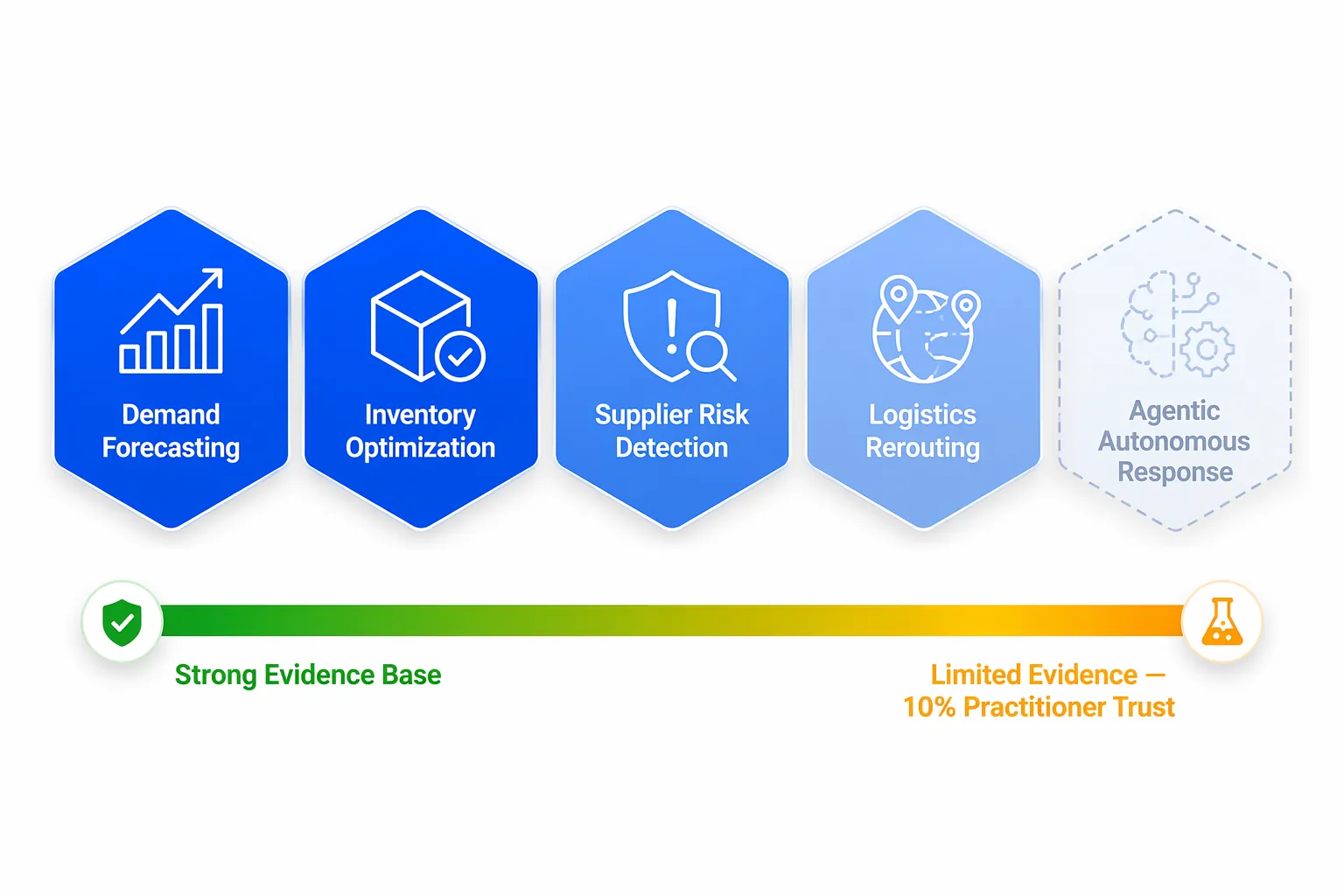
| Function | Measurable outcome to test | Evidence confidence | Core prerequisite | Best use in a first pilot |
|---|---|---|---|---|
| Demand forecasting | 20–50% forecast error reduction; S&OP accuracy studies show 20–40% improvement [1][2][3] | High: replicated range across several cited research aggregations | Clean historical demand, promotion, order, stockout, and calendar data mapped to the planning grain | Strong first pilot when forecast error is a visible disruption-planning constraint |
| Inventory optimization | 20–30% inventory reduction; 5–20% logistics cost reduction in cited aggregate studies [4][3] | High to medium: strong outcome range, but sensitive to data quality and policy adoption | Reliable inventory position, lead-time, service-level, MOQ, substitution, and exception data | Strong first pilot when planners can change replenishment rules, not just view recommendations |
| Supplier risk detection | Reduced mean time to detect disruptions; 73% report disruption losses despite 98% confidence in data, and 44.5% cite lack of accurate data as the primary barrier [5][6] | Medium: useful KPI direction, weaker savings evidence | Supplier master data, tier mapping where available, event feeds, and a process for validating alerts | Viable scoped pilot when measured on detection speed and alert quality |
| Logistics rerouting | Vendor-side and company-disclosed cases report 16% logistics cost reduction in five months, 15% cost reduction, and 34% fewer late deliveries [7] | Medium to low: concrete cases, but mostly vendor-side evidence | Shipment status, carrier performance, lane costs, constraints, and exception ownership | Viable pilot for constrained networks with clear lane-level KPIs |
| Agentic autonomous response | Only 10% of supply chain leaders trust AI for critical decisions without human review; 54% prefer human-in-the-loop. Gartner projects 60% of disruptions resolved without human intervention by 2031, but that is a projection, not a current operating result [8][9] | Low for unsupervised autonomy: high marketing intensity, limited multi-year operational evidence | Governance, approval design, audit trails, scenario boundaries, and exception escalation | Keep to supervised experimentation or governance evaluation before using as the first ROI anchor |
Forecasting Is the Cleanest Place to Start, If the Planning Grain Is Real
Demand forecasting has the strongest claim because its outcome is easy to argue about in a planning meeting. Forecast error either falls at the SKU-location, family, customer, or channel grain being used for decisions, or it does not. The cited 20–50% forecast error reduction range appears across multiple 2026 research summaries that refer back to McKinsey work, and a separate S&OP-focused discussion reports 20–40% accuracy improvement [1][2][3].
That does not mean every forecasting pilot deserves the top line of the range. A model trained on shipment history may look excellent until it meets stockouts, allocation, one-time buys, customer order gaming, and promotions that were never captured cleanly. The pilot should define the forecast level before the demo: weekly or monthly, item or family, ship-to or region, unconstrained demand or orders shipped. If the vendor cannot say where the error reduction is measured, the number is presentation material, not operating evidence.
The practical advantage of a forecasting pilot is that it can be bounded without pretending the whole network is autonomous. A team can test a model against a holdout period, compare it with the current statistical forecast and planner override, and then measure whether the new forecast changes safety stock, expediting, production sequencing, or allocation decisions. The win is not a prettier forecast chart. The win is fewer late surprises moving into S&OP and S&OE with a measurable change in forecast error.
For vendor evaluation, a function-specific lens matters more than a broad AI platform label. The same discipline used in a function-specific disruption planning vendor comparison applies here: ask what signal is ingested, what decision is changed, and how the result is audited after the disruption window closes.
Inventory Optimization Has Strong Numbers and Less Forgiveness
Inventory optimization sits close behind forecasting because the published outcome range is also material: 20–30% inventory reduction and 5–20% logistics cost reduction in cited aggregate studies [4][3]. The reason it should still be treated with more caution is simple. Forecasting can show a statistical improvement before every downstream policy changes. Inventory optimization must collide with service levels, reorder rules, lead-time assumptions, supplier minimums, substitution logic, and the local habit of holding extra stock because nobody trusts the master data.
A good inventory pilot therefore starts with the decision rights. If the model recommends lower safety stock for a volatile component, who approves the change? If it recommends more inventory for a constrained item, who accepts the working-capital increase? If the supplier lead time in the ERP is a negotiated standard rather than lived reality, the optimizer will inherit that fiction. The data prerequisite is not just completeness; it is whether the fields match how planners actually recover from disruption.
- Use inventory reduction only where service-level impact is measured at the same time.
- Separate one-time inventory cleanup from repeatable optimizer performance.
- Require a baseline for expedite cost, backorders, excess, and planner overrides before the pilot starts.
- Test whether recommendations are executable inside ERP or planning-system constraints, not only in a sandbox.
The cross-function benchmark numbers are useful but easy to overextend. A 12.7% logistics cost reduction and 20.3% inventory reduction are reported for adopters that have moved beyond pilot, while a much larger intent-to-adopt population has not necessarily reached that operating stage [3][4]. That distinction matters in a business case. Adoption interest is not the same as production effectiveness.
Supplier Risk Detection Should Be Measured on Speed Before Savings
Supplier risk detection is attractive because disruption rarely waits for a quarterly supplier review. The stronger KPI, however, is not a broad savings claim. It is reduced mean time to detect a supplier or upstream event, plus alert precision good enough that buyers and planners do not start ignoring the feed [6].
The data-confidence contradiction is the important part. In Sphera’s 2026 supply chain risk reporting, 98% of surveyed companies expressed confidence in their data, yet 73% reported disruption losses, and 44.5% cited lack of accurate data as the primary barrier [5]. That is not a minor implementation footnote. It is the difference between a risk system that finds a credible exposure and one that produces a colored map nobody can reconcile with the supplier file.
A supplier-risk pilot should be scoped to a narrow exposure path: a commodity group, a tier-one supplier set, a geography, or a set of parts tied to revenue-critical products. External risk signals may be useful, but they only become operational when matched to approved suppliers, part numbers, open purchase orders, alternate sources, and escalation owners. For a related example of disruption prediction built around a specific signal rather than a generic risk promise, see how AI can surface supply chain disruptions from airport ground stops.
Logistics Rerouting Has Useful Cases, but the Evidence Is Narrower
Logistics rerouting has an appealing operating shape: a disruption occurs, a lane is constrained, and the system recommends a different route, carrier, mode, or fulfillment path. Deposco’s December 2025 guide reports an industrial equipment manufacturer achieving a 16% logistics cost reduction within five months of AI deployment, with other cited cases showing a 15% cost reduction and a 34% decrease in late deliveries [7]. Those are useful proof points, but they are vendor-side or company-disclosed evidence, not broad independent benchmarks.
That does not make them useless. It means the pilot should be designed around the same narrowness as the evidence. Lane-level cost, tender acceptance, late deliveries, dwell time, expedite spend, and service penalties are better test measures than a generic resilience score. The model also needs shipment visibility and constraint data early enough to matter. A reroute recommendation that arrives after the carrier cutoff is documentation, not recovery.
Adjacent operating evidence can help frame the evaluation without overstating it. AI-enabled disruption recovery in airlines and spare-parts networks has shown documented recovery-cost reductions in the 17–30% range in a separate use case, and offshore logistics control-tower examples show how optimization depends on live constraints rather than static routing rules. Those are useful comparison paths for teams evaluating airline disruption recovery and spare-parts supply chains or offshore drilling supply chains, but they should not be pasted into a warehouse or manufacturing transportation ROI model without matching the network conditions.
Agentic Autonomy Is the Wrong First Anchor for Most 2026 Business Cases
Agentic autonomous response is where the sales language is moving faster than the operating evidence. The idea is not trivial: an AI agent monitors a disruption, reasons through options, triggers workflows, and may eventually resolve events without a planner approving every step. That is a serious systems design question. It is not the same thing as adding a better forecast model to an existing planning cycle.
The practitioner trust number is the pause point. RELEX’s 2026 State of Supply Chain report says only 10% of supply chain leaders trust AI to make critical decisions without human review, while 54% prefer a human-in-the-loop approach [8]. Gartner’s projection that 60% of disruptions will be resolved without human intervention by 2031 may turn out to be directionally important, but it is a forecast about a future operating state, not evidence that unsupervised disruption response is delivering repeatable outcomes in 2026 [9].
This distinction changes the pilot shape. If a vendor claims agentic disruption planning, ask whether the agent is recommending, approving, executing, or only orchestrating workflow. Ask what happens when the recommendation violates allocation policy, customer priority, trade-compliance constraints, or supplier capacity. Ask how the system records the reason for the action, not only the action itself. The IT lead who inherits the implementation will need audit trails, role permissions, fallback rules, and exception queues long after the demo scenario is over.
There is still room to test agentic tools. Supervised agents can help generate scenarios, summarize disruption exposure, draft supplier outreach, or assemble recovery options for a planner to approve. That is a different risk profile from unsupervised execution. Teams evaluating agentic procurement and multi-scenario planning can use tariff volatility planning tools as an adjacent evidence trail, and teams designing approval boundaries can compare human-in-the-loop patterns from AI recall response agents. The business case should call that supervised experimentation, not autonomous disruption resolution.
How to Choose the First Pilot
The safest first pilot is the function where outcome evidence, data readiness, and operating trust overlap. In most supply chain organizations, that points first to demand forecasting or inventory optimization, provided the baseline data is good enough and the team can measure changes against an agreed planning grain.
| If the current pain is... | Pilot this first | Avoid making this the headline metric |
|---|---|---|
| Forecast misses are driving expedites, allocation fights, or unstable S&OP plans | Demand forecasting | Generic productivity gain |
| Excess and shortages are happening at the same time | Inventory optimization | Inventory reduction without service-level tracking |
| Supplier events are discovered after planners are already expediting | Supplier risk detection | Total savings before alert precision and detection time are proven |
| Late deliveries and lane disruption are visible and measurable | Logistics rerouting | Enterprise-wide resilience ROI from a narrow routing case |
| Executives want autonomous disruption response | Supervised agent evaluation with governance gates | Unsupervised resolution ROI |
The Fortune 500 automotive OEM case often used in ROI discussions is a good example of how to read disclosed wins carefully. Value Add VC reports a 22% transport cost cut and 250% ROI at two years, but the case is company-disclosed rather than independently verified [3]. It can support a discussion about what is possible under favorable conditions. It should not become the default expectation for a first-time pilot in a different network.
A credible pilot charter should name the function, the baseline, the decision owner, the data gaps, the exception process, and the evidence level behind the expected range. If the function is forecasting, the strongest claim is forecast error reduction. If it is inventory optimization, pair inventory reduction with service performance. If it is supplier risk detection, measure detection speed and alert quality. If it is logistics rerouting, measure lane-level cost and lateness. If it is agentic autonomy, keep human review in the design until operating evidence and trust catch up with the promise.
References
- Top 10 AI Use Cases in Supply Chain, Unframe AI, Apr 2026
- AI in Supply Chain Resilience, Körber, 2026
- ROI of AI in Supply Chain: Real Case Studies, Value Add VC, Jul 2026
- Supply Chain AI Statistics 2026, OpenSkyGroup, Apr 2026
- Supply Chain Risk Report 2026, Supply Chain Digital, Jan 2026
- AI Supply Chain Risk Management 2026, Skycrumbs, 2026
- Guide to AI Supply Chain ROI, Deposco, Dec 2025
- Supply Chain AI in 2026, RELEX Solutions, Jun 2026
- Gartner Says 60% of Supply Chain Disruptions Will Be Resolved Autonomously by 2031, Supply Chain Digital, Mar 2026
§ 42 — Cited evidence
Flag an inaccuracy or submit a comparable account — Contribute or read how claims are verified in Methodology.