§ 41 — Use-case analysis
How Trump's University Research Cuts Threaten Supply Chain AI Talent
The Trump administration's July 2026 directive to shift $200B in federal R&D from universities threatens to structurally choke off AI-capable talent needed to staff supply chain platform rollouts. This analysis connects the policy change to workforce implications and offers guidance on adjusting vendor selection and implementation timelines.
- Function
- supply chain planning
- AI technique
- forecasting
- Failure pattern
- talent shortage
- Evidence source
- White House OSTP report July 21, 2026
In a Q3 2026 supply chain AI platform evaluation, the risky assumption is no longer only whether the model can improve a forecast, optimize inventory, or recommend a better production plan. The risky assumption is whether enough people will be available to make the software work inside a real enterprise stack: the data scientist who can challenge a model result, the ERP integration lead who can map messy SAP history into usable features, the solution architect who can turn a vendor demo into a planning workflow that survives month-end.
That is why the Trump administration's July 21, 2026 OSTP report matters to buyers evaluating o9, Blue Yonder, Kinaxis, RELEX, Anaplan, or adjacent planning platforms. The report proposes redirecting roughly $200 billion a year in federal R&D away from universities and toward individual scientists and AI-centered priorities.[1] The Hill described the same policy move as a plan to shift R&D funding from academia to individual scientists, reinforcing that this is not just routine agency budget noise.[2]

The near-term question is not whether one White House report directly breaks a supply chain AI rollout. That would be too neat. The practical question is whether buyers should still treat AI-capable implementation talent as a temporary recruiting inconvenience, or whether the policy environment has made it a structural risk that belongs in the timeline, staffing plan, and total cost model before signature.
What changed with the July 2026 directive
Federal R&D funding has always moved through political cycles. Programs expand, priorities shift, agencies pause awards, and universities complain. The July 2026 OSTP report is different because it describes a directional redesign of the research funding channel itself. The important supply chain implication is not the phrase "AI" in the report. It is the proposed rerouting of a large annual funding base away from institutions that also train graduate students, sustain labs, employ research staff, and give early-career technical workers their first experience with hard, ambiguous problems.[1]
Funding individual scientists more directly may sound attractive if the alternative is slow university administration. Many capable researchers would probably welcome less overhead and faster access to resources. But enterprise AI implementation depends on more than star researchers. It depends on cohorts: doctoral students, postdocs, research engineers, applied statisticians, operations researchers, and systems people who learn to work across data, optimization, and domain constraints. Those people often move into vendors, consultancies, cloud teams, manufacturers, retailers, logistics providers, and internal centers of excellence without carrying the job title "academic researcher."
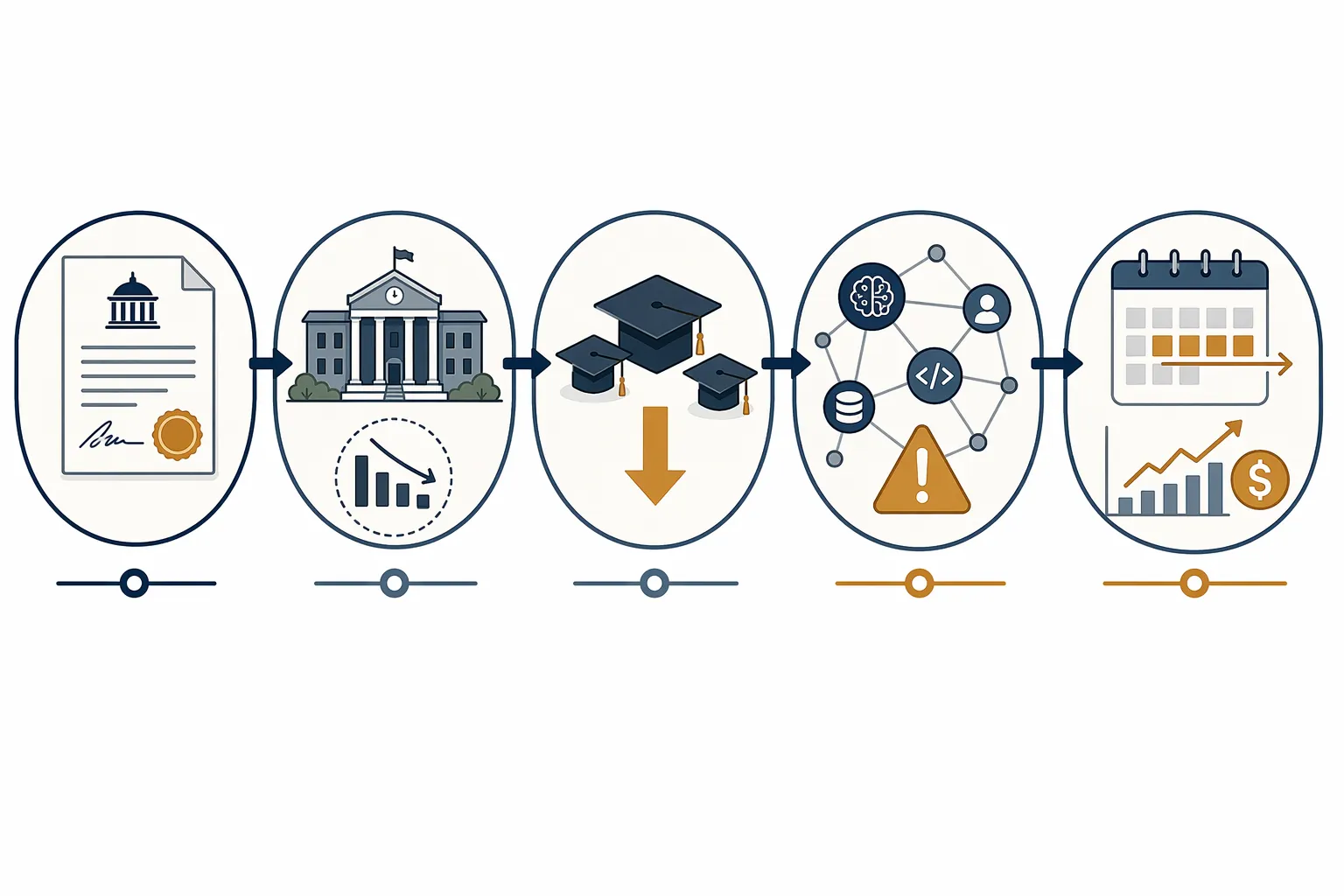
For supply chain buyers, the issue is traceability. The policy changes the funding environment for university research. University research environments help form graduate and early-career technical talent. Supply chain AI rollouts require that hybrid talent. Vendors and customers compete for it. Scarcity then shows up as longer implementation queues, weaker staffing mixes, higher partner dependence, and cost premiums. Some links in that chain are already documented; the final link into a specific rollout schedule is still inferential and should be treated that way.
The pipeline was already strained before the new report
The July 2026 report did not arrive in a stable research labor market. The Center for American Progress mapped federal funding cuts to U.S. colleges and universities and reported $2.3 billion in NIH cuts and $700 million in NSF cuts in 2025, with $1.4 billion still frozen as of early 2026. CAP also reported more than 4,000 terminated grants across more than 600 institutions.[3] Because CAP is an advocacy organization, its interpretation should not be read as a neutral agency audit. Still, the figures are useful for establishing that universities were already operating under disrupted grant conditions before the new OSTP proposal appeared.
The Brennan Center compiled Grant Witness data on frozen and slashed grants, adding another view into the same funding disruption.[4] That material matters less as a final accounting of dollars saved or lost than as a signal of uncertainty inside research programs. A lab does not need to disappear for the talent pipeline to weaken. It can defer admissions, hold back on research staff, stop renewing a postdoc, or shift students away from expensive computational work because the next grant period is unclear.
Harvard Business Review's June 2026 discussion of the U.S. research talent pipeline points in the same direction from the labor side. It cited PhD admissions cuts of roughly 20% at MIT and Duke biology programs, an approximately 5% drop in international doctoral applications at UW Medicine, and a Nature poll in which 75% of scientists said they were considering leaving the country.[5] Those examples are not supply-chain-specific, and the Nature poll methodology needs verification before anyone treats the 75% figure as a precise forecast. The point for implementation planning is narrower: universities were already showing signs of reduced intake, weaker international pull, and lower researcher confidence before a much larger R&D redirection entered the discussion.
That matters because supply chain AI talent is rarely manufactured by a single corporate training course. A planner can learn a tool interface. An analyst can learn how to frame AI inputs. An IT lead can learn the basics of model governance. Those efforts help, and the adjacent training issue is covered in The AI Skills Gap in Supply Chain Is a 2026 ROI Problem. But the harder roles in a rollout require people who can move between probability, optimization, data lineage, systems integration, and operational judgment. University research environments have been one of the places where that mix is formed.
Why supply chain AI depends on university-trained hybrid talent
Supply chain AI platforms do not fail only because a model is inaccurate. They fail because a demand signal is not comparable across regions, a promotion calendar is missing, a lead-time field means three different things in three ERP instances, or an optimization recommendation violates a constraint the model never saw. The valuable people are the ones who can diagnose that boundary between algorithm, data, and process.
Graduate research is not the only way to produce those people, but it is one of the few environments where several relevant habits are trained together. A doctoral student or research engineer may spend years testing whether a model is overfitting, defending assumptions, handling incomplete data, writing code that other people can reproduce, and explaining results to people outside the narrow method. In supply chain work, those habits translate into practical questions: why did the forecast improve in the pilot but degrade in a low-volume category, why did the optimizer recommend an impossible transfer, why did a feature that looked predictive in history become useless after a tariff or assortment change?
The best implementation teams are not staffed only with PhDs. They include planners, business process owners, data engineers, integration specialists, enterprise architects, change leads, and vendor consultants. But the AI-capable layer often leans on people who have absorbed research discipline somewhere: in an operations research lab, a statistics group, an industrial engineering department, a computer science program, a public-sector research institute, or a commercial team built by people who came through those channels.
| Rollout role | Why the research pipeline matters |
|---|---|
| Forecasting or optimization lead | Needs to judge model behavior, not just configure parameters. |
| ERP and data integration lead | Needs to connect transactional history to model features without losing business meaning. |
| Solution architect | Needs to translate a vendor capability into a live planning workflow with constraints, exceptions, and governance. |
| Customer-side AI product owner | Needs to challenge vendor claims, sequence adoption, and decide when a model result is operationally safe. |
This is where the university funding debate becomes an implementation issue. A vendor may say it has a center of excellence. A systems integrator may say it can staff globally. A buyer may assume it can backfill gaps after the contract is signed. Those statements are weaker if the broader labor market is drawing from a thinner and more uncertain formation pipeline.
Demand is moving the other way
The supply-side pressure is landing in a market where demand for AI-capable supply chain workers is already high. Gartner said in June 2026 that demand for supply chain roles requiring AI skills surged 387% from 1Q23 to 1Q26, based on more than 35 million job postings.[6] The exact press-release wording and methodology should be verified because the accessible material is limited, but the direction is consistent with what implementation teams are seeing: AI skills have moved from innovation roles into planning, procurement, logistics, and network design job descriptions.
SDCExec, citing Scope Recruiting, described a 6:1 supply-demand ratio for supply chain professionals and a wider 9:1 ratio for AI-specific roles.[7] That ratio should not be treated as a universal labor-market constant; recruiting ratios vary by geography, seniority, compensation, and industry. It is still a useful warning for buyers because platform projects tend to need the same scarce profiles at the same moments: data readiness, integration design, model validation, user acceptance, and go-live stabilization.
There is also a cost signal. Gartner predicted in May 2026 that 75% of supply chain organizations that pause entry-level AI hiring will pay cost premiums of 15% or more by 2030.[8] That is a forecast, not a measured outcome. But it supports a basic planning point: if companies stop building internal AI-capable supply chain talent and assume vendors or partners will always provide it, they may buy flexibility at a premium later.
This is the collision procurement teams need to price. On one side, universities and research programs face disrupted funding, admissions caution, and international talent anxiety. On the other, supply chain organizations are trying to deploy more AI into planning decisions while job postings increasingly ask for exactly the hybrid skills that take time to develop. Even if the July 2026 R&D redirection is slowed, litigated, or partially revised, the buyer's staffing problem does not wait for a final legal settlement.
Where the causal chain is strong, and where it is still inferential
The strongest documented claims are the existence of the July 2026 OSTP proposal, prior reported NIH and NSF cuts or freezes, signs of strain in the research talent pipeline, and reported demand growth for AI-skilled supply chain roles.[1][3][5][6] The weaker claim would be that the OSTP report has already caused a specific vendor to miss staffing commitments or a specific buyer to delay go-live. The available sources do not establish that.
A responsible version of the argument stays inside the chain. If university-based research capacity contracts, fewer graduate students and research staff may get the kind of training that produces AI-capable implementation talent. If fewer people enter that pool while supply chain demand rises, vendors, consultancies, and customers compete harder for the same profiles. If those profiles sit on the critical path, rollouts take longer or cost more. That is a risk model, not a completed postmortem.
The counterweight also matters. NBC News reported that courts and Congress have rebuffed parts of the administration's effort to gut science research funding.[9] That means some cuts have been blocked or slowed, and figures tied to claimed savings or frozen grants remain contested. It also means the July 21 OSTP report is too recent for downstream effects on supply chain AI staffing to be fully documented.[1][9]
That uncertainty does not make the issue irrelevant to a 2026 platform evaluation. It changes the way the risk should be handled. Buyers should not say, "This policy will delay our go-live by six months." They should say, "The labor pool for AI-capable supply chain implementation is structurally exposed, and our plan needs explicit protection if these roles are on the critical path."
What buyers should change in vendor evaluation
The first adjustment is to stop treating talent as a post-contract sourcing problem. If the implementation plan assumes rare AI, optimization, data engineering, or ERP integration capacity, the buyer should require named staffing commitments before contract signature. A slide about a global delivery center is not the same as knowing which architects, model validators, and integration leads are allocated to the project, when they are available, and what happens if they roll off.
- Ask vendors to separate product support, configuration support, AI or optimization expertise, and ERP/data integration capacity instead of bundling them under one implementation label.
- Require the proposed team to identify which roles are employees, subcontractors, offshore partner resources, or customer-provided resources.
- Tie critical-path staffing assumptions to the project schedule, not just to a generic statement of availability.
- Ask for replacement rules when named experts leave, become unavailable, or are split across multiple clients.
- Review whether the vendor's AI specialists are actually assigned to implementation work or mainly to presales, product strategy, and escalation.
The second adjustment is timeline realism. A project plan that treats model validation as a brief checkpoint is fragile when the same few people must evaluate features, tune exceptions, explain recommendations to planners, and debug integration defects. Scarce technical roles should be visible on the critical path. If they are shared across workstreams, the plan should show the collision rather than hide it in parallel swim lanes.
The third adjustment is partner scrutiny. Offshore and systems integration partners can absolutely expand capacity, especially for data preparation, testing, workflow configuration, and ERP mapping. But buyers should pressure-test whether those teams cover the AI and optimization work itself. A large bench of integration resources does not automatically solve a shortage of people who can judge whether a probabilistic forecast, inventory policy recommendation, or optimization output is valid for the business context.
The fourth adjustment is total cost modeling. Talent risk should appear as a premium, not as an informal worry. That premium may include longer vendor services windows, higher rates for scarce experts, more internal backfill, additional model-validation cycles, delayed benefit realization, or a larger retained team after go-live. The exact premium will vary by project, but excluding it makes the business case cleaner than the rollout will be.
How to read vendor promises in this market
Vendor optimism is not fraud. Planning software companies are under pressure to show AI capability, and many have built serious teams around forecasting, scenario planning, optimization, and decision automation. The issue is that implementation capacity does not scale at the same speed as a roadmap slide. A vendor can improve a product faster than the market can produce people who understand the product, the data, and the operating model well enough to deploy it responsibly.
A buyer comparing platforms should therefore distinguish three questions that are often blurred in demos. Does the product have the capability? Does the vendor have enough qualified people to implement that capability for this customer during this window? Does the customer have enough internal talent to absorb, challenge, and govern the capability after go-live? A strong answer to the first question does not answer the other two.
This distinction also helps with post-implementation disappointment. When a platform underperforms, the failure may be blamed on the algorithm, the vendor, the data, or user adoption. Sometimes those labels are right. Sometimes the root problem is that the project never had enough hybrid expertise to translate between them. That expertise is exactly what becomes harder to assume in a market where the research formation pipeline is under policy pressure and demand is rising at the same time.
Recent deployment stories under tariff and policy stress show that AI planning tools can still produce useful outcomes when teams match the technology to the operating problem. The relevant contrast is not "AI works" versus "AI fails." It is whether the organization has enough technical and process capacity to make AI work under messy conditions. For examples of teams operating under a different kind of policy pressure, see How five teams used AI supply chain planning under new tariffs.
The 2026 decision layer
For a buyer in Q3 2026, the practical response is not to pause every supply chain AI program until the federal funding picture settles. That would replace one unsupported assumption with another. The better response is to treat AI-capable talent as a structural implementation risk and manage it with the same seriousness as data readiness, ERP dependencies, and change capacity.
- Lengthen schedule assumptions where AI, optimization, or advanced data-integration roles sit on the critical path.
- Require vendors and integrators to specify named implementation capacity, not just methodology or center-of-excellence language.
- Pressure-test whether partner and offshore resources cover the scarce technical work or only the surrounding configuration and testing work.
- Build talent-risk premiums into total cost models, including delayed benefits and extended expert-services windows.
- Protect internal entry-level and early-career AI hiring where possible, because pausing the pipeline may make future dependence on expensive external expertise worse.
The Trump administration's university R&D redirection may be narrowed, contested, or partly blocked. The documented downstream effect on specific supply chain AI rollouts will take time to prove. But the staffing exposure is already visible enough to change procurement behavior now: do not sign an aggressive AI planning timeline on the assumption that the market will produce the right people later.
References
- Science: A New Golden Age, White House Office of Science and Technology Policy, July 21, 2026.
- Trump administration plans to shift R&D funding from universities to scientists, The Hill.
- Mapping Federal Funding Cuts to U.S. Colleges and Universities, Center for American Progress.
- The Cost of the Trump Administration's Attacks on Research Funding, Brennan Center for Justice.
- The U.S. Research Talent Pipeline Is in Trouble, Harvard Business Review, June 2026.
- Gartner Says There is an Outsized Need for AI Talent in Supply Chain, Gartner, June 2026.
- Demand Planning in 2026: Why the Job Has Changed Faster Than the Talent Pool, SDCExec / Scope Recruiting.
- Gartner Predicts Supply Chain Organizations Pausing Entry-Level Hiring for AI Will Face Higher Costs by 2030, Gartner, May 2026.
- Trump tried to gut science research funding. Courts and Congress have rebuffed him, NBC News.
§ 42 — Cited evidence
Flag an inaccuracy or submit a comparable account — Contribute or read how claims are verified in Methodology.