§ 31 — Readiness checklist
How five teams used AI supply chain planning under new tariffs
This post-mortem examines five documented deployments of AI supply-chain planning tools between 2025 and 2026, showing what measurable results teams achieved under the new tariff regime and why most organizations lack the data foundations to replicate those outcomes.
- Function
- demand-planning
The uncomfortable part of asking how teams used AI supply chain planning under new tariffs is that the best-documented wins came from environments most companies still do not resemble. By mid-2025, only 23% of supply-chain leaders had a formal AI strategy, according to Gartner.[1] Xeneta identified fragmented, siloed data as the primary reason AI initiatives fail to deliver material ROI in freight and supply-chain work.[2] Accenture’s 2026 manufacturing research found that only 7% of manufacturing leaders had a tested AI incident-response plan.[3]
Those figures matter because tariffs do not wait for a data-cleansing program. They change landed cost, supplier comparisons, customs classifications, transportation choices, inventory buffers, and executive risk tolerance at the same time. The useful question is not whether AI was present in a vendor stack. It is what changed operationally, what was measured, and what had to be true before the tool could help.
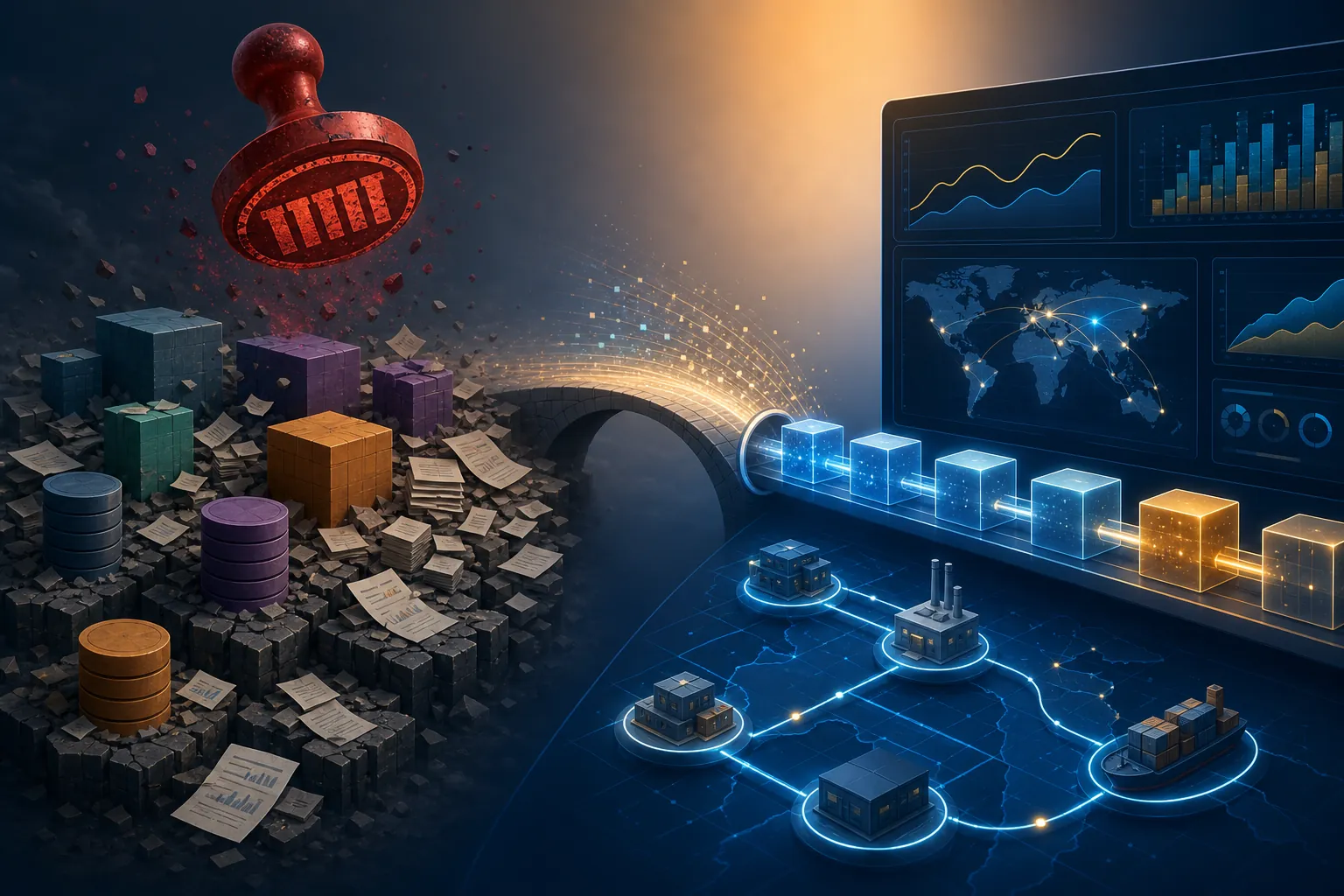
The evidence separates availability from operating change
Between mid-2025 and mid-2026, five reported deployment patterns stood out: Walmart’s agentic planning work, Kinaxis Maestro implementations, KPMG’s generative AI tariff modeler, Altana’s tariff calculator, and Netstock’s SMB customer research. They do not carry the same evidentiary weight. Some report operating outcomes; some report usage; some report readiness or self-described mitigation behavior.
| Deployment | What was reported | What the evidence can support |
|---|---|---|
| Walmart / Wally | $55M waste reduction, 20–25% out-of-stock reduction, 30M unnecessary delivery miles eliminated | A mature retailer used AI on top of deep operating data to improve specific planning outcomes |
| Kinaxis Maestro adopters | Scenario comparison moved from weeks to hours; manufacturers reported inventory, service, and response-speed improvements | Concurrent planning helped teams compare tariff-response options faster across functions |
| KPMG tariff modeler | 100+ Fortune 500 clients; same-day scenarios; KPMG reported hundreds of millions saved | Professional-services teams found strong demand for tariff modeling, but savings remain a vendor-reported claim |
| Altana tariff calculator | 213% usage spike after an early-2026 Supreme Court tariff ruling | Urgent tariff-modeling demand increased, but usage is not the same as ROI |
| Netstock SMB data | Analytics usage and AI inventory adoption rose sharply among surveyed customers | SMB behavior changed under pressure, within a vendor customer base likely tilted toward analytics adopters |
That distinction matters. AI helped some teams compress analysis and expose tradeoffs quickly. It did not, by itself, solve the harder work of reconciling ERP records, supplier files, customs data, demand signals, and governance over who is allowed to change the plan.
Walmart: measurable gains, but on a foundation few teams own
Walmart is the most concrete case, and also the easiest one to over-transfer. Reported 2025 disclosures, cited by Dmitry Sverdlik, attributed $55 million in waste savings to Walmart’s “Wally” agentic AI rollout, along with a 20–25% reduction in out-of-stock rates and the elimination of 30 million unnecessary delivery miles.[4] Retail Dive also reported in October 2025 that Walmart’s Indira Uppuluri described a digital-twin sandbox for evaluating tradeoffs under uncertainty.[5]
The operating mechanism is more important than the label. Walmart was not asking a generic chatbot to guess whether a tariff made a supplier unattractive. It was using planning intelligence on top of decades of transaction data, a retail-specific LLM foundation called Wallaby, and an operating environment where inventory, stores, suppliers, transportation, and demand patterns could be modeled against each other.[4][5]
That matters under tariffs because the plan is rarely a single-variable decision. A team may reduce exposure to one country of origin and create longer lead times, higher minimum order quantities, more split shipments, or worse store availability. A digital twin is useful only if the system can represent those consequences with enough fidelity that planners and executives trust the comparison.
Walmart’s reported results show that AI-enabled planning can move beyond dashboarding into operational waste, availability, and mileage outcomes. They do not show that a company with thin item history, inconsistent supplier master data, or disputed customs classifications can buy the same result. The enabling asset was not only the model; it was the operating data estate beneath it.
Kinaxis Maestro: tariff response as concurrent scenario work
The Kinaxis Maestro evidence is less about one headline savings figure and more about planning cycle compression. FreightWaves reported in 2026 that manufacturers using Maestro saw first-year improvements in inventory levels, customer service, and disruption-response speed. Fabrizio Brasca, Kinaxis’s VP of Global Supply Chain, described the platform’s ability to compare multiple scenarios simultaneously, including alternative suppliers, transportation options, production plans, and inventory strategies.[6]
For tariff response, that simultaneous comparison is not a convenience feature. It changes who can participate before the decision hardens. Procurement can test supplier shifts; planning can see supply and inventory consequences; logistics can expose transportation tradeoffs; finance can compare landed-cost outcomes; and executives can see why the cheapest tariff answer may be a poor service answer.
FreightWaves also reported that MANE selected Maestro specifically to manage cross-regional tariff planning complexity across the United States, Mexico, and Canada.[6] That is a useful selection signal. Cross-border tariff exposure is exactly where spreadsheet chains become brittle: country of origin, supplier capacity, product eligibility, regional production constraints, and customer service commitments all collide.
The reported compression from weeks to hours should be read as a workflow result, not magic forecasting. A planning team still needs current supplier options, routings, bills of material, lead times, cost assumptions, inventory policies, and agreement on which scenarios are decision-ready. Maestro’s value in these cases was that it let functions compare bad options in the same planning frame instead of reconciling separate spreadsheet answers after the meeting had already become urgent.[6]
KPMG: same-day modeling, with attribution kept in view
KPMG’s generative AI tariff modeler shows a different deployment pattern: not a single enterprise planning system, but a services-led model for companies that needed tariff scenarios quickly. KPMG said in May 2025 that its modeler was being used by more than 100 Fortune 500 clients.[7] Business Insider reported in April 2026 that Andrew Siciliano of KPMG said the tool compressed scenario analysis from weeks to same-day turnaround and had saved “hundreds of millions” through strategic tariff planning.[8]
That “hundreds of millions” figure should stay exactly where the evidence puts it: a KPMG-reported claim, not an independently audited benchmark. It is still useful. More than 100 Fortune 500 users is a demand signal from companies with enough exposure to justify urgent modeling, and same-day turnaround is an operating claim that planning and tax teams can benchmark against their own cycle times.[7][8]
The tariff problem here is often classification-heavy and finance-sensitive. Teams need to test sourcing changes, product-level exposure, duty impact, mitigation options, and timing. A services model can help when internal systems are not ready to absorb the whole problem, but it also creates a handoff question: which assumptions enter the model, who validates the source data, and how the result gets converted into purchasing, inventory, or customer commitments.
Altana: a usage spike, not an outcome study
Altana’s tariff calculator belongs in the evidence set because it shows how quickly teams reached for product- and origin-level tariff modeling when legal and policy conditions shifted. Fortune reported in February 2026 that Altana saw a 213% usage spike after the Supreme Court’s tariff ruling earlier that year. Altana also reported that 50% of calculations involved metal articles and 32% involved China-origin goods.[9]
Those are product-usage metrics. They say users urgently needed calculations around exposed categories and origins; they do not prove savings, service improvement, or inventory reduction. The better read is that tariff volatility created a fast, specific planning workload: classify exposure, identify affected articles, and model the cost effect before a procurement or customer-pricing decision is made.
Altana’s data foundation is also part of the story. Fortune reported that roughly 60% of the data in Altana’s supply-chain knowledge graph comes from customer first-party data.[9] That is not a minor implementation footnote. If first-party supplier, shipment, product, and customs data are incomplete, the graph may still be impressive, but the company’s own answer can remain uncertain at the point where a buyer or trade-compliance lead has to act.
Netstock: SMBs moved fast, inside a tilted sample
Netstock’s 2026 Tariff Impact Report, fielded in mid-2026 and published in July 2026, adds the small and midsize business view. Among surveyed Netstock customers, heavy analytics users more than doubled from 8% to 19% over 12 months, while non-users fell from about 25% to 7%. The same report said 82% of SMBs felt more prepared than a year earlier, 97% had at least one active tariff mitigation strategy, and AI adoption for inventory management doubled from 23% to 48%.[10]
The behavioral shift is real enough to take seriously: companies under tariff pressure used more analytics, adopted more AI inventory tools, and moved from having no mitigation strategy to having at least one. But the sample matters. This was vendor-sponsored research among Netstock’s own customer base, so it likely overrepresents SMBs already willing to use planning technology.[10]
For an SMB, the lesson is not that a lighter tool cannot help. It often can, especially for inventory buffers, demand-supply matching, and supplier-risk views. The limit is that self-reported preparedness is not the same as tested response capacity. A company may feel better prepared because it has dashboards and mitigation actions, while still lacking a governed process for deciding when to rebalance inventory, accept margin loss, change suppliers, or pass cost through to customers.
What had to be true before AI helped
Across the five cases, the strongest results came when the tool could sit on top of usable operating data and a decision process that already knew what to do with a scenario. The common prerequisites were not glamorous, but they are the items that usually decide whether tariff-response planning becomes same-day analysis or another emergency spreadsheet exercise.
- Product, supplier, shipment, cost, inventory, and customer-service data had to be connected closely enough for tradeoffs to be visible.
- Tariff exposure had to be modeled at the level where decisions are made, not only as a finance estimate after procurement choices were already set.
- Scenario outputs had to be reviewed by the functions that would bear the consequences: planning, procurement, logistics, finance, trade compliance, and commercial leadership.
- The organization needed governance for acting on a result, including who can approve supplier shifts, inventory builds, route changes, or customer-price actions.
- The metric had to match the claim: outcome metrics for operational gains, usage metrics for demand signals, and survey metrics for readiness or behavior.
That last point is where many AI planning evaluations get loose. Walmart’s reported waste, out-of-stock, and mileage numbers are operational outcomes.[4] KPMG’s client count and same-day modeling point to adoption and cycle-time compression, while the savings figure remains KPMG’s own reported claim.[7][8] Altana’s 213% increase is a usage spike.[9] Netstock’s figures show customer behavior and self-reported preparedness within a vendor customer population.[10]
The practical benchmark for teams evaluating vendors
A team evaluating Kinaxis, Blue Yonder, o9, Anaplan, RELEX, or a services-led tariff modeler can use these cases without pretending they are interchangeable. The benchmark is not whether a demo can generate a tariff scenario. It is whether the organization can feed the scenario with trusted data, compare alternatives across functions, and make a decision quickly enough for the result to matter.
The first readiness test is data lineage. If planners cannot say where supplier cost, country-of-origin, customs classification, lead-time, inventory, and demand assumptions came from, the AI output will be hard to defend in a steering meeting. The second is integration. If tariff exposure lives in one file, supplier capacity in another, and inventory policy inside an ERP field no one trusts, the team will spend the tariff window reconciling inputs instead of comparing responses. The third is response governance. If no one knows who can approve a source change, build ahead, expedited shipment, or price action, faster analysis will only create faster escalation.
The five cases do show that AI supply-chain planning tools can compress tariff-response analysis and, in mature environments, contribute to measurable waste, service, mileage, inventory, and mitigation gains. They also show why the broader market numbers from Gartner, Xeneta, and Accenture are not background noise. Before treating any case as a model to copy, compare your data foundation, integration layer, and response governance with the conditions that made the reported results possible.[1][2][3]
References
- Gartner mid-2025 AI strategy research, Gartner, mid-2025, link
- Xeneta analysis on fragmented supply-chain data and AI ROI, Xeneta, link
- Accenture 2026 manufacturing AI incident-response research, Accenture, 2026, link
- LinkedIn post citing Walmart 2025 disclosures on Wally, Dmitry Sverdlik / LinkedIn, 2025, link
- Retail Dive coverage quoting Walmart’s Indira Uppuluri on digital twin sandbox, Retail Dive, October 2025, link
- FreightWaves coverage of Kinaxis Maestro and tariff planning, FreightWaves, 2026, link
- KPMG generative AI tariff modeler press release, KPMG, May 2025, link
- Business Insider coverage quoting Andrew Siciliano of KPMG on tariff modeling, Business Insider, April 2026, link
- Fortune coverage of Altana AI tariff calculator usage, Fortune, February 2026, link
- 2026 Tariff Impact Report, Netstock, July 2026, link
§ 32 — Next step
Flag an inaccuracy or submit a comparable account — Contribute or read how claims are verified in Methodology.