
§ 41 — Use-case analysis
The AI Skills Gap in Supply Chain Is a 2026 ROI Problem
New 2026 data from Gartner, Deloitte, and Randstad shows AI hiring in supply chain has surged 387% while workforce training lags behind—creating a measurable drag on AI returns. This analysis quantifies the gap across three dimensions so leaders can build the business case for closing it.
- Function
- supply chain planning
- AI technique
- generative AI
- Failure pattern
- workforce capability gap
- Evidence source
- Gartner, Deloitte, Accenture
Demand for supply-chain roles requiring AI skills grew 387% from 1Q23 to 1Q26, according to June 2026 reporting on a Gartner analysis of more than 35 million job postings.[1] That number should not be treated as a decorative “future of work” statistic. It is a market signal: companies are paying for AI capability in supply chain faster than many internal teams are being trained, redesigned, or measured to use it.
There is a sourcing caveat worth putting up front. Gartner’s original press release required authentication, so the 387% figure here relies on consistent secondary reporting from Consumer Goods Technology, Petri.com, and ITPro. For a planning director or procurement lead trying to build a 2026–2027 workforce case, that still matters. Three outlets reporting the same Gartner figure gives the labor-market signal enough weight to enter the budget conversation, even if it should not be overread as a complete map of skill quality or role performance.
The business question follows quickly: if the external market is treating AI-skilled supply-chain labor as urgent, why are many internal supply-chain teams still being enabled as if AI adoption were optional? AI literacy education for the supply-chain workforce can sound like a training department label. In 2026, it is closer to an ROI control issue. Companies are buying planning systems, analytics layers, and generative AI pilots; the leak appears when planners, buyers, category managers, and operations leads cannot turn those tools into changed decisions.
The Gap Is Visible Before the ROI Review
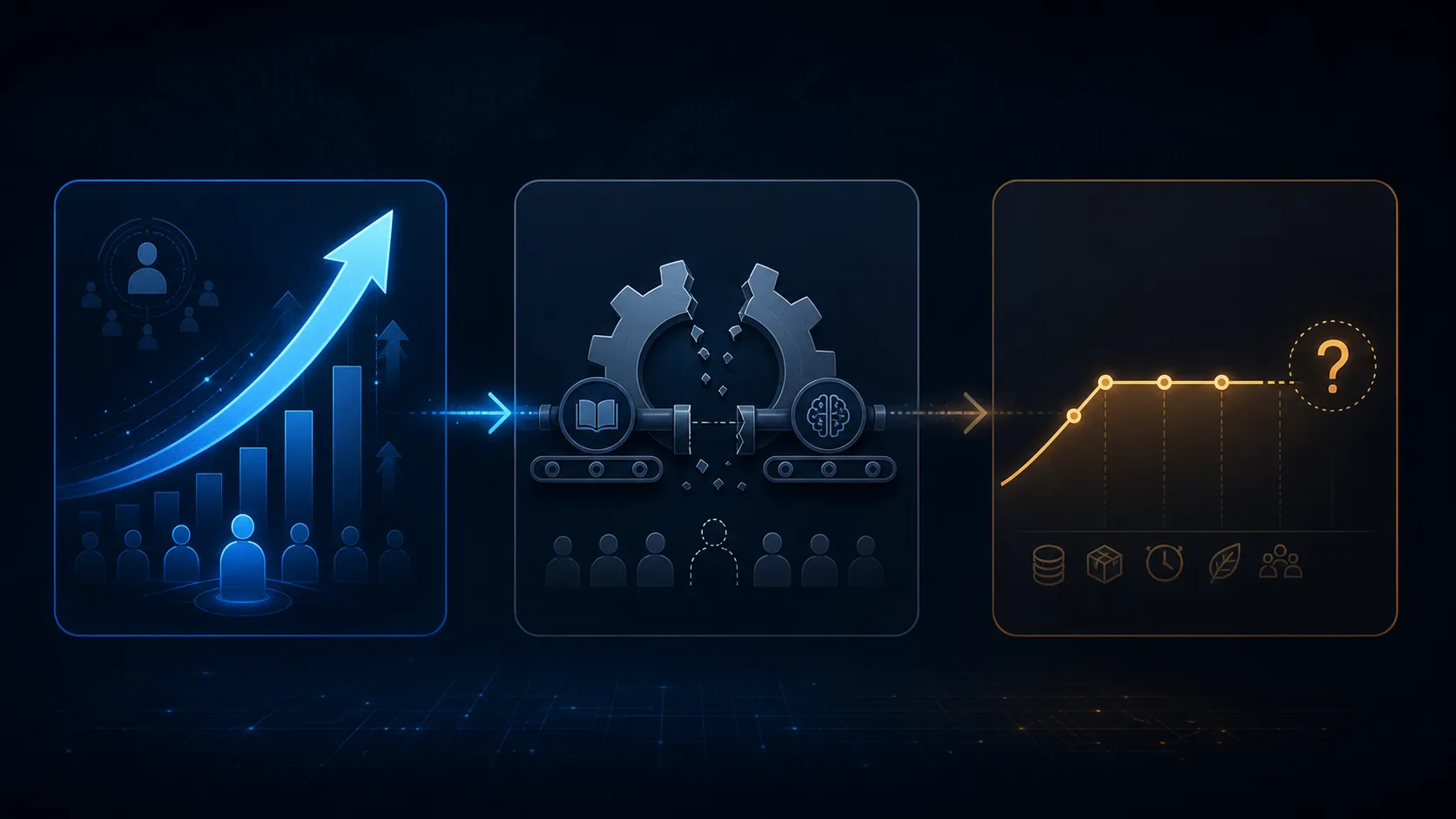
The useful way to frame the AI skills gap is not as a single shortage. It shows up in three places that finance and HR can both understand: the external market is hiring for AI supply-chain skills, internal organizations are not preparing roles at the same pace, and AI outcomes are uneven enough that software spend alone cannot carry the business case.
| Where the gap appears | What the evidence shows | Why it matters to the business case |
|---|---|---|
| Hiring demand | Supply-chain roles requiring AI skills rose 387% from 1Q23 to 1Q26, based on Gartner analysis reported by secondary outlets.[1] | The market is already assigning value to AI capability in supply-chain work. |
| Internal preparation | Deloitte-reported data says insufficient worker skills are the top barrier to AI integration, while 84% of organizations have not redesigned jobs around AI.[2] | Training and job design are lagging the systems being introduced. |
| ROI capture | Accenture found AI-mature supply chains were 23% more profitable than peers in a study of 1,148 companies.[6] | The upside exists, but maturity depends on more than tool deployment. |
That sequence matters. A company can have a credible AI roadmap and still underfund the part of the operating model that determines whether planners trust exception alerts, whether buyers know when to challenge model outputs, and whether managers redesign approval flows instead of adding AI screens on top of old work.
A 387% Hiring Surge Is Not Just a Recruiting Problem
The Gartner figure is striking because it is not limited to AI labs or centralized data teams. It is specifically about supply-chain roles requiring AI skills, captured across more than 35 million job postings between 1Q23 and 1Q26.[1] That suggests employers are embedding AI expectations into operating roles, not merely hiring specialists to sit beside the business.
For supply-chain planning, that distinction is expensive. A demand planner who can use probabilistic forecasts, scenario tools, and AI-assisted exception management changes the cadence of the planning cycle. A planner who cannot may still log in, accept the dashboard, and continue exporting exceptions into spreadsheets. From a finance view, both count as “adoption” if the license is active. Only one has a credible path to reducing duplicated analysis, late escalations, and manual rework.
The hiring signal also creates an internal retention problem. If external job descriptions are moving faster than internal role definitions, capable planners and procurement analysts can see the market value of skills their current employer has not formally budgeted, recognized, or taught. That is not a theoretical culture issue; it affects whether the people closest to demand signals, supplier constraints, and inventory tradeoffs stay long enough to make the system useful.
This is where the AI literacy discussion needs to be more specific than general prompt training. In supply chain, the practical literacy layer includes knowing what the model is optimizing, what data history it is drawing from, where exceptions should be escalated, when a recommendation conflicts with commercial reality, and how to document an override. Those skills do not appear automatically after go-live.
Internal Training Is Not Keeping Pace With Role Change
Deloitte’s 2026 State of AI in the Enterprise survey, summarized by Solved and Scality, gives the organizational side of the gap. The survey covered 3,235 leaders across 24 countries and was fielded in August and September 2025. In that data, insufficient worker skills are identified as the top barrier to AI integration; 84% of organizations have not redesigned jobs around AI; 36% expect at least 10% of roles to be fully automated within a year; and only 20% rate talent capability as highly prepared.[2]
Those numbers are awkward in combination. Leaders are expecting meaningful automation, but most organizations have not redesigned jobs around the technology expected to automate parts of those jobs. That is how AI projects become operationally crowded: the old process remains, the new tool adds another review layer, and the workforce is expected to absorb the difference through informal learning.
Supply chain is especially vulnerable to that pattern because planning and procurement work already spans systems, incentives, and handoffs. A forecast recommendation touches sales input, inventory policy, production constraints, service targets, and finance assumptions. A sourcing recommendation may touch supplier risk, negotiated terms, compliance, and working capital. If the role is not redesigned, AI does not remove ambiguity; it can simply move the ambiguity to a faster screen.
The job-design point is often less comfortable than the training point because it forces ownership. Training can be purchased. Job redesign requires decisions about who approves model-driven recommendations, which manual checks disappear, which exception thresholds change, and how performance metrics are updated. Without those choices, AI literacy education becomes a voluntary add-on instead of a control mechanism for the investment already approved.
Supply-Chain Leaders Know the Gap Exists, Even When They Feel Prepared
The supply-chain-specific data sharpens the contradiction. Skill Dynamics’ 2026 Skills Report, based on 200 senior supply-chain leaders in the US and UK, found that 83% of leaders feel somewhat prepared, while 92% report at least one critical skills gap. AI and automation are the largest single gap, cited by 47%.[3]
That is not the same as saying leaders are unaware. It says something more operationally familiar: teams may be generally confident in their supply-chain function while still lacking the specific capability needed to extract value from new AI-enabled work. A procurement organization can be strong in negotiation and supplier management, yet weak at evaluating AI-assisted spend classification. A planning team can be strong at S&OP facilitation, yet weak at interpreting model confidence or deciding which exceptions deserve human review.
Randstad’s global study, cited through Forbes and ASCM, points to the same coverage problem from the worker side: 75% of companies had adopted AI, while only 35% of workers had received AI training in the past year.[4] Because that figure is secondhand, it should be used cautiously. Still, it is useful corroboration. Adoption is being counted at the company level, while enablement is landing unevenly at the worker level.
Bain & Company’s 2025 research adds another supporting angle: 44% of executives cite lack of in-house AI expertise as a key barrier to generative AI implementation.[5] That does not prove that training alone fixes implementation. It does show that expertise is not a side concern once organizations move from pilots to embedded workflows.
The ROI Problem Starts When Adoption Is Mistaken for Use
A familiar pattern sits behind many disappointing AI returns. The organization funds the platform, the implementation team hits the milestone, the vendor contract is celebrated, and planner enablement becomes a softer follow-up item. By the next budget cycle, the CFO sees software cost, consulting cost, and only partial evidence of changed business outcomes.
This is why adoption metrics are dangerous when used alone. Login rates, active users, generated recommendations, and completed pilots may show activity. They do not necessarily show that forecast bias decreased, expedite costs fell, supplier decisions improved, or planning cycle time shortened. ChainSignal’s analysis of AI demand forecasting maturity benchmarks makes the same distinction in a different setting: the relevant benchmark is not whether AI exists in the process, but whether it changes the quality and speed of planning decisions.
The workforce layer is where that distinction becomes visible. If planners do not know how to challenge a recommendation, they may over-accept weak outputs. If they do not trust the model, they may ignore strong ones. If managers keep old approval thresholds, cycle time may not improve. If incentives still reward local firefighting, better signals may not translate into better decisions.
None of this makes “people” the whole problem. Data quality, integration depth, master-data governance, incentive design, and executive decision rights all matter. But the current evidence set points to workforce capability as the piece most likely to be underbudgeted relative to the ambition of the AI business case.

The Upside Is Real, but It Is a Maturity Story
The reason this gap deserves budget attention is not that AI literacy sounds modern. It is that the upside companies are chasing is measurable. Accenture’s 2024 study of 1,148 companies found that companies with AI-mature supply chains were 23% more profitable than peers.[6]
That finding should be handled carefully. It does not prove that a training program produces a 23% profitability lift. It does not isolate AI literacy from data, process, governance, scale, or industry mix. What it does establish is that AI maturity in supply chain is associated with a meaningful performance gap, which makes weak workforce preparation a legitimate risk to value capture.
For a director building the case, the argument is stronger when it avoids overclaiming. The point is not “train people and profitability follows.” The point is that companies are already funding AI-enabled supply-chain capability, the labor market is already repricing the skills needed to use it, and multiple surveys show internal preparation lagging. That is enough to treat workforce AI investment as part of the ROI model rather than a discretionary learning benefit.
This is also where the conversation should move from pilots to operating economics. A pilot can succeed with a small group of motivated users and a narrow use case. P&L impact requires repeated decisions across planning cycles, sourcing events, inventory policies, and exception queues. ChainSignal’s piece on where supply chain AI delivers measurable ROI is the right continuation for that discussion because it shifts the evidence from implementation activity to financial outcomes.
What Belongs in the 2026 Workforce Business Case
A useful AI literacy business case for supply chain should not be presented as broad culture building. It should be tied to the same value streams used to justify the systems: forecast accuracy, planning cycle time, inventory exposure, expedite costs, supplier risk response, analyst productivity, and decision latency. The training line item needs to sit next to the expected operational change, not in a separate HR appendix.
The stronger cases usually make three distinctions clear:
- Role capability: which planners, buyers, category managers, schedulers, or analysts need AI fluency because their decisions are changing.
- Workflow redesign: which manual reviews, exception thresholds, approvals, or handoffs will change once AI recommendations enter the process.
- Outcome ownership: which metric owner will confirm that AI-enabled work has reduced waste, delay, rework, or risk rather than only increasing system activity.
That framing is more finance-facing than a generic “AI awareness” curriculum. It also avoids blaming employees for a capability gap they did not create. If the organization buys a planning platform but does not change roles, incentives, review routines, or escalation rules, the workforce absorbs the ambiguity. The cost then appears later as shadow spreadsheets, duplicated analysis, stalled adoption, and benefits that remain difficult to prove.
In Q3 2026, the measurable case is already there. Labor-market demand for AI-skilled supply-chain roles has accelerated sharply. Internal preparation remains weak across skills, training coverage, and job redesign. The companies with more mature AI supply chains appear to be capturing stronger performance, while many others are still confusing purchased capability with operationalized capability. Workforce investment is not a guarantee of profitability, but it is becoming a necessary control for the AI returns supply-chain leaders have already promised.
References
- Gartner: Demand for Supply Chain Professionals with AI Skills Surges 387%, Consumer Goods Technology / Petri.com / ITPro, June 15, 2026,
- Deloitte State of AI in the Enterprise 2026, Solved / Scality summary,
- Skills Report 2026, Skill Dynamics,
- Randstad global AI training study, Forbes / ASCM, 2025,
- Generative AI implementation research, Bain & Company, 2025,
- Next Stop, Next-Gen, Accenture, 2024,
§ 42 — Cited evidence
Flag an inaccuracy or submit a comparable account — Contribute or read how claims are verified in Methodology.