
§ 41 — Use-case analysis
Why Space Logistics AI Misses the Real Risk in Starship Launches
Despite a $3.8B spacecraft anomaly detection market, Starship's 2025–2026 launch failures continued because AI investment is concentrated on post-launch satellite health rather than launch-vehicle diagnostics. This analysis explains why procurement teams evaluating space logistics AI must realign their failure-node priorities to avoid repeating the same misallocation.
- Function
- procurement
- AI technique
- anomaly detection
- Failure pattern
- investment misalignment
- Evidence source
- Dataintelo April 2026 report
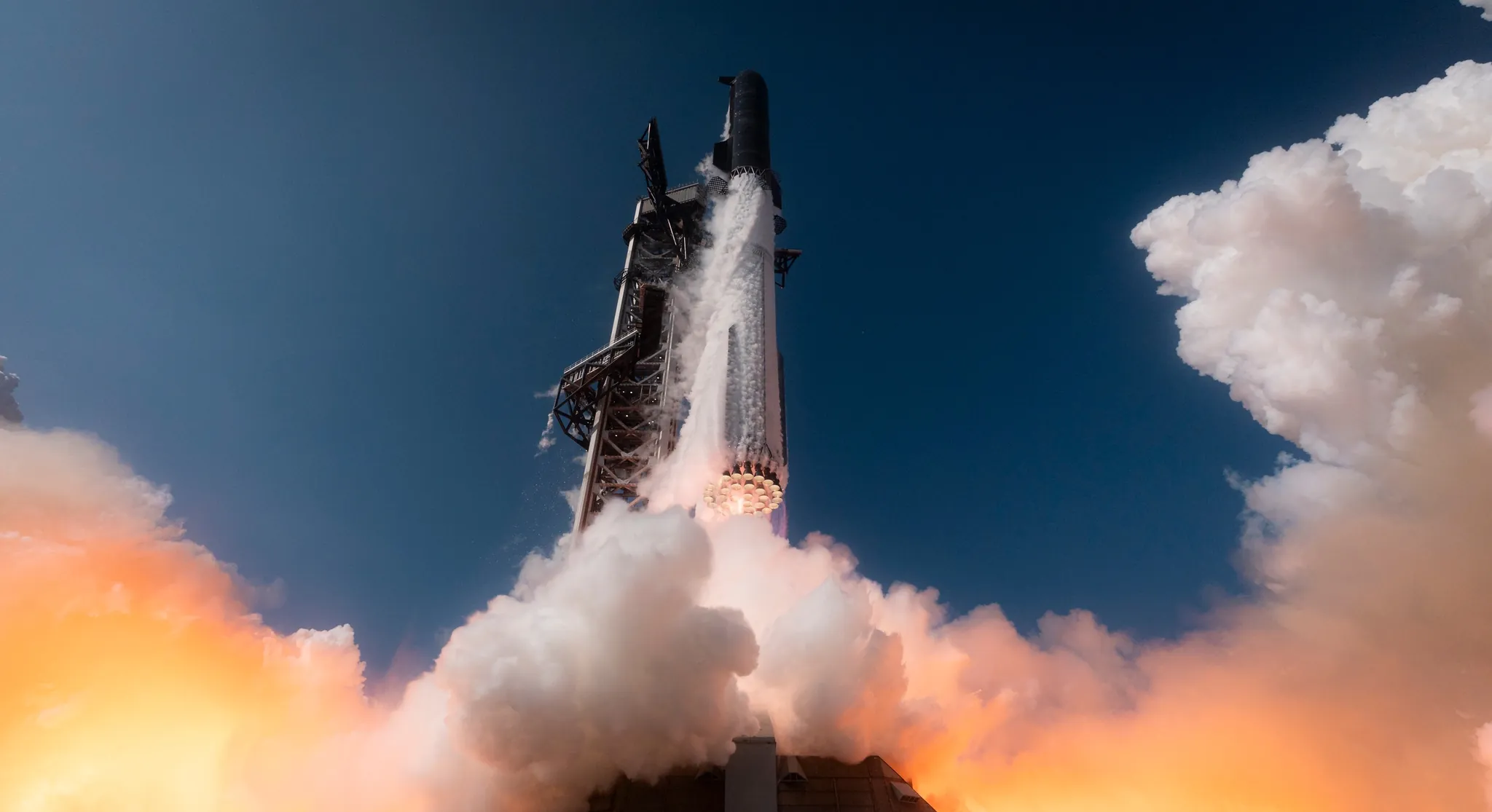
Starship Flight 12 turned into a space logistics problem at T+1m42s, when a Raptor V3 engine failed during ascent. The booster did not complete the planned boostback burn because not all planned engines relit, then suffered a hard splashdown. The FAA required a SpaceX-led mishap investigation before Starship launches could resume, and the program was grounded while that review proceeded.[1][2]
That sequence matters for anyone evaluating space logistics AI after a Starship launch failure because the failure node was not a vague “space operations” risk. It sat in launch-vehicle propulsion, ascent performance, and the decision window before and during flight. If a satellite is already in orbit, anomaly response software may still save a mission. If the launch vehicle cannot sustain the ascent profile, the satellite deployment schedule has already lost its gate.
Only after that bottleneck is visible does the market number become interesting. Dataintelo put the spacecraft anomaly response services market at $3.8 billion in 2025 and projected it to reach $8.6 billion by 2034.[3] Those figures are useful as a proprietary research-firm market signal, not as proof that every operational risk in a Starship-dependent deployment plan is being covered.
The load-bearing procurement question is narrower: if anomaly-detection AI is already a multibillion-dollar category, why did it not reduce the launch failure that interrupted the Starship cadence? The answer is not that AI is irrelevant to space logistics. It is that the funded category has been drawn around a different asset, phase, telemetry stream, and decision window.
The market label is broader than the deployed systems
Dataintelo’s segmentation is more useful than the headline forecast because it shows where the money is actually pointed. On-orbit anomaly response represented 34.2% of the spacecraft anomaly response services market, while predictive anomaly detection represented 13.6%, or roughly $517 million of the $3.8 billion market.[3] The predictive segment was described as the fastest-growing, with a 12.7% CAGR, but the briefed use cases still center on satellite and spacecraft health rather than launch-vehicle propulsion diagnostics.[3]
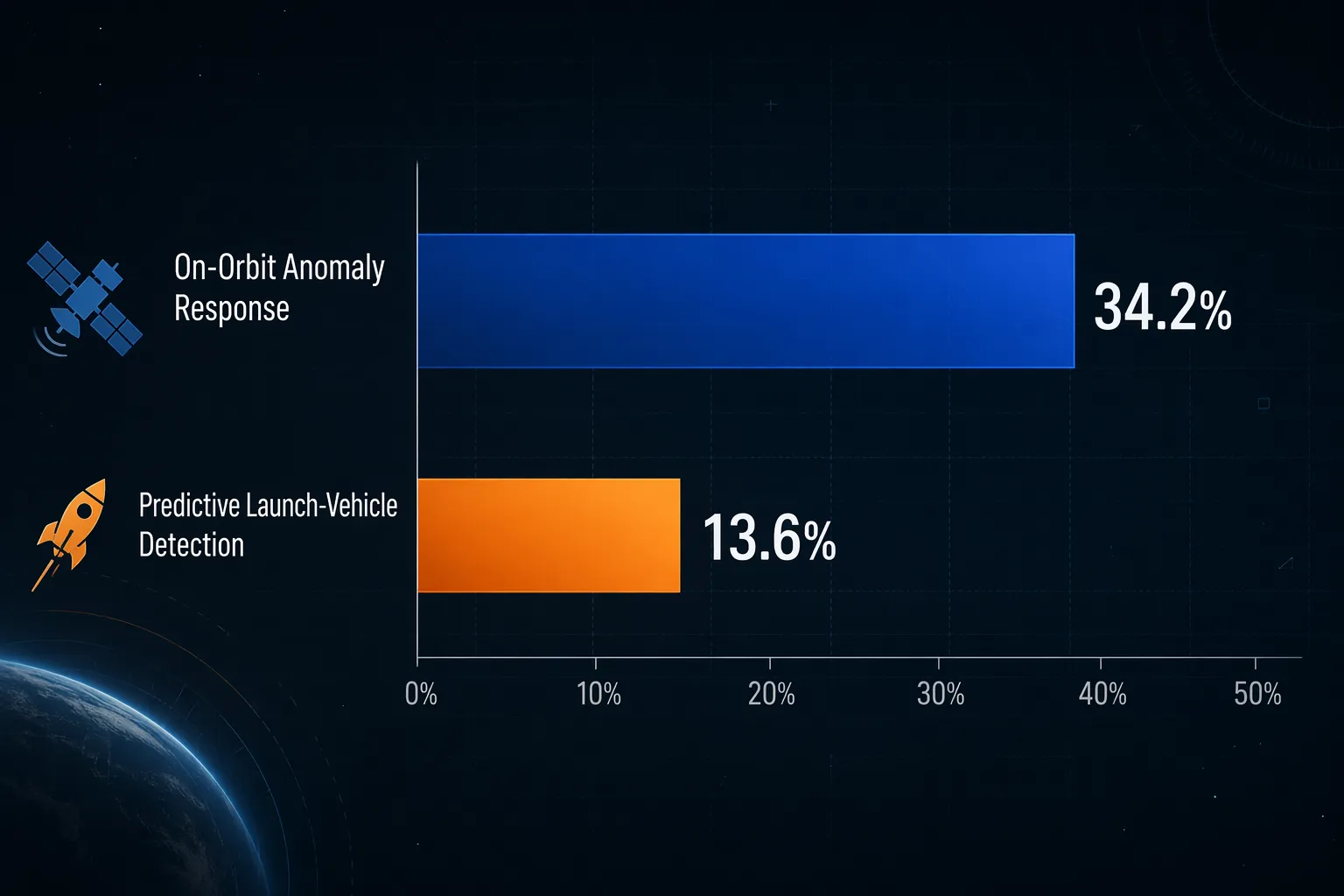
That distinction is easy to flatten in procurement language. “Spacecraft anomaly response” sounds close enough to “space logistics AI” to be cited as general coverage. But on-orbit response is a different operational problem from a Raptor engine failure during ascent. It watches a spacecraft after successful launch, often when operators still have time to isolate a subsystem fault, change mode, reroute power, or preserve mission life. Flight 12’s interruption occurred before that operating envelope existed.
The same pattern appears in the larger awards. Dataintelo cited $2.4 billion in U.S. Space Force anomaly response contracts during 2024–2025, while noting that the funded scope did not target launch-vehicle propulsion or structural failure prediction.[3] The $520 million Raytheon modification cited in the same market context reinforces the point: these are substantial anomaly-response commitments, but they do not, by themselves, buy down the risk that stopped the Starship schedule.[3]
The AFRL/PiLogic “Exact AI” CRADA announced in June 2026 is a clean example of useful AI pointed at a different problem. Public descriptions say the system ingests satellite telemetry to detect internal faults, electronic warfare effects, cyber attacks, and space-weather impacts in spacecraft electrical subsystems.[4][5] That is not trivial work. It is also not countdown health monitoring for a launch vehicle, nor ascent-phase detection for propulsion degradation.
Dataintelo also reported that machine-learning anomaly detection demonstrated a 38% reduction in unplanned outages and a 47% improvement in mean time to detection.[3] Those are material gains, but the measured improvement belongs to the satellite-health side of the operating model described in the market brief. It should not be casually transferred to Starship launch reliability without evidence that the same telemetry access, model scope, validation regime, and intervention window exist on the vehicle before and during ascent.
| Procurement label | What the cited scope mainly observes | Where Flight 12 failed |
|---|---|---|
| Spacecraft anomaly response | Spacecraft or satellite behavior after launch | Launch-vehicle propulsion during ascent |
| On-orbit anomaly response | Satellite health, internal faults, mission continuity | Pre-orbit booster performance and recovery sequence |
| Predictive anomaly detection | Fast-growing segment, still described around spacecraft and satellite monitoring | No cited coverage of Raptor V3 ascent failure prediction |
| Space logistics AI benchmark | Often treated as a broad spend category | Needs failure-node mapping before it can be counted as risk coverage |
Starship reliability is a deployment constraint, not just a launch story
SpaceX’s own risk language connects the technical anomaly to the logistics consequence. In its S-1 language quoted by Spaceflight Now, the company warned that “Unexpected design modifications, supply chain disruptions, anomalies...could result in delays or failures to deploy Starship on our anticipated schedule, which would delay...deployment of our next-generation satellites.”[1] That is the sentence procurement teams should sit with. The issue is not whether a dramatic vehicle loss makes headlines. The issue is whether the launch system gates the downstream satellite plan.
This is familiar outside space. A manufacturer can buy a polished visibility layer for finished-goods movements and still miss the machining constraint that locks the production plan three weeks earlier. An airline supplier can deploy a delay-prediction model and still be blind to the sub-tier component that actually breaks the schedule. The useful question is not whether the software contains AI; it is whether it observes the failure node early enough for an operator to change the outcome.
That is why the closer terrestrial analog is not generic dashboarding, but targeted early warning. In aircraft programs, AI aircraft manufacturing delay prediction only matters when the model watches the work packages, supplier commits, and quality holds that precede the delay. The same standard should apply to space logistics AI. A satellite anomaly system can be excellent and still irrelevant to the launch-vehicle failure mode that determines whether the satellite reaches orbit at all.
The supply base makes misclassification more expensive
The launch bottleneck sits on top of a stressed aerospace industrial base. AIA/PwC reported that U.S. space objects exceeded 3,700 in 2025, more than 10 times the 2019 level, while the average aerospace facility age was 26 years.[6] That combination means demand is moving faster than the physical and supplier base that has to support it.
The same report described a legacy supplier that declined to rebid space work because space-specific requirements consumed more than 30% of engineering time while producing only low-single-digit revenue.[6] That is not a software adoption statistic; it is a capacity warning. When low-margin, engineering-heavy work becomes unattractive, launch reliability risk is not isolated inside the launch provider. It propagates into supplier willingness, qualification lead times, redesign work, and recovery schedules.
For supply-chain teams, this is where AI aerospace supplier visibility becomes relevant. Mapping sub-tier exposure is not a substitute for launch-vehicle diagnostics, but it changes the procurement review. If a propulsion redesign, qualification issue, or facilities constraint emerges after a mishap investigation, the recovery path depends on which suppliers can actually absorb the engineering load.
The satellite side still deserves investment. Constellation operators need anomaly detection once assets are in orbit, and satellite production programs have their own monitoring needs. The lesson from Amazon Kuiper AI satellite monitoring is not that satellite-focused AI is misplaced. It is that satellite monitoring and launch reliability should not be booked under the same risk-control line item.
What procurement teams should stop counting as coverage
A space logistics AI proposal should not get credit for Starship launch-risk coverage merely because it sits in the spacecraft anomaly response market. Procurement teams need to separate four dimensions before benchmarking spend or approving a vendor claim.
- Asset: Is the system observing the launch vehicle, the satellite payload, the ground system, or the supplier network?
- Phase: Does it operate before launch, during countdown, during ascent, during orbit insertion, or after the spacecraft is operational?
- Telemetry: Does it ingest propulsion, structural, thermal, electrical, avionics, supplier, or mission-operations data?
- Decision window: Is there enough time and authority to inspect, hold, scrub, reconfigure, repair, or reroute the schedule?
Those questions are less elegant than a market forecast, but they are harder to evade in a procurement review. A satellite electrical-subsystem model may be the right purchase for preserving an on-orbit asset. It is not evidence that the organization has reduced ascent propulsion risk. A supplier visibility system may expose capacity fragility. It is not a substitute for vehicle-health diagnostics. A launch-vehicle AI program would need to be evaluated on its own telemetry access, test data, false-alarm tolerance, certification posture, and operator decision rights.
Nothing in the cited material proves that a different AI system would have prevented Flight 12. That is not the claim procurement teams should make. The defensible claim is narrower and more useful: the current investment pattern left the Starship launch-vehicle reliability risk largely outside the funded AI perimeter, even while spacecraft anomaly response spending grew around satellite health.
The practical test is simple enough to use before the next benchmark deck: does the proposed AI system observe the asset, phase, telemetry, and decision window where the bottleneck actually occurs? If the answer is no, satellite anomaly-detection contracts should not be counted as coverage for launch-vehicle reliability risk.
References
- FAA requires SpaceX-led mishap investigation before resumption of Starship launches, Spaceflight Now, May 27, 2026
- FAA grounds SpaceX's Starship megarocket after Flight 12 mishap, Space.com, May 27, 2026
- Spacecraft Anomaly Response Services Market Research Report 2034, Dataintelo, Apr 2026
- PiLogic Partners with AFRL on AI Anomaly Detection Tech, Payload Space, Jun 2026
- Can AI Predict Satellite Failures Before They Happen?, The Defense Post, Jun 18, 2026
- Report: Space Launch Boom Risks Outpacing Supply Chain Capacity, SupplyChainBrain, Mar 2026
§ 42 — Cited evidence
Flag an inaccuracy or submit a comparable account — Contribute or read how claims are verified in Methodology.