§ 41 — Use-case analysis
What AI for Food Supply Chain Recall Management Has Delivered
Examines documented results from real AI deployments in food supply chain recall management — traceability speed, incident prevention, defect detection — with clear verification levels on each figure. Helps supply-chain directors pressure-test vendor proposals against actual, dated evidence.
- Function
- recall management
- AI technique
- traceability AI
- Failure pattern
- overstated vendor claims
- Evidence source
- Food Processing 2026, LF Decentralized Trust, Mergen AI 2026, Consumer Goods 2025, Lumafield
The honest evidence ledger for AI in food supply chain recall management is useful, but thinner than most sales decks imply. The strongest documented outcomes fall into three buckets: traceability speed, incident avoidance, and controlled-line detection. The problem is not that the numbers are weak. It is that several of the most attractive numbers are company- or vendor-reported, tied to large-enterprise environments, and rarely repeated with the same metric at full production scale.
| Deployment or dataset | Reported result | What it actually supports | Verification label |
|---|---|---|---|
| Cargill Hazard Alert System | 41 food-safety incidents avoided across 18 months, reported in May 2026 [1] | A specific prevention claim inside a large food company’s operating environment | Company-reported; specific and dated; not independently audited in the source |
| Walmart / IBM Food Trust on Hyperledger Fabric | Traceback compressed from 7 days to 2.2 seconds; pilot covered 25+ products; Walmart later required leafy-green suppliers to participate [2] | A high-end traceability-speed benchmark when the network is instrumented and supplier participation is mandated | Case-study reported; pilot-era benchmark from 2016–2018; not re-run publicly at full production scale |
| 2025 FDA recall dataset analyzed by Mergen AI | 1,576 FDA food recalls, including 770 Class I recalls; 73.7% of Class I recalls tied to microbial contamination; one cucumber supplier failure triggered 258 downstream recalls across 4 tiers with a 23–31 day detection lag [3] | The operational pressure behind faster detection and traceback: one upstream failure can turn into hundreds of downstream actions | Dataset analysis; FDA food and cosmetics scope only, excluding USDA-FSIS meat and poultry |
| UConn machine-learning pathogen detection | Less than 2 hours detection time with 98% accuracy, compared with 1–3 days for traditional culture methods, as referenced in the Mergen AI recall analysis context [3] | A stronger evidentiary signal for detection-method performance than for full recall-management deployment | Academic study referenced by secondary analysis; method-level evidence, not enterprise recall orchestration evidence |
| Nestlé AI vision systems | 80% reduction in manual quality checks and 700 tonnes of food saved | AI inspection can reduce manual verification load in selected quality operations | Company-reported; no independent audit link supplied in the research brief |
| PepsiCo computer vision inspection | 95% defect-detection accuracy | Computer vision can perform strongly on controlled inline inspection tasks | Company-reported; production-scale third-party audits remain rare |
| Chick-fil-A / Ancera | Real-time Salmonella risk monitoring using predictive temperature sensing | A named example of AI-supported risk monitoring closer to the restaurant supply chain | Operational deployment with named partner; no independent outcome audit supplied in the research brief |
| Augury 2025 State of Production Health coverage | Only 16% of food and beverage companies have scaled AI beyond pilot; F&B manufacturers rank supply-chain disruption as their No. 1 barrier to production targets, while supply-chain AI is the area where they report the least AI impact [4] | A reality check: scaled AI adoption in F&B is still limited, and supply-chain AI is not where manufacturers report the strongest payoff | Industry survey/report coverage; useful for adoption context, not recall-specific effectiveness |
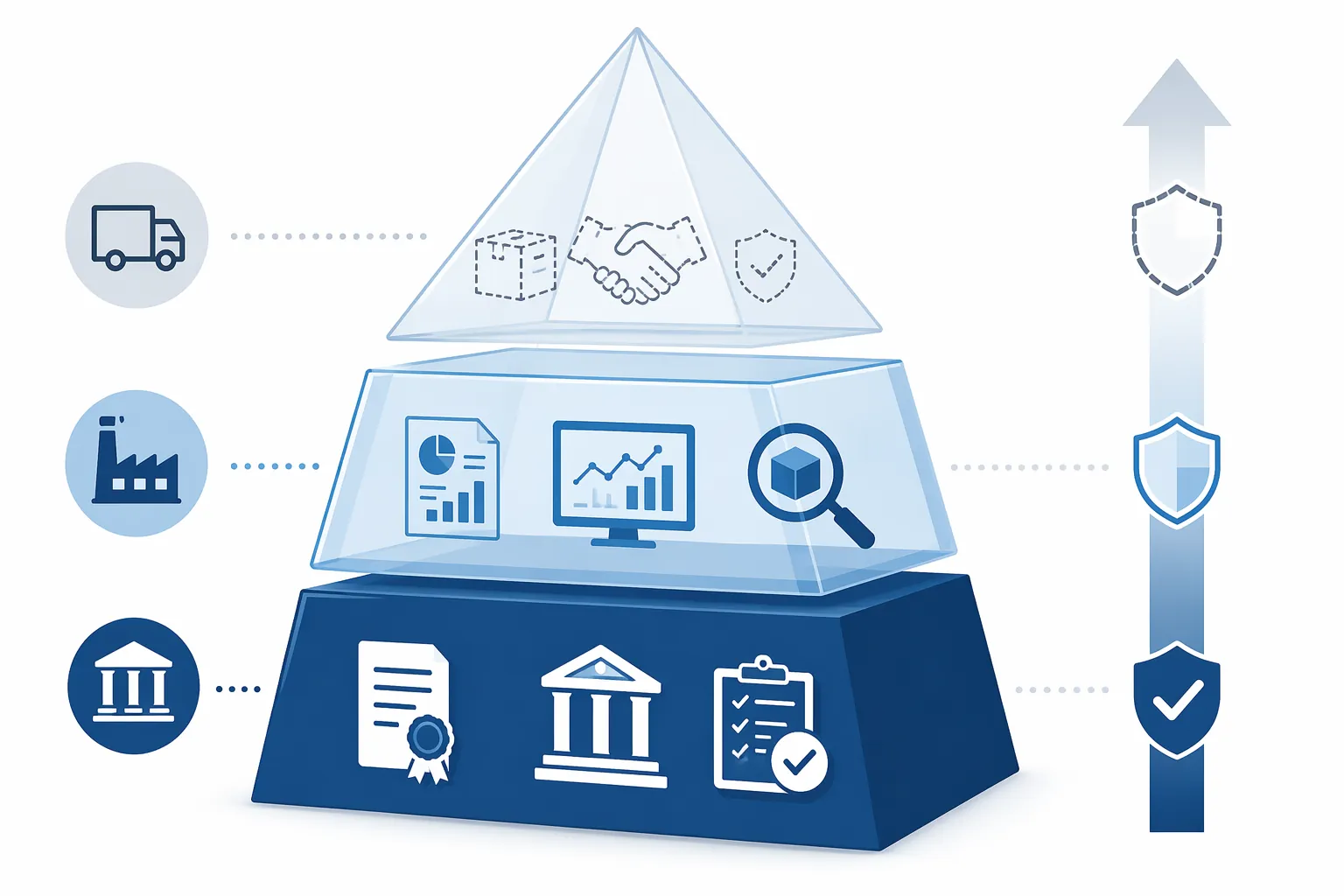
That table is the procurement starting point. It separates a recall-management result from a quality-inspection result, a pilot benchmark from a scaled operating norm, and a company’s internal claim from evidence a buyer could defend in a capital review.
The Walmart Number Is Real Enough to Matter, and Too Specific to Generalize
The Walmart / IBM Food Trust benchmark is still the number that changes the room: traceback time cut from 7 days to 2.2 seconds [2]. Anyone who has waited for supplier spreadsheets, bill-of-lading pulls, lot-code reconciliations, and conference-call confirmations understands why that figure gets repeated.
But the useful reading is narrow. The benchmark came from the 2016–2018 pilot period, involved more than 25 products, and sat inside a network that Walmart could push suppliers to join [2]. It does not prove that any traceability platform, installed into any mixed supplier base, will turn a week of work into seconds. It proves that when the right product data is already captured, permissioned, standardized, and queryable, the act of traceback can collapse from manual triage into database retrieval.
That distinction matters because the software is not doing all the work. The hard part is the network discipline around it: supplier onboarding, lot-level data capture, event standards, exception handling, and a buyer with enough leverage to make participation mandatory. Walmart later required leafy-green suppliers to participate, which is exactly the kind of governance condition that makes the benchmark more believable for Walmart than for a buyer hoping voluntary suppliers will self-organize [2].
For a buyer evaluating traceability software, the 2.2-second figure is best treated as a ceiling case, not a median forecast. The vendor should be able to say whether its proposed deployment has the same ingredients: product scope, supplier mandate, data standards, event capture, and recall-query workflow. Without those, the number is a demonstration of what a governed network can do, not a promise about the buyer’s network.
Prevention Claims Are More Valuable, but Harder to Verify
Cargill’s Hazard Alert System claim deserves attention because it is operationally specific: 41 food-safety incidents avoided over 18 months, reported in May 2026 [1]. A prevented incident is more valuable than a faster recall after distribution has already begun. It can mean a contaminated input was stopped before shipment, a process deviation was caught before release, or a supplier risk signal was escalated before finished goods moved downstream.
The verification weakness is equally clear. The figure is self-reported. The public evidence does not make it an audited avoided-recall count, and it does not allow a buyer to convert 41 avoided incidents into a clean savings figure. Some incidents might have become recalls. Some might have become holds, rework, supplier corrections, or internal investigations. Those distinctions are not accounting trivia; they decide whether the claim belongs in a risk-reduction case, a cost-avoidance model, or only a safety-process narrative.
Still, this is the type of claim worth pursuing in diligence. It has a named company, a named system, a time window, and an outcome count. The next questions are not philosophical. They are procurement questions: What counted as an incident? Who adjudicated avoidance? How many alerts were false positives? How many became supplier corrective actions? Was the baseline the prior 18 months, a risk model, or expert review? Could the buyer speak with the quality leader who closed the cases?
The Recall Dataset Shows Why Slow Detection Multiplies Work
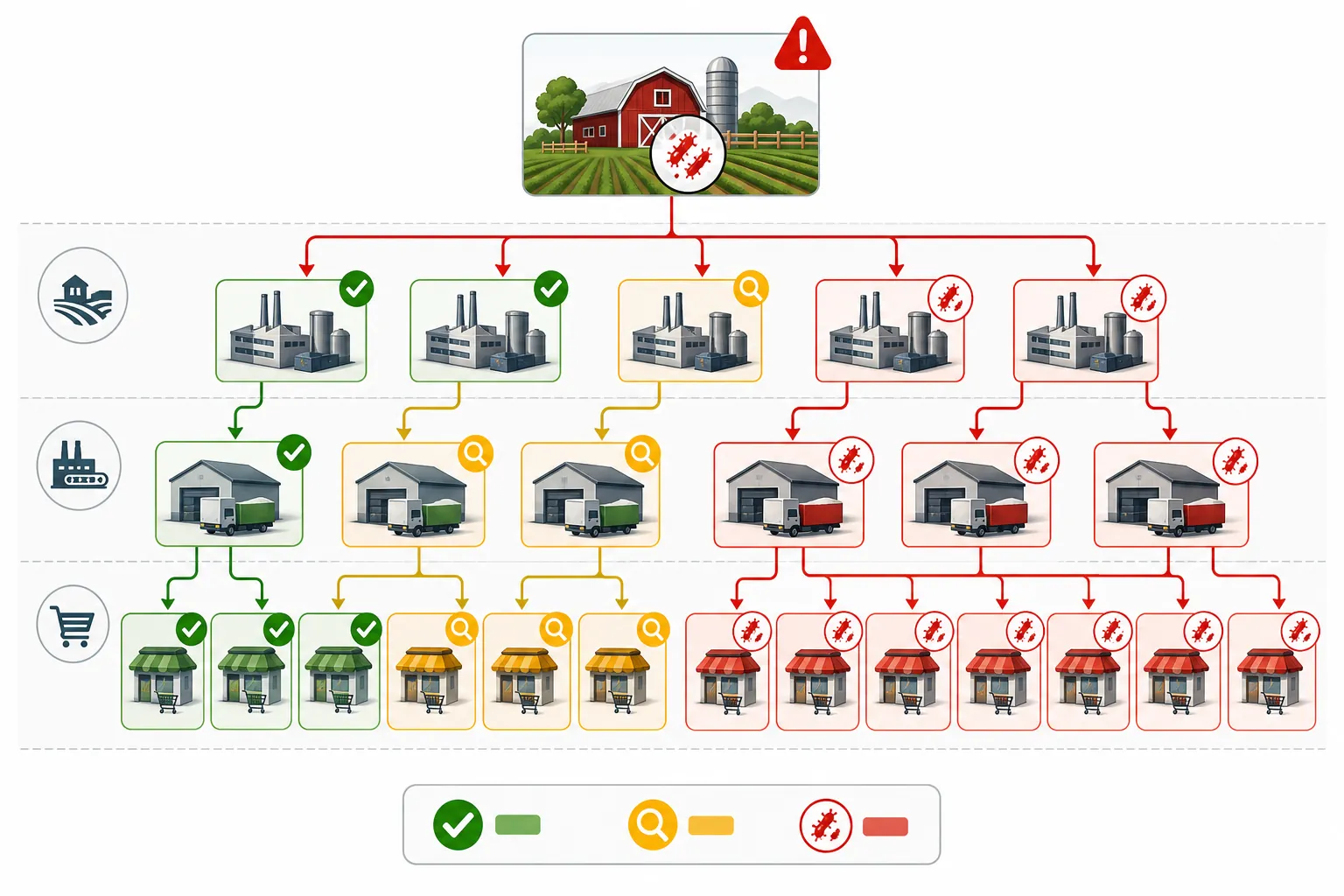
The 2025 FDA recall dataset analyzed by Mergen AI is not an AI deployment result, but it explains the operating pressure. The analysis identified 1,576 FDA food recalls, including 770 Class I recalls, and found microbial contamination behind 73.7% of Class I recalls [3]. The scope is important: the dataset covers FDA food and cosmetics, not USDA-FSIS meat and poultry, so it should not be treated as a complete U.S. food-recall count [3].
The cucumber cascade is the part that should make recall teams uncomfortable. One supplier failure triggered 258 downstream recalls across 4 tiers, with a 23–31 day detection lag [3]. That is not an abstract “supply chain complexity” problem. It is a queue of downstream consignees, private-label customers, distributors, foodservice accounts, public notices, inventory holds, and customer-service scripts forming while the source remains unresolved.
This is where traceability speed and early warning begin to connect. A slow pathogen signal gives contaminated product time to move. A slow traceback gives affected product time to fragment across customers and channels. A slow supplier confirmation forces a recall coordinator to choose between over-recalling and waiting. AI does not remove those choices by itself, but the strongest evidence says it can compress certain steps if the data exists before the emergency.
For related case framing on how traceback gaps magnify downstream action, the egg-recall planning analysis at ChainSignal’s recall traceability planning coverage is a useful companion, but the cucumber case alone is enough to show why procurement teams should not evaluate recall AI only as a documentation convenience.
Detection Evidence Is Strongest When the Environment Is Controlled
PepsiCo’s reported 95% defect-detection accuracy sits in a different evidence lane from recall traceback. It supports the case for computer vision in inline inspection, where lighting, product presentation, defect definitions, and rejection rules can be controlled. It does not, by itself, prove that an AI platform can manage multi-tier recall decisions across suppliers, customers, and regulators.
Nestlé’s reported 80% reduction in manual quality checks and 700 tonnes of food saved belongs in the same neighborhood. The claim points to labor and waste reduction from AI vision systems, and it matters because fewer manual checks can change plant tempo. But the public claim should remain in the “company-reported operational result” column unless the buyer can inspect deployment scope, baseline, exception rate, and audit history.
The UConn pathogen-detection result deserves a different kind of respect. A machine-learning approach delivering less than 2 hours detection time with 98% accuracy, compared with 1–3 days for traditional culture methods, is stronger method-level evidence than a generic vendor accuracy slide [3]. The boundary is that pathogen detection is not the same as recall management. A faster positive signal still has to flow into lot genealogy, product disposition, customer notification, regulatory decisioning, and corrective action.
That boundary is not a knock on detection technology. It is the implementation map. A buyer can procure fast detection and still have slow release holds. A buyer can procure traceability and still have late microbial confirmation. The better question is where the current recall process loses the most time: waiting for a lab result, waiting for supplier records, reconciling lots, confirming customer shipments, or approving public communication.
Cost Avoidance Needs a Dated Baseline, Not a Vague Multiplier
The common recall-cost baseline is still the 2011 Grocery Manufacturers Association figure: an average direct recall cost of $10 million per incident [5]. That figure is old, and many current recalls would exceed it once inflation, customer penalties, logistics disruption, and brand effects are considered. But it remains useful as a floor for capital-review math because even one avoided major recall can dominate the subscription and implementation cost of many systems.
The same source discussion cites a 3–5x total economic impact multiplier and notes that 49% of total cost can come from business interruption in a pharma recall-cost analysis applied by analogy to food [5]. That analogy should be used carefully. It can help explain why direct disposal and logistics costs understate exposure, but it should not be pasted into a food business case as if the food-company loss profile has been audited.
This is why avoided-incident claims need definitions. If Cargill’s 41 avoided incidents included hazards that would have become Class I recalls, the economic value could be enormous [1]. If they were mostly internal holds or near misses, the value is still real but belongs to a different line of the business case. Procurement should not reject prevention claims because they are hard to monetize; it should force the vendor and internal sponsor to classify them honestly.
FSMA 204 Raises the Data Bar, but It Does Not Validate AI Claims
FSMA 204 matters because it pushes food companies toward more disciplined traceability records for covered foods. The compliance timeline, however, remains in active regulatory process, with a proposed extension to July 2028 and final language subject to change. That makes FSMA 204 relevant to readiness planning, not a shortcut for evaluating AI effectiveness.
The practical link is narrower: the more complete the critical tracking event and key data element record is before a recall, the more plausible a fast traceback claim becomes. AI can help query, reconcile, flag exceptions, and prioritize risk, but it cannot recover missing lot genealogy after distribution has already scattered product through four tiers.
For teams building the regulatory data foundation, ChainSignal’s FSMA 204 traceability analysis is the better place to go deeper. In this evidence review, the point is simply that compliance infrastructure can make AI recall tools more useful, but compliance intent is not evidence of recall-performance results.
Adoption Is Still Behind the Sales Narrative
The Augury 2025 State of Production Health coverage is a useful cold-water check. Food and beverage manufacturers ranked supply-chain disruption as their No. 1 barrier to production targets, yet supply-chain AI tooling was where they reported the least AI impact; only 16% of F&B companies had scaled AI beyond pilot [4].
That does not contradict the Walmart, Cargill, UConn, PepsiCo, or Nestlé results. It explains why they should not be treated as normal outcomes. The public record is still concentrated around large companies, named pilots, controlled production environments, and company-reported success stories. Mid-market, multi-supplier, independently audited recall-management results are much harder to find.
This gap matters in procurement because a food manufacturer does not buy an industry trend. It buys a deployment into its own supplier leverage, plant systems, data quality, recall team capacity, customer notification rules, and regulatory exposure. A vendor that cannot explain how its reference cases map to those conditions is asking the buyer to underwrite the difference.
What to Demand Before Treating a Result as Procurement Evidence
A single accuracy percentage without date, scope, and verification status should not survive the first review meeting. The buyer needs the result broken into operating claims: what changed, where it changed, who measured it, and whether the result has been repeated outside the sales reference account.
- Named deployment: customer, business unit, geography, product category, and whether the buyer can speak with the operating owner.
- Dated result: pilot dates, production go-live date, measurement window, and whether the metric was re-measured after scale-up.
- Scope boundary: number of suppliers, products, plants, distribution nodes, customers, and covered hazard types.
- Baseline method: prior-period comparison, control line, expert adjudication, lab method comparison, or modeled counterfactual.
- Verification level: self-reported, vendor case study, customer-confirmed, academic peer-reviewed, third-party audited, or regulator-observed.
- Operational side effects: false positives, manual review burden, supplier exception rates, missed detections, alert fatigue, and recall-decision governance.
The strongest RFP question is not “What is your AI accuracy?” It is “Show the last three dated recall, withdrawal, hold, or avoided-incident outcomes from deployments that look like our network, and label which were independently verified.” A vendor with real evidence will have to narrow the claim. A vendor without it will usually widen the language.
How to read the major result types
| Claim type | Good evidence looks like | Weak evidence looks like |
|---|---|---|
| Traceback speed | Time-stamped recall simulation or real event across named suppliers and products | A dashboard demo showing instant search against sample data |
| Incident prevention | Adjudicated avoided incidents with definitions, alert history, and corrective actions | A count of “risks detected” with no outcome classification |
| Pathogen detection | Peer-reviewed method performance or validated lab comparison tied to a workflow | Accuracy percentage without matrix, sample conditions, or false-positive impact |
| Inline inspection | Production-line performance with defect definitions, reject rates, and human review burden | Vision-model accuracy from a controlled test set only |
| Cost avoidance | Scenario model tied to direct recall-cost baseline, interruption exposure, and incident severity | Multiplying every avoided alert by a generic recall-cost estimate |
The available evidence supports investment when the proposed use case is concrete. Traceability platforms can materially reduce traceback time if the supplier network is governed. Detection models can outperform slower methods in defined testing conditions. Vision systems can reduce manual checks and catch defects on controlled lines. Prevention systems may stop incidents before they become public recalls, but the public numbers are still mostly self-reported.
The procurement test is sober: AI recall-management investment is justified when the vendor can show named, dated, scope-specific outcomes at the buyer’s relevant scale, with verification labels attached. If the best available proof is a pilot benchmark, a company-reported avoided-incident count, or an accuracy percentage from a controlled line, treat it as a ceiling case until the vendor proves otherwise.
References
- AI Helped Cargill Avoid 41 Food Safety Incidents, Food Processing, May 2026.
- Walmart Case Study, LF Decentralized Trust.
- FDA Recalls Story Final, Mergen AI, February 2026.
- Where Food & Beverage Manufacturers See Real ROI From AI, Consumer Goods.
- The Real Cost of a Product Recall and How to Prevent One, Lumafield.
§ 42 — Cited evidence
Flag an inaccuracy or submit a comparable account — Contribute or read how claims are verified in Methodology.