
§ 41 — Use-case analysis
How Salmonella Egg Recalls Expose Supply Chain Planning Gaps
Using the 2025 salmonella egg recalls as a stress test, this analysis maps how five major supply-chain planning platforms handle lot-level traceability under FSMA 204 rules, revealing why most food enterprises default to costly shotgun recalls and which platform offers the closest surgical alternative — along with the evidence gaps buyers must verify.
The August Egg Company recall is the right place to start. It had the uncomfortable shape planners recognize: a real public-health event, a large product universe, several brand names, and lot codes that existed but still did not make the recall feel narrow.
FDA’s June 2025 outbreak investigation tied the August Egg Company recall to 1.7 million dozen eggs, or 20.4 million individual eggs, with 134 illnesses, 38 hospitalizations, and one death across 10 states.[1] The recalled shell eggs were sold under multiple brand names, and the recall language identified plant codes and Julian date windows rather than a single consumer-facing label.[1] That is not a documentation failure in the simplistic sense. It is what happens when production, packing, branding, channel allocation, distributor execution, store withdrawal, and customer notification all have to line up after the product has already moved.
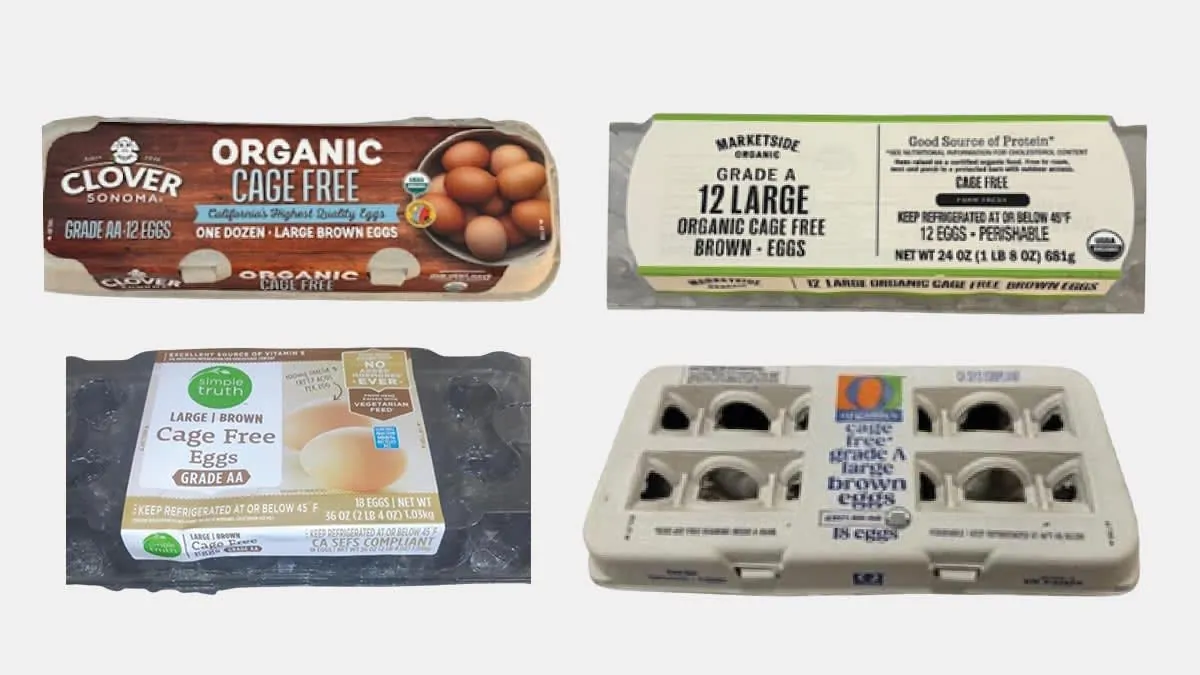
A second FDA salmonella egg investigation in August 2025 reported 105 illnesses across 14 states linked to Country Eggs.[2] Taken together, the 2025 egg events were less a neat sequence of isolated recalls than a stress test of how shell-egg supply chains behave when a biologically simple product becomes operationally fragmented: one egg is traceable at the plant, but one carton may be traceable only if every downstream handoff preserves the same evidence with the same discipline.
Why Lot Codes Do Not Automatically Produce Surgical Recalls
The planning problem is not that eggs lack identifiers. The August Egg Company recall named plant codes P-6562 and CA-5330 and used Julian date windows to define affected product.[1] Those identifiers matter. In a clean internal model, they should let a company move from source to finished goods, then from finished goods to customers, stores, and remaining inventory.
The trouble starts when that internal model meets the real commercial map. Shell eggs can leave a concentrated production source and be packed or repacked into different labels. They can move through retail and foodservice channels. They can sit in distributor systems that preserve purchase orders and case movements but not always the same lot-level structure the plant used. They can be split across customer accounts whose withdrawal processes are built around item numbers, store lists, pallet records, or vendor notices rather than a common traceability event model.
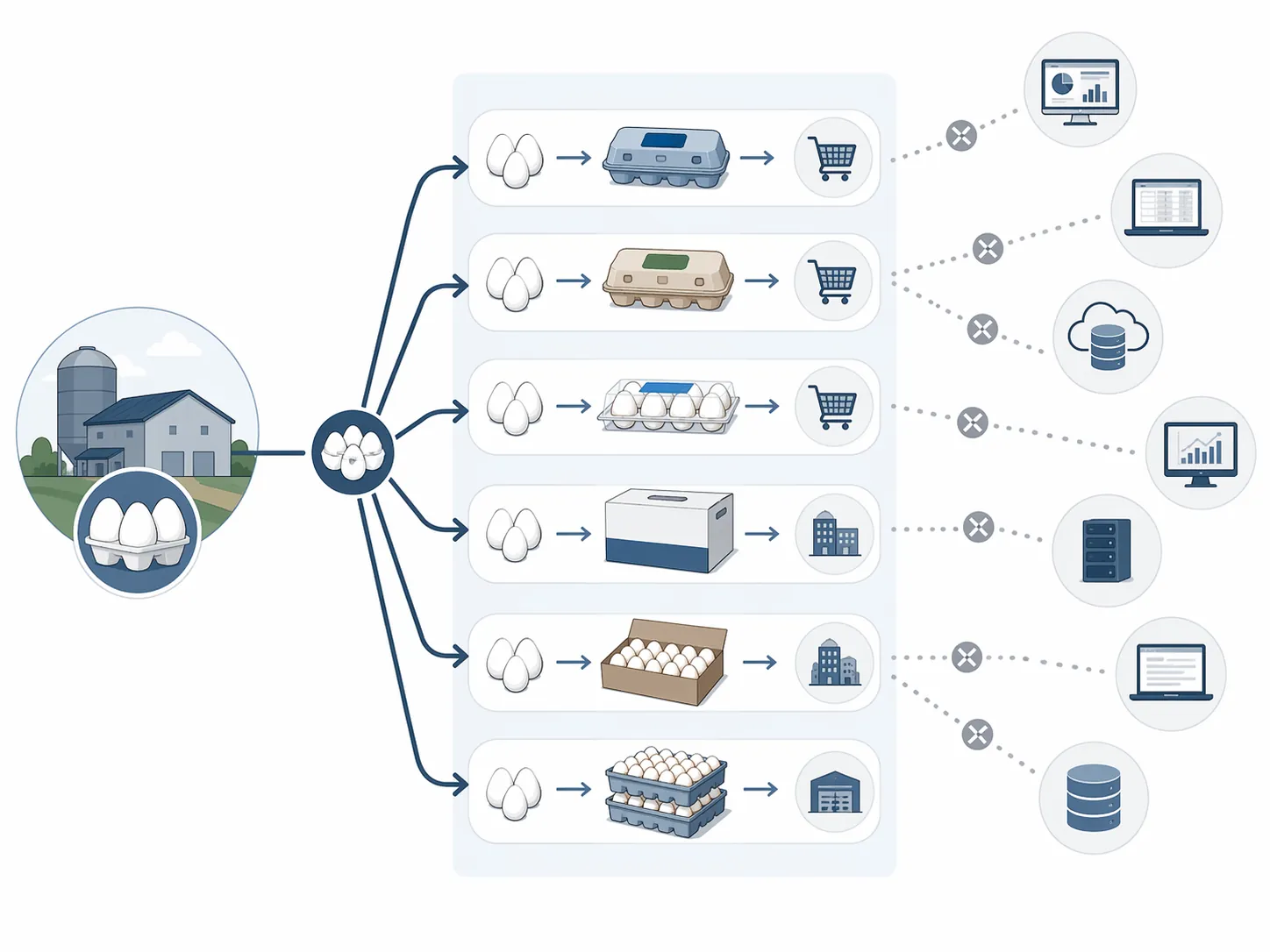
That is the difference between having a lot code and having lot-level continuity. A planner can know the plant, date range, and item family and still be unable to prove quickly which customers, stores, formats, or downstream lots are clean. Under pressure, the safe answer becomes the broad answer: pull everything plausibly connected, then reconcile later.
This is where the phrase “shotgun recall” earns its keep. It is not merely a larger recall. It is a recall whose scope is widened because the data chain cannot support a narrower one with enough confidence. A surgical recall requires more than knowing what left the plant. It requires a durable thread through critical tracking events: production, transformation or repackaging, shipping, receiving, redistribution, and channel execution.
FSMA 204 Raises the Bar From Internal Visibility to Traceability Evidence
FSMA 204 matters here because shell eggs are on the Food Traceability List, and covered firms must be able to provide required traceability records to FDA within 24 hours when requested.[3] The rule’s critical tracking event and key data element structure is not a planning taxonomy; it is a pressure test for whether the business can produce usable evidence when regulators, customers, and internal risk teams are waiting at the same time.[3]
A planning system can be excellent at forecasting demand, allocating supply, or optimizing inventory and still be weak at recall execution. Forecasting asks what should happen next. Recall traceability asks what exactly happened already, who touched it, what it became, where it went, and which records prove it. Those are adjacent disciplines, but they are not the same discipline.
The practical gap shows up in the handoffs. If repackaging changes the consumer-facing brand, the traceability record must preserve the relationship between source lot and finished label. If foodservice and retail draw from the same production window, channel splits must remain visible after order allocation. If a distributor receives mixed product, the receiving and shipping events must not flatten the lot detail into a generic item movement. If stores execute a pull, the withdrawal record must connect back to the same lot universe the recall team is using.
Supply-chain adaptation to FSMA has therefore been less about discovering that traceability matters and more about discovering where traceability stops. Enterprises tend to control their own plants, co-manufacturing records, item masters, and ERP transactions more tightly than they control distributor, customer, and store-level evidence. That boundary is exactly where broad recall language starts to look operationally rational.
What a Planning Platform Must Do Before a Recall Can Narrow
For a food enterprise evaluating planning platforms, the useful question is not whether a vendor says “visibility.” The useful question is what the platform can preserve, connect, and prove once a Class I recall is moving faster than the normal planning calendar.
| Recall-execution requirement | Why it matters in an egg recall | What weak evidence forces |
|---|---|---|
| Lot-level digital thread | Connects plant code, Julian date, pack configuration, and brand label after product moves | Broad product-family or date-window recall |
| Repackaging and transformation linkage | Preserves the relationship between source eggs and finished cartons or foodservice formats | Uncertainty across labels and formats |
| Partner-side event capture | Maintains receiving, shipping, redistribution, and withdrawal evidence outside the enterprise boundary | Distributor and customer over-pulls |
| Regulatory record readiness | Supports rapid production of CTE/KDE-style records when FDA requests traceability information | Manual reconciliation during regulator timelines |
| Mock-traceability testing | Shows whether the data chain works before an outbreak | Confidence based on architecture diagrams rather than executed proof |
The last row is the one that usually gets too little attention. A platform demo can show a beautiful chain after the data has been modeled. A mock traceability exercise shows whether a real lot can be followed through production, repackaging, distribution, customer receipt, and store or account withdrawal without a special project team quietly filling gaps in the background.
Blue Yonder Is the Closest Fit on Paper
Among the five platforms in scope, Blue Yonder’s Chain of Custody uses the language closest to the egg-recall problem. The company describes a lot-level chain of custody intended to support targeted recalls, immutable records, AI-based risk scoring, IoT monitoring, and FSMA 204 traceability mapping.[4] In a grocery-focused discussion, Blue Yonder also frames traceability as a way to move from broad inventory pulls toward more precise product removal.[5]
That matters because the product claim sits inside the recall rather than merely around it. A demand-planning module can help rebalance supply after a recall. An inventory optimization module can help decide where substitute product should go. A scenario engine can model service impacts. Chain of Custody, at least in public positioning, is aimed at the harder question: which lot moved through which custody events, and which units have to come out?
The caveat is large. The available material is vendor-published, and no independent post-mortem was found showing a named food company using Blue Yonder Chain of Custody to reduce a real recall from a broad pull to a narrower lot-level removal. That does not make the capability untrue. It does mean a buyer should treat it as the first proof request, not as a settled result.
The adoption issue is just as important as the feature issue. A lot-level digital thread only stays intact if plants, packers, distributors, customers, and execution points contribute compatible evidence. If the platform is strong inside the enterprise but partner records arrive as spreadsheets, PDFs, incomplete ASN data, or customer-specific pull confirmations, the recall team is still reconciling by hand at the exact moment the software is supposed to prevent it.
The Other Platforms Help Around the Recall
o9 Solutions has public evidence of food-and-beverage relevance. Danone selected o9 to modernize its global supply chain planning, a meaningful signal that the platform can operate in a complex food enterprise environment.[6] That is adoption evidence for planning applicability, not evidence of native recall execution. A Danone planning modernization does not prove that o9 can maintain lot-level traceability through repackaging, distributors, and store withdrawals during a Class I egg recall.
Kinaxis belongs in the conversation for concurrent planning and scenario response. In a recall, those strengths can matter after the affected product is identified: reallocating clean supply, testing service-level impacts, managing constrained substitutes, and coordinating demand changes. But those are post-identification planning problems. They do not, by themselves, establish the custody evidence needed to say which lot is affected.
RELEX is relevant where retail inventory, replenishment, and store execution are central. In an egg recall that crosses grocery customers, that downstream view can be valuable. The limitation is the same: inventory and replenishment visibility do not automatically reconstruct source-lot continuity across production, repackaging, distributor handling, and customer withdrawal.
Anaplan is useful for connected planning, financial scenario modeling, and cross-functional coordination. Those capabilities can help a company estimate exposure, model service recovery, and align commercial, supply, and finance teams after a recall decision. They should not be mistaken for a native recall-traceability engine unless the enterprise has integrated a separate system of record for lot-level events and partner custody data.
| Platform | Most defensible recall-adjacent role from public materials | What public materials do not prove |
|---|---|---|
| Blue Yonder | Lot-level chain of custody, targeted recall positioning, immutable records, IoT monitoring, FSMA 204 mapping | Independent named deployment reducing real recall scope |
| o9 Solutions | Food-enterprise planning modernization and supply-chain planning applicability | Native recall execution across lot custody events |
| Kinaxis | Scenario response, constrained supply planning, service-impact management | Lot-level recall traceability through repackaging and distribution |
| RELEX | Retail inventory, replenishment, and store execution relevance | Source-to-store recall evidence chain |
| Anaplan | Connected financial and operational scenario planning | Native custody-event recordkeeping for Class I recall execution |
This distinction can feel pedantic until the first customer asks for a withdrawal list by store, the regulator asks for traceability records, sales asks which brands are safe to keep shipping, and the plant team is still reconciling Julian dates against distributor receipts. Then it becomes the whole job.
The Cost Case Is Real, But the ROI Claims Are Not Yet Proven
The commonly cited average direct cost of a food recall is $10 million, based on a Grocery Manufacturers Association study that is still widely referenced but dates back to 2011.[7] It is best treated as a floor, not a current full-cost estimate. Modern recalls carry higher complexity in labor, customer communication, freight, disposal or diversion, legal work, production interruption, and commercial recovery.
The broader risk environment supports that caution. CRC Group reported that FDA recall units surged 232% in Q1 2025 to 70 million units.[8] Lumafield, writing on product recall economics, points to business interruption as a major component of total recall cost, including a 49% share in a pharmaceutical-sector analysis.[7] That sector is not food, so the number should not be imported as a food-specific ratio. It does reinforce the same operational lesson: the product pull is only part of the bill.
Automation claims deserve the same discipline. Food Industry Executive reported in June 2025 that automation can halve recall time and cut labor costs up to 90%, citing Recall InfoLink’s CEO.[9] That is a useful signal from a recall-automation specialist, not a quantified ROI result for o9, Blue Yonder, Kinaxis, RELEX, or Anaplan. None of the five platforms in this comparison publishes a verified estimate showing how much it reduces total recall cost in a real salmonella egg scenario.
A buyer can still build a business case, but it should be built from executed traceability tests rather than vendor averages. Take one actual high-risk product family. Select a production lot. Follow it through packing, rebranding, channel allocation, distributor movement, customer receipt, and withdrawal. Measure how long the team needs, how many manual touches occur, how many records are missing, and how much inventory must be pulled because the data cannot prove it is clean. That is the recall-cost model worth trusting.
What Buyers Should Ask Before Treating Visibility as Recall Readiness
A food enterprise evaluating these platforms should not ask for another end-to-end visibility slide. It should ask for evidence against the exact failure pattern the 2025 egg recalls exposed.
- Show a named food deployment where lot-level traceability survived repackaging, rebranding, and multi-channel distribution.
- Demonstrate how plant codes, Julian dates, finished SKUs, customer shipments, distributor receipts, and withdrawal confirmations remain linked.
- Run a mock traceability exercise using real historical transactions, not a prepared demo data set.
- Identify which partner systems must participate and what happens when a distributor or customer cannot provide event-level records.
- Measure the difference between the initial broad recall universe and the narrower universe the platform can support with evidence.
- Separate recall execution from recovery planning, demand rebalancing, inventory optimization, and financial scenario modeling.
Blue Yonder deserves the first traceability-specific proof request because its Chain of Custody materials address the lot-level recall problem most directly. It does not deserve an automatic win without independent deployment evidence, partner-side adoption proof, and a mock exercise that shows measurable recall-scope reduction. o9, Kinaxis, RELEX, and Anaplan may be valuable in the surrounding planning response, but public materials do not support treating them as native substitutes for recall-execution traceability.
The lesson from the 2025 salmonella egg recalls is narrow and important: broad recalls are often not the result of lazy planning. They are the consequence of broken lot-level continuity across commercial reality. Until a platform can prove that continuity through production, repackaging, distribution, and channel execution, “visibility” remains a planning promise, not recall readiness.
References
- Outbreak Investigation of Salmonella: Eggs, FDA, June 2025, link
- Outbreak Investigation of Salmonella: Eggs, FDA, August 2025, link
- Food Traceability & FSMA 204: How Traceable Are Your Products, SafetyChain, link
- What is Blue Yonder Chain of Custody, Blue Yonder, link
- Why Traceability is the Future of Grocery Retail, Blue Yonder, 2025, link
- o9 Solutions Partners with Danone to Modernize its Global Supply Chain, o9 Solutions, link
- The Real Cost of a Product Recall and How to Prevent One, Lumafield, link
- Beyond the Label: What 2025's Product Recall Trends Reveal About Emerging Risk, CRC Group, link
- Automating Recalls Dramatically Improves Speed, Accuracy, Traceability, Food Industry Executive, June 2025, link
§ 42 — Cited evidence
Flag an inaccuracy or submit a comparable account — Contribute or read how claims are verified in Methodology.