
The Hidden Bottleneck: Why Batch Data Pipelines Sabotage Warehouse AI
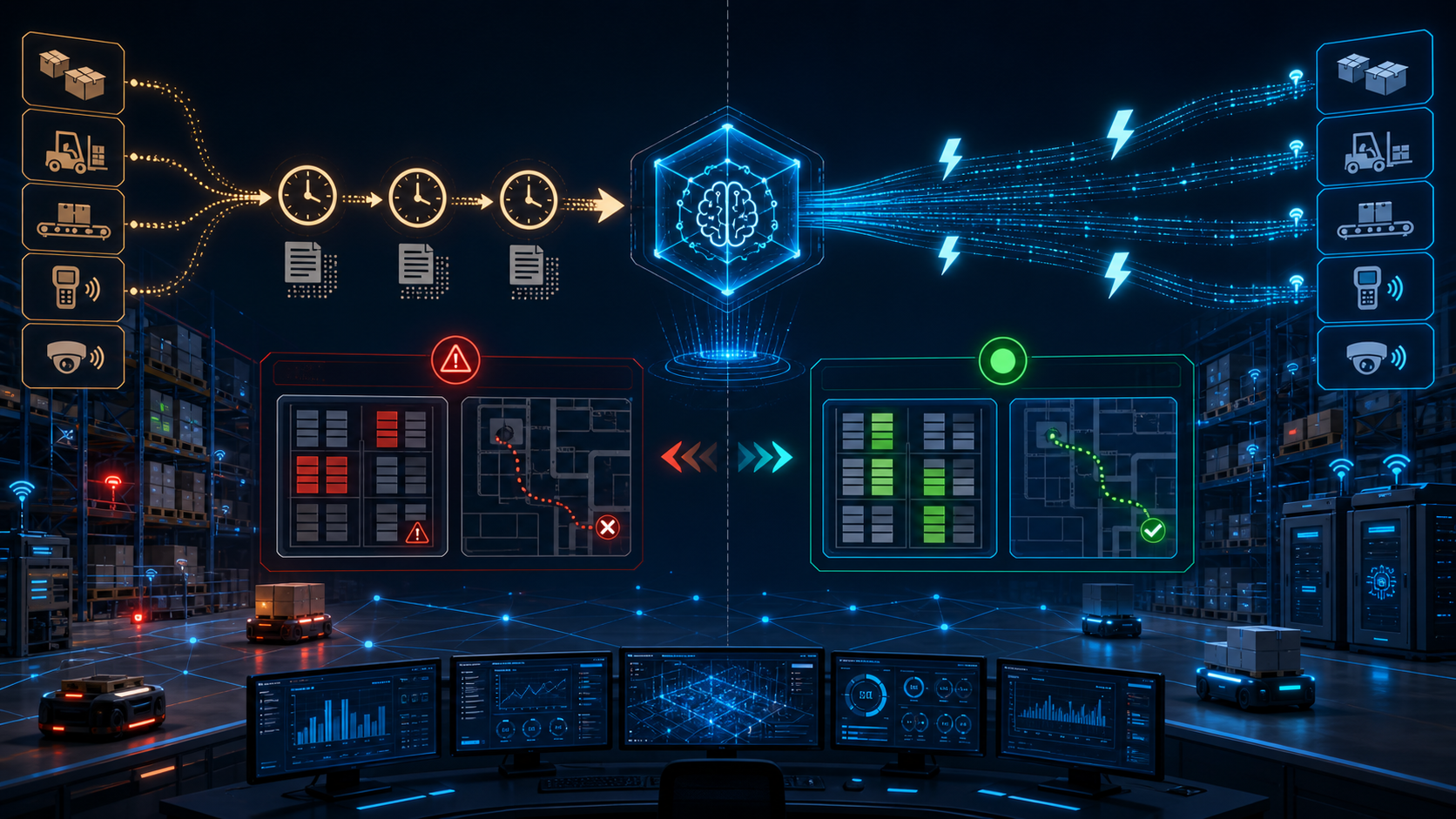
Warehouse AI models—whether for dynamic slotting, real-time pick-path optimization, or predictive maintenance—are only as good as the data they receive at inference time. The common assumption among supply chain leaders is that data quality (accuracy, completeness, consistency) is the primary barrier. In practice, however, a more insidious problem exists: data latency. When a warehouse management system (WMS) exports data in nightly batch extracts, the information feeding the AI is already 12 to 24 hours old by the time it reaches the model. In a fast-moving distribution center where inventory positions, labor assignments, and order priorities shift every few minutes, yesterday’s data is not simply stale—it is misleading.
Research from McKinsey’s The State of AI in Supply Chain 2025 reports that 73% of logistics firms still rely on batch data extracts rather than streaming architectures. These organizations have accurate data—their nightly dumps are clean and well-structured—but the time gap renders that accuracy useless for any real-time decision. A model trained on batch data can identify patterns, but when deployed it tries to recommend actions based on a snapshot of a warehouse that no longer exists. The result is model drift, low trust among operators, and eventual abandonment of the AI initiative.
This distinction matters because it shifts the readiness conversation. Instead of asking “Is our data clean enough?” warehouse IT leaders must ask “Can our data reach the AI model in sub-second time, from every sensor, scanner, and device on the floor?” The answer to that second question exposes a readiness gap that no volume of data quality initiatives can close.
The Evidence: How Batch Dependency Creates a Two-Tier Data Readiness Landscape
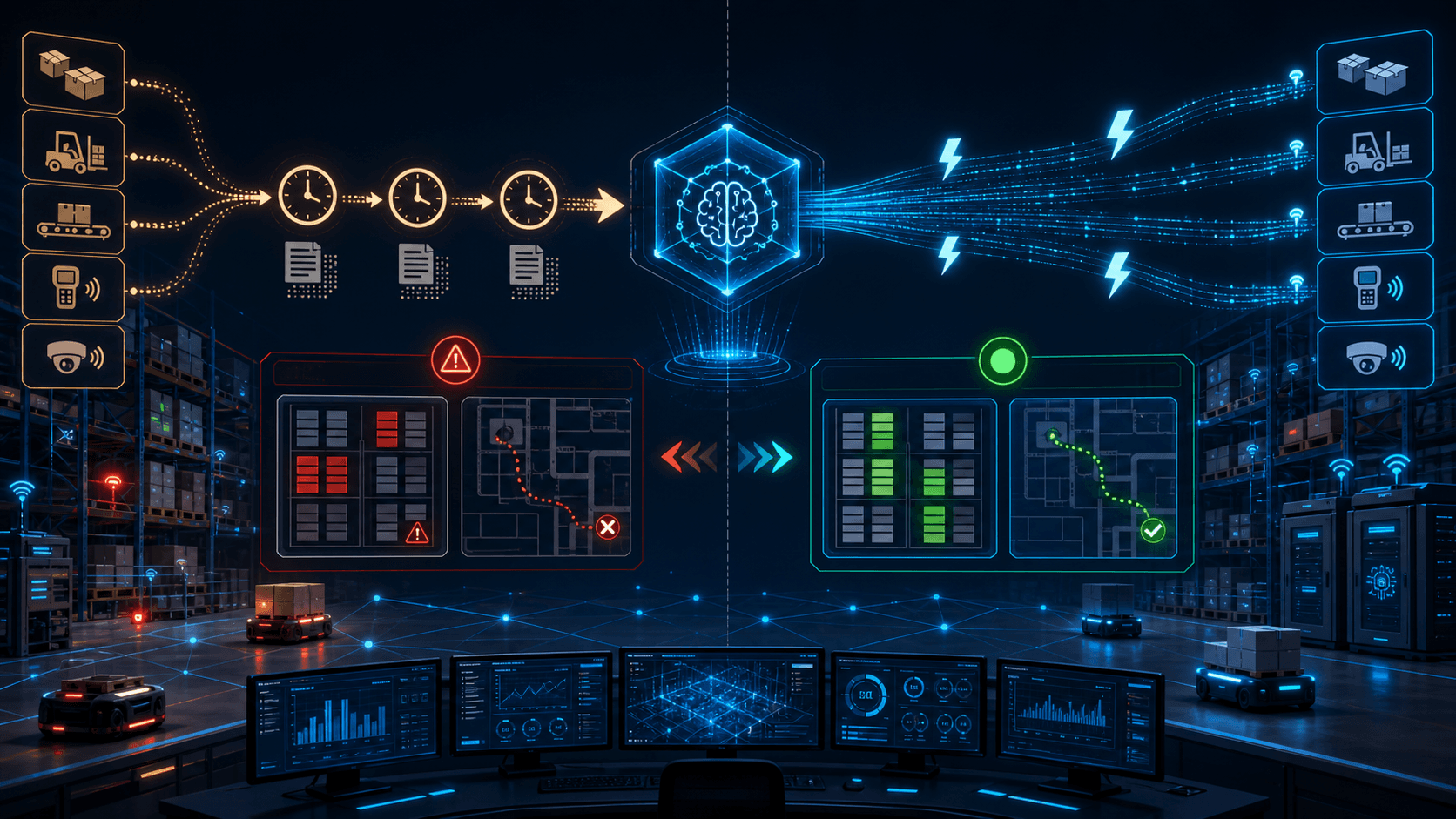
The data readiness divide between batch-dependent firms and streaming-capable firms is striking. According to the same McKinsey analysis, the industry median for data readiness stands at 45%, while leading firms achieve 70–80%. The primary differentiator is not data volume, governance policies, or even workforce skills—it is the presence of a real-time pipeline infrastructure.
| Readiness Dimension | Median Firms (45%) | Leading Firms (75%) |
|---|---|---|
| Data pipeline architecture | Batch extracts (nightly/12-hr cycles) | Real-time streaming (sub-second latency) |
| WMS API accessibility | Limited read-only endpoints | Full read/write API integration |
| Edge computing capability | None or pilot phase | Deployed in ≥50% of facilities |
| IoT / sensor network coverage | <20% of dock and rack locations | >70% coverage with automated data ingestion |
| Cellular / Wi-Fi reliability | Intermittent coverage in yard | Redundant, high-bandwidth networks throughout facility |
The warehouse environment amplifies this gap. Office-based supply chain operations (planning, procurement) typically enjoy 70%+ infrastructure readiness—stable networks, modern APIs, centralized servers. In contrast, warehouse infrastructure—edge devices, sensor networks, Wi-Fi coverage across sprawling facilities, ruggedized hardware—shows readiness gaps of 40–60%. This split environment means that even companies with advanced AI teams in the corporate office find themselves stuck when they try to push those models into the four walls of the DC.
The Streaming Infrastructure Checklist: What Warehouse AI Actually Requires
Transitioning from batch to streaming for warehouse AI requires a specific set of infrastructure components. Below is a checklist organized by readiness criteria and typical gap for each component, based on the warehouse conditions documented in the DB Schenker assessment and industry benchmarks.
| Infrastructure Component | Readiness Criteria | Typical Gap in Warehouses |
|---|---|---|
| Edge computing nodes | Local processing to avoid cloud latency; ability to run inference on-site | Only 28% of facilities have edge computing capability (DB Schenker assessment) |
| WMS API readiness | Real-time read/write access to inventory, orders, and labor data | Many legacy WMS offer batch-only export or limited API endpoints |
| IoT/sensor network integration | Continuous scanning of rack, dock, and conveyor positions | 19% have integrated sensor networks; most rely on periodic handheld scans |
| Cellular/Wi-Fi connectivity | Redundant, high-bandwidth coverage across all zones including yard | 34% have sufficient Wi-Fi for real-time AI; yard coverage is a frequent blind spot |
| Data streaming middleware | Message broker (e.g., Kafka, MQTT) to ingest and publish events | Rarely deployed; most facilities lack event-driven architecture |
Each component on this list represents a potential failure point. A common mistake is to install edge hardware without first verifying that the WMS can serve real-time API calls, or to upgrade network bandwidth while neglecting sensor integration. The checklist should be treated as a holistic maturity model—deficits in any one area will bottleneck the entire pipeline.
Cost-Benefit Analysis: Infrastructure Investment vs. Failed AI Deployments
Faced with the cost of upgrading edge computing, network infrastructure, and data pipelines, many warehouse leaders hesitate—often leading to a decision to “start small” with existing batch infrastructure. That approach typically results in underperforming models and, ultimately, abandoned projects. Industry estimates suggest that up to 70% of AI projects fail to deliver expected value (Virtasant, referenced via agility-at-scale), often because the data foundation cannot support production use. The cost of failed deployments—wasted engineering time, lost confidence, postponed digital transformation—frequently exceeds the upfront infrastructure investment.
| Investment Category | Typical Cost Range | Expected Benefits | Risk of Under-Investment |
|---|---|---|---|
| Edge computing (per facility) | $30K–$100K | Sub-second inference; reduced cloud dependency | AI models depend on cloud; latency kills real-time use cases |
| WMS API modernization | $50K–$200K (integration) | Real-time data access; ability to close the control loop | Batch-only WMS blocks dynamic slotting and adaptive routing |
| IoT/sensor network expansion | $20K–$80K per zone | Continuous asset tracking; improved model accuracy | Sparse data leads to biased or incomplete AI predictions |
| Network upgrades (Wi-Fi 6, cellular) | $50K–$150K | Reliable coverage; supports multiple real-time streams | Frequent dropouts cause data gaps and model instability |
| Data streaming platform | $40K–$120K annual | Event-driven architecture; future-proofing | Batch dependency locks out high-value AI use cases |
The ROI of closing the pipeline gap becomes clearer when compared to the cost of inaction. The global AI-in-warehousing market was estimated at $14–15 billion in 2025 and is projected to reach $45 billion by 2030, according to industry analysts cited by MSDynamicsWorld. Organizations that delay pipeline modernization will find themselves unable to deploy the next generation of warehouse AI—while competitors with streaming infrastructure will capture the value first.
Case in Point: DB Schenker’s 430-Warehouse Assessment
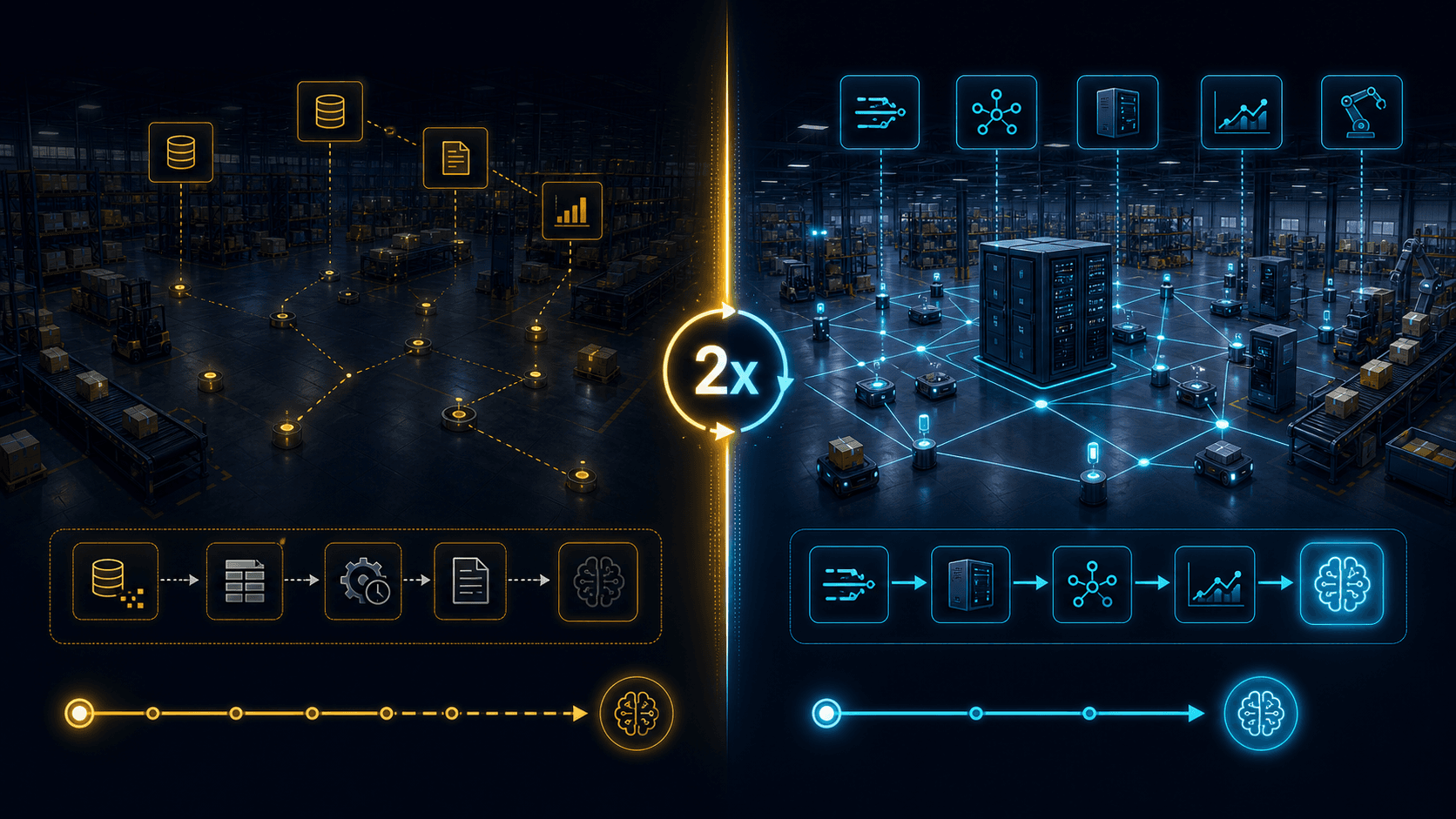
One of the most instructive large-scale data readiness assessments comes from DB Schenker, which evaluated 430 European warehouses to determine their readiness for AI deployment. The findings, documented in DB Schenker’s 2025 Annual Report and reported in a 2026 assessment guide, reveal a clear correlation between infrastructure readiness and deployment speed.
| Readiness Category | Facilities Scoring | Infrastructure Status | AI Deployment Timeline | Outcome |
|---|---|---|---|---|
| High readiness (>60%) | ~20% of assessed | Wi-Fi, edge computing, API access in place | 3–4 months | Rapid AI deployment; models online quickly |
| Medium readiness (40–60%) | ~35% of assessed | Partial infrastructure (edge or Wi-Fi but not both) | 4–6 months | Some delays; needed targeted upgrades |
| Low readiness (<40%) | ~45% of assessed | Batch-only; limited Wi-Fi, no edge, no APIs | 6–9 months | Major infrastructure investment required; deployment postponed |
The program saved an estimated EUR 12 million by preventing premature AI deployments. Instead of forcing a single AI platform across all facilities—which would have failed in the low-readiness warehouses—DB Schenker prioritized infrastructure upgrades first, then deployed AI only where the pipeline was ready. This approach avoided wasted license costs, frustrated operators, and the reputational damage of a failed corporate AI rollout.
Migration Roadmap: Moving from Batch to Streaming Without Disrupting Operations
Shifting from batch to streaming infrastructure in a live warehouse environment requires a phased approach that avoids operational downtime. The following roadmap outlines key milestones and a realistic timeline for a mid-sized distribution network.
| Phase | Duration | Key Milestones |
|---|---|---|
| 1. Audit current pipeline architecture | 4–6 weeks | Inventory all data sources (WMS, scanners, sensors); measure current batch latency; identify critical gaps |
| 2. Prioritize high-value AI use cases | 2–3 weeks | Select 1–2 use cases (e.g., dynamic slotting, labor forecasting) that benefit most from real-time data |
| 3. Invest in edge computing and API connectivity | 8–12 weeks | Deploy edge nodes in one pilot facility; enable WMS real-time API endpoints; install message broker |
| 4. Pilot with single facility | 4–8 weeks | Run AI model on streaming data in pilot; compare performance against batch-based model; adjust architecture |
| 5. Roll out to additional facilities | 12–24 weeks | Scale edge and network upgrades to next 5–10 facilities; use lessons from pilot to accelerate |
| 6. Optimize and expand use cases | Ongoing | Add sensor integration, expand edge coverage, deploy additional AI models now feasible with real-time data |
A few critical success factors: involve WMS vendor support early to understand API capabilities and limitations; plan for network redundancy during the pilot phase—streaming fails fast if connectivity drops; and establish a cross-functional team of IT, operations, and data science to avoid siloed decision-making. The goal is not to achieve a perfect streaming infrastructure across all facilities before deploying any AI. Rather, it is to identify the 20–30% of sites that can be made streaming-ready quickly and start there, building organizational confidence and proving ROI before expanding.
The pipeline architecture gap is not a permanent barrier—it is a diagnostic that reveals exactly where to invest next. For warehouse IT leaders and technology architects, the path forward is clear: stop asking whether your data is clean, and start asking how fast it flows.
Comments
Join the discussion with an anonymous comment.