
Why Functional Scope Matters: Control Towers Are Not One-Size-Fits-All
The term "supply chain control tower" appears in vendor brochures, analyst reports, and conference keynotes as if it describes a single, well-defined category of software. In practice, the label covers at least five distinct functional scopes, each integrating with a different set of operational systems, consuming different data types, and optimizing for different KPIs. Selecting the wrong scope for your organization's primary bottleneck is one of the most common — and most expensive — implementation failures.
Both Endava and ketteQ independently describe the same five-type taxonomy: logistics and transportation, fulfillment, inventory, supply assurance, and end-to-end (E2E). The convergence of two vendor-adjacent sources on the same classification suggests the taxonomy reflects real market segmentation rather than marketing invention. This article unpacks each type — its integration pattern, data sources, and typical KPIs — then provides a decision framework to help operations managers and IT architects match scope to pain point.
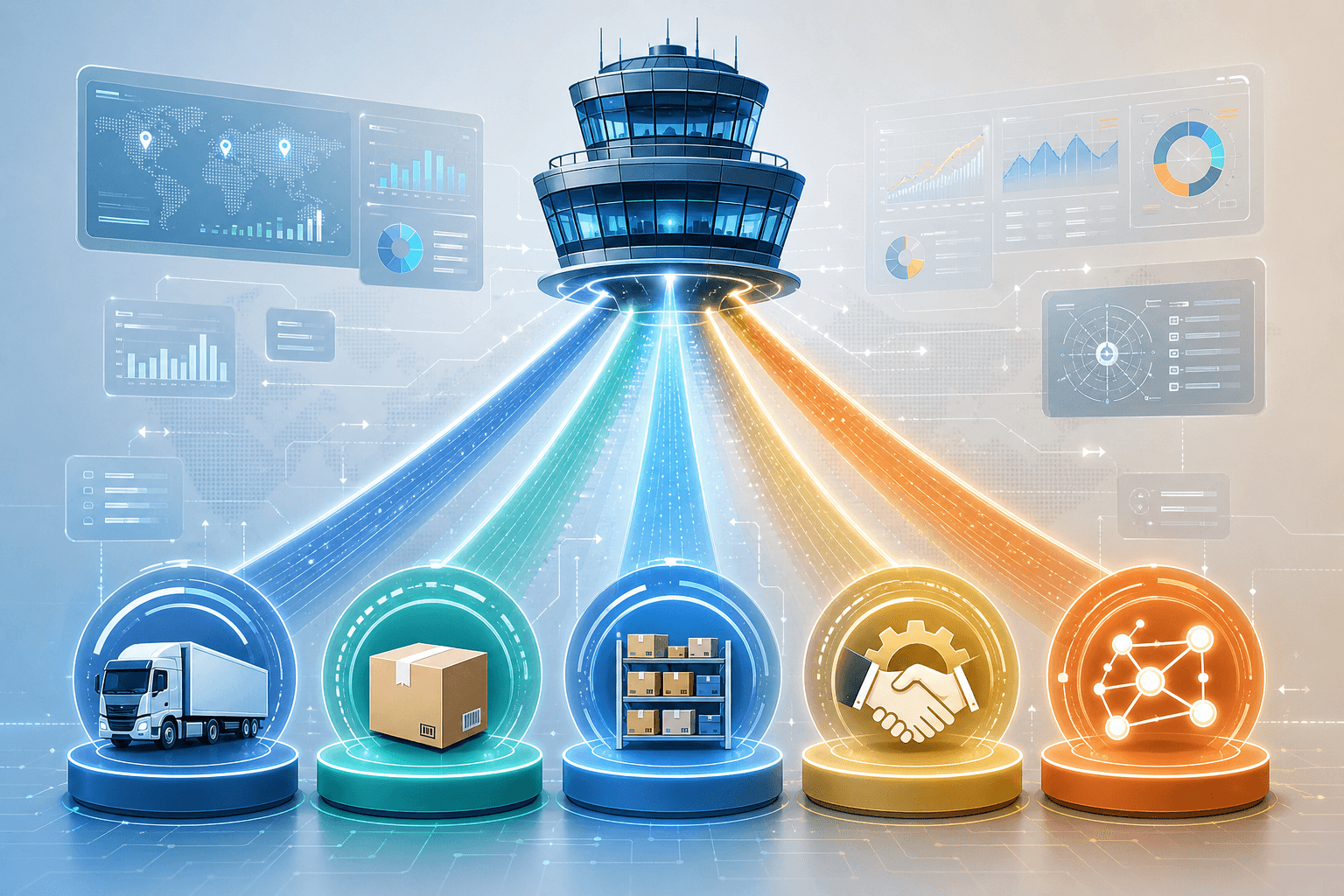
Logistics and Transportation Control Towers
The logistics and transportation control tower is the most widely deployed type and often the entry point for organizations new to the concept. Its primary integration is with the Transportation Management System (TMS), though it also ingests data from carrier APIs, telematics devices, and port community systems. Core capabilities include real-time shipment tracking, carrier performance monitoring, route deviation alerts, and automated freight audit and payment reconciliation.
The operational pain this type addresses is acute. A Gartner survey cited by FourKites found that a single disruption requires an average of 34 manual system updates across 6 different platforms. That manual orchestration workload is a direct consequence of fragmented visibility — each carrier, leg, and mode generates its own data stream, and without a logistics tower, someone must reconcile them by hand. McKinsey's Supply Chain 4.0 study, also cited by FourKites, estimated that 40–60% of a supply chain planner's time is consumed by transactional, non-strategic work — much of it spent on exactly this kind of cross-platform data reconciliation.
Typical KPIs for a logistics tower include:
- On-time in-full (OTIF) delivery rate
- Average time to detect and respond to shipment exceptions
- Carrier compliance to contracted service levels
- Freight cost per unit shipped
- Percentage of shipments with real-time visibility
Fulfillment Control Towers
Fulfillment control towers center on the order lifecycle rather than the carrier movement. Their primary integration points are order management systems (OMS), warehouse management systems (WMS), and ecommerce platform APIs. Where a logistics tower asks "Where is the shipment?", a fulfillment tower asks "Is the customer promise at risk?" and "What is the lowest-cost way to fulfill this order?"
The distinction matters because fulfillment optimization often requires trade-offs that a pure logistics view cannot support. For example, splitting an order across two warehouses may increase transportation cost but reduce delivery time and preserve the customer promise. A fulfillment tower evaluates both dimensions simultaneously, factoring in inventory availability at each node, carrier capacity, and delivery SLAs.
Key capabilities include:
- Order-level cost-to-serve calculation across fulfillment nodes
- Real-time order promise and ATP (available-to-promise) checks
- Automated order routing to the optimal warehouse or drop-shipper
- Exception handling for orders that cannot meet their delivery window
- Returns management and reverse logistics orchestration
Fulfillment towers are especially relevant for omnichannel retailers and direct-to-consumer brands where order complexity — multiple line items, split shipments, varied delivery speeds — creates a combinatorial optimization problem that manual planning cannot solve at scale.
Inventory Control Towers
Inventory control towers focus on stock visibility and availability across the network. Their primary integration is with the WMS, but they also connect to inventory planning systems, ERP inventory modules, and — in retail — point-of-sale (POS) data streams. The goal is to prevent stock-outs and overstock situations by providing a single, real-time view of inventory positions across all nodes.
The financial impact of poor inventory visibility is substantial. Endava reports that hospitals can lose up to 10% of inventory value due to lost or misplaced items — a figure that likely understates the problem in complex multi-site operations where inventory records are reconciled only during periodic cycle counts. In manufacturing, the cost appears as expedited freight for missing components; in retail, as lost revenue from stock-outs and markdowns from excess inventory.
Typical capabilities include:
- Real-time inventory visibility across warehouses, distribution centers, and in-transit stock
- Stock-out and overstock alerts with root-cause analysis
- Perishable goods lifecycle tracking and expiration date management
- Inventory aging analysis and slow-mover identification
- Cross-node inventory rebalancing recommendations
Supply Assurance Control Towers
Supply assurance control towers address the upstream side of the supply chain: supplier performance, raw material availability, and procurement continuity. Their primary integration is with procurement systems (e.g., SAP Ariba, Coupa), supplier portals, and quality management platforms. They also ingest external data such as weather reports, geopolitical risk feeds, and financial health scores for key suppliers.
This type is distinct from inventory towers because it focuses on the supply pipeline before inventory is created. A supply assurance tower answers questions like: "Which suppliers are at risk of missing their delivery window?" "How will a port closure in Southeast Asia affect raw material availability in week 12?" and "Which single-source components need qualification of an alternative supplier?"
Core capabilities include:
- Supplier on-time delivery (OTD) tracking and trend analysis
- Lead time variability monitoring and predictive alerts
- Raw material inventory position vs. production consumption rates
- Supplier risk scoring based on financial, operational, and geopolitical factors
- Purchase order lifecycle visibility from requisition to receipt
For procurement teams specifically focused on managing lead time uncertainty, our implementation guide on AI for supplier lead time variability prediction provides a deeper look at the data requirements and model approaches for this use case.
End-to-End Control Towers
End-to-end (E2E) control towers represent the most ambitious scope. They integrate across all four upstream and downstream domains — logistics, fulfillment, inventory, and supply assurance — and connect to the ERP as the system of record for financial and transactional data. An E2E tower provides cross-functional visibility across the Plan-Source-Make-Deliver process chain and typically incorporates AI/ML capabilities for simulation, what-if analysis, and decision automation.
The complexity of E2E towers is significantly higher than single-scope towers because they must reconcile data from systems that were never designed to interoperate: ERP, TMS, WMS, OMS, procurement platforms, demand planning systems, and external data feeds. Gartner's 2018 report "Don't Believe the Control Tower Hype — Buyer Beware," summarized by ToolsGroup, critiqued bolt-on visualization layers that simply aggregate data without providing embedded intelligence. The report called for control towers to evolve into "solution towers" that not only visualize data but control processes — gathering, integrating, normalizing, and cleansing data from multiple sources, then feeding it into a supply chain model capable of simulation, root-cause diagnosis, and predictive analytics.
E2E towers are typically deployed by organizations with mature data integration practices and a centralized supply chain operations team. They are less common than single-scope towers: a FourKites survey of 250 U.S. supply chain leaders found that only 2 in 10 organizations understand 75–100% of their supply chain activity in real time, and only 22% of shippers with over $1B in revenue rate their control tower as "highly effective". These figures suggest that the gap between aspiration and operational reality remains wide for E2E implementations.
Decision Framework: Matching Functional Type to Operational Pain Point
The following matrix maps common supply chain pain points to the control tower type most directly suited to address them. Use it as a starting point for scoping discussions with stakeholders and vendors.
| Primary Pain Point | Symptoms | Best-Fit Control Tower Type | Primary System Integration |
|---|---|---|---|
| Shipment delays, carrier non-compliance, high freight costs | Expediting calls, manual tracking spreadsheets, late deliveries | Logistics & Transportation | TMS, carrier APIs, telematics |
| Order errors, missed delivery promises, high cost-to-serve | Customer complaints, split-shipment inefficiencies, returns volume | Fulfillment | OMS, WMS, ecommerce platforms |
| Stock-outs, overstock, inventory write-offs, expired goods | Emergency replenishment orders, discounting to clear inventory | Inventory | WMS, inventory planning, POS |
| Supplier delivery misses, raw material shortages, quality issues | Production line stoppages, last-minute sourcing, supplier disputes | Supply Assurance | Procurement systems, supplier portals |
| Fragmented visibility across functions, inability to simulate trade-offs | Siloed data, slow decision-making, reactive rather than proactive planning | End-to-End | ERP, all operational systems |
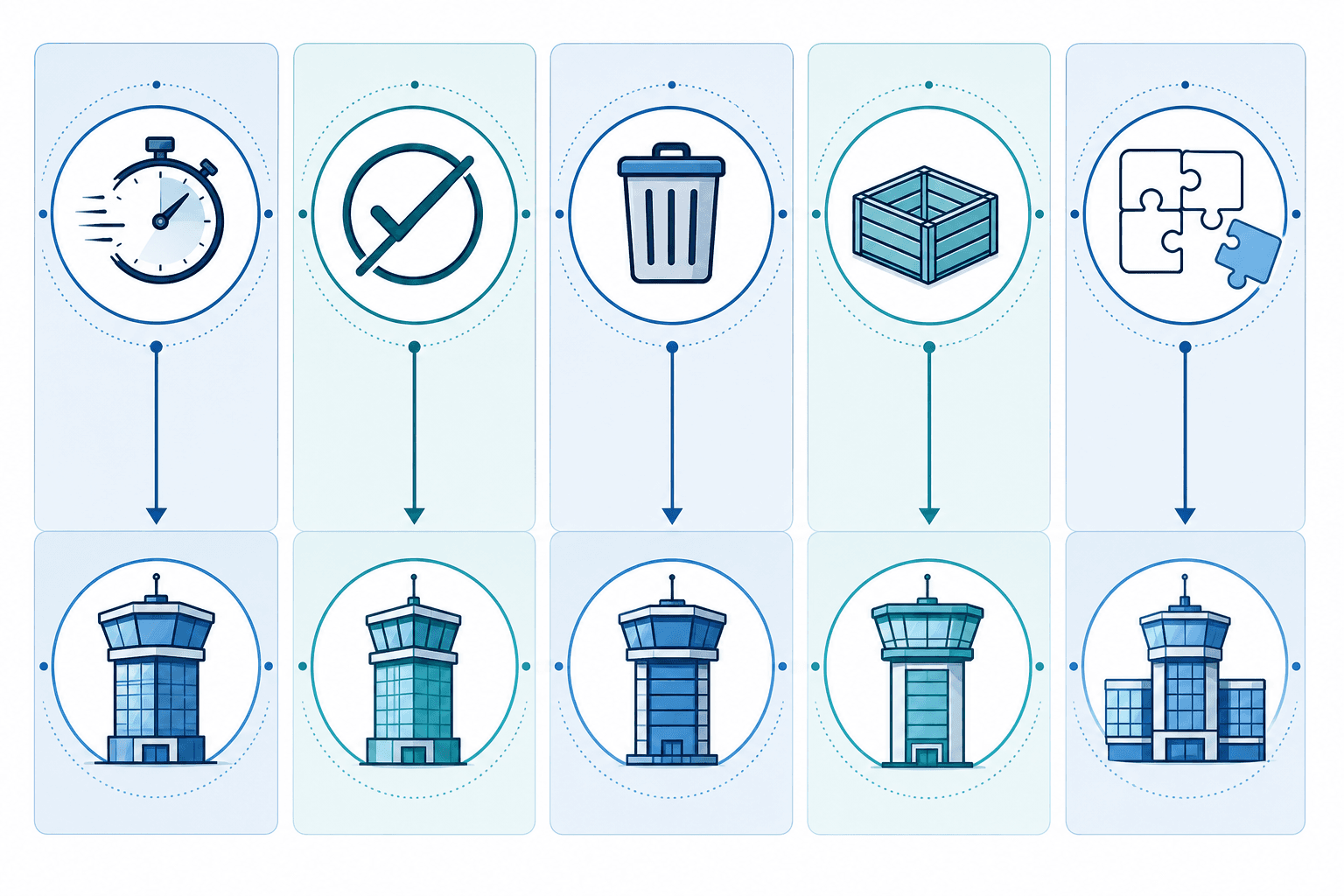
The Maturation Path: Starting with One Type and Expanding
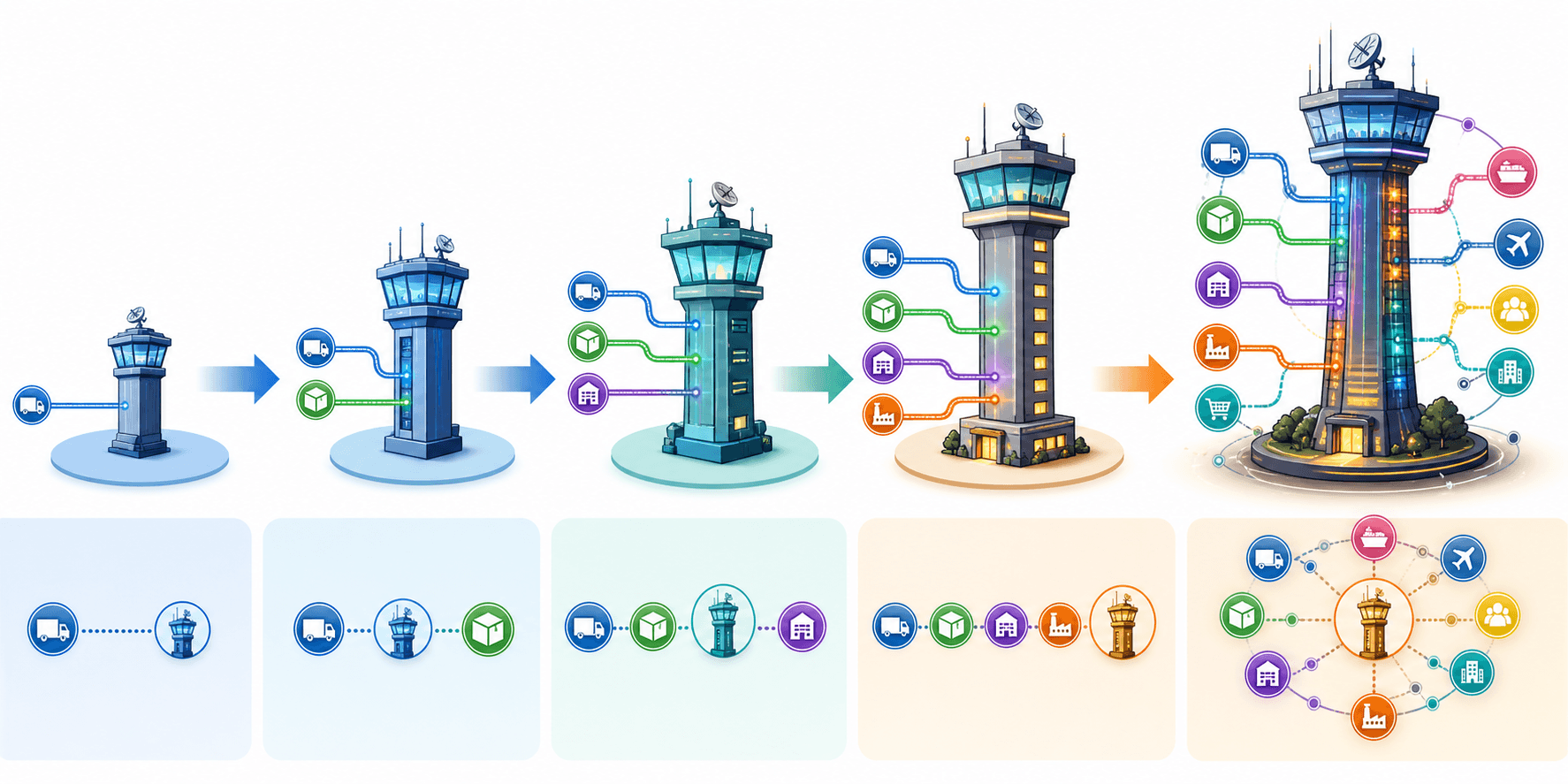
Most organizations do not deploy an E2E control tower as their first implementation. The typical maturation path begins with a logistics or transportation tower — the most bounded scope with the clearest ROI case — and expands outward as data integration maturity grows. A logistics tower requires integration with a TMS and carrier APIs, which most organizations already have. An E2E tower, by contrast, requires clean, normalized data from ERP, WMS, TMS, OMS, and procurement systems — a level of data maturity that few organizations achieve on their first attempt.
The expansion path typically follows one of two trajectories:
- Logistics → Fulfillment → E2E: Common for retailers and 3PLs where order lifecycle management is the natural extension of shipment visibility.
- Logistics → Inventory → Supply Assurance → E2E: Common for manufacturers where raw material continuity and finished goods inventory are the critical adjacencies.
Planning-led platforms such as Kinaxis Maestro often serve as the anchor for E2E expansion because they already maintain the cross-functional data model and simulation engine that an E2E tower requires. Organizations that begin with a planning platform may find the E2E step less disruptive than those starting from a pure visibility tool.
The global supply chain control tower market is projected at USD 8.75 billion in 2026 (Business Research Insights, cited by Locus), and 37% of organizations are prioritizing control tower investments (Inbound Logistics, cited by Locus). As the market matures, the distinction between functional types will likely blur — vendors will add adjacent capabilities, and the taxonomy may shift. For now, the five-type framework provides a practical lens for scoping a control tower initiative. The key is to start with the pain point, not the technology.