
Quantified Impact of ML Across Warehouse Functions
Supply chain executives evaluating machine learning investments in warehouse operations need defensible, source-attributed ROI ranges — not vendor claims. The available data, drawn from McKinsey, Accenture, Fortune Business Insights, and other analyst sources, shows that ML delivers measurable returns across four primary dimensions: inventory reduction, logistics cost reduction, labor productivity, and operational accuracy. Each dimension has a distinct ROI profile and dependency on implementation maturity.
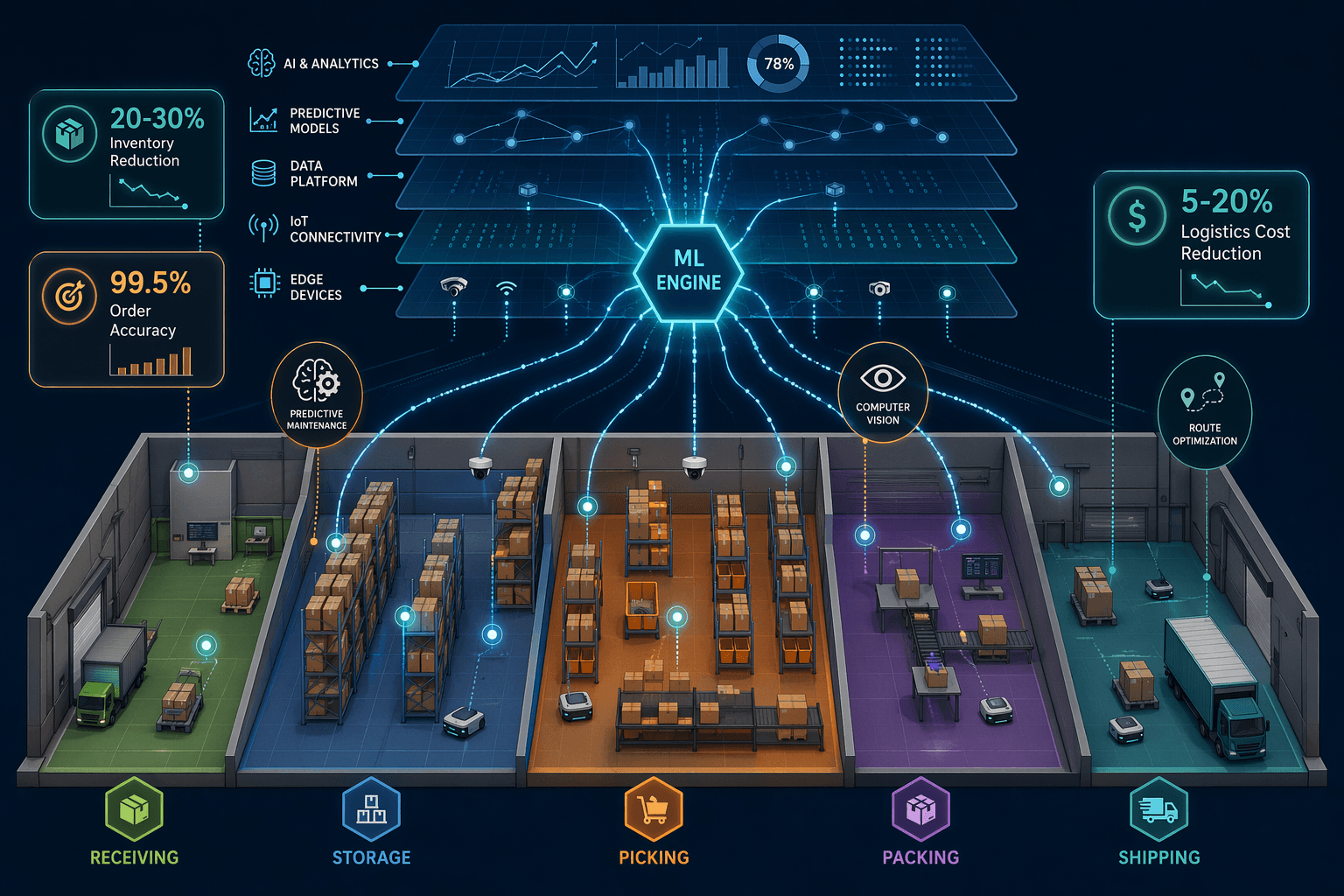
McKinsey's 2024 analysis of AI-enabled distribution operations found that organizations can achieve a 20–30% reduction in inventory levels and a 5–20% reduction in logistics costs. These figures are not hypothetical — they reflect observed outcomes across companies that deployed predictive analytics for demand sensing, dynamic slotting algorithms, and automated replenishment systems. The inventory reduction alone can free up substantial working capital, particularly for firms carrying high volumes of slow-moving or seasonal SKUs.
On the accuracy and speed front, Tredence reports that AI-supported warehouses now achieve an average order accuracy of 99.5%, while Fortune Business Insights notes that AI integration increases picking speed by 30–50% with minimal error. These gains compound: higher accuracy reduces returns and rework costs, while faster picking directly improves throughput without proportional increases in labor hours.
Labor cost reduction is another well-documented benefit. Omniful's industry data indicates that automated solutions can cut manufacturing and labor costs by 25–30%. This aligns with broader warehouse automation trends: as of 2026, over 4.2 million commercial warehouse robots are projected to be installed globally, and more than 90% of warehouses either use or plan to adopt a warehouse management system (WMS).
| ROI Dimension | Reported Impact Range | Primary Source |
|---|---|---|
| Inventory reduction | 20–30% | McKinsey (2024) |
| Logistics cost reduction | 5–20% | McKinsey (2024) |
| Order accuracy | 99.5% | Tredence (2025) |
| Picking speed improvement | 30–50% | Fortune Business Insights (2026) |
| Labor cost reduction | 25–30% | Omniful (2026) |
| Predictive maintenance: downtime reduction | 30–50% | Fortune Business Insights (2026) |
| Predictive maintenance: equipment lifespan extension | 17–20% | Fortune Business Insights (2026) |
| Predictive maintenance: cost reduction | 7–10% | Fortune Business Insights (2026) |
ROI Timelines: What the Data Says About Payback Periods
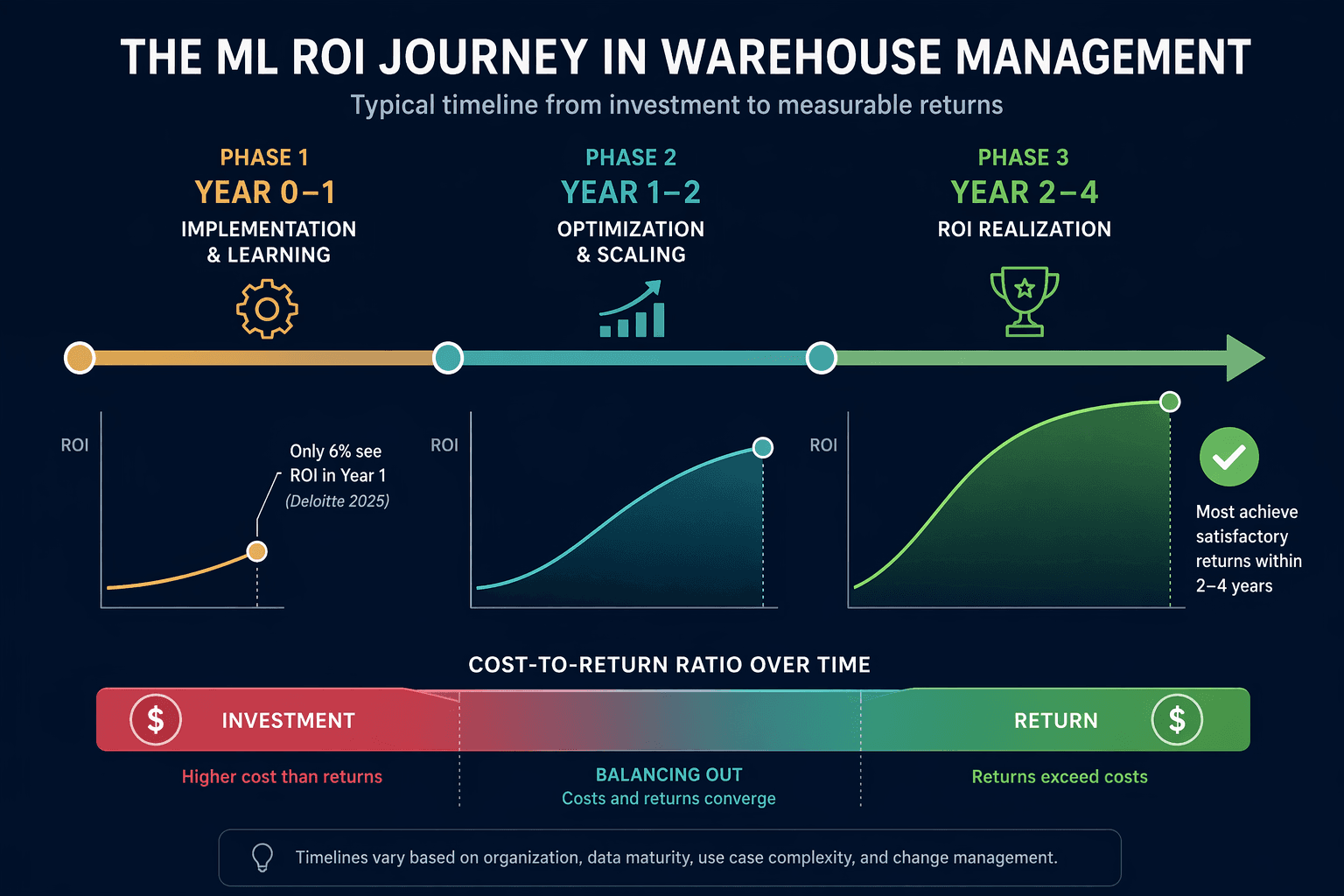
One of the most critical — and most frequently glossed over — aspects of ML warehouse investments is the timeline to positive returns. Deloitte's 2025 survey of AI investment outcomes found that only 6% of organizations see ROI in under a year. The vast majority achieve satisfactory returns within a 2-to-4-year window. This finding should inform both budget planning and stakeholder expectation management.
The extended timeline is not a sign of failure; it reflects the structural reality of warehouse ML deployments. Unlike a software-as-a-service subscription that delivers value from day one, ML systems require a period of data accumulation, model training and tuning, process integration, and organizational adaptation. A predictive slotting algorithm, for example, needs weeks or months of order and pick-path data before it can generate reliable recommendations. A computer vision system for inbound quality inspection must be trained on thousands of product images before it reaches acceptable accuracy thresholds.
The implication is clear: organizations that treat warehouse ML as a quick-hit cost-saving initiative are likely to be disappointed. Those that approach it as a phased capability build — starting with a focused pilot, scaling incrementally, and measuring progress against defined milestones — are far more likely to realize the returns that the data suggests are achievable.
Cost Breakdown: Where the Investment Goes
Building a credible business case requires understanding not just the potential returns, but also the cost structure of ML warehouse initiatives. The investment typically falls into four categories: hardware, software, integration, and training. The relative weight of each category depends on the specific use cases being deployed and the existing technology infrastructure.
| Cost Category | Description | Typical Cost Drivers |
|---|---|---|
| Hardware | Sensors, cameras, robotics (AMRs, AGVs, AS/RS), IoT devices, edge computing nodes | Number of zones automated; choice between purchasing and RaaS (Robotics-as-a-Service) models |
| Software | ML platform licenses, WMS integration modules, analytics dashboards, digital twin environments | Deployment model (SaaS vs. on-premise); number of concurrent users; data storage requirements |
| Integration | Legacy system connectivity, data pipeline setup, API development, middleware configuration | Complexity of existing WMS/TMS/ERP stack; data quality remediation effort; custom integration needs |
| Training & Change Management | Workforce upskilling, process redesign, change management consulting, new role definitions | Scale of deployment; workforce size; existing digital literacy levels; union or regulatory considerations |
A notable development in the hardware cost category is the rise of Robotics-as-a-Service (RaaS) models. As Intellias notes, RaaS arrangements can significantly reduce upfront capital expenditure by shifting hardware costs to an operational expense model. This is particularly relevant for mid-market organizations that may lack the balance sheet to absorb large capital outlays for robotic systems.
Integration costs are frequently underestimated. Connecting ML systems to legacy WMS and ERP platforms often requires custom API development, data cleansing, and middleware configuration. Organizations with highly customized or outdated warehouse management systems should expect integration to represent a larger share of total investment than software licensing.
Market Context: The AI Warehousing Investment Landscape
The ROI data for individual warehouse ML deployments sits within a broader market context that reinforces the strategic importance of these investments. According to Fortune Business Insights, the global AI in warehousing market was valued at $12.69 billion in 2025 and is projected to grow to $83.42 billion by 2034, representing a compound annual growth rate (CAGR) of 23.10%. North America held the largest regional share at 36.10% in 2025.
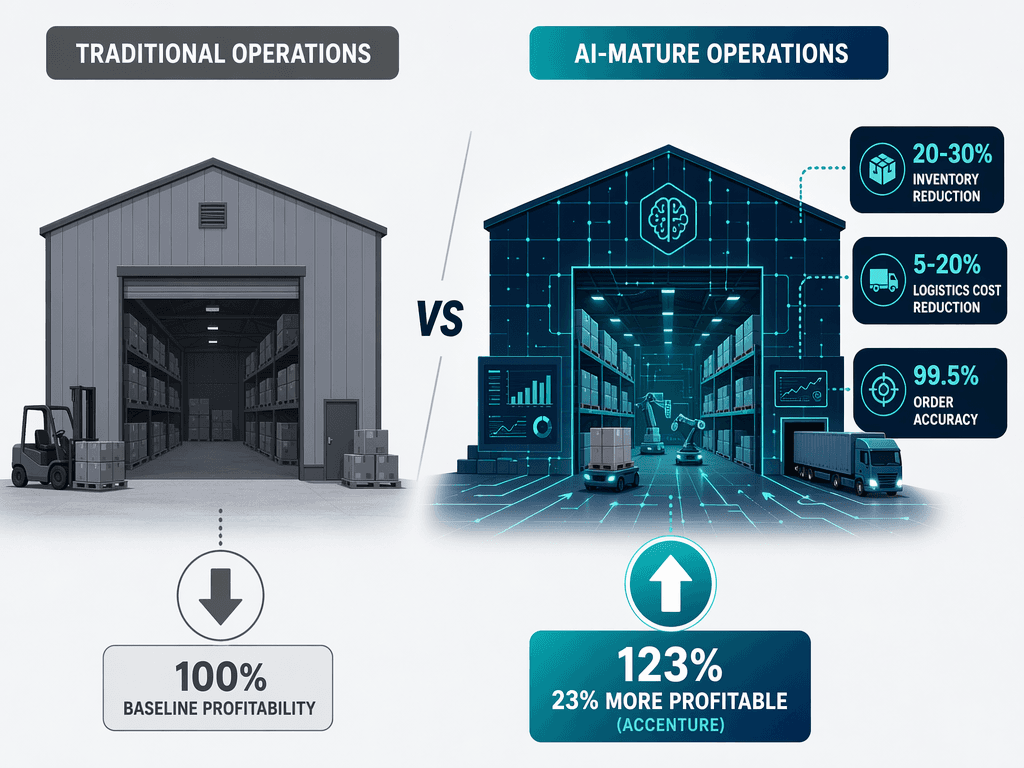
The competitive implications of this market shift are underscored by Accenture's 2024 finding that organizations with AI-mature supply chains are 23% more profitable than their peers. This profitability gap is not a theoretical projection — it reflects the cumulative effect of lower operating costs, higher inventory turns, fewer stockouts, and better labor utilization that ML-enabled warehouses achieve.
Two large-scale examples illustrate the magnitude of potential returns. Amazon estimates that warehouse automation could save the company $10 billion annually by 2030. Walmart projects that AI and automation could contribute approximately $20 billion in EBIT by 2029. While these figures reflect the scale of the world's largest retailers, they establish an upper bound on what is achievable and signal that the competitive baseline is shifting.
| Metric | Value | Source |
|---|---|---|
| Global AI warehousing market (2025) | $12.69 billion | Fortune Business Insights |
| Projected market (2034) | $83.42 billion | Fortune Business Insights |
| CAGR (2025–2034) | 23.10% | Fortune Business Insights |
| North America market share (2025) | 36.10% | Fortune Business Insights |
| Profitability premium for AI-mature supply chains | 23% | Accenture (2024) |
| Amazon projected annual savings by 2030 | $10 billion | Fortune Business Insights / Amazon |
| Walmart projected EBIT contribution by 2029 | $20 billion | Fortune Business Insights / Walmart |
Risk Factors That Affect ROI Outcomes
The ROI ranges cited above represent outcomes achievable under favorable conditions. In practice, several risk factors can delay, reduce, or entirely negate returns. Supply chain executives building business cases should account for these risks explicitly rather than treating them as edge cases.
Data Quality
ML models are only as good as the data they are trained on. Tredence explicitly warns that poor data quality leads to wrong insights. In warehouse contexts, common data quality issues include inconsistent SKU categorization, incomplete pick-path histories, inaccurate inventory counts, and missing timestamps on operational events. Organizations that have not invested in data governance and cleansing before deploying ML should expect degraded model performance and extended time-to-value.
Legacy System Integration
Connecting ML platforms to existing WMS, ERP, and TMS systems is often the most technically challenging and costly part of a warehouse AI deployment. Intellias and Tredence both identify legacy system integration as a major risk factor — it is expensive, complex, and can introduce latency or data inconsistency if not architected properly. Organizations running highly customized or older-generation WMS platforms should budget additional time and resources for integration work.
Workforce Adoption and Change Management
Oracle's analysis of AI in warehouse management notes that workforce adoption is a significant implementation challenge. Warehouse operators and supervisors who have spent years developing expertise in manual processes may resist or mistrust algorithmic recommendations. Effective change management — including transparent communication about how ML tools augment rather than replace human decision-making, hands-on training programs, and clear career progression paths — is essential for realizing the labor productivity gains that the data suggests are possible.
- Data quality: Poor data leads to inaccurate model outputs and extended time-to-value. Invest in data governance before deployment.
- Legacy integration: Connecting ML to existing WMS/ERP systems is complex and costly. Budget for custom API development and middleware.
- Workforce adoption: Operator resistance can undermine productivity gains. Invest in change management, training, and transparent communication.
- Measurement difficulty: Short-term ROI quantification is challenging. Develop new metrics that capture indirect and long-term benefits.
For a deeper analysis of these risk factors and the specific failure modes that can derail warehouse AI initiatives, see our guide on the hidden costs and failure modes of AI warehouse implementation.
A Framework for Measuring ML ROI in Warehouse Operations
Measuring the return on ML investments requires a structured framework that captures both direct operational improvements and indirect strategic benefits. The following KPIs, drawn from industry practice and the available research, provide a baseline for tracking ROI across warehouse ML deployments.
| KPI | Definition | Relevance to ML ROI |
|---|---|---|
| Order accuracy | Percentage of orders fulfilled without errors | Directly improved by AI picking and verification systems; 99.5% benchmark from Tredence |
| Fulfillment speed | Time from order receipt to shipment | Improved by dynamic slotting, optimized pick paths, and AMR coordination |
| Cost per order | Total warehouse operating cost divided by orders fulfilled | Captures labor, equipment, and overhead efficiency gains from ML |
| Throughput | Units processed per labor hour or per shift | Measures productivity impact of ML-driven process optimization |
| Inventory turnover | Cost of goods sold divided by average inventory value | Reflects the 20–30% inventory reduction McKinsey attributes to AI-enabled distribution |
| Labor productivity | Units picked or packed per labor hour | Directly tied to the 25–30% labor cost reduction reported by Omniful |
| Equipment uptime | Percentage of time critical equipment is operational | Improved by 30–50% through AI-powered predictive maintenance (Fortune Business Insights) |
Tredence provides a straightforward ROI formula that organizations can adapt to their specific context:
AI ROI = (Net Gain from AI Investment - Cost of AI Investment) / Cost of AI Investment × 100Net Gain should include both hard savings (reduced labor costs, lower inventory carrying costs, fewer stockouts) and soft benefits (improved customer satisfaction from faster fulfillment, reduced returns from higher accuracy). Costs should encompass all four categories discussed earlier: hardware, software, integration, and training.
Organizations that establish baseline measurements for each KPI before deployment, track them consistently during the implementation phase, and compare post-deployment performance against the baseline will be in a far stronger position to quantify returns and justify further investment. For a step-by-step implementation roadmap that includes measurement milestones, see our guide on how to implement AI in warehouse management.
For organizations still assessing their integration readiness, our AI WMS integration readiness checklist provides a practical six-dimension assessment tool that can help identify gaps before deployment begins.