
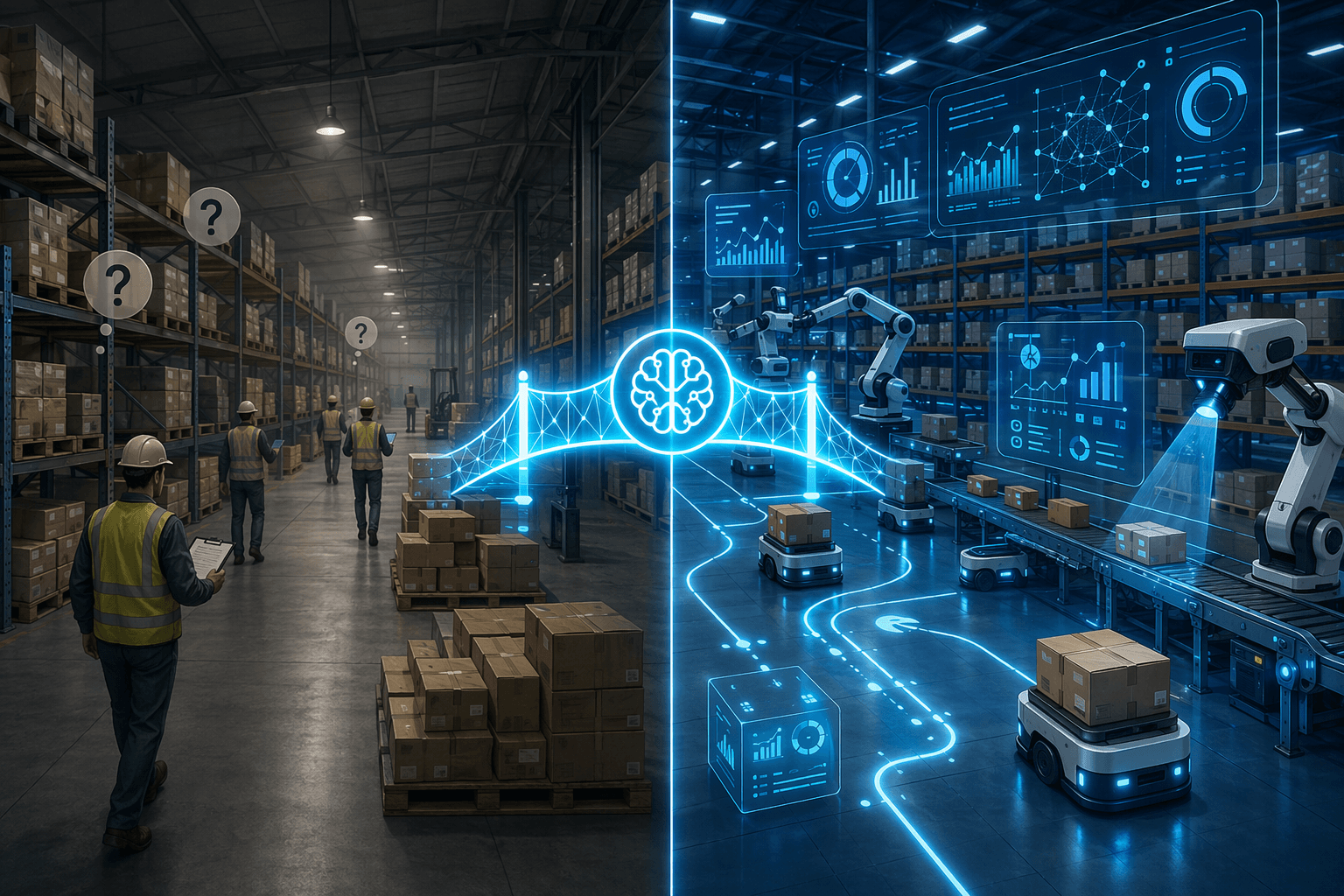
Definition: What AI in Warehouse Management Is (and Is Not)
AI in warehouse management refers to the integrated application of machine learning, computer vision, natural language processing, robotics, and predictive analytics to optimize the physical and operational workflows within a distribution center or fulfillment facility. It is not a single software feature or a standalone robot. Rather, it is an ecosystem of technologies that collectively enable a warehouse to sense its environment, make decisions, execute actions, and learn from outcomes — all with diminishing reliance on manual intervention.
This distinction matters because the market often conflates traditional warehouse management systems (WMS) with AI-augmented operations. A conventional WMS is a rules-based system: it assigns tasks based on predefined logic, such as first-in-first-out or zone-based picking. It executes instructions. AI-augmented warehouse management, by contrast, learns from historical and real-time data to dynamically adjust those instructions. It predicts which items will be needed tomorrow and pre-positions them. It detects a damaged package on a conveyor belt and reroutes it before it reaches the shipping dock. It optimizes the path of every autonomous mobile robot (AMR) in real time to avoid congestion.
For supply chain leaders evaluating AI adoption, the key takeaway is that AI in warehouse management is not an all-or-nothing replacement of existing infrastructure. It is a set of capabilities that can be introduced incrementally — starting with predictive analytics on existing WMS data, adding computer vision for quality inspection, or deploying a small fleet of AMRs alongside a human workforce. The definition is intentionally broad because the technology stack is modular.
Core AI Technologies Powering Warehouse Operations
Five technology categories form the foundation of AI in warehouse management. Each addresses a distinct operational pain point, and together they create the sensing, decision-making, and execution loop that defines an intelligent warehouse.
- Machine Learning (ML): ML models analyze historical order patterns, inventory movements, and external variables to generate demand forecasts, optimize slotting assignments, and predict equipment failures before they occur. These models improve over time as they ingest more data. In warehouse operations, ML is the engine behind dynamic inventory placement and workload forecasting.
- Computer Vision: Camera systems combined with deep learning algorithms enable zero-touch quality control at goods-in, automated damage detection during put-away, and visual verification during picking and packing. Computer vision systems can inspect thousands of items per hour with accuracy rates that exceed human visual inspection, and they operate consistently across shifts.
- Natural Language Processing (NLP): NLP powers voice-directed picking systems that understand natural speech, LLM-enabled chatbots that assist workers with exception handling, and systems that extract structured data from unstructured shipping documents or supplier communications. In practice, NLP reduces the cognitive load on warehouse staff by allowing them to interact with systems conversationally rather than through terminal screens.
- Robotics and Autonomous Systems: AMRs, autonomous guided vehicles (AGVs), and robotic picking arms execute physical tasks that were historically manual. AMRs navigate dynamically, avoiding obstacles and rerouting in real time. Robotic arms equipped with vision systems can handle heterogeneous items — a capability that was impractical before advances in computer vision and gripper technology. Approximately 4.7 million warehouse robots are projected to be installed globally by 2026 across more than 50,000 warehouses, according to data cited by SellersCommerce.
- Predictive AnalyticsPredictive models use historical sensor data, maintenance logs, and operational metrics to forecast equipment failures, labor requirements, and inventory needs. McKinsey research indicates that predictive maintenance can reduce unplanned downtime by 30–50%, extend equipment lifespan by 17–20%, and lower maintenance costs by 7–10%. For warehouse operators, this translates to fewer conveyor breakdowns during peak periods and more predictable maintenance budgets.

Key Applications by Warehouse Function
AI applications map to every major warehouse function. The following table summarizes the primary AI application, the operational problem it addresses, and the documented impact for each function.
| Warehouse Function | AI Application | Problem Solved | Documented Impact |
|---|---|---|---|
| Receiving | Computer vision for automated inspection and label reading | Manual inspection is slow and inconsistent; paper-based receiving creates data lag | 40–60% faster inspection; 20–35% reduction in returns due to inbound errors (Appinventiv) |
| Put-away | ML-driven dynamic slotting optimization | Static slotting ignores changing demand patterns, leading to inefficient travel paths | 20–40% reduction in picker travel time (Appinventiv) |
| Picking | AMR-assisted picking with real-time path optimization; voice-directed picking via NLP | Manual picking accounts for 50–55% of warehouse labor cost; travel time is the largest waste | 2–3x throughput increase; 25–30% labor cost reduction (SellersCommerce) |
| Packing | Computer vision for box-size recommendation and damage detection | Oversized boxes waste shipping cost; damaged goods reach customers | Up to 70% reduction in fulfillment errors (SellersCommerce) |
| Shipping | ML-based carrier selection and route optimization | Suboptimal carrier and route choices increase freight spend and transit time | 5–20% logistics cost reduction (McKinsey, via Open Sky Group) |
| Inventory Management | Predictive analytics for demand forecasting and safety stock optimization | Excess inventory ties up capital; stockouts cause lost revenue | 20–30% inventory reduction; 20–35% improvement in forecast accuracy (Appinventiv) |
| Maintenance | Predictive maintenance on conveyors, sorters, and AS/RS equipment | Unplanned downtime costs US manufacturers approximately $50B annually (Fortune Business Insights) | 30–50% reduction in unplanned downtime; 15–25% maintenance cost savings (Appinventiv) |
Market Context and Adoption Data
The market for AI in warehousing is expanding rapidly, driven by e-commerce growth, labor shortages, and the increasing availability of affordable sensors and compute power. According to Fortune Business Insights, the global AI in warehousing market was valued at $12.69 billion in 2025 and is projected to grow from $15.78 billion in 2026 to $83.42 billion by 2034, representing a compound annual growth rate (CAGR) of 23.1%. North America held the largest regional share at 36.1% in 2025, reflecting early adoption by major retailers and 3PLs.
Adoption intent is high, but organizational readiness lags. A 2025 ABI Research survey cited by Open Sky Group found that 94% of supply chain companies plan to use AI or generative AI for decision support within two years. However, Gartner reported in 2025 that only 23% of supply chain organizations have a formal AI strategy in place. This gap between intent and strategy is one of the most important dynamics for decision-makers to understand.
| Metric | Figure | Source |
|---|---|---|
| AI in warehousing market size (2026) | $15.78B | Fortune Business Insights, June 2026 |
| Projected market size (2034) | $83.42B at 23.1% CAGR | Fortune Business Insights, June 2026 |
| Companies planning AI use within 2 years | 94% | ABI Research, 2025 (via Open Sky Group) |
| Organizations with formal AI strategy | 23% | Gartner, 2025 (via Open Sky Group) |
| Logistics employees using AI tools (2024) | 72% | ActivTrak, 2025 (via Open Sky Group) |
| Operations leaders who have integrated AI | 57% | PwC, 2025 (via Open Sky Group) |
| Warehouse robots installed globally (2026) | ~4.7 million | SellersCommerce, 2026 |
| Warehouse automation market (2026) | $29.98B | SellersCommerce, 2026 |
Measurable Outcomes and ROI Expectations
Supply chain leaders evaluating AI investments need realistic benchmarks. The following table summarizes the most commonly cited outcome ranges across AI warehouse deployments, with source attribution and a note on verification status.
| Outcome Metric | Reported Range | Source | Verification Note |
|---|---|---|---|
| Labor cost reduction | 25–30% | SellersCommerce; Omniful | Industry consortium data; not independently audited |
| Order fulfillment speed improvement | Up to 300% | SellersCommerce | Vendor-reported; varies by facility type |
| Picking accuracy | 99%+ | SellersCommerce | Commonly cited across multiple vendor case studies |
| Inventory reduction | 20–30% | McKinsey (via Open Sky Group; Appinventiv) | Consultancy analysis based on client engagements |
| Logistics cost reduction | 5–20% | McKinsey (via Open Sky Group; Appinventiv) | Consultancy analysis; range reflects varying scope |
| AMR payback period | Under 24 months | SellersCommerce | Vendor-reported; assumes full utilization |
| AMR ROI | Above 250% | SellersCommerce | Vendor-reported; based on live deployments |
| Unplanned downtime reduction | 30–50% | McKinsey (via Fortune Business Insights; Appinventiv) | Cross-validated by multiple sources |
| Maintenance cost savings | 15–25% | Appinventiv | Vendor-reported; dependent on equipment type |
| Forecast accuracy improvement | 20–35% | Appinventiv | Vendor-reported; varies by demand volatility |
A critical nuance often lost in vendor marketing is the timeline to ROI. Deloitte's 2025 survey, cited by Open Sky Group, found that while 85% of organizations increased AI investment, only 6% saw ROI in under a year. The majority of organizations achieve satisfactory ROI within 2–4 years. This timeline is consistent with the capital-intensive nature of warehouse automation and the time required to train models, integrate systems, and achieve workforce adoption.
Adoption Reality Check: Intent vs. Strategy Gap
The 94% intent figure and the 23% strategy figure tell a story that every supply chain leader should internalize. The gap is not a failure of technology — it is a failure of organizational readiness. Many companies are investing in point solutions — a fleet of AMRs here, a predictive maintenance pilot there — without the data infrastructure, governance framework, or change management capability to scale those investments.
The consequences of this gap are measurable. Accenture's 2024 research, cited by Open Sky Group, found that companies with AI-mature supply chains are 23% more profitable than their peers. But maturity requires more than purchasing technology. It requires clean, integrated data; a workforce trained to work alongside AI systems; and executive sponsorship that extends beyond a single fiscal year.
Another dimension of the reality check involves workforce adoption. ActivTrak's 2025 data shows that 72% of logistics employees already use AI tools — the highest adoption rate across all industries surveyed. This suggests that resistance to AI among warehouse workers may be overstated in industry discourse. The more pressing challenge is ensuring that these tools are deployed in ways that augment rather than replace worker expertise, and that training programs keep pace with tool deployment.
Implementation Challenges and How to Navigate Them
Deploying AI in a warehouse environment presents challenges that are distinct from those in other supply chain functions. The physical nature of the operation, the mix of human and automated labor, and the real-time decision-making requirements create a unique set of obstacles.
- Data quality and integration: AI models are only as good as the data they ingest. Warehouse data is often siloed across WMS, labor management systems, conveyor control systems, and ERP platforms. Inconsistent SKU master data, missing timestamps, and manual data entry errors degrade model performance. The first implementation step should be a data readiness audit — not a technology selection.
- Workforce adoption and change management: Introducing AI tools changes how warehouse workers perform their jobs. Pickers who have relied on paper lists or handheld scanners for years may resist voice-directed picking or AMR collaboration. Effective change management includes involving floor supervisors in the pilot design, providing hands-on training before go-live, and clearly communicating that the goal is augmentation, not replacement.
- Technical complexity and integration: AI systems must integrate with existing WMS, warehouse control systems (WCS), and warehouse execution systems (WES). Many legacy WMS platforms were not designed to expose real-time APIs for AI consumption. Organizations may need middleware or edge computing infrastructure to bridge the gap. KNAPP notes that high data quality is a prerequisite for AI to reach its full potential in warehouse logistics.
- ROI realization timelines: As noted earlier, most organizations achieve satisfactory ROI within 2–4 years, not months. This timeline can conflict with corporate budgeting cycles that expect payback within 12–18 months. Leaders should set realistic expectations with finance stakeholders and structure deployments in phases that deliver incremental value — such as starting with a single high-velocity picking zone before expanding to the full facility.
- Data privacy and security: AI systems in warehouses generate and process vast amounts of operational data, some of which may be commercially sensitive (customer order patterns, supplier information). Cloud-based AI platforms raise questions about data residency and cybersecurity. Oracle's guidance on implementation challenges specifically flags data privacy and security as a top concern. Organizations should conduct a data classification exercise and ensure that AI vendors comply with their security requirements before deployment.
Vendor Landscape and Technology Ecosystem
The vendor ecosystem for AI in warehouse management spans three broad categories. This is not an exhaustive directory but a structural overview to help readers orient themselves.
- WMS vendors with embedded AI capabilities: Major WMS platforms — including Oracle, Infor, Blue Yonder, and SAP — are embedding ML and predictive analytics directly into their core systems. These vendors offer the advantage of native integration: the AI models consume data from the same database as the WMS, reducing integration complexity. The trade-off is that their AI capabilities may be less advanced than those of specialized point solution providers. Oracle's approach, for example, emphasizes cloud-based AI that integrates with its WMS for scalability.
- Robotics and automation vendors: Companies such as Amazon Robotics, Locus Robotics, Geek+, and GreyOrange provide AMRs, robotic picking systems, and autonomous forklifts. These vendors typically offer their own fleet management software that uses AI for path optimization, traffic management, and task allocation. Amazon's Sequoia system, for instance, stores inventory 75% faster than previous systems, according to Amazon's own announcements. Robotics-as-a-Service (RaaS) models, which spread the cost of hardware over monthly payments, have lowered the entry barrier for mid-market operators.
- Specialized AI and analytics platforms: A growing number of companies offer AI software that layers on top of existing WMS and automation infrastructure. These platforms specialize in demand forecasting, slotting optimization, labor planning, or predictive maintenance. They are typically cloud-native and API-first, designed to integrate with multiple WMS backends. For organizations that already have a WMS investment and want to add AI capabilities without replacing their core system, this category offers the most flexible path.
KNAPP's 2026 trends analysis highlights that RaaS models are enabling first automation steps without major capital investment. This is particularly relevant for mid-market warehouses that may not have the budget for a full-scale automation overhaul but can justify a monthly operational expense for a small AMR fleet or a computer vision inspection station.
Future Outlook: From Automation to Autonomous Warehouses
The trajectory of AI in warehouse management is moving from task-level automation toward facility-level autonomy. Several emerging trends define this direction.
KNAPP identifies AI as a co-pilot in WMS and WES platforms — a shift from systems that execute predefined rules to systems that recommend actions, flag exceptions, and learn from operator corrections. This co-pilot model is already appearing in workload balancing, order prioritization, and predictive resource planning. The next evolution is swarm intelligence for AMR fleets, where robots communicate with each other to prevent traffic congestion and dynamically re-route based on real-time bottlenecks.
Digital twins — virtual replicas of the warehouse that combine internal operational data with external factors such as weather, traffic, and supplier lead times — are emerging as early warning systems. A digital twin can simulate the impact of a conveyor breakdown on shipping deadlines or model the effect of a 20% order surge on labor requirements. These simulations enable proactive decision-making rather than reactive firefighting.
Sustainability management is another growing application. AI systems are being used to track Scope 3 emissions across warehouse operations, optimize energy consumption for HVAC and lighting, and support compliance with regulations such as the EU's Corporate Sustainability Reporting Directive (CSRD) and ESRS standards. As regulatory pressure mounts, AI's role in sustainability reporting will likely become a mandatory capability rather than a differentiator.
The convergence of these trends points toward a warehouse operating model that is fundamentally different from today's. In this model, humans focus on exception handling, system oversight, and continuous improvement, while AI systems manage the routine decisions — what to pick, where to store, which route to take, when to service equipment. The transition will not happen overnight, but the market data suggests it is already underway. For supply chain leaders, the question is no longer whether AI will reshape warehouse management, but how quickly their organization will adapt.