
Tropical Storm Bertha is already an operations problem, not a planning exercise. As it moves through the Gulf Coast window on July 22–24, the storm is being reported as the second named storm of the 2026 Atlantic season, with NPR tracking its progression and USA Today describing a messy, lopsided system with sustained winds of 50 mph and storm surge of up to 4 feet.[1][2] FreightWaves has issued a supply chain alert for possible Gulf Coast logistics disruption, which is the right level of caution: an alert, not a complete map of every lane, terminal, supplier, and cutoff time that will matter to each shipper.[3]
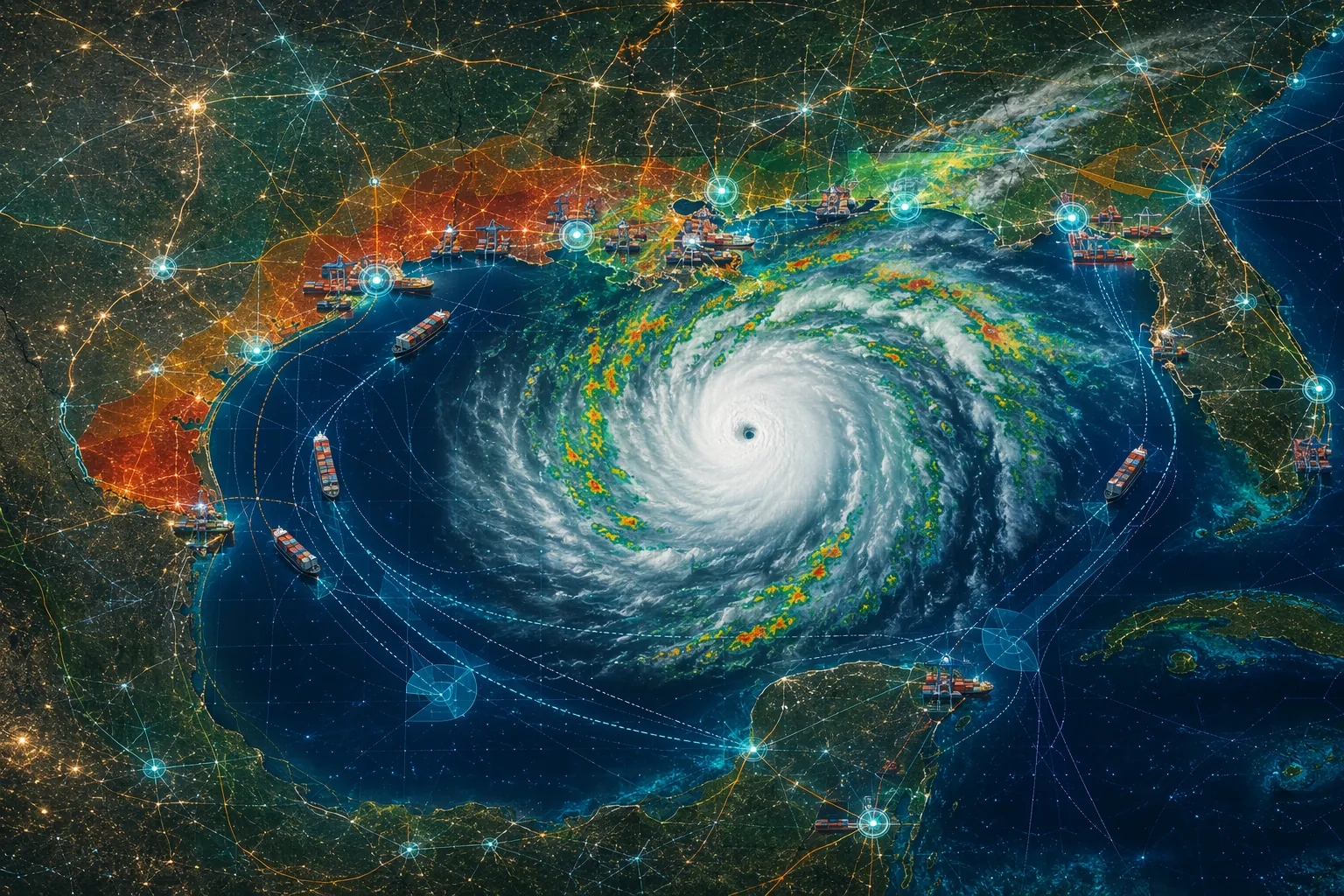
That distinction matters on a day like this. The useful question is not whether a storm exists. It is whether a logistics team can turn an uncertain warning into the next three decisions before the easy choices disappear: which inbound freight to reroute, which suppliers to call before cutoff notices arrive, and which inventory to pull forward before demand and transportation capacity move at the same time.
The cost of waiting is not abstract. Geotab and WeatherOptics estimate that weather-related trucking delays cost $2.2 billion to $3.5 billion annually, with 32 billion lost vehicle hours and a $56-per-hour per-vehicle delay cost.[4] Those numbers do not say what Bertha will cost any one company. They do explain why shaving hours from a response cycle is worth more than a cleaner dashboard after the storm has passed.
The real gap is hours versus days
Traditional storm response often starts with a forecast, then breaks into separate threads: transportation asks carriers for lane status, procurement checks supplier locations, planning compares inventory by region, customer teams wait for a credible answer, and leadership asks whether the disruption is material enough to justify exceptions. None of that is irrational. It is just slow when the storm clock is already running.
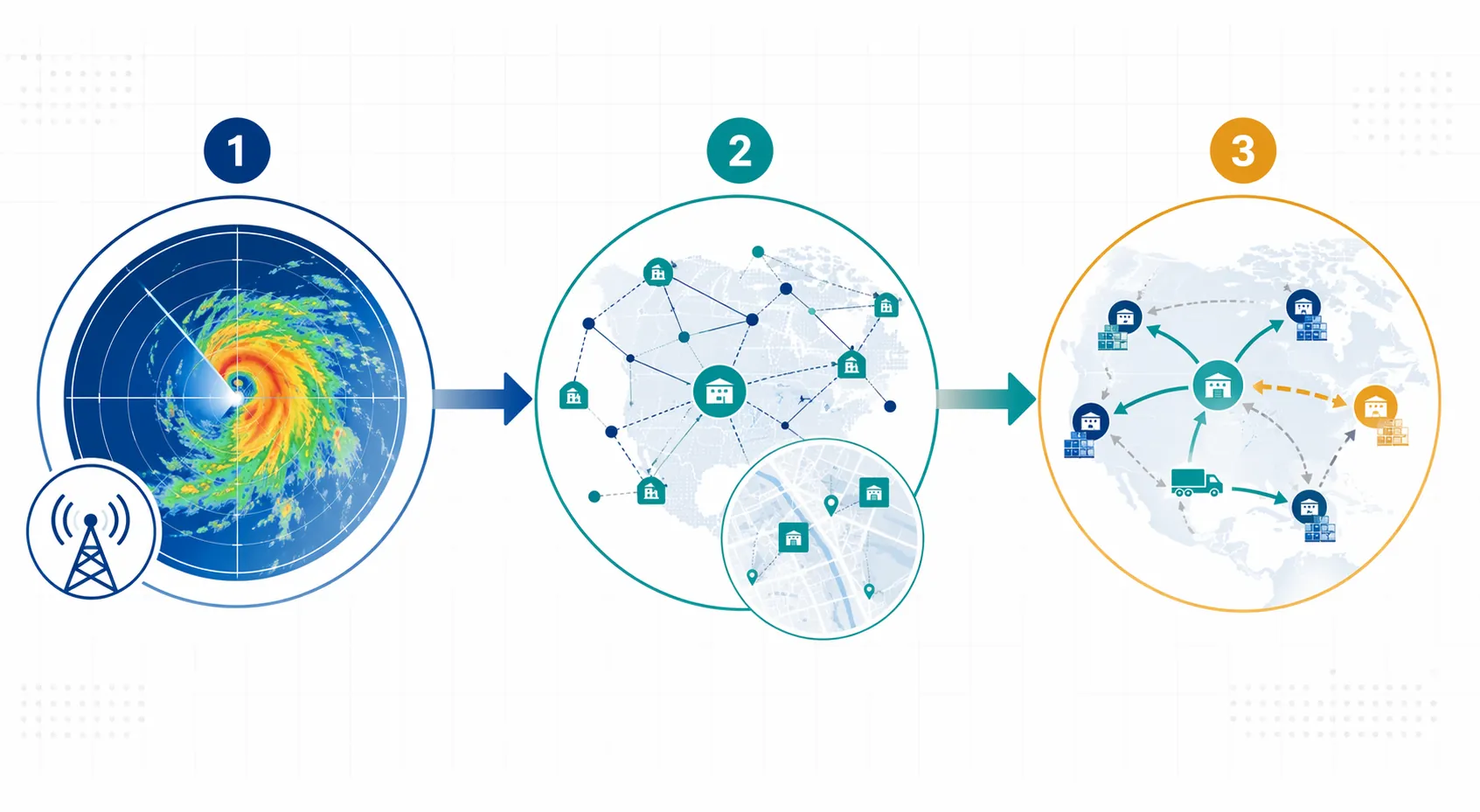
AI-enabled disruption planning is useful when it compresses that handoff. The strongest use cases around Bertha-scale supply chain disruption are not general promises about autonomy. They are narrower and more operational: earlier storm signal, faster exposure mapping, and better conversion of risk into purchase orders, inventory positioning, or route changes.
| Decision point | What the AI layer changes | Operational consequence |
|---|---|---|
| Detect | Turns storm structure and forecast signals into earlier warnings and hourly hazard outputs | Teams get more time to decide which sites, lanes, and customers need attention |
| Map | Checks active shipments, facilities, and suppliers against current or forecasted geographies | Planners see which freight, locations, and supplier tiers are actually exposed |
| Act | Connects the warning to demand, inventory, supplier availability, and transportation options | Orders, reallocations, and reroutes happen before cutoff notices or stockouts force the issue |
Earlier warning only matters if someone can use it
DTN has described a deep-learning tropical storm forecast model that uses semantic segmentation, a technique also used in driverless-car perception, to identify and forecast storm hazards. The company says the model can provide warnings up to 4 days earlier than conventional forecasts and produce hourly wind, precipitation, and surge outputs across a 7-day horizon.[5]
The timing needs a careful label. DTN’s article described capabilities for the 2024 hurricane season, so it should not be treated as a fresh 2026 independent audit. Still, the operational value of the claim is easy to understand. A four-day earlier signal can be the difference between a normal expedite request and a late scramble after terminals, carriers, suppliers, or receiving sites have already tightened their windows.
Earlier detection does not decide what to do with Bertha by itself. A Gulf Coast warning becomes useful only when it is joined to a company’s own map: open purchase orders, inbound containers, truckload appointments, cross-docks, supplier plants, customer commitments, and inventory by location. Otherwise the forecast remains a weather artifact sitting next to the planning system rather than inside the response.
Exposure mapping is where the forecast becomes a work queue
For Bertha, the first useful map is not a beautiful storm cone. It is a list of assets and obligations inside or near the likely disruption area. FourKites describes tools that check active shipments against current and forecasted disruptions, including Custom Zones that allow users to draw geo-borders around a storm’s projected track and trigger automated alerts.[6] In practice, that means a transportation team does not have to manually compare every shipment against a weather layer, then reconcile the result against carrier emails.
Everstream Analytics describes a similar planning problem from the network side: geofence a hypothetical or actual storm zone, visualize affected facilities with color-coded incident risk scores, and simulate how disruption could propagate across a supplier network.[7] That kind of scenario view is not valuable because it predicts every consequence with certainty. It is valuable because it narrows the field of argument. Instead of debating whether the Gulf Coast is generally at risk, the team can ask why Plant A has two critical inbound components in the zone while Plant B has enough cover to wait.
This is also where single-tier visibility starts to fail. A company may know its direct supplier is outside the path, while that supplier’s packaging source, raw-material source, sterilization provider, or regional warehouse is not. During a fast storm window, the team that sees only Tier 1 may falsely relax; the team that sees Tier 1 through Tier N can at least decide which assumptions deserve a phone call.
The Cooper Health example shows the value of acting before cutoffs
Interos.ai’s Hurricane Idalia example is useful because it shows a concrete pre-storm action rather than a generic visibility claim. The company says its catastrophic risk model and multi-tier supplier mapping helped Cooper University Health Care identify three suppliers in the storm’s path, allowing Cooper to place orders before hurricane cutoff notices were triggered.[8]
That is the unglamorous part of storm response that matters. The win was not merely knowing that a hurricane existed. It was identifying three exposed suppliers early enough that procurement could order before the normal commercial process narrowed. For a hospital system, the consequence of that timing is not just freight cost. It is whether critical supplies arrive before the supplier, carrier, or receiving process starts operating under emergency constraints.
Applied to Bertha, the same pattern would not require a company to predict the perfect path. It would require a current supplier graph, a storm-zone overlay, and a rule for when exposed suppliers move from watch list to action list. The output should look like a short operating queue: suppliers to contact now, orders to accelerate now, substitute sources to confirm now, and shipments to hold until the risk is clearer.
The hardest step is converting risk into inventory decisions
Most storm dashboards are better at showing danger than deciding inventory. That is understandable: demand shifts during a hurricane are uneven. Some products see a pre-storm pull-forward, some see a post-storm repair spike, some are constrained by store closures or port interruptions, and some do not move enough to justify any exception. The planner’s problem is not simply “storm equals more stock.” It is where, when, and for which SKU family.
ClimateAi’s Hurricane Ian case study is the strongest example in the available material because it follows the decision all the way into demand positioning. The company says its FICE model, a probabilistic machine-learning model, quantified the timing, duration, and magnitude of hurricane-driven demand spikes. In ClimateAi’s vendor-published case study, a roofing materials producer used those forecasts to pre-position Florida-specific inventory ahead of Hurricane Ian and captured $15 million in additional sales.[9]
That claim should be read as a vendor-documented deployment outcome, not independent proof that every AI planning project will produce similar returns. Even with that caveat, the sequence is instructive. The model did not merely say a hurricane was coming. It translated the expected event into a product-and-place decision: put the right roofing materials closer to the market likely to need them before transportation and replenishment options tightened.
For Bertha, that kind of decision conversion is the layer many companies still struggle to build. A storm warning may reach the planning desk quickly, but the exception workflow still has to answer several questions before anyone changes the plan: which demand signals are storm-sensitive, which locations can receive earlier, which inventory can be moved without creating a shortage elsewhere, which customers have service-level priority, and which transportation options are still available.
- Pull forward inventory when the exposed market is likely to need the product and receiving capacity is still open.
- Hold inventory when the storm risk is mainly transportation delay and the destination cannot use additional stock before landfall.
- Reroute freight when the shipment is valuable, time-sensitive, and still early enough in transit to avoid the highest-risk corridor.
- Place pre-storm supplier orders when upstream exposure is specific enough to justify action before cutoff notices.
ClimateAi also describes hurricane-season AI use in terms of de-risking supply chains and capturing demand opportunities, but the practical lesson is narrower than the marketing frame.[10] The useful tool is the one that tells a planner which exception is worth making while there is still time to make it.
What should change during Bertha
A company using AI-enabled disruption planning well during Bertha should see its response rhythm change. The first meeting should not be a long debate over whether to monitor the storm. The system should already have flagged exposed shipments, suppliers, facilities, and demand zones, with enough confidence levels and timestamps for people to challenge the output without rebuilding it from scratch.
Transportation should be working from a ranked list of shipments rather than a raw shipment file. Procurement should know which suppliers are in or near the risk zone, including multi-tier dependencies where that data exists. Planning should know which inventory decisions are tied to storm-driven demand and which are only panic moves. Customer teams should know which commitments are likely to slip before the customer asks.
There is still judgment involved. A modeled storm track can shift. A supplier inside a projected zone may remain open while a carrier outside it loses capacity. A demand model can identify a likely spike without guaranteeing margin, service, or replenishment success. The point is not to remove operators from the loop. It is to stop wasting the first usable hours assembling the same exposure picture every storm season.
The evidence is useful, but not universal proof
The case evidence available here is strongest when kept close to what it actually documents. DTN describes earlier warning capabilities for a model introduced around the 2024 hurricane season.[5] FourKites and Everstream describe platform functions for shipment disruption checks, geofenced storm zones, facility visualization, and scenario planning.[6][7] Interos.ai provides a vendor-published example of Cooper Health placing pre-storm orders with three suppliers before Hurricane Idalia cutoff notices.[8] ClimateAi provides a vendor-published Hurricane Ian case in which a roofing materials producer captured $15 million in additional sales after pre-positioning inventory.[9]
Those are not interchangeable claims. A forecasting model’s earlier signal is not the same as measured profit. A visibility platform’s geofence is not the same as a completed supplier order. A vendor case study is not the same as a third-party benchmark. Treating them separately makes the evidence more useful, not less.
For teams dealing with Bertha now, that is enough to support a sober operating judgment. The storm does not prove that every AI supply chain platform works, and it does not remove the need for experienced planners. It does show why earlier warning, mapped exposure, and demand-aware inventory positioning matter when the disruption clock is already running.
References
- Tropical Storm Bertha hurricane season, NPR, July 22, 2026.
- Could Bertha become a hurricane? 'Messy and lopsided' storm, USA Today, July 21, 2026.
- Supply chain alert: Bertha could disrupt Gulf Coast logistics, FreightWaves.
- Hurricanes, supply chain and transportation, Geotab.
- AI is driving new DTN advanced tropical storm forecast, DTN.
- Tips for keeping your supply chain running during hurricane season, FourKites.
- Scenario planning for supply chain risk management, Everstream Analytics.
- Protecting your supply chain from extreme weather: steps to minimize risk, Interos.ai.
- Accurate hurricane forecasting helps roofing materials producer, ClimateAi.
- Three ways AI can help companies de-risk supply chains and capture new opportunities during hurricane season, ClimateAi.
Comments
Join the discussion with an anonymous comment.