
The Red Sea blockade turned ocean visibility from a tracking convenience into a live operating test. Published schedules, carrier updates, and freight indices were all lagging indicators once vessels began avoiding the Suez route. For teams managing customer promises, allocation, detention risk, and expediting decisions, the useful question was not whether a dashboard showed a vessel in the wrong place. It was whether the system gave them enough earlier warning to do something before the exception became expensive.
That is where the strongest evidence for AI-enabled supply chain resilience has to sit: not in generic resilience language, but in lead time, ETA accuracy, manual work removed, and cost buckets that actually move.
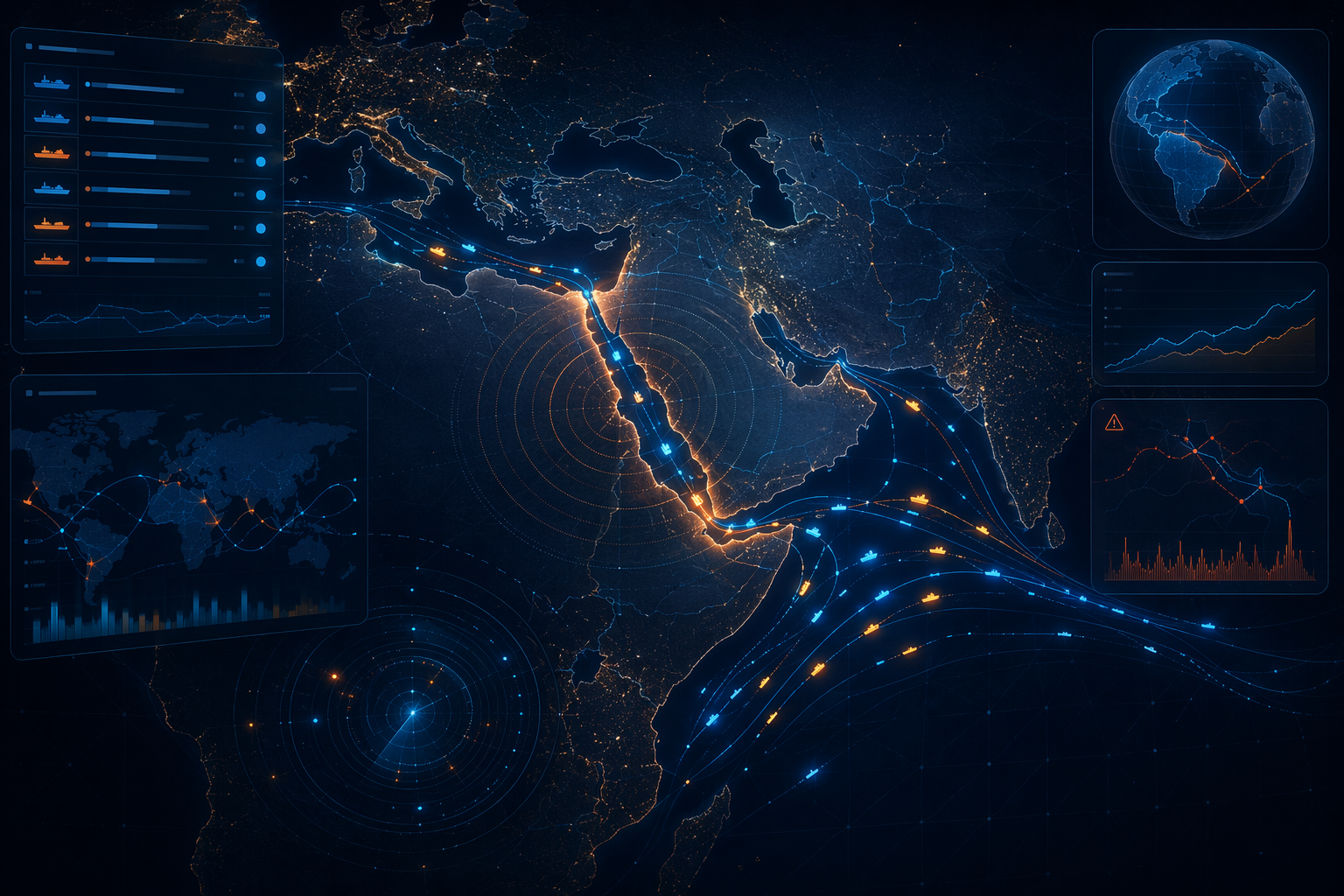
The disruption was large enough to break normal exception handling
The scale matters because small schedule slippage can be absorbed by the usual mix of carrier emails, manual portal checks, and planner judgment. The Red Sea disruption was not that kind of event. Space Sat Lab described satellite and AIS-based chokepoint monitoring as producing a 7–10 day lead-time advantage over published freight indices during the Red Sea disruption, a window long enough to support proactive operational adjustments rather than post-facto explanation.[1]
Project44 reported a 75% drop in Suez container traffic and transit-time increases of 47% on key lanes during the crisis.[2] Celonis, citing Bloomberg, stated that roughly 62% of global container capacity had been rerouted.[3] Those figures are not current-state claims for Q3 2026; the Red Sea situation and carrier responses have continued to evolve. They are still the right stress-test period to examine because they show the operating condition under which a visibility tool either becomes decision infrastructure or becomes another noisy screen.
A dispatcher can work around one unreliable ETA. A regional control tower can work around a lane disruption. But when routings, transit times, carrier communications, and arrival sequences all shift together, the bottleneck becomes information reconciliation. Coordinators refresh portals. Customer service waits for a defensible promise date. Finance starts asking why detention and demurrage exposure is rising. IT is asked whether the visibility feed can actually land inside the TMS or ERP workflow instead of sitting in a separate browser tab.
What predictive ocean visibility is actually predicting
Predictive ocean visibility platforms are not just vessel maps with a machine-learning label attached. The useful systems combine multiple signals: satellite AIS and terrestrial AIS, weather, port congestion, carrier schedules, historical transit patterns, and sometimes economic or market signals that indicate route pressure. The platform then produces predictive ETAs, disruption alerts, route-risk indicators, and exception priorities.

The distinction matters. If a system merely repeats a carrier ETA faster, it may reduce portal chasing but will not handle a geopolitical chokepoint shock well. During a Red Sea-type disruption, the value comes from detecting that a vessel’s behavior, route, port sequence, or expected arrival has changed before the official schedule catches up.
| Input signal | Operational use |
|---|---|
| Satellite and AIS vessel position data | Detect route changes, slow steaming, chokepoint avoidance, and vessel behavior that conflicts with the published schedule |
| Weather and ocean conditions | Adjust arrival predictions when rerouted vessels face longer passages or weather-related delays |
| Port congestion and berth activity | Estimate whether a vessel that arrives near port will actually discharge on time |
| Carrier schedules | Compare official plans with observed movement and likely revised arrival windows |
| Economic and market signals | Identify broader capacity pressure and rerouting patterns that may affect future sailings |
That pipeline only matters if the output changes work. A predictive ETA should trigger customer communication earlier. A disruption alert should move the shipment into a higher-priority exception queue. A route-risk signal should help planners decide whether to adjust inventory promises, change downstream transport booking, or avoid last-minute premium freight. If the only result is a red icon beside a shipment the team already knows is late, the model has not earned its place in the process.
The Red Sea evidence: useful, but not neutral
Three metrics deserve more attention than the usual AI visibility claims: the 7–10 day lead-time advantage from Space Sat Lab, Portcast’s stated ±1.5 day ETA accuracy up to three weeks ahead, and Siemens/Portcast deployment figures for reduced manual tracking and cost exposure.[1][4] They are not the same kind of evidence, and they should not be treated as interchangeable.
Lead time is the first test
Space Sat Lab’s 7–10 day lead-time claim is important because it points to the core operational advantage of satellite and AIS-based monitoring over published freight indices.[1] Freight indices are useful for market interpretation, procurement discussions, and trend awareness. They are too slow for shipment-level exception management when a customer is waiting for a new arrival promise or a planner needs to protect a production schedule.
A week of earlier signal can change the work. Customer teams can reset expectations before the delivery miss becomes a surprise. Inland transport can be rebooked before the appointment window collapses. Inventory planners can decide whether to consume buffer stock or hold back allocation. The lead time claim does not prove that every platform will perform that way, or that every shipper will act on the warning. It proves that the sensing layer can move faster than traditional published indicators under a chokepoint shock.
ETA accuracy is the harder benchmark
Portcast’s reported ±1.5 day predictive ETA accuracy up to three weeks ahead is the metric buyers should pressure-test most aggressively.[4] It is specific enough to evaluate. It also gets close to the decision window that matters for ocean freight: not whether the vessel is visible today, but whether the arrival prediction is reliable enough to coordinate downstream capacity, customer commitments, and exception handling weeks before arrival.
Still, the benchmark needs careful handling. It is vendor-attributed, and the research materials do not establish it as an industry average. Buyers should ask how accuracy was measured, which lanes were included, whether transshipment cargo was separated from direct sailings, how blank sailings and omitted port calls were treated, and whether the accuracy was calculated against actual time of arrival, berth time, discharge completion, or another operational milestone.
That level of questioning is not procurement theater. A ±1.5 day ETA can be excellent for customer promise management and downstream planning if the milestone matches the buyer’s workflow. It is less useful if the business really needs container availability or appointment readiness and the platform is only predicting vessel arrival.
ROI figures show where the workflow changed
The Siemens/Portcast case is valuable because the reported benefits map to operational pain points: an 80% reduction in manual shipment tracking updates, a 15% decrease in detention and demurrage charges, and a 5% reduction in expedited freight costs.[4] Those are vendor-reported deployment figures, not neutral market averages, but they point to the right places to measure.
Manual update reduction matters because exception rooms often hide labor cost in routine chasing. If coordinators stop checking carrier portals for shipments that the system can monitor reliably, they can spend time on exceptions that require human intervention. Detention and demurrage reduction matters because earlier arrival and delay signals can change free-time planning, appointment scheduling, and escalation timing. Expedited freight reduction matters because a late ocean signal often forces an expensive air or premium truck decision that could have been avoided with earlier warning.
The caveat is equally important. A vendor-published ROI figure may reflect a strong customer, a favorable lane mix, a mature process, or a deployment where integration work had already been solved. A buyer should not copy the percentages into a business case. The better move is to copy the measurement categories, then test them against the buyer’s own shipment profile, free-time exposure, exception volume, and premium freight history.
Representative platforms are converging on the same operating problem
The vendor landscape is no longer a collection of experimental point tools. Siemens cited Strategic Market Research sizing maritime AI at $4.3 billion, growing at a 40.6% annual rate, which is enough to treat the category as a serious buying market rather than a lab experiment.[4] Market size does not prove effectiveness, but it does explain why buyers now see multiple credible options instead of one-off pilots.
| Platform or provider | Relevant differentiation for disruption management |
|---|---|
| Portcast | Predictive ETA and ocean visibility analytics, with Red Sea-era accuracy and Siemens deployment claims available for buyer scrutiny |
| project44 | Broad supply chain visibility network and disruption reporting, including Red Sea traffic and transit-time analysis |
| Windward | Maritime AI and vessel behavior intelligence, especially relevant where risk, compliance, and vessel movement patterns matter |
| Shippeo | Transport visibility platform with multimodal visibility orientation, useful where ocean events must connect to downstream transport workflows |
| Siemens AX4 | Supply chain collaboration and logistics platform context, relevant when predictive data must connect into broader execution workflows |
That list should not be read as a ranking. The practical comparison is narrower: which platform has the strongest data coverage on the buyer’s lanes, which milestones it predicts, how it handles carrier schedule conflicts, and whether its outputs can be consumed by the systems where planners already work.
The implementation risks are not side issues
The fastest way to overbuy predictive visibility is to evaluate the model in isolation. During a disruption, the model is only one part of the operating chain. The harder questions are data provenance, integration, exception ownership, and whether people trust the prediction enough to act before the carrier confirms it.
Data quality decides whether the alert layer is useful
AIS gaps, stale carrier schedules, inconsistent container milestones, port congestion noise, and transshipment ambiguity can all degrade prediction quality. A platform may be very good at vessel-level movement and still weak at the shipment milestone the buyer cares about. Data quality is also not a one-time certification problem. Coverage can vary by carrier, lane, port, service type, and handoff point.
SCMR’s 2026 discussion of AI in global supply chains points to data clean rooms and blockchain-based provenance as emerging ways to improve data integrity and trust across supply chain parties.[5] Those approaches may help, especially where multiple organizations need to share sensitive or disputed operational data. They do not remove the need to validate the actual fields feeding the ETA model, or to understand what happens when sources disagree.
Legacy TMS and ERP integration can make or break adoption
A predictive ETA that lives outside the execution workflow is easy to admire and easy to ignore. If planners must copy data from a visibility portal into a TMS, email it to customer service, and manually update an ERP promise date, the organization has only shifted manual work from tracking to translation.
Before procurement, buyers should map the operational handoff. Which system receives the updated ETA? Does the ETA overwrite the carrier schedule, sit beside it, or require approval? Can the TMS trigger an exception workflow when the predicted arrival moves beyond a tolerance? Can customer-facing promise dates be updated with an audit trail? Does finance receive enough context to connect lower demurrage exposure to earlier exception handling?
The integration issue is not just technical. It determines whether the lead-time advantage becomes action time. A seven-day earlier warning is much less valuable if it spends five days waiting for someone to reconcile two systems.
Human-in-the-loop exception management is still required
The point of predictive visibility is not to remove planners from disruption management. It is to reserve their time for exceptions that deserve judgment. A useful workflow separates low-risk monitoring from shipments that need intervention because of customer priority, production dependency, detention exposure, or downstream capacity constraints.
That means buyers need exception rules before they need more dashboards. A two-day ETA change may be irrelevant for one import flow and urgent for another. A delayed vessel may not matter if inventory is buffered, but the same delay may trigger a production issue for a single-source component. The platform can rank and surface risk; the organization still has to define which consequences matter.
Trust fails when AI ETAs conflict with carrier schedules
The most predictable adoption problem is also the most human: a model says the vessel will arrive later, the carrier schedule still says it will arrive on time, and the planner has to decide which date to use with a customer. If the organization punishes people for acting on an AI prediction that later changes, they will wait for the carrier email. The tool will become decorative.
Trust-building has to be designed into the rollout. Teams need side-by-side accuracy tracking, clear confidence indicators, escalation rules for conflicting ETAs, and post-event reviews that compare predictions with outcomes. The goal is not blind trust in the model. It is enough justified trust that people can act earlier when the evidence is stronger than the official schedule.
How to build a buyer case that survives scrutiny
A credible business case for predictive ocean visibility should start with the buyer’s own disruption economics, not a vendor’s average ROI. The Red Sea evidence gives the categories to examine: lead time, ETA accuracy, manual tracking effort, detention and demurrage exposure, and expedited freight. Those categories are concrete enough for a pilot and hard enough to expose weak claims.
- Validate ETA performance on the lanes and milestones that matter: vessel arrival, berth, discharge, container availability, or delivery appointment readiness.
- Measure lead time against the buyer’s current sources, including carrier portals, forwarder updates, freight indices, and internal exception reports.
- Calculate manual tracking reduction from actual coordinator activity, not from assumed shipment counts.
- Link detention, demurrage, and expedited freight savings to specific decisions made earlier because of the predictive signal.
- Test integration readiness by pushing predictive events into the TMS, ERP, control tower, or customer communication workflow used in daily operations.
- Review data-source transparency, including AIS coverage, carrier schedule handling, port congestion inputs, confidence scoring, and exception logic.
A pilot that only asks whether users like the dashboard will miss the point. The better pilot asks what the team did differently because it knew sooner, and then checks whether that action reduced a measurable cost, prevented a broken promise, or removed manual work.
A bounded judgment
Predictive ocean visibility is mature enough to evaluate as a deployable AI use case for ocean freight disruption management. The Red Sea blockade produced a hard test: unstable routings, longer transit times, carrier schedule uncertainty, and enough operational pressure to reveal whether earlier signals changed decisions. The best available evidence supports a serious evaluation, especially around earlier chokepoint detection, three-week ETA prediction, reduced manual tracking, and avoidable delay-related costs.
The business case should remain bounded. Buyers should not treat vendor-published ROI as a guaranteed outcome, or assume that an accurate vessel ETA automatically becomes a trusted customer promise. The decision should rest on validated ETA performance, integration readiness, source transparency, and workflows that let people act on predictive signals before the old confirmation channels catch up.
References
- How Red Sea Disruptions Impact Global Supply Chains, Space Sat Lab
- project44 analysis, project44
- Red Sea disruptions, Celonis
- When Sea Freight Gets Smarter, Siemens
- How AI is shifting global supply chains..., SCMR
Comments
Join the discussion with an anonymous comment.