
Noise used to sit in the appendix of many data center site-selection decks. In 2026, it belongs on the first screen. For AI data center location planning, noise regulation is now a gating question: can the site survive local setbacks, property-line limits, acoustic modeling, post-occupancy testing, and the neighborhood reaction that begins after the equipment runs all night?
That shift matters because there is no single federal compliance box to check. The federal Office of Noise Abatement and Control was effectively defunded in 1981, leaving community noise control largely to state and local governments.[1] The result is exactly the kind of patchwork that can trap a project team: one county wants a minimum residential setback, another wants day and night property-line limits, another wants post-construction verification, and a city that once welcomed data centers may pause rezoning after residents have lived with the sound for years.
The business consequence is no longer hypothetical. Between May 2024 and March 2025, at least 16 U.S. data center projects were rejected or delayed, with $900 million in projects blocked and $45.8 billion delayed in Virginia alone, according to Ramboll’s review of local data center noise conflicts.[2] Those numbers do not prove noise was the only reason every project stalled. They do show why noise has moved from nuisance management to capital-risk screening.
The First Screen Is Local, Not National
A national map of power, fiber, land, tax incentives, and labor availability is not enough. Noise feasibility has to be checked at the ordinance level, because the rules that matter are often county amendments, zoning conditions, special-use permit requirements, or draft language moving through local boards.
Fairfax County, Virginia is a useful example because its 2024 zoning amendment turned data center noise from a general compatibility issue into a defined approval requirement. The county requires data centers to meet a minimum 200-foot setback from residential property, submit pre-construction acoustic modeling, and complete post-occupancy noise verification within 60 days after the facility starts operation.[3] For a supply chain leader, that means noise is not something to be tuned after commissioning. It affects whether the parcel geometry works at all.
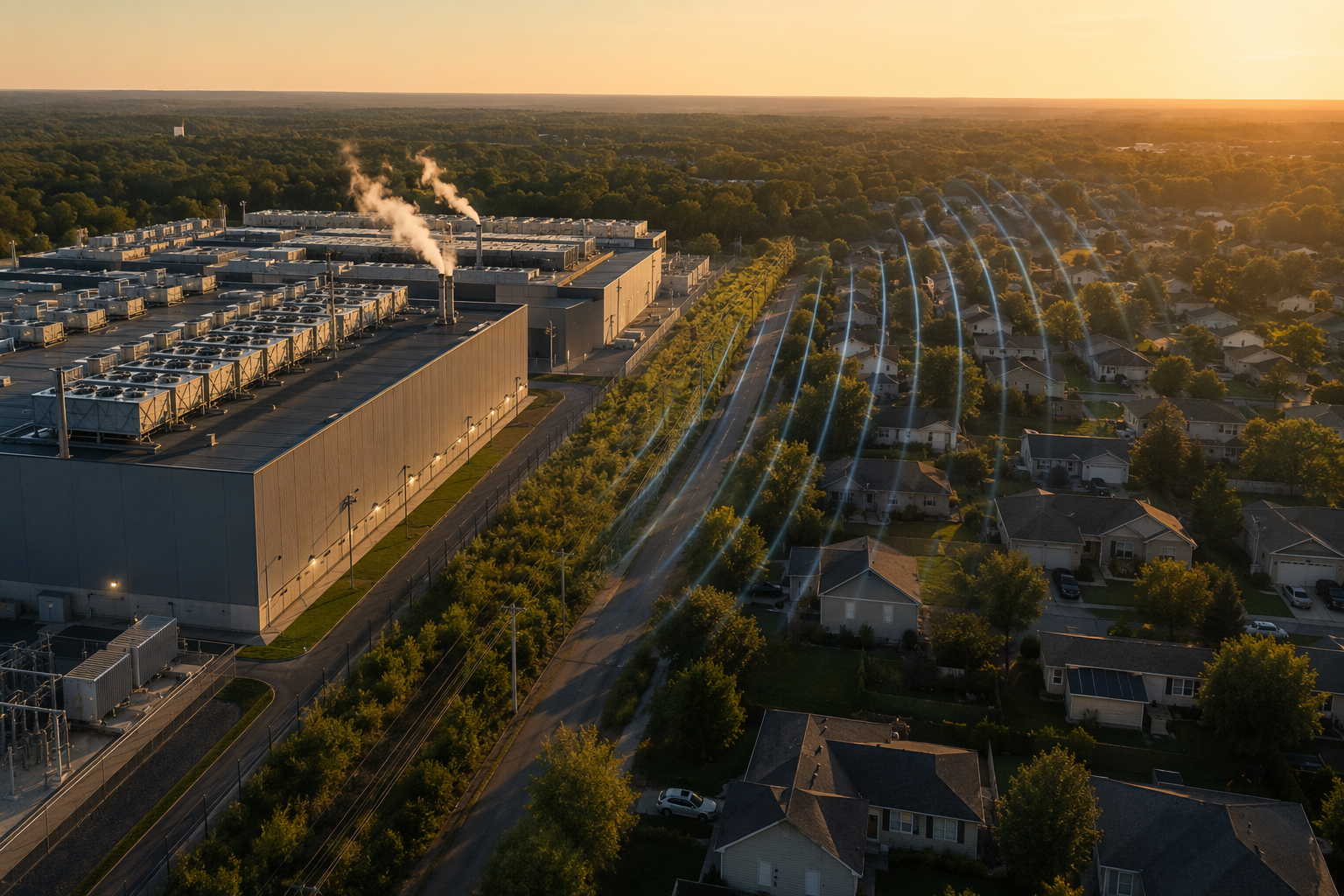
Northern Virginia also shows why “available land” can be misleading. A 2024 Virginia legislative review found that nearly one-third of the state’s data centers were located within 200 feet of residentially zoned properties.[1] A parcel can look usable on a regional capacity map and still be exposed to a setback rule, a rezoning fight, or a verification test that arrives after the project has already become public.
Chandler, Arizona points to the same risk from the other side of the timeline. The city had hosted data centers for years, then imposed a rezoning moratorium after prolonged resident complaints about noise and air pollution.[4] That is the kind of fact that rarely fits into a simple “business-friendly jurisdiction” label. Local tolerance can change after operations begin.
| Regulatory screen | What it changes in site selection | Why it matters operationally |
|---|---|---|
| Residential setback | Removes parcels that cannot keep equipment, buildings, or property boundaries far enough from homes | Can make an otherwise attractive site infeasible before design starts |
| Property-line dBA limit | Requires modeling against a defined boundary and operating condition | Can drive equipment placement, wall design, and enclosure cost |
| Day/night standard | Makes the nighttime operating profile more important than the average daily condition | AI workloads and cooling systems do not stop at bedtime |
| Pre-construction acoustic study | Moves acoustical engineering into due diligence and rezoning | Creates a record that planning staff and residents can challenge |
| Post-occupancy verification | Adds a test after the facility is running | Turns design assumptions into measurable compliance risk |
| Octave-band or C-weighted limits | Captures low-frequency sound that may not show up clearly in dBA-only review | Targets the hum residents are most likely to notice indoors |
The decision is plain: if the parcel fails one of these screens, the project either needs a different design, a different entitlement path, or a different site. The expensive mistake is treating all six as late-stage permitting details.
What Actually Varies by Jurisdiction
Most community noise ordinances still speak in familiar property-line terms. Many cap data center noise around 50–60 dBA at property lines, but the exact limit, measurement point, operating condition, and exceptions vary by local code.[5] That last part is where many screening errors begin. A number without the measurement method is not a usable requirement.
A planning team should separate the regulation into pieces instead of asking only, “What is the dB limit?” The first piece is the receptor: is the limit measured at the data center property line, the nearest residential property line, the nearest dwelling, or a designated zoning boundary? The second is the clock: is there a stricter nighttime standard? The third is the operating condition: does the test include normal cooling only, emergency generators, periodic generator testing, or a worst-case equipment scenario?
Albemarle County, Virginia’s draft data center ordinance illustrates the direction of travel. The draft addresses property-line noise limits and distinguishes between day and night standards.[6] Because it is draft language, it should not be treated as a settled compliance number. It should be treated as a warning that localities are writing data center-specific controls rather than relying only on older industrial noise rules.
Setbacks add another layer because they are not solved by buying quieter equipment. Fairfax County’s 200-foot minimum setback gives planners a bright-line geometry test.[3] If the buildable area shrinks below the required campus layout, the site is not “nearly compliant.” It is structurally misfit unless the design changes or the entitlement path allows relief.
Post-occupancy verification deserves special attention. A model prepared before construction can help win approval, but a verification test after startup creates a second gate. If the facility fails, the owner is negotiating from a worse position: the building exists, the neighbors have a lived experience of the sound, and the fix is now a retrofit.
- During market screening, eliminate parcels that clearly conflict with adopted setbacks or residential adjacency rules.
- During site diligence, read the current ordinance, pending amendments, zoning conditions, and staff reports instead of relying on a summarized dB number.
- Before acquisition or rezoning, model normal operations, nighttime conditions, and generator testing assumptions.
- Before public commitment, price the quiet design that the model requires, not the cheaper design the campus would use in an unconstrained location.
- After occupancy, verify performance where required and keep an operating record for generator tests and complaint response.
Why dBA Alone Can Miss the Fight
A-weighted decibel limits are still common because they are familiar and administratively convenient. They are also an imperfect proxy for the sound residents complain about around data centers. Low-frequency sound can travel differently, penetrate buildings differently, and remain noticeable even when a facility appears acceptable under a dBA-only property-line test.
The practical example is the hum. KnowYourH2O describes how A-weighted measurements can understate low-frequency sound, including around 63 Hz, where wavelengths are roughly 18 feet.[5] That does not mean every data center creates the same low-frequency condition. It means a single dBA number may be too blunt for a 24/7 facility with large cooling systems, fans, vents, transformers, and backup power equipment.
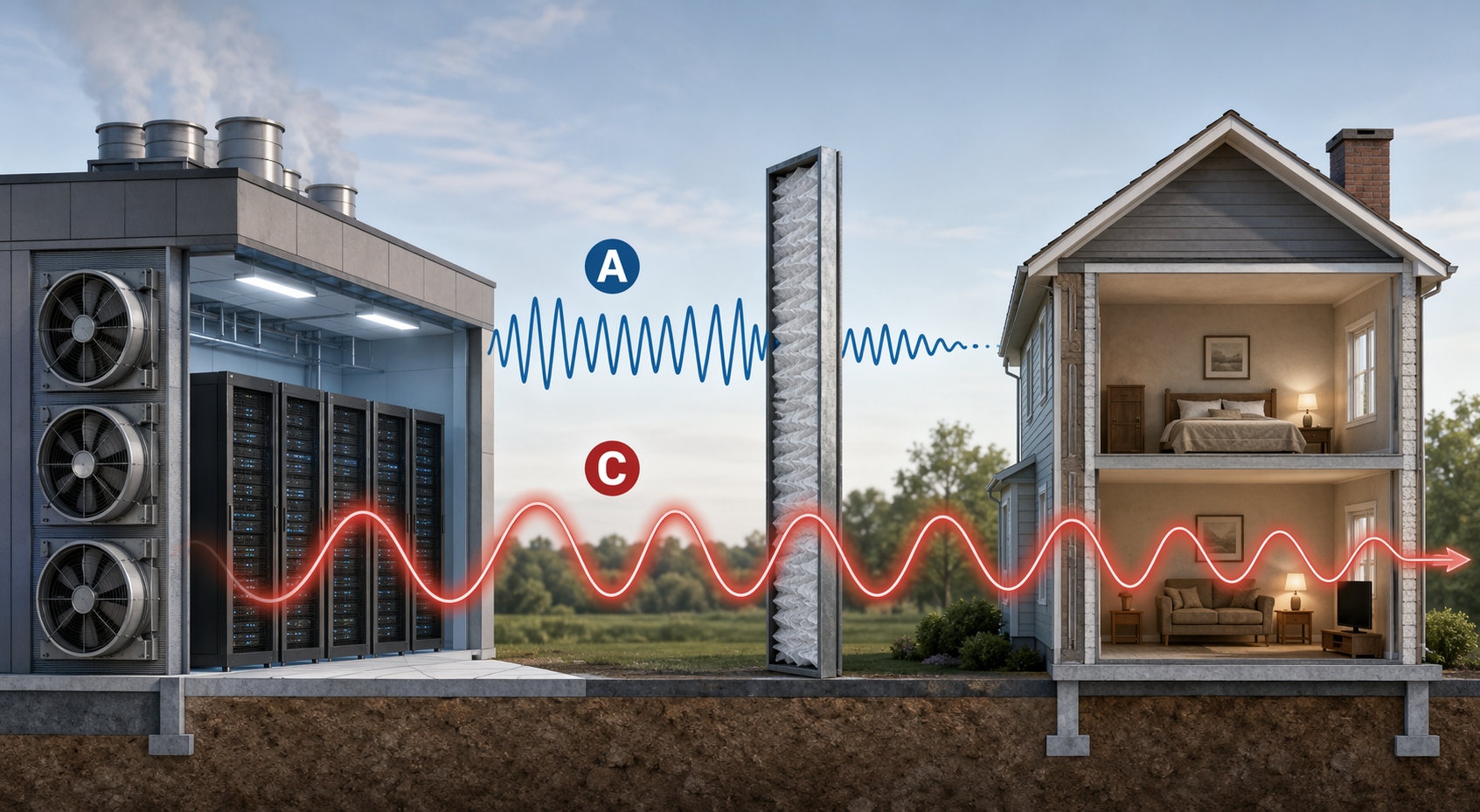
That is why some jurisdictions and consultants are moving toward octave-band review or C-weighted limits. Ramboll notes that communities revising noise ordinances are paying closer attention to measurement methods that better capture low-frequency data center sound.[2] For site selection, this changes the question from “Can we meet 55 dBA?” to “Can we meet the applicable limit in the frequencies and time periods the locality actually regulates?”
The 24/7 profile is the other problem. A warehouse, factory, or construction site may have loud moments, but residents can often locate them in time. Data center cooling noise can become a constant background condition. Backup generators add intermittent high-noise events, especially during testing or outages. A project that treats generator noise as an emergency-only edge case may still face a predictable permitting question: when are the generators tested, how many run at once, and what does the nearest home hear?
The health evidence should be used carefully. A 2026 Frontiers in Climate article discusses sleep disruption, cardiovascular risks, and cognitive effects in relation to 24/7 data center noise, drawing on broader environmental-noise research.[7] It is not a longitudinal epidemiological study proving a quantified data-center-specific disease burden. It is still relevant because planning boards do not wait for perfect epidemiology before responding to residents who say they cannot sleep.
Complaints Are Becoming Legal and Financial Events
Community opposition is easy to underestimate when it is described as a public-relations issue. The harder version is a lawsuit, a moratorium, a denied rezoning, or a board hearing where staff asks for another study while the capacity plan waits.
In June 2026, residents in three small U.S. cities filed lawsuits against data centers over noise, according to a New York Times report preview.[8] The available brief detail should be verified against the full article before relying on additional specifics, but the direction is clear enough for planning purposes: noise complaints are no longer confined to comment periods and neighborhood meetings.
This is where supply chain ownership becomes awkward. The team that announced the site is not always the team that inherits the operating constraint. Someone later has to explain why a commissioned facility cannot run equipment as planned, why generator testing is politically sensitive, why a wall or enclosure must be added, or why the next campus in the same market faces a colder reception.
The capital exposure is not limited to the acoustic fix. A late redesign can affect the electrical yard, cooling layout, truck circulation, stormwater design, building orientation, and phasing. If the site is already public, the developer is also paying with credibility. Residents and planning staff tend to remember when the first model missed the lived condition.
Mitigation Works Best Before the Site Is Defended in Public
Noise mitigation is real, but it is not a magic eraser for a poor site. Diesel generators can reach 105 dBA, while full acoustic enclosures can reduce measured noise by up to 40 dBA at the property line, according to Acoustical Consultants.[9] Inside Climate News has reported that Tier 4 engines are about 50% quieter than Tier 2 engines in the context of data center generator noise.[10] Those are useful engineering levers. They also cost money and need space.
Some fixes are more surgical. The Frontiers in Climate article cites a Compass Datacenters case in Leesburg, Virginia, where re-engineering fan mounts reduced low-frequency tonal noise by 20%.[7] That is encouraging, but the lesson is not that every contested site can be rescued with a fan-mount redesign. The lesson is that low-frequency problems can come from specific design choices, and those choices are cheaper to address before procurement and construction harden.
Good-neighbor design starts earlier than the enclosure purchase. Acentech’s guidance emphasizes site selection, building orientation, equipment placement, and equipment choice as part of data center noise control.[11] In practice, that can mean placing cooling equipment away from homes, using the building mass as a shield, avoiding direct line-of-sight between major sources and receptors, specifying quieter fans or engines, and designing generator yards for tested operating conditions rather than optimistic averages.
The most disciplined teams price those choices before they need them. If a site only works after adding walls, enclosures, quieter equipment, and a constrained generator-testing schedule, those costs belong in the site comparison next to power interconnection, water access, land price, tax treatment, and fiber. Otherwise, the “cheaper” parcel wins the deck and loses the hearing.
A Practical Screening Posture for 2026
For AI data center location planning, noise regulation should be treated as an early exclusion and design variable, not a post-selection compliance task. The screening question is not whether a project can eventually hire an acoustical consultant. It is whether the location, layout, equipment concept, and local approval path make quiet operation plausible before the company commits publicly.
That requires a current local-code check, not a recycled market memo. Ordinances are changing quickly, and some cited limits in circulation come from draft language, summaries, or incomplete public documents. For any live investment decision, the team should verify adopted code, pending amendments, zoning conditions, staff interpretations, and appeal history in the jurisdiction itself.
The operating model also has to be honest. Model the cooling configuration the facility will actually run, the backup generators the site actually needs, the nighttime condition residents will actually experience, and the measurement method the locality actually uses. If post-occupancy testing is required, assume the test will happen and design to pass it.
The workable posture is simple: verify the current ordinance before acquisition or rezoning, model noise before the site is announced, include low-frequency review where the community or code demands it, price quiet design in the base case, and leave enough layout flexibility to fix problems without rebuilding the campus plan.
References
- Communities Are Raising Noise Pollution Concerns About Data Centers, Environmental and Energy Study Institute
- Data centers challenge communities revising noise ordinances for balance, Ramboll
- Board of Supervisors Approve New Data Center Zoning Ordinance Amendment, Fairfax County
- 'Living in Hell': Data Center Neighbors Grapple With Noise, Air Pollution, U.S. News & World Report, April 28, 2026
- Noise, Vibration, Zoning Ordinances, Data Centers Zoning Issues, KnowYourH2O
- Read the Draft Ordinance, Albemarle County
- Data center noise pollution and community health impacts, Frontiers in Climate, February 2026
- As Data Centers Spread, Residents Are Pushing Back Against the Noise, The New York Times, June 17, 2026
- A Guide to Noise Control in Data Centers, Acoustical Consultants
- Data Center Diesel Generators and Noise Pollution, Inside Climate News, November 12, 2025
- Good Noise Neighbor, Acentech, November 6, 2025
Comments
Join the discussion with an anonymous comment.