
The old renewal drill for a supply chain AI platform was uncomfortable but familiar: confirm hosting, security controls, support terms, data retention, export language, maybe a subcontractor list if the deal touched controlled programs. That checklist no longer carries the load. A defense supplier buying an AI planning, forecasting, supplier-risk, or logistics tool now has to ask whether the model itself is eligible for use, whether the vendor’s ownership structure creates a covered-nation problem, whether the AI components can be documented, and whether the licensing terms preserve the government’s data rights.
That is the practical impact for defense supply chain AI buyers: vendor selection is no longer a feature comparison followed by a cyber review. It is a traceability exercise before the shortlist is safe. The FY2026 NDAA already created a prohibition on covered AI for defense and intelligence acquisitions; the FY2027 NDAA proposals, still subject to conference as of July 23, 2026, add procurement rules that would push buyers toward interoperability, anti-lock-in protections, AI Bill of Materials documentation, and clearer treatment of agentic AI.
The FY2026 Rule Comes First
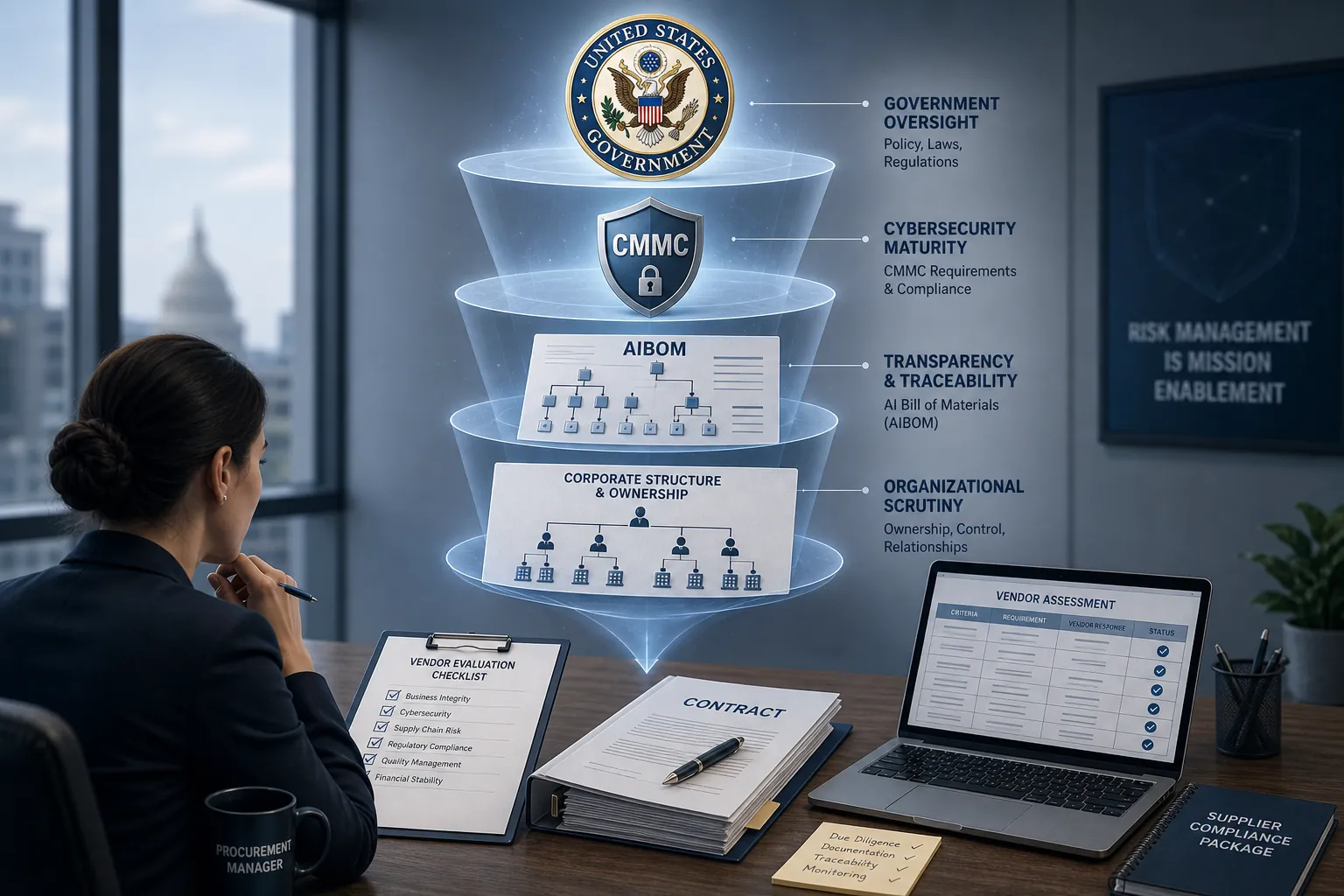
Start with what is enacted. Section 1532 of the FY2026 NDAA restricts defense agencies and the intelligence community from acquiring certain AI systems tied to covered nations, including China, Russia, North Korea, and Iran, and reaches entities domiciled in, controlled by, or otherwise connected to those jurisdictions under the covered AI definition described by outside counsel analyses.[1][2]
The mistake is treating this as a named-product ban. DeepSeek is the easy example because it gives the buyer something visible to avoid. The harder procurement problem is a US-incorporated AI vendor using a model component, investment structure, data pipeline, or cloud inference dependency that creates a covered AI issue without appearing in the first sales deck. A supplier-risk platform can look domestic at the contracting layer while depending on model weights, fine-tuning services, or ownership chains that the buyer has never asked the vendor to document.
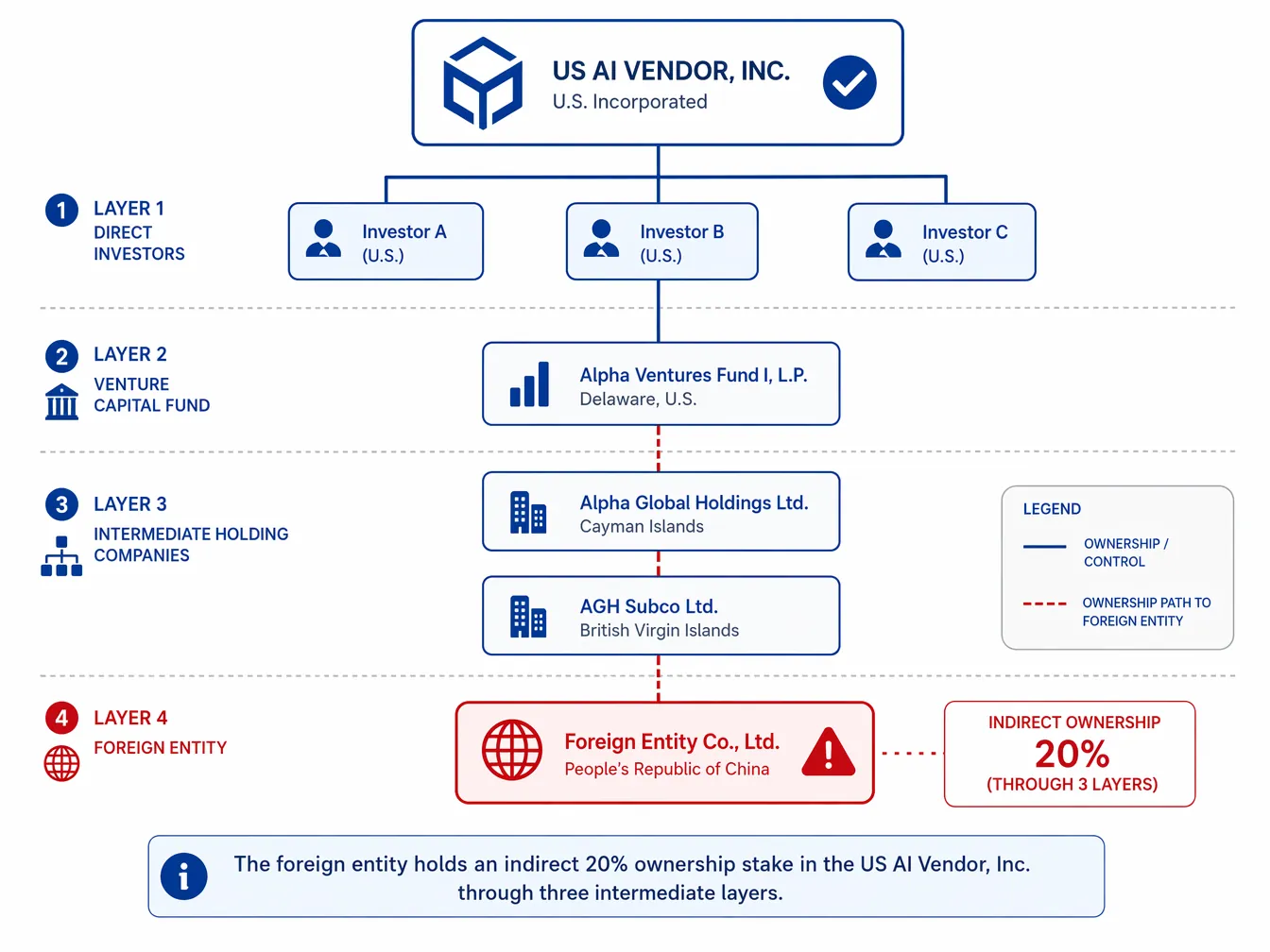
The 20 percent threshold is where the normal diligence packet starts to break. Analyses of the FY2026 NDAA note that the covered AI definition can reach an entity in which a covered nation or covered-nation entity holds at least a 20 percent ownership interest, including indirect holdings.[1][3] That means the useful question is not simply “Are you a Chinese AI company?” It is “Can you trace beneficial ownership through venture funds, intermediate holding companies, affiliates, and investors well enough to certify that no covered-nation entity crosses the threshold?”
The Vendor Evaluation Sequence Changes
A defense supplier does not need to turn every buyer into outside counsel. It does need to move compliance gates earlier. If a vendor cannot answer ownership and model-origin questions until legal review, that vendor is not ready for the shortlist. The sequencing matters because procurement teams waste time when they test demos, negotiate price, and secure user buy-in before discovering that the tool cannot be supported with defensible documentation.
| Old AI Vendor Check | NDAA-Era Check |
|---|---|
| Confirm the vendor entity and contracting address | Trace direct and indirect ownership, including covered-nation interests at the 20 percent threshold |
| Ask where the SaaS platform is hosted | Map cloud inference, model serving, support access, and cross-border data movement |
| Review data retention and privacy terms | Confirm training, fine-tuning, model improvement, and customer-data reuse rights |
| Document cybersecurity controls | Decide whether AI systems processing CUI enter the CMMC assessment boundary |
| Compare features and integrations | Require interoperability, portability, and anti-lock-in terms where FY2027 procurement language applies |
| Collect a security questionnaire | Collect an AI Bill of Materials or equivalent documentation for AI components |
This is where an internal supply chain AI vendor evaluation checklist needs an NDAA supplement. A generic questionnaire can still ask about SOC reports, encryption, uptime, and incident response. The NDAA supplement should ask about model origin, ownership, data rights, and component traceability before business owners fall in love with a dashboard.
Ownership Diligence Has to Reach Past the Contracting Entity
For commercial AI suppliers, ownership can be messy in ordinary ways: preferred shares, venture funds, strategic investors, offshore holding companies, employee vehicles, and subsidiaries created for tax or regional sales reasons. A buyer does not need a theory about every entity in the chart. It needs a representation that covers direct and indirect ownership, a process for updating that representation, and enough supporting detail to survive an internal audit or government inquiry.
A useful diligence request asks for the vendor’s current capitalization and beneficial ownership review at the level required to determine whether any covered nation or covered-nation entity holds 20 percent or more, directly or indirectly. It should also ask whether any investor, affiliate, parent, subsidiary, or controlling person appears on the Consolidated Screening List or civil-military fusion list, because the FY2026 covered AI discussion is not limited to domicile alone.[1][2]
The certification should not be a one-time checkbox buried in the onboarding portal. AI vendors raise rounds, restructure, acquire model companies, and change infrastructure partners. A procurement team renewing a forecasting platform in 2026 should treat ownership as a refresh item, not as a fact frozen from the first purchase order.
Model Origin Is Its Own Supply Chain
The model is not just a feature inside the product. It has its own supply chain: base model, weights, training data, fine-tuning pipeline, evaluation data, retrieval sources, third-party libraries, embeddings, agents, orchestration services, and cloud inference infrastructure. A vendor can be clean at the corporate layer and still leave the buyer unable to prove where a material AI component came from.
For a supplier-risk tool, the relevant evidence may include whether the vendor built its own model, licensed a commercial foundation model, fine-tuned an open-weight model, or routes prompts and outputs through a third-party inference provider. For a demand forecasting system, it may include whether procurement history, part descriptions, supplier performance notes, or program-related demand signals were used to train or improve the model. The procurement consequence is simple: if the vendor cannot separate customer configuration from model training and model improvement, the buyer cannot confidently separate ordinary SaaS usage from defense-relevant data exposure.
The right answer is not always “custom model only.” Smaller suppliers may not be able to afford a bespoke architecture, and many commercial tools will continue to rely on third-party models. The buyer’s job is to know which components matter, which rights attach to them, whether any component is restricted, and whether the government or prime contractor can audit the chain later.
AIBOM Turns AI Components Into Procurement Records
The FY2027 NDAA proposals are not enacted final law as of July 23, 2026; House and Senate provisions remain subject to the conference process. That distinction matters. Still, the direction is clear enough for procurement teams to prepare: proposed AI Bill of Materials requirements would move AI component documentation from a nice-to-have engineering artifact into a contracting and audit concern.[4]
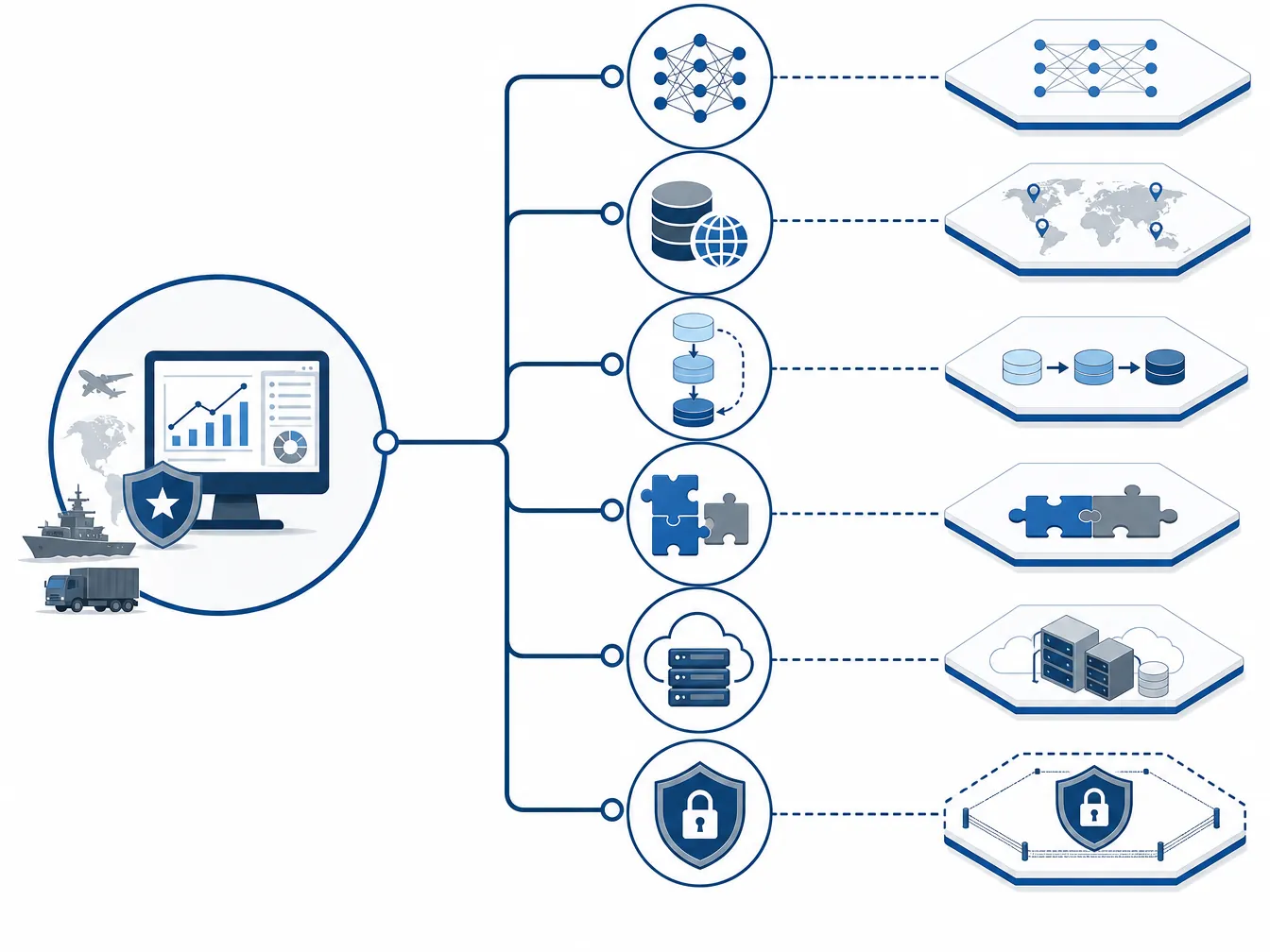
An AI Bill of Materials for a defense supply chain tool should not be a glossy “responsible AI” page. It should identify the components a buyer would need to trace if a question comes later: model architecture, model weights, training data sources, fine-tuning process, evaluation datasets, third-party dependencies, inference infrastructure, human review points, and update cadence. The point is not to publish trade secrets to every customer. The point is to create a controlled record that can support eligibility, cybersecurity scoping, data-rights analysis, and subcontractor flow-downs.
This is especially important for tools embedded in deliverables or used to generate outputs that feed defense work. A planning platform that only helps a commercial warehouse reorder packaging supplies may sit outside the hardest questions. A forecasting model trained on procurement data tied to defense programs, supplier capacity, or controlled part demand sits in a different posture. The same software category can produce very different compliance consequences depending on the data it touches and the outputs it creates.
CMMC Boundaries Follow the Data, Not the Sales Category
CMMC scoping becomes harder when AI tools process controlled unclassified information. Outside analyses of the FY2026 defense policy environment note that AI systems processing CUI can bring the relevant model pipeline into the CMMC assessment boundary, including use cases such as demand forecasts built on procurement data or supplier risk scores derived from sensitive supply chain information.[4][5]
That boundary does not stop at the application login page. If CUI enters prompt logs, embedding stores, fine-tuning datasets, model monitoring tools, support tickets, or a vendor’s model-improvement workflow, those locations need to be understood before the purchase. A buyer who only asks “Is your application CMMC-ready?” may miss the actual path the data takes.
A practical scoping review should follow one representative transaction. Take a hypothetical supplier-risk workflow: a user uploads a supplier file, the platform enriches it, the model assigns a risk score, an analyst adds notes, and the score flows back into an ERP or sourcing system. The buyer should ask where each step is stored, whether any step is used for training or model improvement, which subcontractors can access it, whether logs contain sensitive fields, and how deletion works. If the vendor cannot draw that path, the buyer should not draw the CMMC boundary for them.
FY2027 Procurement Language Hits SaaS Licensing
The Senate FY2027 NDAA’s competitive AI procurement language, including Section 1637 as described in public analysis, points toward interoperability, limits on vendor lock-in, and exclusive government data rights.[6] Those terms sound like policy until they collide with a commercial AI subscription.
Many SaaS AI contracts are built around proprietary workflows, bundled integrations, customer-data reuse, model improvement clauses, and limits on export of configuration or derived data. A vendor may promise that the customer owns its input data while reserving broad rights to use interaction data, feedback, derived insights, or anonymized outputs to improve models. That distinction may be tolerable for a commercial retail forecast. It becomes harder when the same platform handles defense demand signals, supplier fragility, part shortages, or procurement timing.
Interoperability also has teeth. A supply chain AI platform that cannot export usable data, model outputs, configuration history, decision logs, and integration mappings may create the kind of lock-in the proposed language is trying to avoid. Procurement teams should test this before award: what leaves the platform at termination, in what format, with what metadata, and under what fee schedule? A vague “API available” answer does not resolve whether the government can preserve operational continuity or move to a competing tool.
Exclusive government data rights can be even more awkward. Commercial AI vendors often want rights to learn from usage patterns because that is how the product improves and how the margin model works. Defense buyers may need narrower terms: no training on covered customer data without express approval, no commingling of regulated data into general model improvement, no derivative use that undermines government rights, and audit support if a prime or agency asks how data was handled.
AI Is Also Being Used to Police Supply Chain Risk
None of this means defense supply chains are walking away from AI. The Defense Logistics Agency’s Business Decision Analytics work is a useful signal because it shows AI being used to detect supply chain risk, not merely creating another compliance headache. DLA reported that its system analyzed 43,000 vendors and flagged 19,000 as high risk.[7]
That is one agency deployment, not a universal mandate. It should not be stretched into a claim that every defense buyer must copy DLA’s tool or process. But it does show how DoD risk thinking is moving: more data sources, more automated screening, more attention to ownership and supplier behavior, and less patience for paper certifications that cannot be tested against external signals.
For suppliers, the uncomfortable part is that the same AI category can sit on both sides of the table. A contractor may buy AI to screen subcontractors while a prime or agency uses AI to screen that contractor. In that environment, sloppy attestations become discoverable weak points. Analyses of the FY2026 NDAA warn that incorrect certifications can create False Claims Act exposure, including treble damages, and note that supply chain fraud involving foreign-sourced parts has already produced guilty pleas in DLA-related investigations.[1][3]
Small Suppliers Get Hit First
The compliance cascade lands hardest on firms that do not have a bench of AI counsel, cyber assessors, and licensing specialists. A small machining supplier asked to renew a scheduling or supplier-visibility tool may suddenly need answers about model provenance, CUI movement, customer-data reuse, and indirect ownership. The cost burden is real.
Congress appears to recognize at least part of that burden. The Senate FY2027 NDAA proposed a CMMC grant program with $50 million in funding and grants capped at $100,000 for small businesses, according to Federal News Network reporting.[8] That helps frame the policy concern, but it is not a reason for loose certifications. A grant program may help pay for readiness work; it does not make an unsupported AI attestation safer.
Primes should be careful here. Flowing down a 12-page AI certification to a small supplier without giving them a way to answer it produces bad paperwork, not better security. The better move is to standardize the questions, provide examples of acceptable evidence, and identify which AI use cases actually touch defense data or deliverables. Burden reduction should come from clearer scoping, not from pretending the risk is too complex to document.
Questions to Add Before Shortlisting or Renewal
The practical change is not that every AI vendor becomes unusable. It is that a buyer should not shortlist or renew a supply chain AI tool until the vendor can answer a tighter set of questions with evidence. The questions belong early, before pricing pressure and user preference make everyone search for a workaround.
- Can the vendor document direct and indirect ownership well enough to determine whether any covered nation or covered-nation entity reaches the 20 percent threshold?
- Is the vendor, parent, affiliate, model provider, or key subcontractor tied to a covered nation, the Consolidated Screening List, or a civil-military fusion list concern?
- Which base models, model weights, training datasets, fine-tuning pipelines, third-party dependencies, and inference providers are used in the product?
- Will the vendor provide an AI Bill of Materials or equivalent controlled documentation for AI components that affect defense supply chain work?
- Does any CUI enter prompts, logs, embeddings, fine-tuning datasets, support systems, monitoring tools, or model-improvement workflows?
- If CUI enters the AI workflow, which systems, subcontractors, and cloud services fall inside the CMMC assessment boundary?
- Do the contract terms prohibit unapproved training, commingling, or model improvement using government or defense customer data?
- Can the customer export inputs, outputs, configurations, risk scores, decision logs, integration mappings, and relevant metadata in a usable format?
- Do termination, transition, and API terms support interoperability rather than locking the buyer into a proprietary workflow?
- Can the vendor refresh ownership, model, infrastructure, and subcontractor representations during the contract term and before renewal?
Those questions will feel heavier than the old AI sales cycle. They are. But they are also closer to how defense procurement actually works once a certification has to be signed, a clause has to flow down, and a buyer has to defend why a tool was treated as safe for supply chain use. Capability still matters. So do price, implementation time, and user adoption. The difference is that documentation now decides which vendors make it far enough for those comparisons to matter.
References
- AI Supply Chain and Security: Congress Mandates Strict Controls for AI Acquired by U.S. Defense Agencies and Intelligence Community — Freshfields
- What the NDAA Means for AI and Cybersecurity — WilmerHale
- FY 2026 NDAA: Domestic Sourcing, Artificial Intelligence, Cybersecurity, and Acquisition Reforms — King & Spalding
- CMMC for AI? Defense Policy Law Imposes AI Security Framework and Requirements on Contractors — Crowell & Moring
- Artificial Intelligence in Defense Contracting: What Contractors Need to Know Now — Bradley
- Reading through the Lines of the FY2027 NDAA — War on the Rocks
- Utilization of Artificial Intelligence (AI) to Illuminate Supply Chain Risk — Defense Logistics Agency
- Senate NDAA proposes CMMC grant program — Federal News Network
Comments
Join the discussion with an anonymous comment.