
Within 24 hours of the Houthi blockade declaration in July 2026, Windward’s vessel-behavior analysis showed the Red Sea splitting into two operating realities: five commercial tankers carrying roughly 3.84 million barrels of Saudi crude reversed course, while an OFAC-sanctioned Iranian vessel made its first-ever Red Sea transit.[1] That is the part of the Houthi tanker strike crisis worth slowing down for. The important fact is not just that ships moved. It is that a behavioral signal appeared fast enough to matter before the disruption hardened into delayed purchase orders, missed production windows, or a quarterly risk memo.
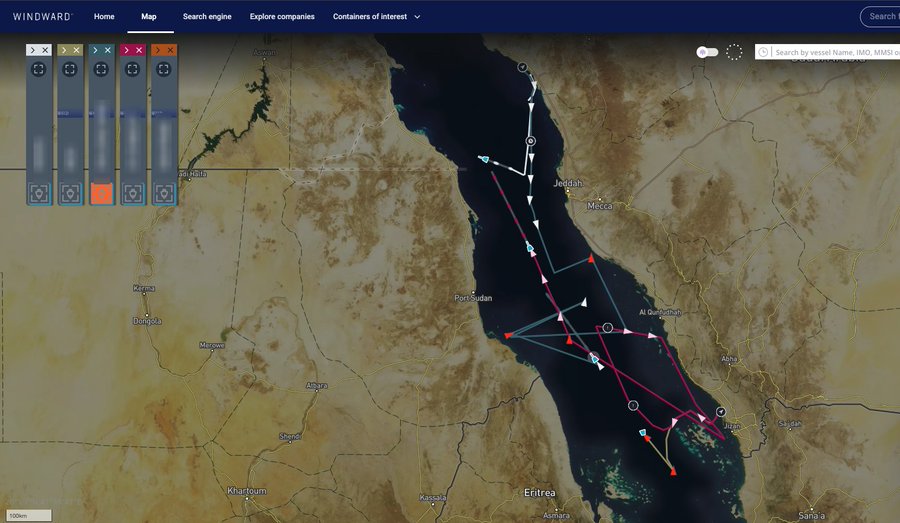
A normal AIS screen could show positions. The more useful question is whether a system can flag abnormal intent: tankers turning together, sanctioned tonnage behaving differently from commercial traffic, and routing decisions diverging before the market has finished arguing about the headline. That is where AI-powered maritime analytics have crossed a threshold. They are no longer only decorating dashboards with risk colors. At their best, they identify behavior that forces a commercial decision.
The problem is what happens next. If the signal stays inside a maritime intelligence tool, it is interesting but incomplete. If it reaches the insurer too late to affect war-risk terms, procurement too late to reallocate supply, and the customer team too late to reset commitments, the organization has bought detection without resilience. The 2026 Red Sea crisis is exposing that seam more clearly than any executive resilience deck could.
The Signal Has to Move Downstream
Container transits through the Suez Canal remain 72% below pre-crisis levels, according to project44’s Red Sea crisis tracking.[2] That number matters because it measures sustained behavioral change, not a temporary press cycle. The Red Sea is not simply a point on the map where vessels are in danger. It is now a pricing input, a lead-time assumption, a port-allocation problem, and a customer-service exposure.
The emerging stack has three practical layers. Detection tools identify abnormal vessel, threat, or trade behavior. Underwriting tools convert that risk into economic terms. Response tools decide whether freight should move, wait, reroute, split, or be covered differently. The stack is available. The operating model is usually not.
| Layer | What It Must Decide | Typical AI Role | Failure Mode When Siloed |
|---|---|---|---|
| Detection | Is the threat pattern changing fast enough to alter operations? | Behavioral vessel analytics, anomaly detection, physical threat sensing | The alert becomes another feed nobody is accountable for acting on |
| Pricing | What does this route now cost to insure or reinsure? | Submission processing, sanctions checks, KYC, voyage-risk support | Premiums change after routing decisions have already been made |
| Response | What should move differently across ports, suppliers, inventory, and customers? | Network visibility, scenario ranking, rerouting support | A better route is identified but never reaches procurement or commitments in time |
This is why maritime chokepoint AI should be judged less by feature lists and more by handoffs. Who receives the alert? Does it change the risk price? Does that price change the route? Does the route change inventory policy, supplier allocation, and customer promises quickly enough to matter?
Detection Is Getting Better at Behavior, Not Just Location
Windward’s July 2026 example is useful because it is not a generic claim about geopolitical intelligence. It shows vessels making different choices under the same declared threat environment. Five commercial tankers reversed. A sanctioned Iranian vessel entered for the first time. That contrast is exactly the kind of pattern a human analyst can notice eventually and a behavioral model can surface quickly.[1]
Detection also has a physical dimension. Maritime AI is being asked to interpret a threat environment that may include missiles, drones, uncrewed surface vessels, and potentially other tactics that do not resemble yesterday’s attack pattern. That is where vessel analytics and the broader discipline of AI counter-drone systems start to meet. A chokepoint risk model that only learns from prior missile behavior can underread a shift toward coordinated USV or submersible threats.
That limitation should not be used as an excuse to ignore AI detection. It should be used to set the right governance. A model flag is not a prophecy. It is a decision input that needs escalation rules, insurance translation, and operating thresholds. A tanker reversal pattern may justify one response. A confirmed attack pattern may justify another. A sanctioned vessel behaving differently from commercial traffic may be a compliance signal as much as a security signal.
This is where many control towers still disappoint. They ingest maritime feeds, port feeds, weather feeds, and carrier updates, but the operating question remains unresolved. If the Red Sea risk score crosses a threshold, does the freight team own the decision, does treasury own the insurance exposure, does legal own sanctions review, or does the business unit absorb the service failure? A supply chain control tower AI capability only earns the name when it can coordinate those decisions, not just visualize them.
Insurance Is Where Risk Becomes an Operating Constraint
The insurance layer is often treated as a back-office consequence of disruption. In a chokepoint crisis, it becomes one of the mechanisms that changes behavior. War-risk premiums can make one route commercially unattractive before a shipment is physically blocked. Coverage conditions can force better vessel, cargo, counterparty, and sanctions diligence. Reinsurance capacity can determine whether risk is absorbed, repriced, or avoided.
Concirrus says its Marine One platform uses AI to process hull, cargo, and liability submissions with 97% submission accuracy, reducing underwriting work from hours to minutes while integrating sanctions checks and environmental liability monitoring.[3] That figure should be read carefully because it is vendor-sourced, not independently validated in the available materials. Still, the direction is operationally important: faster submission handling matters when a voyage-risk view is changing inside the same day.
The broader insurance evidence points the same way, with less vendor specificity. IUMI reported a 2025 study presented at its 150th annual conference finding that AI adoption is positively associated with risk assessment accuracy in marine insurance.[4] That does not prove every AI underwriting tool improves every book of business. It does support the narrower conclusion that marine insurers are moving from static, document-heavy assessment toward more data-driven risk selection and pricing.
The reported DFC-Chubb $40 billion maritime reinsurance facility, announced in the March-April 2026 window, is more interesting than a normal capacity headline because it points toward a bridge between AI-enabled KYC vetting and war-risk pricing.[5] That bridge is rare. Detection tools normally speak in alerts. Underwriters speak in submission quality, exclusions, deductibles, and premium. Supply chain teams speak in lead time, allocation, and service levels. If a facility can connect counterparty diligence and voyage-risk pricing at sovereign scale, it begins to close one of the most expensive handoff gaps in the stack.
Premium numbers should still be handled with restraint. War-risk rates vary by voyage and can change rapidly; reported figures around the July 2026 escalation differed across market sources. The practical point is not a single universal rate. The point is that insurance pricing is dynamic enough to become a routing signal, and most supply chain systems are not built to consume it that way.
Rerouting Is the Test of Whether Intelligence Changed Anything
A rerouting decision is where impressive visibility either becomes work or evaporates. Someone has to decide whether to accept a higher premium, avoid a passage, shift cargo to alternative ports, split volume, change mode, adjust inventory, or disappoint a customer. The models can rank options. They cannot erase the trade-off.
One automaker example is the strongest response-layer evidence in the available material: during the Red Sea crisis, the company avoided $220 million in losses by using AI-powered visibility to dynamically reroute through 12 pre-mapped alternative ports using political stability scores.[6] The number is case-specific, not a general benchmark. Its value is that it shows preparation meeting decision speed. The alternative ports were not invented after the alert. They were already mapped.
That is the part many visibility programs skip. They buy location awareness first and scenario architecture later. In a live chokepoint event, later is usually too late. A platform can show that freight is exposed in the Red Sea, but the useful work is deciding in advance which alternate ports are viable, which suppliers can absorb a shift, which SKUs deserve scarce capacity, which customers have hard penalties, and which insurance terms change the economics of each route.
Altana, Everstream, and project44 sit in this response layer from different angles. Altana’s role is closer to trade-network visibility and counterparty context; readers doing diligence on that layer can start with ChainSignal’s Altana trade compliance profile. Everstream adds disruption monitoring across geopolitical, logistics, cyber, and other operating risks. project44 contributes transport visibility and transit-impact measurement. The point is not that one response platform replaces the others. The point is that each sees a different part of the operating consequence.
Cyber risk is not a side issue in this stack. Everstream reported a 965% increase in cyber-attacks targeting logistics from 2021 to 2025, a compounding exposure now monitored alongside geopolitical disruption.[7] A reroute around a maritime chokepoint can still fail if the alternative port, carrier, broker, or logistics system becomes the next weak link. The response layer has to treat disruption as a network condition, not a single-lane detour.
The Missing Capability Is Not Another Feed
The most common failure pattern is familiar: maritime intelligence goes to the risk team, insurance terms go to treasury or the broker, visibility alerts go to logistics, and customer commitments live somewhere else entirely. Each function may have a good tool. Nobody owns the end-to-end decision.
An integrated operating model does not require every company to build a single monolithic platform. It does require common thresholds and handoffs. A detection alert should have a defined path into underwriting review. A premium or coverage change should feed routing economics. A routing change should update procurement, inventory, and customer-service assumptions. A sanctions or KYC issue should stop being discovered after the logistics plan has already been approved.
For a supply chain team, the minimum viable workflow looks more like this:
- Define chokepoint exposure by lane, SKU, supplier, vessel type, insurance condition, and customer commitment.
- Set escalation thresholds for vessel behavior, attack-pattern changes, sanctions exposure, and port viability.
- Connect those thresholds to insurance review, not just security monitoring.
- Pre-map alternate ports and routes with political, operational, cost, inventory, and service-level constraints.
- Run decision drills where logistics, risk, treasury, procurement, legal, and customer teams act on the same scenario.
That last point is where the technology conversation becomes uncomfortable. Most organizations do not lack intent. They lack the operating discipline to make a signal travel across functions before the event gets worse. ChainSignal has covered the same pattern in the broader AI supply chain disaster-preparedness bottleneck: the model may be ready before the organization is.
What to Demand From the Stack in 2026-2027
Buying a maritime AI feed, an underwriting automation tool, or a visibility platform as a standalone answer is no longer enough. The questions for vendors and internal teams should be more specific.
- Can detection outputs be translated into route-level insurance and service-cost assumptions?
- Can underwriting signals be consumed by logistics planning before booking decisions are locked?
- Can the visibility layer rank alternate ports and routes using constraints the business has already approved?
- Can sanctions, KYC, environmental liability, and physical-threat alerts be reconciled in one decision workflow?
- Can the organization explain who has authority to reroute, delay, insure, or reject a shipment when signals conflict?
The hard part is conflict. A detection model may flag rising risk while a customer penalty argues for moving anyway. An insurer may price the voyage but at a rate that destroys the margin. A visibility platform may identify an alternate port that solves ocean exposure and creates inland congestion. A sanctions screen may block the fastest option. Integrated AI does not remove those conflicts. It puts them in front of the right people early enough for a real decision.
That is the practical standard for the Houthi tanker strike crisis. The technology stack for maritime chokepoint resilience is now available across detection, pricing, and response. Broad deployment of a truly integrated operating model is still much less certain. The strategic test for 2026-2027 is whether organizations connect threat detection, dynamic insurance signals, supply chain visibility, and rerouting workflows before the next chokepoint event forces the integration under worse conditions.
References
- Houthi Blockade Announcement: The Red Sea Split in Two, Windward, July 22, 2026.
- The Red Sea Crisis: A Year of Houthi Attacks & Their Impact on Global Shipping, project44.
- Marine, Concirrus.
- Unlocking the Power of AI in Marine Insurance: From Data to Actionable Insight, IUMI, September 2025.
- DFC-Chubb maritime reinsurance facility coverage, Insurance Business Mag, March-April 2026.
- Navigating Turbulent Waters: How Geopolitical Shifts and AI-Powered Visibility Stabilize Global Supply Chains, Sensos.
- Are You Prepared for the Supply Chain Disruptions of 2026?, Everstream Analytics.
Comments
Join the discussion with an anonymous comment.