
A heat advisory is not one disruption. It is a warning label on several different operating failures that happen at different speeds: steel expands, asphalt softens, reefer loads lose margin, cranes and lift trucks overheat, people slow down or leave the floor, and the planning systems watching all of it may be running through stressed data-center infrastructure.
That distinction matters because the useful question is not whether AI can “handle heat.” The useful question is whether a specific planning capability can move a decision earlier than the reactive playbook. If a rail corridor becomes suspect when ambient temperature rises above 30°C because rails are pre-stressed at 27°C and track temperature can run 20°C above the air, the decision is concrete: slow trains, reroute, stage inventory, or warn customers before the timetable fails.[1]

The same discipline applies to road freight. Weather accounts for 23% of U.S. road delays, with an annual cost to trucking companies estimated at $2 billion to $3.5 billion.[1] Those figures do not prove that every heat advisory creates a freight crisis. They do prove that weather-linked delay is already a measurable operating cost, and heat is one of the conditions that turns a lane from scheduled to conditional.
Extreme-weather urgency is not imaginary either. Economist Impact reports that billion-dollar extreme-weather events now occur roughly every three weeks, compared with once every four months 40 years ago.[2] But frequency is only the beginning of the planning problem. The work starts when a broad alert is broken into failure modes.
| Heat-advisory failure mode | Operational question | AI planning capability that fits |
|---|---|---|
| Transportation infrastructure | Which rail, bridge, or road segments cross an engineering threshold before the advisory ends? | Predictive weather-to-impact modeling and infrastructure exposure scoring |
| Road freight | Which lanes lose service reliability, dwell-time tolerance, or driver capacity? | Dynamic rerouting and ETA risk adjustment |
| Cold chain and inventory | Which temperature-sensitive loads, SKUs, or regions lose safety margin first? | Predictive monitoring, scenario testing, and inventory repositioning |
| Ports and warehouse equipment | Which handling assets become the bottleneck when heat affects motors, batteries, tires, or yard operations? | Digital twin simulation and equipment-aware scheduling |
| Workforce productivity | Which shifts, tasks, and locations lose effective capacity under heat stress? | Labor scheduling optimization |
| Data-center and planning-system strain | Which digital dependencies face cooling, power, or latency risk during peak heat? | Infrastructure-aware planning and failover prioritization |
Transportation: where a forecast becomes a mechanical constraint
Rail is the cleanest example because the physical threshold is not abstract. Everstream’s description of rail buckling gives planners a usable trigger: rails pre-stressed at 27°C can expand and buckle when ambient temperatures rise above 30°C, especially because track temperature can exceed air temperature by 20°C.[1] That is not a mood indicator. It is a rule candidate.
Once that rule exists, an AI planning system has something worth doing. It can combine forecast heat, asset location, infrastructure vulnerability, service commitments, and inventory position to show which lanes need earlier intervention. The value is not that a model says “hot.” The value is that it can identify the corridor where a delayed rail move will strand the wrong inventory node, then test alternatives while dispatch still has time to act.
For road freight, the mechanism is less tidy but still operational. Heat can soften road surfaces, increase tire and equipment stress, slow loading yards, and amplify congestion where speed restrictions or incidents appear. The U.S. weather-delay cost cited above gives the business case some weight, but it should not be misread as a heat-only number.[1] It is evidence that weather-related road disruption is costly enough to justify lane-level planning, not evidence that AI has eliminated those costs.
Dynamic rerouting earns its place only when it sees the same constraints the dispatcher sees: carrier availability, hours-of-service exposure, delivery appointment rules, refrigerated capacity, customer penalties, and receiving dock congestion. A heat advisory over a long-haul route may not require a new route. A heat advisory over the final 80 miles into a constrained metro area may require a different delivery window, a cross-dock change, or a customer exception notice before the truck leaves the origin.
This is also where lead time becomes more valuable than model sophistication. Trax Technologies cites Johnson & Johnson data, routed through McKinsey/WCI, stating that an AI system detected 85% of major supply disruptions an average of seven days before impact.[3] That claim is useful because seven days changes what a planner can do. It should also be treated as a secondary, attributed claim unless the original Johnson & Johnson documentation is verified. The planning lesson is narrower and stronger: earlier detection matters when it converts from warning to action.
Cold chain: heat risk is cumulative, not just catastrophic
Cold chain failures rarely wait for a dramatic breakdown. A reefer that works harder in high heat, a delayed handoff at a yard, a warehouse dock door held open too long, or a receiver that misses an appointment can each consume temperature margin. By the time a load is visibly in trouble, the cheaper choices may already be gone.
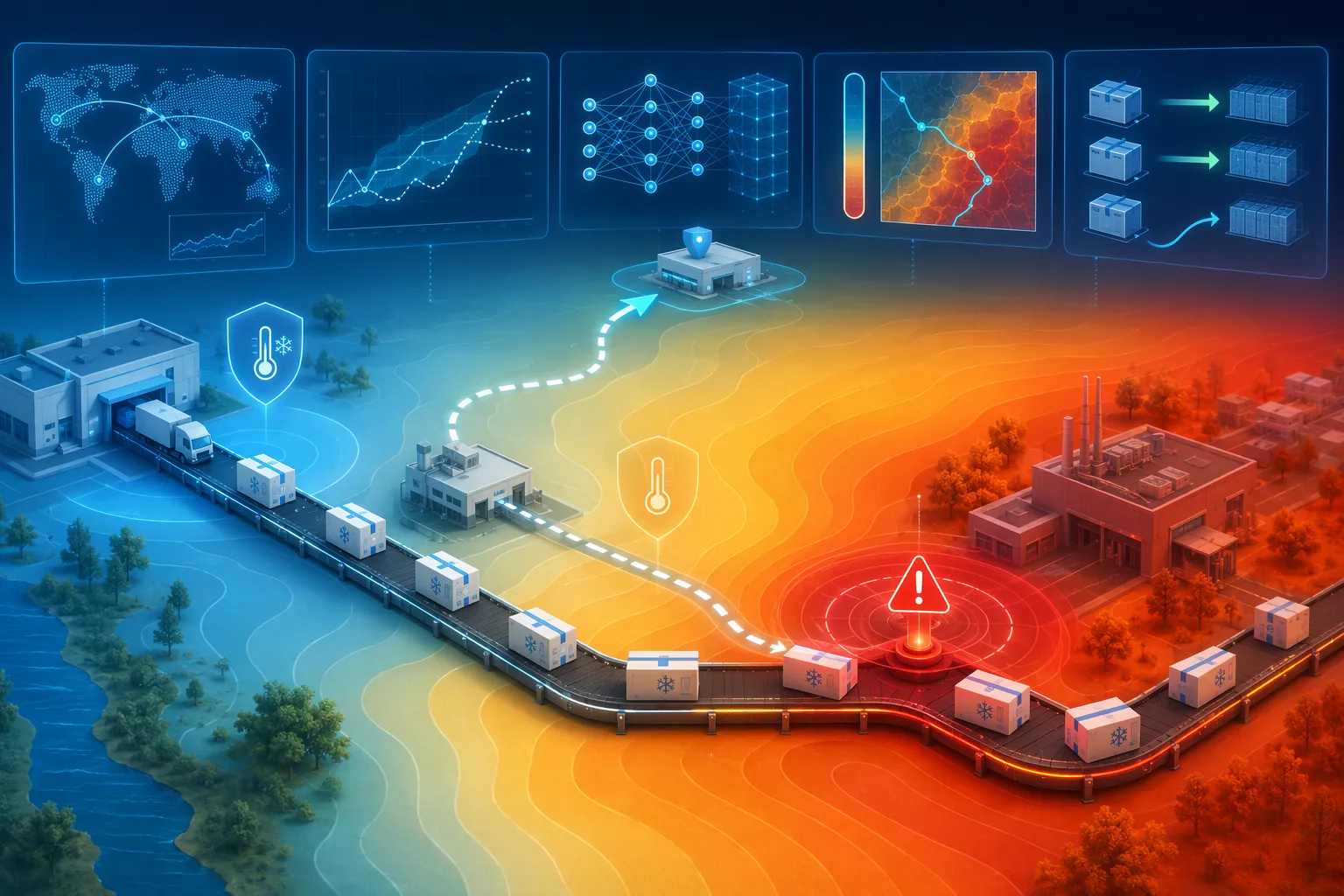
For pharmaceuticals, the consequence is especially unforgiving because product quality, patient safety, and compliance sit on top of the logistics cost. 7 Step Solutions rates pharma cold chain as “HIGH” risk under heat advisories in its June 2026 procurement advisory.[4] That source is a practitioner advisory rather than an independently verified loss study, so it supports the risk picture rather than carrying it alone.
The planning capability here is predictive monitoring tied to inventory decisions. Temperature sensors can tell an operator that a shipment is drifting. AI planning becomes more useful when it connects that drift to available substitute stock, customer priority, remaining shelf life, lane alternatives, and regional demand. For a deeper treatment of sensor-driven excursion prevention, ChainSignal’s cold chain monitoring analysis is the more focused companion piece.
Food exposure follows a similar logic, though the tolerances and economics differ. Heat can shorten usable life, increase spoilage risk, and change demand patterns at the same time. A grocer or distributor facing a heat advisory is not only asking whether trucks can stay cold. It is asking whether the right mix of beverages, frozen products, fresh items, and replacement stock is close enough to the demand spike without overloading the most fragile lanes.
The clearest inventory-repositioning case in the available material is not a heat-advisory case, and that distinction matters. ClimateAi says a roofing-materials producer used its AI climate forecasting to reposition inventory ahead of Hurricane Ian and generated $15 million in additional sales.[5] That does not prove the same outcome follows from heat planning. It does show the relevant capability: translate a regional weather threat into earlier inventory placement before access, demand, or service reliability changes.
For heat advisories, that capability might point in several directions. Move temperature-sensitive stock away from a high-risk node. Pull forward replenishment before a hot weekend. Stage spare reefer capacity near a constrained lane. Shift demand coverage to a facility with better dock control. The system does not need to be framed as autonomous to be valuable; it needs to show the cost of waiting.
Ports, yards, and warehouses: equipment becomes capacity
Heat advisories expose a familiar blind spot in network planning: a facility can be open and still lose throughput. Port cranes, yard tractors, forklifts, batteries, tires, refrigeration units, dock equipment, and building cooling systems do not fail in the same way, but they all translate heat into capacity risk.
A digital twin is useful here only if it represents constraints at the right level. A warehouse twin that treats labor, dock doors, lift equipment, trailer availability, and cooling as infinite or average resources will understate the heat problem. A better simulation asks what happens when outdoor yard moves slow down, charging cycles change, staging space fills, and inbound appointments keep arriving.
That simulation does not need to predict every fault. It needs to tell the operations manager which decision is time-sensitive: cap inbound volume, change appointment sequencing, add a night shift, prioritize temperature-sensitive unloading, delay noncritical replenishment, or move a promotion out of a stressed building. The best AI planning output is often not a new answer; it is a ranked queue of consequences.
This is where methods developed for other disruptions transfer cleanly. The same scenario logic used in tariff planning can be applied to heat if the model represents constraints instead of averages; ChainSignal’s discussion of AI planning under tariff volatility is relevant because the decision pattern is similar: test alternatives before the external shock reaches the P&L.
Labor productivity: the shift plan is part of heat resilience
Heat risk is often written as if it belongs to assets. In warehouses, yards, farms, maintenance teams, and delivery operations, it also belongs to people. A heat advisory can reduce effective capacity without closing a site: more breaks, slower picks, shorter safe outdoor work windows, higher absence risk, and more supervisor attention diverted to safety controls.
Labor scheduling optimization is the appropriate AI planning capability, but only if it is constrained by safety and work rules. The weak version simply chases productivity. The useful version moves the most heat-exposed tasks to cooler windows where possible, changes the mix of indoor and outdoor assignments, protects critical receiving and shipping cutoffs, and shows which service promises no longer fit the available labor capacity.
The point is not to automate judgment away from site leaders. It is to stop pretending that yesterday’s engineered labor standard will survive tomorrow’s heat index. If a planner keeps the original capacity assumption while the floor is operating under heat controls, the forecast will look stable until the backlog appears.
Planning systems also depend on physical infrastructure
Heat advisories can stress the digital layer that planners rely on: data centers, cloud regions, telecom links, power supply, and cooling systems. One risk figure sometimes attached to this issue says 64% of new data-center capacity is in hazardous zones, but without a directly citable source, it remains an unresolved data point rather than a planning benchmark.
The operational issue remains valid without the uncited number. AI planning tools are themselves part of the supply chain’s infrastructure. If a heat event increases demand for simulations, rerouting, customer updates, warehouse execution changes, and exception workflows at the same time that cooling and power systems are under strain, resilience planning has to include the planning stack.
Infrastructure-aware planning asks basic but often skipped questions. Which decisions require real-time model access? Which can be precomputed before the advisory period? Which facilities can operate from cached plans? Which control-tower alerts matter if bandwidth or system responsiveness degrades? Which manual fallback is actually current?
What AI planning can and cannot prove from the current evidence
The evidence base is uneven. Rail buckling thresholds and road-delay costs are concrete. The ClimateAi inventory case is concrete, but it is a hurricane example rather than a heat example. The Johnson & Johnson disruption-detection claim is exactly the kind of lead-time metric planners should care about, but in the cited material it is routed through a vendor article and attributed sources rather than original documentation.[3][5]
Vendor material is still usable when it is treated carefully. Everstream, ClimateAi, Interos, Trax, and similar providers see operational patterns because they work close to risk workflows. They also have commercial incentives. A planner evaluating AI planning for heat-advisory supply chain impact should separate three questions: whether the failure mode is real, whether the tool can detect it earlier, and whether the organization can act on the lead time.
Market forecasts belong in the business-case margin, not at the center of the argument. Trax cites a Precedence Research projection that the AI supply chain market will grow from $7.15 billion in 2024 to $192.51 billion in 2034.[3] That projection may help explain why buyers are seeing more AI supply chain offerings, but it does not validate any heat-risk capability by itself.
Geography is another limit. Much of the cited evidence is U.S.- and Europe-centered. It would be careless to generalize the same thresholds, infrastructure vulnerabilities, labor exposure, and data availability across Southeast Asia, South Asia, Africa, the Middle East, or Latin America without local asset data and regional climate evidence.
A practical prioritization test
The starting point is not a platform shortlist. It is a heat-risk map by node. For each major lane, facility, product family, and digital dependency, planners should identify the vulnerable mechanism, the available data, and the decision that would change if they had earlier warning.
- If the failure mode is rail or road exposure, prioritize weather-to-impact modeling, lane risk scoring, and rerouting rules.
- If the failure mode is temperature-sensitive product quality, prioritize predictive monitoring, inventory substitution logic, and exception workflows.
- If the failure mode is facility throughput, prioritize digital twin simulation that includes labor, dock, yard, equipment, and cooling constraints.
- If the failure mode is workforce capacity, prioritize scheduling optimization bounded by safety rules and task-level exposure.
- If the failure mode is planning-system continuity, prioritize precomputed scenarios, failover processes, and cached operating plans.
The investment case is strongest where three things line up: a measurable heat threshold, a data feed that can see the threshold early, and an operational lever that can still be pulled. A warning that arrives after the crew is already waiting, the reefer is already out of margin, or the train is already slowed is just a better postmortem.
For teams still building the data foundation, ChainSignal’s data readiness guide for AI inventory optimization is a useful companion because heat planning depends on the same basics: clean inventory position, product constraints, lead times, facility rules, and exception history.
Heat-advisory planning should therefore be ranked by vulnerable node, available data, and decision lead time. AI is most defensible where it moves action earlier than a reactive playbook and makes the trade-off visible before service failure becomes the explanation.
References
- The Impact of Extreme Weather on the Supply Chain, Everstream Analytics
- Climate change's disruptive impact on global supply chains and the urgent call for resilience, Economist Impact
- AI Weather Forecasting and Supply Chain Risk Management, Trax Technologies
- When the Heat Is On: What the June 2026 Heatwave Reveals About Your Supply Chain, 7 Step Solutions
- Climate Risk: An Essential Element of Supply Chain Risk Mapping in 2026, Climate.ai
Comments
Join the discussion with an anonymous comment.