
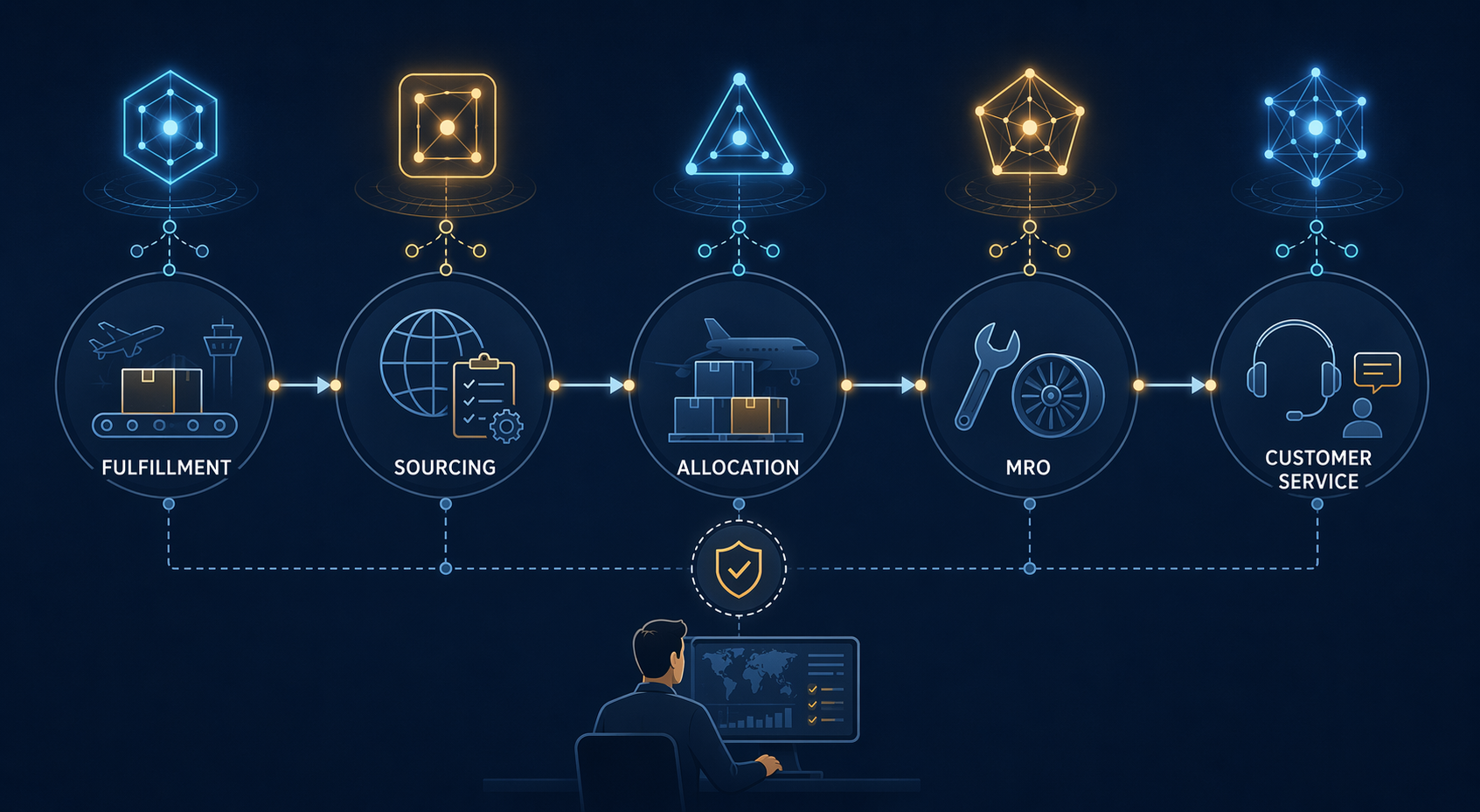
The useful way to read GE Aerospace’s Palantir expansion is not as another AI strategy announcement. It is as a closed-loop supply chain problem: an engine produces field and operational signals; those signals feed AI-enabled visibility; agentic workflows support fulfillment, sourcing, allocation, MRO, and customer service; and a human expert still decides what happens when the answer affects readiness, contract performance, or a regulated supplier action.
That distinction matters in aerospace. A prediction that a part may be short is helpful. A dashboard that shows the shortage is familiar. The harder question is whether the next action reaches the right planner, sourcing manager, repair coordinator, supplier contact, or customer service team before the aircraft sits idle. GE Aerospace’s March 2026 announcement with Palantir is interesting because it targets that handoff, not merely the model layer.

In March 2026, GE Aerospace and Palantir said they were expanding their partnership to deliver “advanced agentic AI-powered solutions” across select supply chain and production systems, including fulfillment, sourcing, allocation, maintenance, repair, and customer service.[1] The same announcement ties the expansion to a 2024 pilot on U.S. Air Force T-38 trainer jet J85 engines, where the companies say AI improved parts demand visibility and shortage prediction.[1] Yahoo Finance also reported the expansion as extending Palantir’s role into defense and factory operations.[2]
That is the core of GE Aerospace’s AI supply chain strategy: not a claim that autonomous software is now running procurement or maintenance, but a claim that GE Aerospace is using Palantir AIP as a deployment layer for AI agents inside specific operational workflows. The strongest documented evidence is still scope, chronology, and qualitative operating improvement. The missing piece is equally important: GE Aerospace has not disclosed dollar-value ROI, audited savings, or a full deployment timeline for the 2026 expansion.
The 2024 Pilot Is Doing More Work Than the Press Release Headline
The T-38 J85 pilot matters because it keeps the 2026 announcement from floating away into platform language. It gives the partnership an origin point in a real readiness problem: predicting demand for parts and spotting shortages earlier for engines used in U.S. Air Force trainer aircraft.[1] That is not the whole aerospace supply chain, but it is a credible place to test whether AI can improve visibility before planners and maintainers are trapped in expediting mode.
The operational lesson is narrower than “AI improves readiness.” The pilot, as publicly described, supports the idea that AI can help translate engine and supply signals into better parts demand visibility and shortage prediction.[1] It does not prove that every downstream sourcing decision was automated, that suppliers responded faster across the board, or that readiness gains were quantified in a way outsiders can audit. Those are different claims, and they should not be smuggled in under the glow of a successful pilot.
Still, the pilot is a useful proof point because it sits where aerospace supply chain failures usually become expensive: between the physical asset, the maintenance plan, the parts position, and the supplier response. If an AI system only improves a forecast but leaves the exception queue untouched, the operational burden simply moves to the human teams who must chase confirmations, substitutes, approvals, and customer updates. GE Aerospace’s 2026 expansion is notable because the listed functions are the places where that chasing work accumulates.
What Is Actually Being Expanded
The March 2026 scope is specific enough to be useful. GE Aerospace and Palantir did not describe a generic AI layer for “the enterprise.” They named select supply chain and production systems and called out fulfillment, sourcing, allocation, maintenance, repair, and customer service.[1] Those functions do not sit neatly in one department. They form a chain of operational commitments.
| Function named in the expansion | Why it matters in the closed loop |
|---|---|
| Fulfillment | Turns demand and availability signals into delivery actions, exceptions, and customer commitments. |
| Sourcing | Connects predicted shortages to supplier engagement, alternate supply options, and commercial constraints. |
| Allocation | Forces prioritization when parts, capacity, or repair slots cannot satisfy every request at once. |
| Maintenance and repair | Links engine condition, repair demand, material availability, and turnaround execution. |
| Customer service | Translates internal supply and repair status into external communication and expectation management. |
Agentic AI is relevant here because these workflows are coordination-heavy. A shortage does not resolve itself after a model classifies it. Someone has to check available inventory, inspect demand priority, look at repair timing, confirm supplier feasibility, route an exception, and update the affected customer or program team. In a bounded deployment, an AI agent can prepare the next action, assemble the context, trigger a workflow, or prompt a human review. That is meaningfully different from a dashboard that waits for a planner to notice the red cell.
The authority boundary is the part worth watching. The public materials support a human-in-the-loop reading: AI agents are being applied to improve visibility, prediction, and workflow support, while human experts remain responsible for high-value problem-solving and critical decisions. That design is not a formality in aerospace. Supplier actions, military readiness implications, export-controlled contexts, and maintenance decisions cannot be treated like consumer-app optimization problems.
Why GE Has a Data Advantage That a Generic Manufacturer Does Not
GE Aerospace also brings an asset that most AI case studies cannot invent after the fact: a huge installed base. In the March 2026 Palantir announcement, GE Aerospace says its approximately 50,000 commercial engines and 30,000 military engines generate proprietary performance data that can support AI models.[1] That matters because the useful signal is not just purchase order history or supplier lead time. It is the relationship between fielded engines, operating conditions, maintenance demand, parts consumption, repair capacity, and customer commitments.
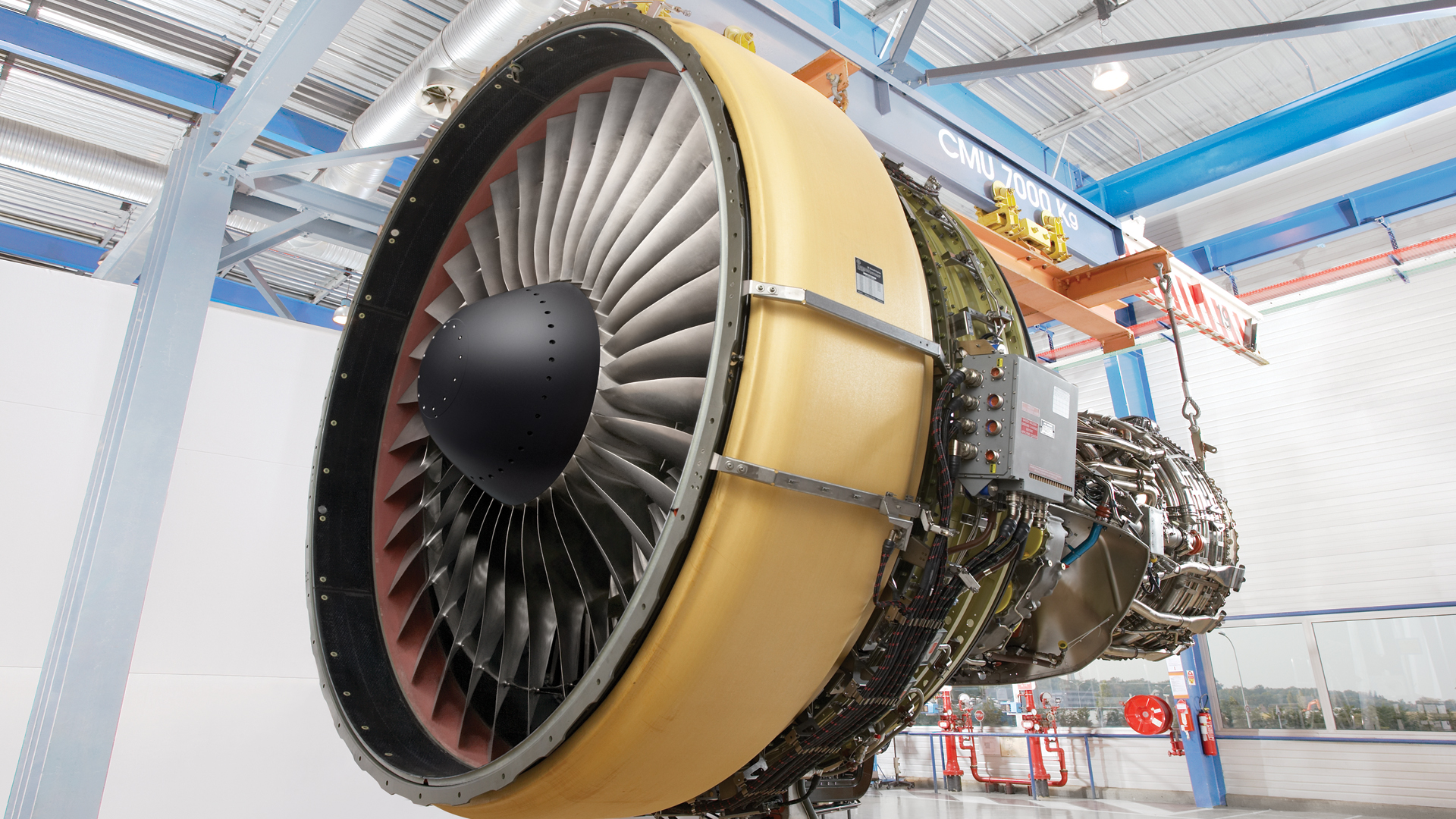
This is where the case becomes hard to generalize. A company with a thinner installed base, less field data, or weaker aftermarket connectivity cannot simply license the same platform and expect the same operating leverage. The platform may help orchestrate agents, integrate data, and govern workflows. It does not magically create decades of engine performance history or the institutional knowledge needed to interpret what a signal means for readiness.
Reuters gave a useful piece of external business context in May 2025, reporting that GE Aerospace CEO Larry Culp saw supply chain improvements despite tariff pressure.[3] That does not validate the Palantir expansion by itself, and it predates the March 2026 announcement. It does, however, place the AI work inside a company already managing supply chain recovery, cost pressure, and production execution rather than inside an isolated innovation lab.
From Signal to Supplier Action
The most credible mechanism in the GE-Palantir expansion is the move from passive visibility to action preparation. In a conventional supply review, the same shortage can be re-described several times: demand planning has one view, fulfillment has another, sourcing has a supplier version, MRO has an execution constraint, and customer service is left explaining uncertainty. The delay is not always a lack of data. Often it is the time required to align data, authority, and next action.
A bounded agentic workflow can reduce that delay if it does a few concrete things well. It can detect that a forecasted part need conflicts with available inventory. It can pull the relevant engine, order, repair, and supplier context into one workspace. It can route the case to the person with authority to approve an allocation decision or supplier escalation. It can draft the customer-facing status update without pretending to own the commitment. The productivity gain, if it materializes, comes less from replacing the expert than from reducing the repetitive assembly and coordination work around the expert.
That is also where governance has to be practical rather than decorative. The useful question is not whether an AI agent is “autonomous” in the abstract. It is what the agent may observe, what it may recommend, what it may execute, when a human must approve, and how exceptions are logged. For a broader discussion of why supply chain teams need graduated authority rather than binary automation, see Agentic AI in Supply Chain: A Practitioner’s Guide to Graduated Autonomy in 2026.
GE Aerospace has not publicly disclosed enough governance detail to judge that operating model in full. The available materials make the intended direction visible, but not the approval matrix, exception policy, audit trail design, or failure-mode handling. In aerospace, those details are not implementation trivia. They determine whether agentic AI shortens the loop safely or merely accelerates the creation of unresolved exceptions.
The Predix Shadow, Without the Easy Morality Tale
The strategic contrast with GE’s earlier software ambitions is unavoidable, but it needs to be handled carefully. Predix is often treated as a simple warning against industrial companies building software platforms. That is too tidy. The more useful lesson is about scope. Trying to build a broad horizontal industrial platform is a very different problem from using a specialist AI platform to deploy bounded agents inside known aerospace workflows.
Third-party analysis from Klover.ai describes Predix as a roughly $4 billion failure tied to GE’s attempt to build a horizontal industrial AI platform in competition with major cloud platforms such as AWS and Azure.[4] That figure should be attributed as an outside analysis, not treated as GE’s official accounting. Even so, the strategic warning is relevant: owning every layer of the stack can become a liability when the operational problem is already complex enough.
The Palantir model looks more pragmatic. GE Aerospace contributes domain data, installed-base context, operational workflows, and decision authority. Palantir AIP supplies a platform for deploying and orchestrating AI-enabled workflows. If the partnership works, the advantage is not that GE becomes a generic AI platform company. It is that GE uses a partner’s infrastructure to improve the speed and quality of decisions in the parts of the aerospace supply chain it understands deeply.
That is a narrower ambition, and therefore a more believable one. It also leaves room for parallel AI investments. GE Aerospace’s AI Wingmate, launched on Microsoft Azure in September 2024, is a separate company-wide generative AI platform for employees; GE said it reached about 500,000 employee queries shortly after launch.[5] Wingmate shows a broader AI investment thesis, but it is not the same thing as Palantir-supported supply chain execution. One supports enterprise knowledge work. The other is being positioned around supply chain, production, and readiness workflows.
What Other Aerospace and Defense Leaders Can Actually Take From This
The lesson is not “copy GE.” The aerospace context is too specific, and GE’s installed base is too large for that. The more transferable lesson is architectural: start with a closed operational loop, not with a platform aspiration. Decide which field signal should trigger which supply chain response, who has authority to act, and where an AI agent can remove coordination drag without taking over decisions it should not own.
For a supply chain director, the GE case suggests a practical sequence. Prove the mechanism in a readiness-sensitive pilot. Expand into adjacent workflows only after the pilot shows better visibility or earlier shortage detection. Keep the platform partner accountable for integration, orchestration, and agent deployment. Keep internal experts accountable for policy, prioritization, supplier strategy, and customer commitments. That sequence is less glamorous than promising autonomous supply chain management, but it is better matched to regulated manufacturing.
The unanswered questions are the right ones to ask before treating GE Aerospace as a finished benchmark. How many workflows will move from pilot or selected deployment into steady-state production? What decisions can agents execute without approval, if any? How are supplier-facing actions governed? What are the measured effects on shortage resolution time, maintenance turnaround, allocation quality, customer response, and cost? Which outcomes are attributable to AI rather than broader supply chain recovery or process redesign?
Until those answers are public, the strongest conclusion is disciplined rather than dismissive. GE Aerospace is one of the clearest 2026 examples of a major aerospace OEM moving from an AI pilot to a scaled agentic AI deployment pattern without trying to own every layer of the AI stack. The case is concrete enough to matter, especially because it connects engine data, supply chain execution, MRO, and customer service. It is not complete enough to be a quantified ROI benchmark.
References
- GE Aerospace and Palantir Expand Partnership to Transform Military Aircraft Readiness, GE Aerospace, March 2026
- GE Aerospace Deepens Palantir AI, Yahoo Finance
- GE Aerospace CEO Sees Supply Chain Improvements Despite Tariff Hit, Reuters, May 28, 2025
- GE AI Strategy: Industrial AI Dominance from Ashes of Predix, Klover.ai
- GE Aerospace Launches Company-Wide Generative AI Platform for Employees, GE Aerospace, September 2024
Comments
Join the discussion with an anonymous comment.