
GE Aerospace’s useful claim is not that AI can see around every corner of the aerospace supply chain. The more concrete claim is that AI can accelerate FLIGHT DECK, the company’s lean operating model, by reducing waste and giving teams more time for value-added work. That distinction matters. In aerospace, knowing that a constraint is coming does not machine a part, qualify a process, free a test cell, or recover a supplier. Visibility only becomes resilience when somebody is already assigned to act on the signal.
That is why the GE case is worth reading closely under a narrow question: what changes when AI is embedded inside a management system that already has cadence, escalation paths, supplier teams, and kaizen habits? The answer is less glamorous than most coverage of AI in aerospace supply chains, but more operationally useful. AI shortens the distance between weak signal and countermeasure. FLIGHT DECK determines whether the organization does anything disciplined with that signal.
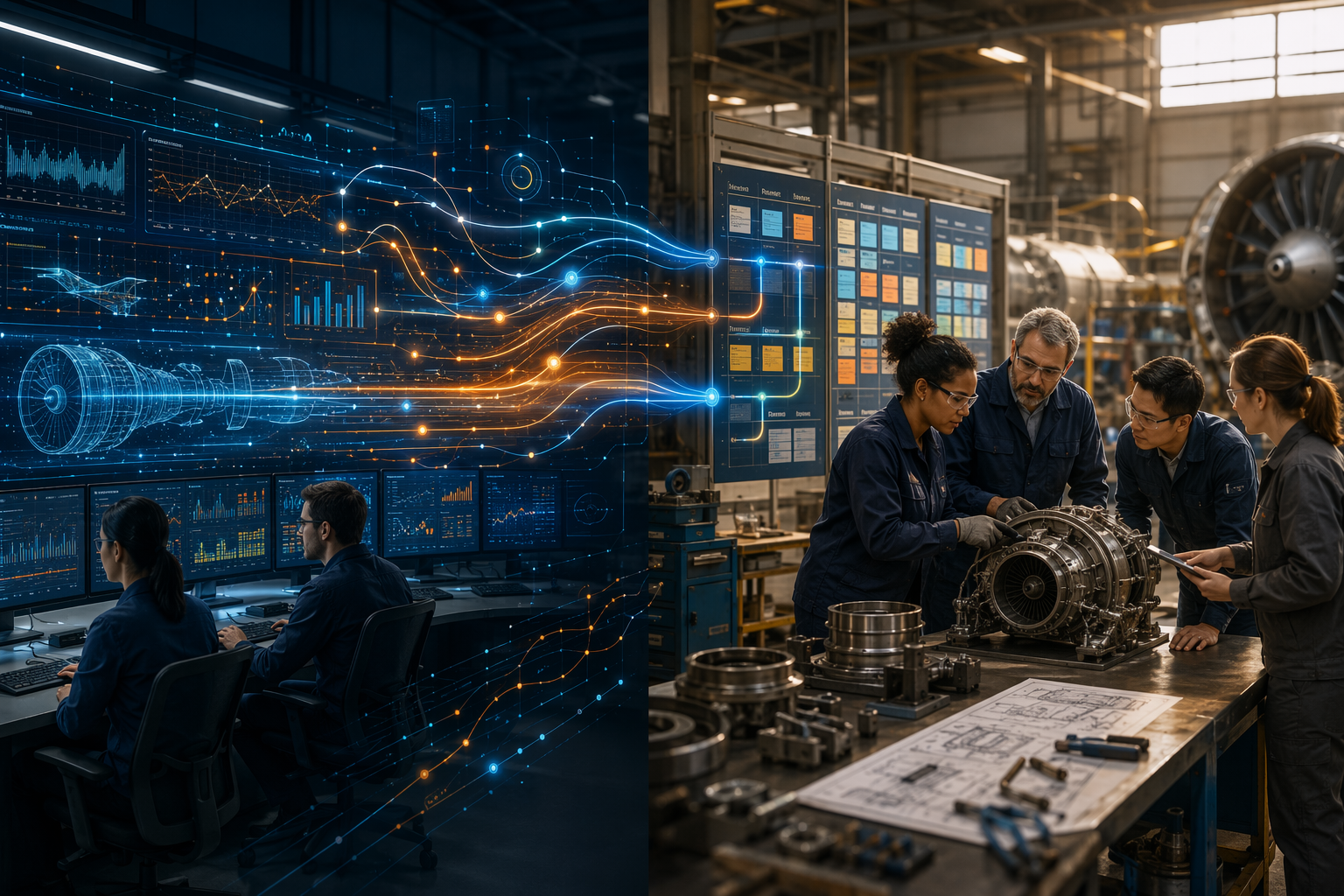
Aerospace resilience still starts with constraints, not dashboards
The pressure backdrop is real, but it should not be inflated into a generic crisis narrative. Roland Berger’s 2025 aerospace supply chain report focused on European suppliers in the UK, Germany, and France and found that pressure remained visible across the supplier base it studied; that evidence is useful, but it is not a direct measurement of every GE Aerospace supplier relationship or every North American constraint.[1] Deloitte’s 2026 aerospace and defense outlook also frames the sector around continued demand and execution pressure, which helps explain why delivery reliability remains a board-level concern rather than a procurement footnote.[2]
In that environment, an AI alert is only a starting point. If a casting queue is slipping, a special process is backed up, or an MRO shop visit is waiting on material, the expensive failure is usually not ignorance alone. It is the lag between recognizing the constraint and aligning engineering, sourcing, supplier operations, quality, and production control around a recovery path.
GE Aerospace’s 2025 Annual Report describes FLIGHT DECK as an operating model built on 10 fundamentals and grounded in Respect for People, Customer Driven, and Continuous Improvement. More important than the label is the deployment detail: GE says it has 550 embedded supply chain professionals and engineers working with top suppliers.[3] That number is not a dashboard metric. It says the company is putting people close enough to the constraint to see whether a countermeasure is real.
What FLIGHT DECK contributes before AI enters the room
The temptation is to start the story with algorithms. GE’s own evidence makes that a mistake. FLIGHT DECK appears first as a way to standardize how people see work, surface waste, run kaizen, and hold operating cadence. AI can speed up that system, but it does not replace the system.
The Terre Haute component repair facility is the cleanest example of that boundary. GE Aerospace reports that on-time delivery at the site improved from 20% to 96% through a FLIGHT DECK-driven culture change.[4] That result should not be attributed to AI. Its value in this story is different: it shows that the operating model can change behavior and delivery performance before predictive tools are layered on top.
That sequence is easy to underappreciate. A site with weak daily management can buy better forecasts and still spend the week arguing about which number to trust. A supplier recovery team without standard work can identify a bottleneck and then lose three days deciding who owns the next action. FLIGHT DECK’s contribution is to make the organization more capable of absorbing information and converting it into work.
This is also where the company’s respect-for-people language has operational teeth. In supplier development, respect does not mean lowering expectations. It means sending capable people into the work, helping remove the causes of missed commitments, and making the supplier’s process visible enough that the discussion moves from blame to flow.
The supplier kaizen result is vivid, and bounded
The most memorable GE-reported supplier example is a FLIGHT DECK kaizen event that improved brazed honeycomb assembly output from 47 pieces per week to more than 470 pieces per week.[3] That is a 10x change in weekly output, and anyone who has sat through a supplier escalation call knows why it gets attention. A constraint that severe does not usually need a better executive presentation. It needs people at the process, looking at sequence, handling, waiting, staffing, tooling, rework, and the points where work stops moving.
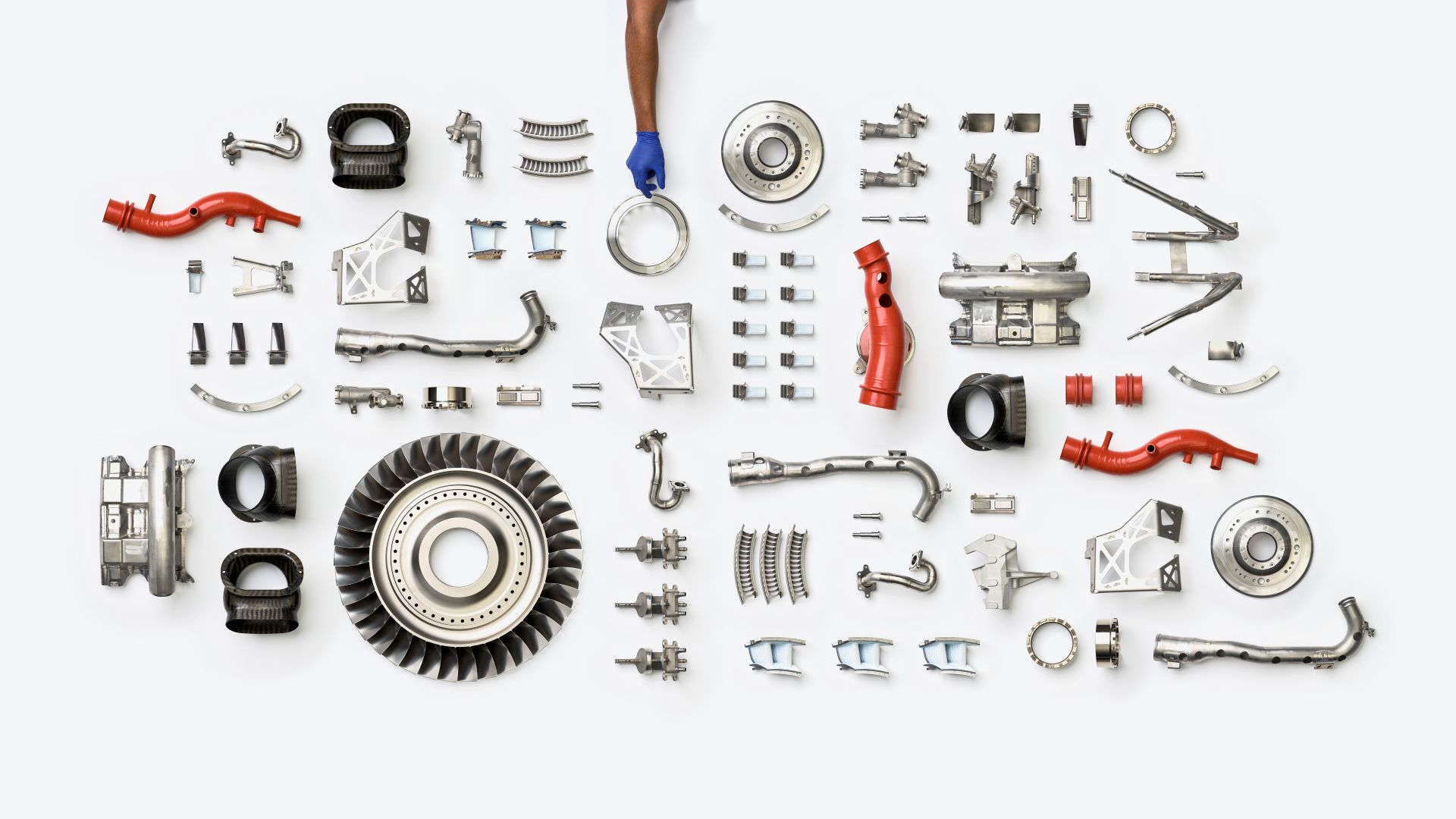
The result should be handled carefully. It is a single kaizen event at one supplier, reported by GE Aerospace. It is not proof that every supplier process has a hidden 10x gain waiting for the right workshop. But it does show the kind of problem FLIGHT DECK is designed to attack: not a vague supply chain risk, but a specific production flow whose output can be measured before and after intervention.
This is where AI can matter without pretending to be the hero. If analytics help identify which supplier operation is becoming the pacing item, which material input is starving downstream assembly, or which quality loop is consuming capacity, the kaizen team enters with a sharper target. The improvement still comes from changing the work. The acceleration comes from finding the right work sooner.
AI Material Assistant shows the planning side of the loop
GE’s AI Material Assistant is a clearer example of AI working inside an operating flow rather than hovering above it. GE Aerospace says the tool predicts LEAP engine shop visit parts requirements nine months ahead and has achieved a 5-to-7-day turnaround time reduction at its Celma facility in Brazil and Malaysia MRO facilities.[5]
The useful point is what the prediction changes. In an MRO environment, a late part can turn a planned shop visit into a waiting game. Earlier visibility gives planners and material teams more time to position parts, review shortages, and decide where expediting or substitution work is actually needed. It does not eliminate the physical constraint, but it changes when the organization first sees it.
That time shift is a practical form of resilience. A 5-to-7-day turnaround reduction is not the same as saying the model is universally accurate or that every shop visit becomes predictable. It is GE’s reported outcome at named MRO facilities. Still, it connects the AI claim to a shop-floor consequence: fewer days tied up in the repair cycle.
Analytics-assisted lean at Lynn
The Lynn HPT shaft example sits between classic lean and AI-enabled management. GE Aerospace reports a 49% lead time reduction through small improvements plus AI analytics visibility.[3] That pairing is important. The result is not described as a model autonomously fixing lead time. It is described as visibility combined with many smaller changes.
That sounds familiar because most durable lead-time reduction looks like that. One queue is reduced. One inspection loop is tightened. One handoff is clarified. One recurring delay is made visible early enough that it stops being treated as a surprise. AI can help expose the pattern, but the work still gets done through process changes that production, quality, engineering, and planning can sustain.
This is also the right place to separate acceleration from substitution. AI can compress the search for constraints. It can help teams sort signals across a larger data field than a manual review would comfortably handle. But in the GE examples provided, human teams still decide what to change, run the kaizen, and live with the operational consequences.
What appears to be scaling
The aggregate numbers matter more after the operating examples are understood. GE Aerospace reports more than 95% committed delivery, a 40% year-over-year increase in priority supplier material input, seven consecutive quarters of sequential improvement, and a 26% increase in engine deliveries.[3] Those are company-reported outcomes, not independent proof of causation. They do, however, suggest that the operating pattern is not confined to one poster-ready kaizen event.
| Evidence | What it supports | What it does not prove |
|---|---|---|
| 550 embedded supply chain professionals and engineers | GE is treating supplier resilience as hands-on operating work | That every supplier issue can be solved through embedded support |
| Brazed honeycomb output from 47 to 470+ pieces per week | A specific kaizen event delivered a major throughput gain | That 10x improvement is broadly replicable |
| Terre Haute on-time delivery from 20% to 96% | FLIGHT DECK can change operating culture and delivery performance | That AI caused the improvement |
| AI Material Assistant 9-month parts prediction and 5-to-7-day MRO turnaround reduction | AI can improve planning time and material readiness in named MRO settings | That every shop visit or facility will see the same reduction |
| Lynn HPT shaft 49% lead time reduction | Analytics visibility can support lean lead-time improvement | That analytics alone reduced lead time |
The pattern is not “AI finds savings” in the abstract. It is closer to a closed loop: detect the constraint earlier, focus improvement energy on the right place, change the process, measure whether flow improves, and then repeat. That loop is not new to lean operators. The newer piece is the speed and breadth of detection when AI is tied into the same cadence.
Knowledge scaling is useful, but it is not the center of the case
GE Aerospace is also investing in broader AI adoption. The company says it doubled its AI investment in 2026 versus 2025.[5] It has also deployed AI Wingmate, a generative AI platform, to 52,000 employees; GE reported about 500,000 queries and said the platform includes a FLIGHT DECK learning module.[6]
Those details show commitment and reach. They are not, by themselves, evidence of operational resilience. A learning module can spread language, examples, and access to internal knowledge. It can make it easier for employees to ask how a FLIGHT DECK concept applies to their work. But knowledge distribution only becomes operational capability when managers reinforce the practice in daily management, supplier reviews, problem-solving routines, and recovery planning.
The same caution applies to the company’s broader AI stack and partnerships. GE Aerospace’s work with Palantir AIP is relevant context for readers following agentic AI in industrial operations, but the operating model question is separate: whether AI outputs are governed by a system that keeps people responsible for decisions, countermeasures, and learning. The more autonomy enters planning and execution, the more that boundary matters.
What other manufacturers can and cannot infer
The transferable lesson is not to copy GE’s tools, metrics, or branding. The safer inference is structural: AI is more likely to improve supply chain resilience when it is attached to a management system that already knows how to act on constraints. Without that system, predictive visibility can become another queue of alerts waiting for owners.
For an operations leader, the diagnostic questions are plain enough. When AI flags a shortage, who owns the first response? When a supplier operation becomes the pacing constraint, who goes to the process? When the model is wrong, who learns from the miss? When the signal is right, how quickly does it become a changed schedule, a supplier kaizen, an engineering decision, or a material move?
GE Aerospace’s case supports a bounded conclusion. AI can compound lean resilience when it accelerates detection, learning, and supplier improvement inside a disciplined operating model. The condition is doing much of the work in that sentence. The companies most able to borrow from the GE example will not be the ones with the most impressive dashboards. They will be the ones with a management system capable of turning AI signals into repeatable operational action.
References
- Aerospace supply chain report 2025: Is the crisis over? — Roland Berger, 2025
- 2026 aerospace and defense industry outlook — Deloitte
- GE Aerospace 2025 Annual Report — GE Aerospace
- How innovation, collaboration and FLIGHT DECK power resilient skies — GE Aerospace
- Artificial Intelligence — GE Aerospace
- GE Aerospace launches company-wide generative AI platform for employees — GE Aerospace
Comments
Join the discussion with an anonymous comment.