
Federal AI funding for supply chain innovation is large enough to take seriously and fragmented enough to waste months if approached as one market. Brookings found that federal AI contract potential value reached $91.8 billion in 2026, up 1,912% from 2024, with the Department of Defense controlling 98.9% of that potential value.[1] That is the right opening signal, but the wrong shortcut: the figure measures potential contract value, not obligated spending, and Brookings’ search method counted contracts whose descriptions explicitly included “artificial intelligence” or “AI,” which means embedded AI work may be missed.[1]
For a supply chain leader, the useful question is not whether federal money exists. It does. The useful question is whether the money is usable by your type of organization, for your type of project, on a timeline that still exists in Q3 2026.

The federal government is not only funding abstract AI research. The Defense Logistics Agency has already used AI models for supplier risk work: its BDA Supplier Risk models analyzed 43,000 vendor records, flagged more than 19,000 as high risk, and were connected to at least one fraud conviction.[2] DLA also established an AI Center of Excellence in June 2024.[2] That does not mean a commercial shipper can copy DLA’s procurement path. It does mean federal supply chain AI demand is operational, not theoretical. For a deeper look at that case, see How the DLA Scaled AI for Supply Chain Resilience.
The Funding Map Starts With Fit, Not Agency Acronyms
A 2026 federal AI funding guide from Pertama Partners catalogs more than 25 programs and more than $50 billion annually across the landscape.[3] The count is useful because it confirms the scale. It is also where many searches go wrong. A company looking for deployment capital, a university consortium building foundational AI methods, a small software vendor seeking non-dilutive R&D funding, and a transit agency testing AI-enabled traffic systems are not competing for the same pool in the same way.
| Funding route | Best fit | What it usually supports | Scale and timing signal |
|---|---|---|---|
| DoD and DLA contracts | Large enterprises, defense suppliers, dual-use AI vendors, established integrators | Procurement, analytics platforms, supplier-risk systems, operational AI capability | Brookings found $91.8B in 2026 federal AI contract potential value, heavily concentrated in DoD.[1] |
| DOT SMART Grants | Public-sector transportation applicants and partners with logistics, mobility, or infrastructure projects | Planning and demonstration grants for smart community technologies, including AI-enabled transportation use cases | $500M authorized over five years through FY2026; Stage 1 grants up to $2M.[4] |
| NIST Manufacturing USA AI institute | Manufacturing consortia, universities, nonprofits, industry partners | AI for manufacturing resilience and supply chain networks | Up to $70M over five years; concept papers were due in September 2024 and full proposals in January 2025.[5][6] |
| NSF AI Research Institutes and AI-Ready America | Research universities, institutes, education and workforce hubs, consortia | Research, AI methods, education infrastructure, workforce access | NSF announced a $100M AI Research Institutes investment round in 2025; AI-Ready America hubs may receive up to $1M per year.[7][8] |
| SBIR/STTR | Startups and small technology firms, often with agency-specific technical topics | Early-stage R&D, prototypes, technical feasibility, commercialization pathfinding | NSF Phase I up to $305K and Phase II up to $1.25M; reauthorization status requires current checking in 2026.[3] |
| CHIPS-related wireless supply chain funding | Semiconductor, telecom, wireless, and advanced manufacturing ecosystem players | Wireless supply chain innovation and domestic technology capacity | $1.5B wireless supply chain funding was part of the broader $53B CHIPS Act context; the cited application window ran through July 2024.[10][11] |
| EDA AI Upskill Accelerator | Organizations and regional partners with workforce capability gaps | AI workforce training and adoption capacity, not usually direct product deployment | $25M pilot announced in May 2026; awards listed at $1M to $8M.[3] |
The table is intentionally uneven. Some routes buy capability. Some fund research. Some build workforce capacity. Some are current competitions; others are worth monitoring because the confirmed application window may already have closed. Treating them as interchangeable “AI grants” is how teams end up with a long spreadsheet and no pursuit decision.
DoD And DLA: The Largest Signal, But Usually A Contracting Route
The defense route matters first because of scale. Brookings’ 2026 estimate puts almost all identified federal AI contract potential value under DoD control.[1] For supply chain AI, that points toward procurement and mission systems more than open-ended commercial implementation grants. The likely reader fit is a company that can sell into defense procurement, work through an integrator, support supplier-risk analytics, or adapt a dual-use platform to a defense logistics problem.

DLA’s supplier-risk work is the cleanest supply-chain-specific proof point in the available material. The agency used AI-enabled analysis on vendor records, generated high-risk flags, and tied the work to enforcement consequences.[2] That is different from a pitch deck claim about resilience. It shows an agency using data to decide where risk lives in a supplier base.
The caution is equally important. A defense example proves federal capability and demand; it does not prove that a private manufacturer can obtain grant money to install the same type of system in its own network. Companies evaluating this route should ask procurement questions first: Does the agency buy this kind of capability? Is there a relevant contract vehicle or teaming path? Is the company eligible to sell directly, or does it need a prime contractor relationship?
DOT SMART: Useful For Transportation And Logistics, With FY2026 Urgency
The Strengthening Mobility and Revolutionizing Transportation program is one of the more legible routes for AI-enabled transportation and logistics projects. DOT describes SMART as a $500 million, five-year program authorized through fiscal year 2026, with Stage 1 planning and prototyping grants of up to $2 million.[4]
This is not a general corporate AI fund. It is most relevant when the project touches transportation systems, smart infrastructure, mobility operations, public-sector logistics, or resilience use cases that can be framed through eligible applicants and partners. A private logistics company may have a role, but often through a public agency, regional partnership, or transportation-focused project structure rather than as a stand-alone applicant.
The timing deserves attention. Because the authorization runs through FY2026, current-year notice language matters more than older round summaries.[4] A team exploring AI-enabled freight routing, port-adjacent resilience, emergency logistics, or storm-response transportation planning should check the active DOT notice before spending time on a proposal calendar. ChainSignal’s AI demand surge storm planning coverage is a useful example of the kind of operational problem that can become transportation-relevant when public systems and logistics constraints meet.
NIST Manufacturing USA: A Consortium Route, Not A Quick Company Grant
NIST’s AI-focused Manufacturing USA institute is directly relevant to supply chain innovation, but it is built for a different kind of applicant than a single company looking for implementation funding. NIST announced up to $70 million over five years for an institute focused on AI for manufacturing resilience and supply chain networks.[5] The competition schedule in the available material shows concept papers submitted in September 2024 and full proposals in January 2025.[6]
As of Q3 2026, the current-status question is the point. The NIST competition page was updated on July 21, 2026, but the research materials do not confirm whether an award has been made, delayed, or newly clarified.[6] That makes this a monitor-or-partner route unless an organization is already inside the relevant consortium orbit. For manufacturers, software providers, and applied AI teams, the practical move is to identify the institute winner or active consortium structure before assuming there is an open federal application to pursue.
NSF: Strong For Research And Talent Pipelines, Less Direct For Deployment
NSF funding is attractive when the project is closer to research, methods, education infrastructure, or a university-led consortium than to buying a commercial platform. NSF announced a $100 million investment round in National Artificial Intelligence Research Institutes in 2025.[7] The agency’s TechAccess: AI-Ready America program also offers up to $1 million per year per hub to broaden AI access and capability.[8]
A supply chain company should not ignore NSF, but it should be honest about its role. The better fit is often partnership: provide use cases, data-sharing structures, pilot environments, domain expertise, or commercialization pathways. If the internal objective is “fund our warehouse optimization deployment next quarter,” NSF is probably not the first door. If the objective is “develop new AI methods for resilient multi-tier supply networks with research partners,” it becomes more plausible.
SBIR And STTR: Small-Firm R&D, With A 2026 Authorization Check
SBIR and STTR are the natural starting point for many small AI firms because the programs are designed around early-stage R&D and commercialization. The Pertama guide lists NSF Phase I awards up to $305,000 and Phase II awards up to $1.25 million.[3] DoD also releases agency-specific topics, including supply-chain-relevant solicitations such as the Air Force topic AF25D-T003 for an AI-driven supply chain intelligence platform using knowledge graphs.[9]
This is where timing can quietly break a plan. The research brief notes that SBIR/STTR authorization expired on September 30, 2025, and that H.R. 5100 had passed the House while Senate action was pending as of February 2026.[3] Because today’s planning horizon is Q3 2026, no team should treat SBIR/STTR as reliably available without checking the current authorization and the specific agency solicitation page. If active, it remains one of the clearest non-dilutive routes for small technology firms; if not, the search has to move to agency contracts, state-linked programs, private pilots, or consortium roles.
CHIPS-Related Funding: Relevant, But Do Not Assume An Open Window
CHIPS-related funding belongs on the map because semiconductor, wireless, and advanced manufacturing supply chains are central to U.S. industrial policy. The research materials identify $1.5 billion for wireless supply chain innovation within the broader $53 billion CHIPS Act context.[10][11] That is a meaningful supply chain signal, especially for telecom, semiconductor, and hardware ecosystem organizations.
It should be handled cautiously in Q3 2026. The materials indicate applications were being accepted through July 2024, but they do not confirm a new open round by July 2026.[10] For most supply chain AI teams outside the semiconductor or wireless ecosystem, this is not the most efficient first pursuit. For companies inside that ecosystem, the action is to check current CHIPS for America notices and treat older wireless supply chain rounds as precedent, not proof of current availability.
EDA AI Upskill Accelerator: Adjacent Funding That May Decide Whether AI Can Be Used
The EDA AI Upskill Accelerator is not the same thing as funding an AI supply chain product deployment. It matters because many organizations cannot absorb AI tools without workforce capacity, regional training partners, and operational change. Pertama’s guide describes a $25 million pilot announced in May 2026, with individual awards from $1 million to $8 million.[3]
This route is most relevant when the bottleneck is people rather than software: planners who need to interpret AI recommendations, procurement teams that need model-governance literacy, frontline managers who need to work with exception alerts, or regional employers trying to raise baseline AI capability. It is adjacent to supply chain innovation, but in many organizations, adjacent is where implementation risk actually sits.
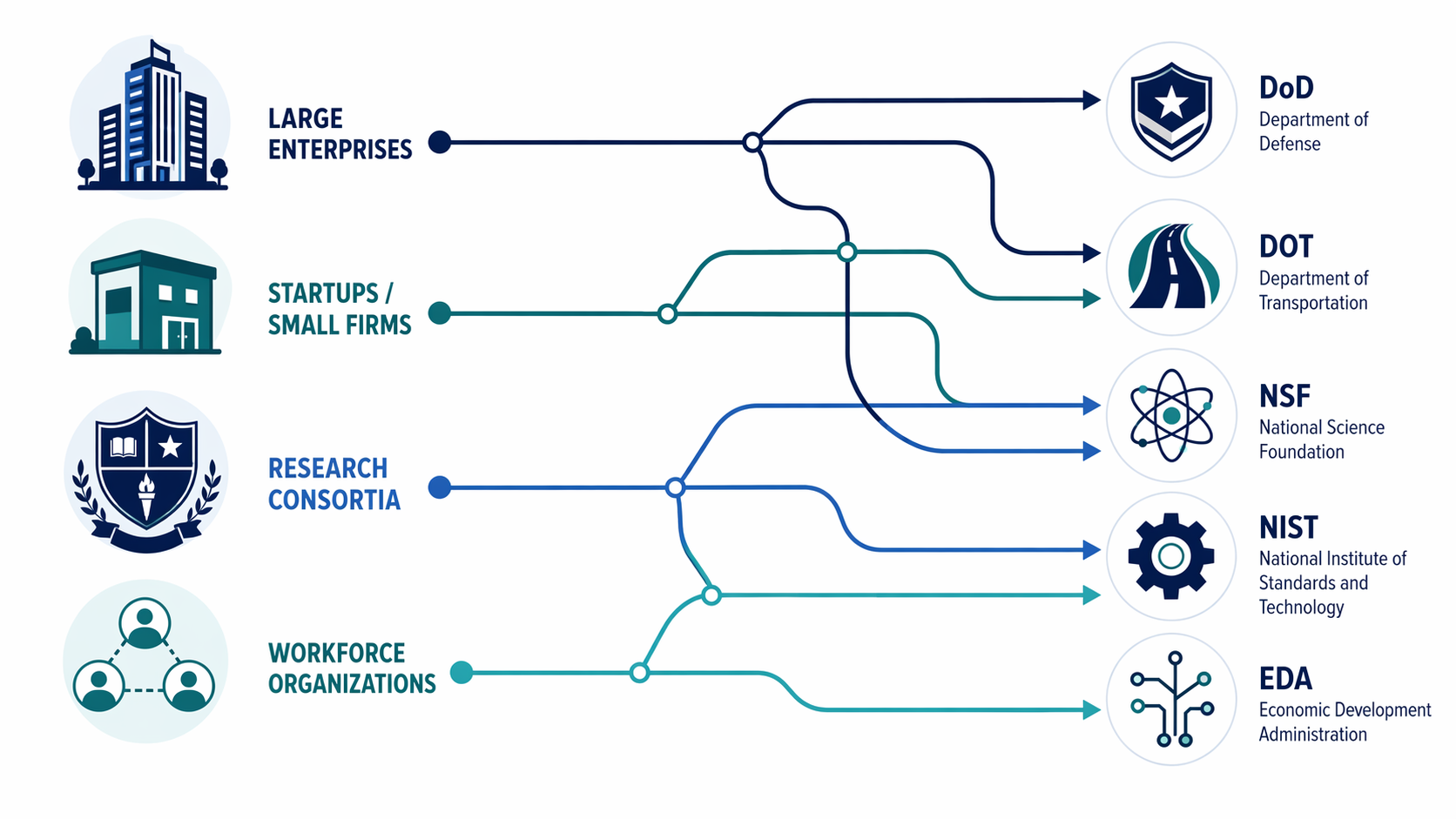
Where Different Organizations Should Start
The fastest way through the landscape is to disqualify poor fits first. A supply chain executive does not need to become fluent in every agency program. The first filter is organization type; the second is project goal.
| If you are... | Start with... | Usually avoid starting with... | Reason |
|---|---|---|---|
| A large enterprise already selling to government or able to team with a prime | DoD/DLA opportunities and relevant agency contract vehicles | Small-business-only R&D programs | The largest AI contract signal is defense-heavy, but it behaves like procurement rather than general grant funding.[1] |
| A logistics, mobility, port, transit, or infrastructure partner | DOT SMART, especially through eligible public-sector or regional applicants | Research-only programs if the project is mainly a field deployment | SMART is structured around transportation technology planning and demonstration, with FY2026 timing pressure.[4] |
| A university, nonprofit, or industry consortium | NSF AI Research Institutes, AI-Ready America, and NIST Manufacturing USA structures | Direct defense procurement unless there is a clear buyer and contracting path | These routes reward research capacity, convening power, workforce reach, and multi-party technical programs.[5][7][8] |
| A small AI startup or technical vendor | SBIR/STTR if currently authorized and aligned with an active topic | Large consortium competitions unless you have a partner role | Award sizes are smaller, but the mechanism is designed for early-stage technical development.[3] |
| A manufacturer or regional employer with AI skills gaps | EDA AI Upskill Accelerator or workforce-focused partnerships | Product deployment grants framed as workforce programs | The funding case is stronger when the problem is adoption capacity and training, not software purchase.[3] |
| A semiconductor, telecom, or wireless supply chain organization | Current CHIPS for America notices and any new wireless supply chain rounds | Expired 2024 windows treated as active opportunities | The strategic fit is real, but current availability is not confirmed in the cited materials.[10][11] |
A Practical Triage Before Assigning Proposal Staff
- Name the mechanism first: procurement contract, grant, research institute, small-business R&D topic, workforce award, or infrastructure program.
- Check applicant eligibility before reading award language. If the eligible applicant is a public agency or consortium, decide whether your company is a partner, vendor, or lead.
- Separate adoption from effectiveness. A funded pilot or contract shows agency interest; it does not prove the same model will work in a private network.
- Treat old windows as evidence of policy direction, not active opportunity. This is especially important for CHIPS-related rounds and NIST competitions.
- For SBIR/STTR, confirm both program authorization and the live solicitation topic before writing technical volume drafts.
No single federal program is “the” AI supply chain funding path. Large contractors should look first at DoD and DLA demand. Transportation and logistics applicants should test DOT SMART fit while the FY2026 window is still relevant. Research consortia should track NSF and NIST structures. Small technology firms should verify SBIR/STTR status and topic alignment. Organizations that cannot yet use AI well should not skip workforce funding. The available money is real; the usable money depends on the route.
References
- Where does federal AI spending stand in 2026? Brookings.
- Utilization of Artificial Intelligence (AI) to Illuminate Supply Chain Risk Defense Logistics Agency.
- US Federal AI Funding Guide 2026 Pertama Partners.
- SMART News U.S. Department of Transportation.
- NIST Announces Funding Opportunity for AI-Focused Manufacturing USA Institute National Institute of Standards and Technology.
- AI for Resilient Manufacturing Institute Competition National Institute of Standards and Technology. July 21, 2026.
- NSF announces $100 million investment in National Artificial Intelligence Research Institutes National Science Foundation. 2025.
- TechAccess: AI-Ready America National Science Foundation.
- Exploring Resilient Supply Chain Autonomous Intelligence Assistant (AF25D-T003) SBIR.gov.
- Home | CHIPS Act CHIPS Act.
- CHIPS FOR AMERICA National Institute of Standards and Technology.
Comments
Join the discussion with an anonymous comment.