
The useful starting point for Cathie Wood's 2026 supply chain AI stock picks is not a live portfolio dashboard. It is a Q1 2026 13F snapshot, filed May 12, 2026, showing holdings as of March 31, 2026.[1] That date boundary matters. A 13F can show what ARK owned at quarter-end and how those positions changed versus the prior quarter; it cannot prove what Cathie Wood thinks today, why each trade happened, or whether a supply chain buyer should treat the portfolio as a vendor shortlist.
Still, the filing is useful if it is read operationally rather than prophetically. Beyond the usual AI magnets, five increased positions point toward distinct supply chain and industrial AI use cases: Trimble, Symbotic, Palantir, Aurora Innovation, and Caterpillar. They do not carry equal evidence. They do not sit at the same maturity level. But together they make a more interesting map than another pass through Nvidia, Tesla, and Amazon.
| Company | Supply chain AI lens | What the workflow touches | Maturity read |
|---|---|---|---|
| Trimble | Construction workflow digitization | Connected jobsite data, project execution, construction supply chain coordination | Established operating model with software and recurring revenue evidence |
| Symbotic | Warehouse robotics | Physical fulfillment automation inside distribution centers | More proven use case than most AI narratives, though still execution-dependent |
| Palantir | Enterprise data integration | Fragmented logistics, operations, and decision data made usable across functions | Mature platform company, but supply chain is only one lens |
| Aurora Innovation | Autonomous trucking and logistics | Driverless freight movement and autonomous delivery economics | Emerging model with large market claims but operational proof still developing |
| Caterpillar | AI-enabled industrial and construction equipment | Digitized jobsites, equipment productivity, and construction supply chain execution | Inferential thesis; worth watching, not over-reading |
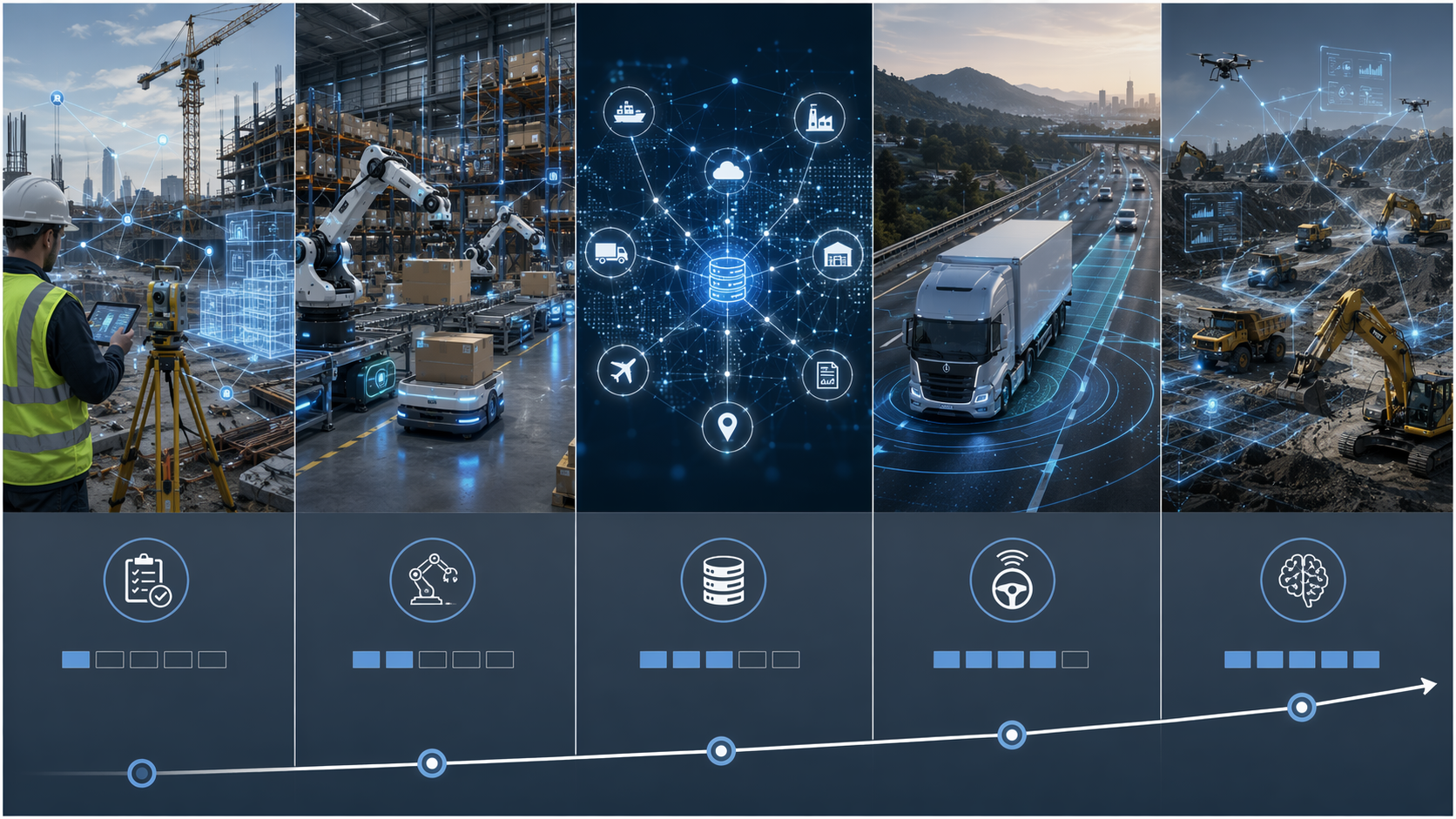
Trimble Is The Clearest Operating Thesis
Trimble is the cleanest case because its relevance is not just that ARK owned it. The company has been shifting from a legacy hardware and positioning-technology profile toward a more software-heavy model. Yahoo Finance reported that recurring revenue reached 65%, up from 33% in 2020, with $2.5 billion in annual recurring revenue and gross margins past 70%.[2] Those numbers do not guarantee customer ROI, but they do show a business that has moved well beyond one-time device sales.
For a construction supply chain leader, that distinction matters. Construction is not one tidy factory line. Materials, equipment, crews, subcontractors, site conditions, design changes, and inspections often move through separate systems and separate accountability structures. A platform that connects field data, project execution, and commercial workflows is not simply “AI exposure.” It is an attempt to make a messy operating environment legible enough for software to coordinate decisions.
Trimble’s “Connect and Scale” strategy is the phrase that makes the supply chain reading credible. The important word is not only “connect”; many vendors promise that. The more material point is that construction workflows become more valuable when the software layer spans planning, work execution, asset location, and handoffs among firms that do not all sit inside the same enterprise system. That is where AI-adjacent value begins to look practical: not in a dashboard demo, but in reducing the distance between what is happening on a jobsite and what planners, procurement teams, and project managers can actually see.
This is also why Trimble deserves more weight than a simple ticker mention. In supply chain technology evaluation, maturity shows up in boring places: contract structure, repeatable workflows, implementation patterns, gross margin profile, and whether customers keep paying for the software layer. Trimble’s recurring-revenue mix and ARR give buyers something more concrete to inspect than a broad claim that industrial AI will digitize the physical world.[2]
Symbotic Maps To A More Proven Warehouse Automation Problem
ARK increased its Symbotic position by 21.67% in Q1 2026, bringing the holding to $41.6 million at quarter-end.[1] That is portfolio action, not proof of operational superiority. But the operational category is easier to understand than many AI stock stories: warehouse robotics addresses the physical movement, storage, sequencing, and retrieval of goods inside high-volume fulfillment environments.
The practical question for a buyer is not whether warehouse robotics sounds futuristic. It is whether the automation changes throughput, labor dependency, order accuracy, space utilization, or service consistency in a facility with real constraints. Symbotic’s relevance sits there. It is tied to a workflow where AI, robotics, software orchestration, and physical infrastructure meet in the same building.
That makes Symbotic more operationally direct than a general-purpose AI platform, even if the buying decision is still hard. Warehouse automation projects create integration work, facility disruption, capital planning, maintenance requirements, and change-management obligations. A stock filing will not tell a supply chain team whether a given site is ready. It does, however, explain why Wood’s portfolio action belongs in the conversation: among AI-adjacent supply chain use cases, robotic fulfillment has a clearer path from software intelligence to measurable operating change.
Palantir Fits The Data Layer, With A Necessary Caveat
Palantir is both relevant and easy to overstate. Its Artificial Intelligence Platform fits a persistent supply chain problem: important decisions depend on data scattered across ERP, transportation, warehouse, procurement, finance, and external partner systems. If planners cannot trust the data layer, AI recommendations become another screen to reconcile rather than a decision system.
The growth evidence is real at the company level. Motley Fool reported on June 29, 2026, that Palantir had more than 600 U.S. commercial customers, up from a handful a few years earlier, and cited gross margins of 84%.[3] Those figures support the idea that Palantir has become a serious commercial software platform, not merely a government contractor with an AI label. They do not prove that supply chain is the primary reason for Wood’s interest, nor do they prove that every Palantir deployment produces logistics value.
For supply chain evaluation, the Palantir question is narrower: can the platform help an enterprise connect messy operational data quickly enough to improve decisions that cross functions? Examples could include inventory positioning, supplier risk monitoring, logistics exception management, or production-distribution tradeoffs. Those are plausible supply chain applications, but they should be treated as use-case fits within a broad platform company, not as Palantir’s whole identity.
That caveat is not a dismissal. In many large organizations, the binding constraint on AI is not model selection; it is data usability, permissioning, workflow adoption, and trust between the people who own different pieces of the operation. Palantir is relevant because it aims at that layer. It deserves caution because the same platform logic can serve defense, government, finance, manufacturing, or logistics, and a supply chain lens is only one way to read the holding.
Aurora Is The Long-Horizon Freight Bet
ARK increased its Aurora Innovation position by 23.57% in Q1 2026, with the holding valued at $26.6 million at quarter-end.[1] This is a different kind of supply chain AI exposure from Trimble or Symbotic. Aurora is not digitizing an existing project workflow or automating a warehouse cell. It is tied to the much larger question of whether autonomous trucking can become a commercial freight model.
ARK’s Big Ideas 2026 autonomous logistics theme gives the position its macro frame. ARK projected autonomous delivery scaling from near zero to a $1 trillion to $2 trillion revenue opportunity by 2030.[4] That number is useful as a signal of ARK’s imagination for the category, but it should not be confused with current operational maturity. Autonomous freight has to pass through safety validation, regulatory acceptance, lane design, customer adoption, insurance questions, fleet operations, and exception handling before it behaves like a normal logistics procurement option.
The supply chain relevance is obvious enough: trucking capacity, cost, service reliability, and driver availability sit near the center of freight planning. If autonomous trucks become commercially dependable, they could change network design and linehaul economics. The word “if” carries more weight here than it does in warehouse robotics or construction workflow software. Aurora belongs on the map, but it sits further out on the maturity curve.
Caterpillar Is The One To Treat Most Carefully
Caterpillar is the most interesting inclusion precisely because it is not usually treated as an AI stock. ARK increased its Caterpillar position by 71.44% in Q1 2026, and the holding stood at $41.5 million at quarter-end.[1] That was the largest Q1 increase among the industrial names in the supplied materials, but the available evidence does not directly explain Wood’s reasoning.
The supply chain interpretation is therefore inferential. Caterpillar can be read through AI-enabled heavy equipment, digitized jobsites, equipment utilization, predictive maintenance, fleet productivity, and construction supply chain execution. Those are legitimate industrial technology themes. They are also not the same as saying Caterpillar is a pure supply chain AI company.
For a buyer or operator, the useful stance is to watch the thesis rather than overclaim it. Heavy equipment is central to construction and resource supply chains, and the jobsite is becoming more instrumented. But compared with Trimble’s software transformation, Symbotic’s warehouse robotics role, or Palantir’s data-platform angle, Caterpillar’s AI supply chain connection is thinner in the available materials. The position is notable; the operational conclusion should remain modest.
The Maturity Curve Matters More Than The Tickers
Read together, the five holdings form a maturity curve rather than a single category. Trimble sits closest to established workflow digitization: software, recurring revenue, and construction operations already intersect. Symbotic occupies the physical automation layer, where robotics can attack specific warehouse constraints. Palantir sits in the enterprise data layer, where the value depends on whether fragmented decision systems can be made usable across functions.
Aurora moves further out. Its promise is not a better planning interface or a more automated facility, but a changed freight operating model. Caterpillar is different again: an industrial incumbent whose AI relevance depends on how equipment, telematics, autonomy, and jobsite software converge over time. The further right this curve moves, the more careful the language needs to become.
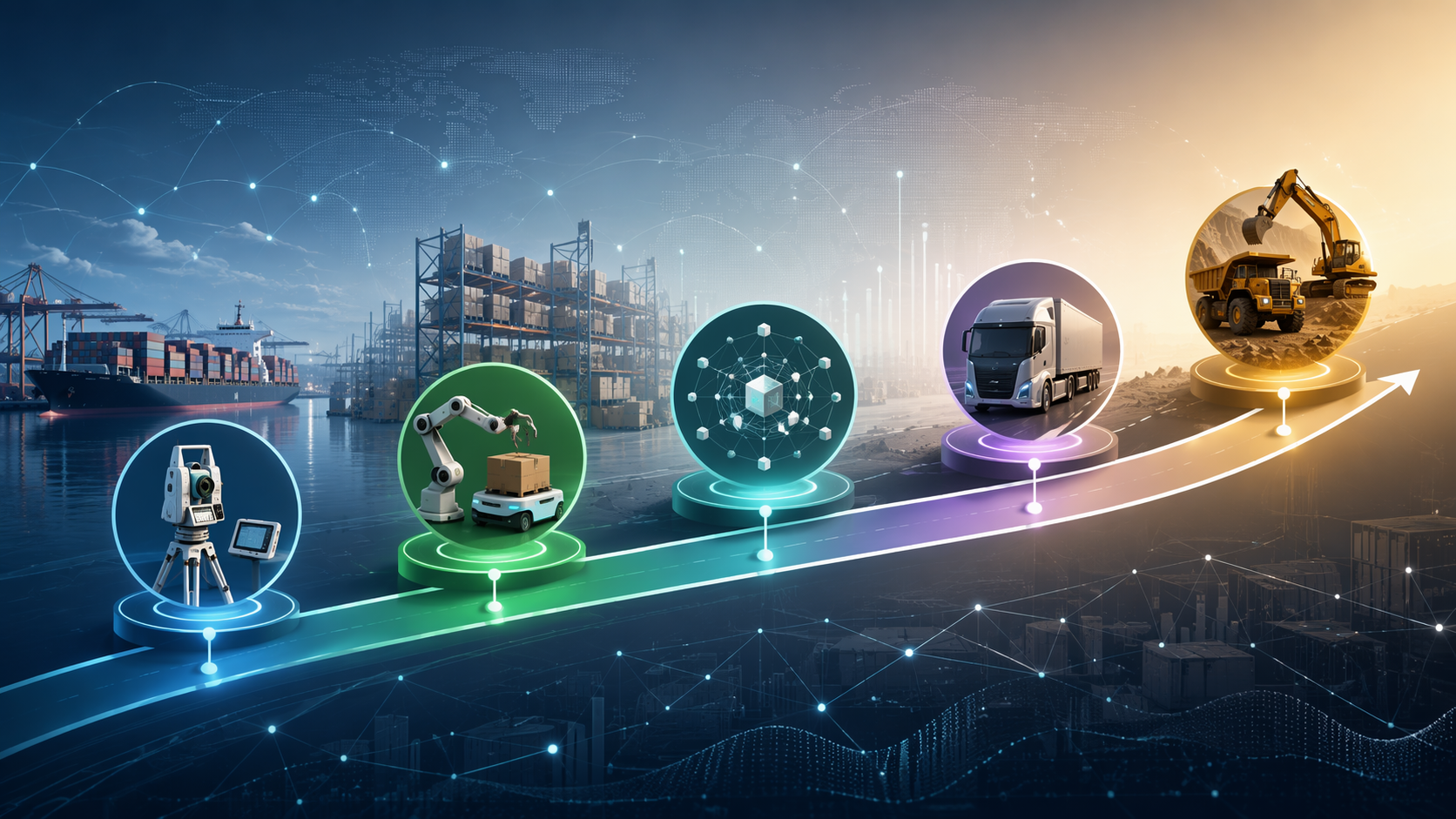
That maturity curve is more useful than ranking the stocks by excitement. A logistics leader evaluating vendors would ask different questions at each point. For Trimble, the questions are about workflow coverage, partner ecosystem, implementation depth, and whether field data actually changes project execution. For Symbotic, they are about facility fit, throughput, uptime, integration, and payback assumptions. For Palantir, they are about data governance, model transparency, user adoption, and whether the platform improves decisions rather than just centralizing information.
Aurora would require a different evaluation posture: lane readiness, safety case, regulatory environment, operating model, and how exceptions are handled when autonomy meets freight reality. Caterpillar would require evidence that equipment intelligence is changing jobsite productivity or construction supply chain coordination, not merely adding connected features to machines.
Selective Industrial AI, Not A Blanket Logistics Theme
The filing also becomes more interesting when set against what was not simply accumulated. The research materials note reductions or exits in Deere and UPS. Without the full reasoning behind those moves, it would be sloppy to build a large conclusion around them. Still, the contrast is helpful: Wood’s industrial AI exposure should not be read as a generic “buy everything logistics” posture.
That selectivity is the real point for supply chain readers. These five holdings are not interchangeable. Trimble and Symbotic speak most directly to operational systems already being bought, integrated, and measured. Palantir is highly relevant where the core problem is fragmented enterprise data, but its business is broader than supply chain. Aurora points to a potentially large logistics model that remains earlier in commercialization. Caterpillar is an industrial signal with an AI-enabled construction and equipment thesis that needs more evidence before it can be treated as a direct supply chain AI pick.
So the practical use of Cathie Wood’s Q1 2026 supply chain AI stock cluster is not to copy the trades. It is to sharpen the evaluation map. If a vendor claims to be an AI supply chain company, ask which operating layer it changes: workflow digitization, warehouse automation, enterprise data integration, autonomous freight, or equipment-enabled jobsite execution. Then ask how mature that layer is, what evidence supports adoption, and who inside the operation would actually change behavior because of it.
On that basis, the Q1 2026 13F is useful but bounded. It points to a credible set of supply-chain-relevant AI themes beyond Nvidia and Amazon. It does not provide a current trading recommendation, a complete statement of Wood’s present holdings, or equal proof of supply chain relevance across all five companies.
References
- ARK Invest Q1 2026 13F data, InvestorLens, filed May 12, 2026.
- The 3 Best Cathie Wood Stocks to Buy for 2026, Yahoo Finance, January 7, 2026.
- Cathie Wood Goes Bargain Hunting, Motley Fool, June 29, 2026.
- Big Ideas 2026, ARK Invest.
Comments
Join the discussion with an anonymous comment.