
The Bab el-Mandeb blockade risk assessment problem for shipping starts with a cost line, not a map. By the time a carrier announces a diversion around the Cape of Good Hope, the easy decisions are already gone: transit time stretches, inventory promises move, finance asks why emergency freight is back on the approval queue, and procurement discovers that everyone else is trying to buy the same alternative capacity in the same week.
Maersk reported a $153 million loss in its Ocean division for Q4 2025, in a market still distorted by Red Sea and Bab el-Mandeb disruption.[1] War risk pricing moved just as violently: premiums cited by Insurance Business rose from 0.05% of hull value to 1% per voyage, equal to $1 million for a $100 million vessel, while BIMCO warned that vessels with U.S. or Israeli business connections could become uninsurable.[2] The broader Cape of Good Hope workaround has been estimated by ITF/OECD at roughly $15 billion to $20 billion a year in added global trade costs.[3]
Those numbers explain why “wait, then reroute” is no longer a defensible baseline. A late diversion is not a strategy; it is a forced buy in a tightening market, with insurance, lead time, and customer service penalties arriving together.
Why This Chokepoint Behaves Like a Live Planning Variable
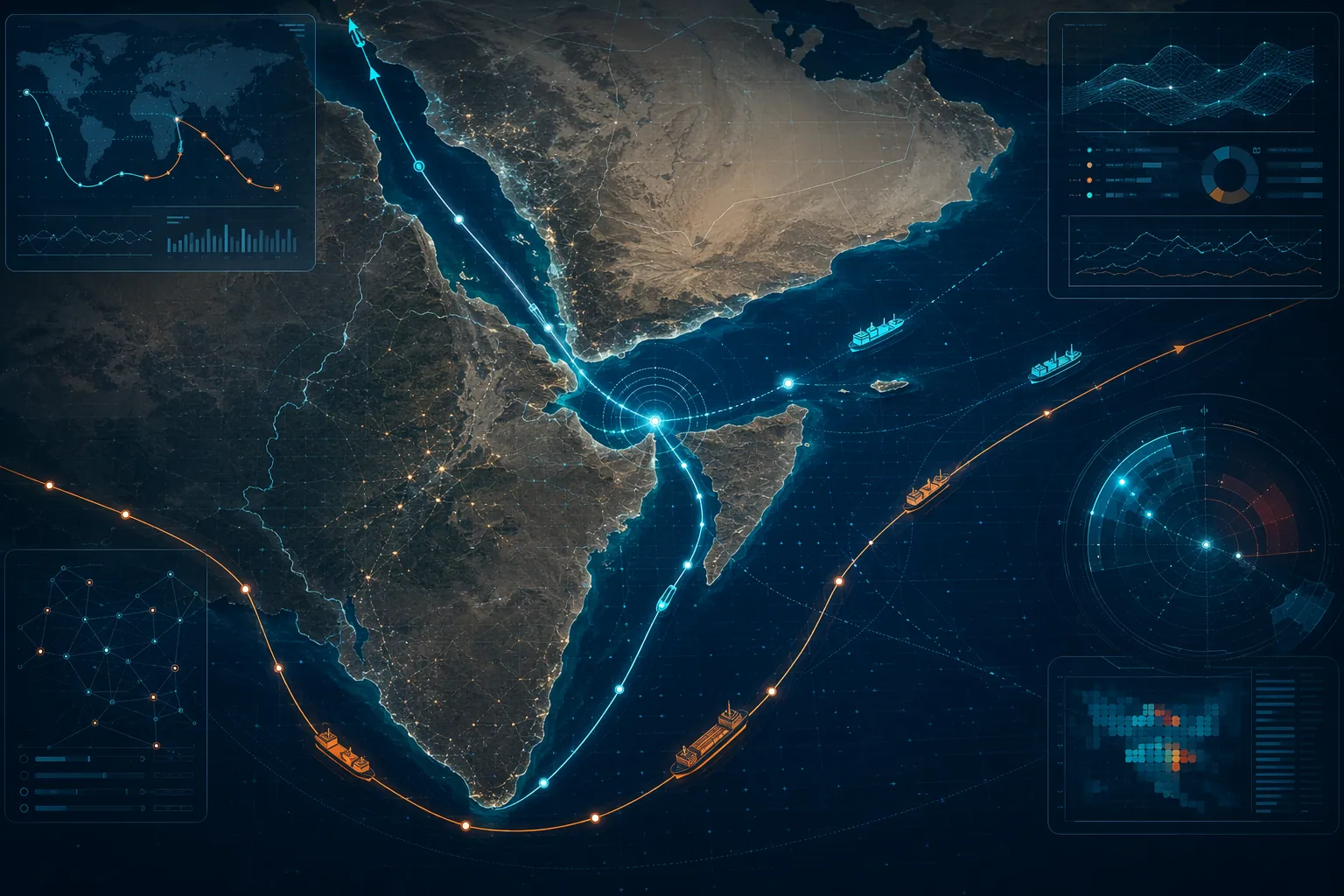
Bab el-Mandeb is the narrow passage between the Red Sea and the Gulf of Aden, bordered by Yemen, Djibouti, and Eritrea. Its commercial importance comes from the traffic it channels between the Indian Ocean, the Suez Canal, and European markets.[4] In a normal procurement cycle, that geography is embedded inside schedules, service strings, bunker assumptions, and allocation commitments. In a crisis cycle, it becomes a moving constraint.
The current risk is not only that a ship may be attacked. It is that the rules governing insurability, carrier appetite, naval posture, and supplier routing can change faster than a quarterly bid file. The Houthi threat to Red Sea shipping, and the group’s operational relationship with Iran, remain dynamic as of July 2026; reporting on the July 13, 2026 warning underlined that this is still an active security problem rather than a closed disruption episode.[5][6]
Hormuz sits in the background as the stress case procurement teams cannot ignore. A simultaneous or near-simultaneous pressure event around Hormuz and Bab el-Mandeb would not simply add two map problems together. It would compress vessel availability, insurance capacity, energy-linked cost assumptions, and executive tolerance for service failure at the same time. That is exactly the type of scenario that should be rehearsed before it becomes a booking-window problem.
What AI Risk Assessment Has To Include Before It Deserves The Name
A useful AI risk assessment for Bab el-Mandeb is not a red icon on a dashboard. It has to connect exposure, probability, commercial options, and decision rights. If the assessment does not tell a team what it is allowed to do next, it is only an expensive alert.
The minimum working version has four layers. First, it needs vessel and lane visibility: AIS feeds, carrier service strings, port calls, historical dwell, and current routing behavior. Second, it needs geopolitical and insurance overlays: attack patterns, advisories, sanctions exposure, political stability signals, war risk premiums, and exclusion language. Third, it needs scenario simulation: what happens if one carrier suspends Red Sea transits, if premiums cross a threshold, if a vessel class is excluded, or if a second chokepoint deteriorates. Fourth, it needs an action register: which suppliers move, which ports receive volume, which carriers have pre-negotiated Cape or multimodal space, and who can approve the premium.
The quality test is operational. Does the model trigger a pre-negotiated Cape allocation before the spot market tightens? Does it identify whether a Jeddah, Eilat, or other multimodal option is commercially viable for a specific supplier lane? Does it warn that the route recommendation is unusable because insurance has disappeared? Does it distinguish a supplier that can absorb a longer ocean leg from one whose inventory position will fail inside the extended transit window?
The MIT Sloan Model: Understand, Anticipate, Adapt
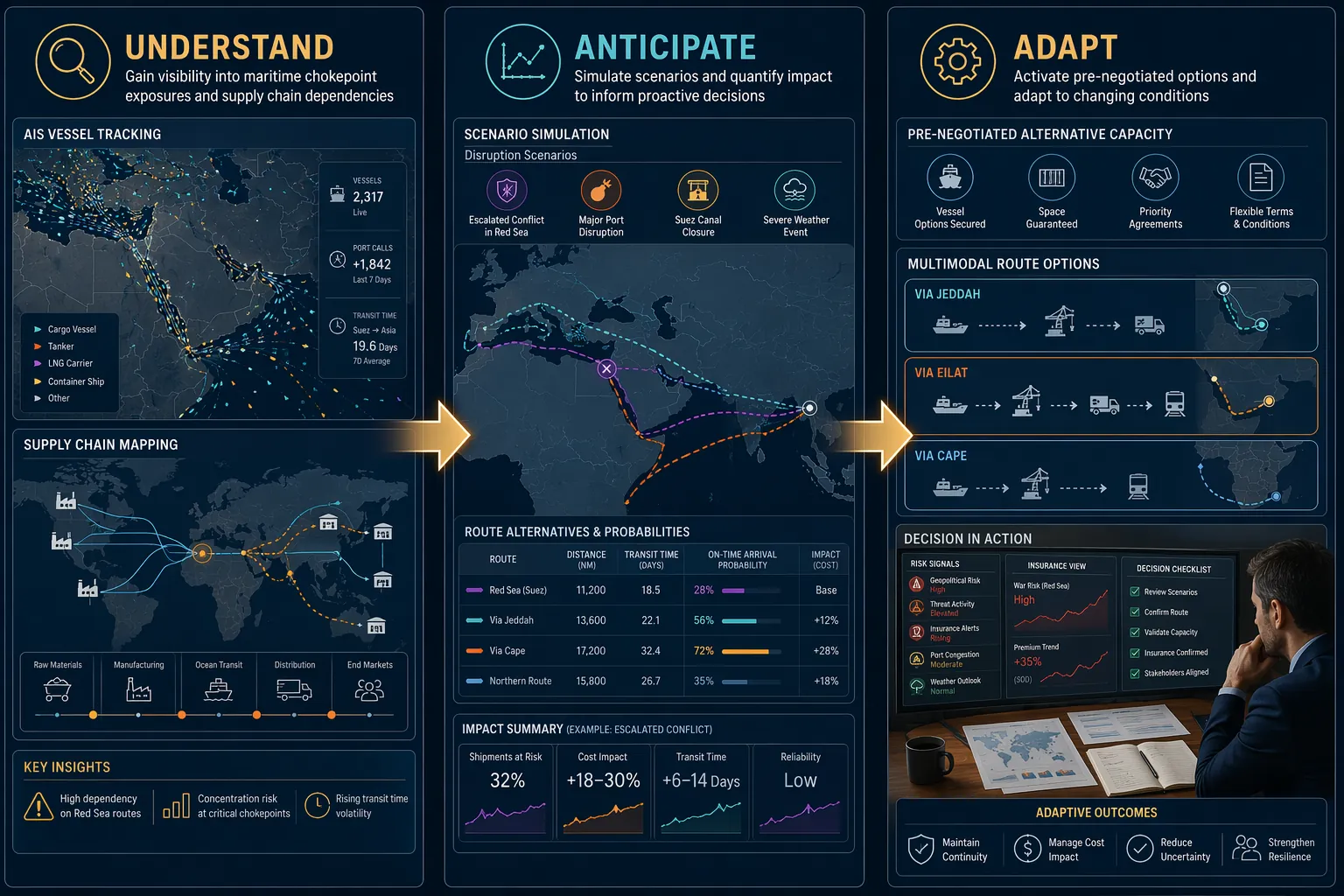
The strongest academic backbone in the available material is the MIT Sloan Management Review framework from Cohen and coauthors: Understand, Anticipate, Adapt. It is based on a study of 13 multinationals, which makes it useful but not universal. A global automotive or electronics company can fund data integration and supplier mapping in ways a smaller importer may not be able to copy directly.[7]
For Bab el-Mandeb, “Understand” starts with a lane-level exposure map. Procurement already knows the named carriers and contracted corridors; the gap is often below that level. Which tier-N suppliers depend on components moving through Red Sea-linked routings? Which purchase orders are tied to vessels that may be delayed, diverted, or refused coverage? Which customers receive finished goods from production lines that cannot tolerate an extra Cape loop? AI can help map these relationships faster than a manual spreadsheet exercise, but the point is not prettier visibility. The point is to know which commitments are exposed before a carrier advisory lands.
“Anticipate” is where the work becomes more than monitoring. Scenario planning should include routine escalation paths, not only worst-case theater. A realistic simulation might ask what happens if war risk premiums rise above an internal tolerance, if a vessel with a particular ownership or customer connection becomes uninsurable, if a key carrier withdraws service, or if a naval advisory changes the acceptable transit window. Monte Carlo simulation is useful here because it can show distributions of delay, cost, and service failure rather than one preferred forecast.
“Adapt” is the part many companies underfund. A contingency plan that says “reroute via Cape” is not an adaptive capability unless capacity, cost, customs, insurance, supplier release timing, and customer allocation rules have already been worked through. The real output is a set of options with owners: carrier A has conditional Cape space; carrier B can support a different gateway; a forwarder can activate a multimodal bridge; finance has an approved premium band; customer service knows which accounts receive early warning.
Turning The Framework Into A Weekly Operating Rhythm
The MIT Sloan model is strongest as a management structure. The Predict-Adapt-Collaborate sequence derived from Sensos and Kpler practice is useful because it pushes the discussion closer to the operating floor: detect risk, change the plan, and share enough information that suppliers and logistics partners move before the crisis queue forms.[8]
| Operating question | AI-supported input | Decision it should unlock |
|---|---|---|
| Which shipments and suppliers are exposed? | AIS feeds, carrier schedules, supplier maps, order data | Prioritized exposure list by lane, customer, and inventory risk |
| What changes would make the current routing unacceptable? | Geopolitical signals, insurance pricing, advisories, vessel profile data | Human-approved thresholds for reroute, hold, expedite, or split shipment |
| Which alternatives are commercially ready? | Scenario simulations, port and transit-time comparisons, capacity data | Pre-negotiated Cape, alternate port, or multimodal options |
| Who needs to act before disruption becomes visible downstream? | Shared supplier risk data and exception workflows | Supplier release changes, customer notices, premium freight approvals |
In practice, this should feel less like a quarterly strategy deck and more like a disciplined allocation meeting. The team reviews lanes with Bab el-Mandeb exposure, current vessel behavior, insurance movement, carrier advisories, and supplier readiness. The AI layer flags changing probabilities and likely cost or delay ranges. Humans decide whether the signal is strong enough to activate a commercial option.
That human decision point matters. A model can rank a Red Sea transit as statistically acceptable based on recent AIS movement, but a procurement lead may still override it if the vessel’s ownership, cargo profile, or customer connection makes insurance uncertain. Conversely, a model may prefer a full Cape diversion while a logistics team chooses a split plan: move urgent components through an alternative gateway, let lower-value inventory absorb the longer ocean leg, and reserve premium capacity for orders tied to revenue penalties.
Where Vendor Claims Help, And Where They Need Guardrails
Vendor-originated material is valuable when it describes a workflow, but performance claims need labeling. Sensos cites supply chain resilience research indicating that companies co-investing in AI visibility tools with suppliers reduced crisis recovery time by 63%.[8] That figure is useful as a directional benchmark, not as a guarantee. It likely reflects companies with better-than-average data sharing, executive support, and partner alignment.
The same caution applies to the cited automaker example. Sensos, referencing Belhadi et al. 2024, describes an automaker that avoided $220 million in losses during the 2024 Red Sea crisis by using AI to reroute through 12 pre-mapped alternative ports selected with political stability scores.[8] That is a concrete and relevant claim because it shows preparation before escalation, but it should not be treated as independently verified proof for every sector. The lesson is narrower: pre-mapped ports, risk scoring, and decision authority can make a reroute faster than a meeting-by-meeting scramble.
Platform capabilities from companies such as Windward, Kpler, and Altana-style value-chain mapping providers belong in the data layer of the discussion, not at the center of the strategy. Sequence search, predictive ETA, vessel behavior analytics, and value-chain mapping can all improve the inputs. They do not replace the commercial work of negotiating capacity, checking policy exclusions, confirming supplier flexibility, and deciding who pays when the safer route costs more.
The Preparatory Decisions That Matter Most
A Bab el-Mandeb AI risk assessment program should end in named decisions, not general resilience language. The first decision is exposure ownership. Someone must own the list of lanes, suppliers, SKUs, and customers that fail under extended Red Sea disruption. If ownership is split between procurement, logistics, planning, and risk without a shared escalation table, the dashboard will find the risk faster than the organization can act on it.
The second decision is capacity posture. Pre-negotiated Cape capacity is expensive if nothing happens and painfully cheap if the market locks. The right level will vary by margin, service promise, inventory buffer, and customer penalty structure. AI can help rank which lanes deserve protected optionality, but the organization still has to approve the premium before a crisis.
The third decision is route diversity. Not every shipment should default to the same Cape answer. Some flows may tolerate longer ocean transit. Some may justify air-sea, sea-air, or alternate gateway moves. Some may be better served by shifting production release timing rather than changing the freight mode. The point of simulation is to compare consequences early enough that the team is not choosing under customer escalation.
The fourth decision is the insurance trigger. If war risk premium movement or coverage availability changes the economics or legality of a route, the model needs to elevate that condition immediately. BIMCO’s warning about potentially uninsurable vessels with U.S. or Israeli business connections is the kind of constraint that cannot be solved by a better ETA prediction.[2]
The fifth decision is supplier collaboration. Sensos’ recovery-time claim is tied to companies co-investing in visibility with suppliers, which is the important part of the sentence. A buyer may have a sophisticated geopolitical model, but if suppliers do not share order status, release timing, component constraints, or alternate port feasibility, the buyer still ends up reacting late.
A Double-Chokepoint Simulation Is Not Optional
The Bab el-Mandeb plan should be tested against a Hormuz-linked stress scenario even though Bab el-Mandeb remains the center of gravity. The purpose is not to predict a specific escalation. It is to understand whether the company’s “alternative” capacity depends on the same carriers, fuel assumptions, insurance markets, or executive approvals that would also be stressed in a Gulf crisis.
A useful simulation asks plain operating questions. If Red Sea transit becomes unacceptable and fuel-linked costs rise at the same time, which customers lose allocation first? If two carriers withdraw capacity, which supplier lanes still have contracted protection? If finance caps premium freight, which orders move by service criticality rather than whoever escalates loudest? If insurance coverage becomes unavailable for a vessel category, who has authority to override a model recommendation that still shows the fastest route?
The simulation should produce a playbook with thresholds, not a single forecast. One threshold may activate daily carrier calls. Another may reserve alternative capacity. Another may release customer communications. Another may freeze bookings through a route until insurance is confirmed. These are not glamorous AI outputs, but they are the outputs that keep a supply chain from discovering its policy limits after the vessel is already exposed.
What Changes When The Team Stops Waiting
The practical difference between reactive routing and predictive resilience is time under control. In the reactive version, the company waits for a carrier notice, asks for alternatives, learns the new price, checks insurance, calls suppliers, explains delays to customers, and then requests budget approval. In the predictive version, the company has already ranked exposed lanes, priced alternatives, negotiated conditional space, modeled customer impact, and agreed on escalation triggers.
AI makes that discipline easier to sustain because it can refresh exposure maps, ingest AIS behavior, detect geopolitical signal changes, compare route probabilities, and run scenarios faster than a manual risk committee. It also makes weak operating models more visible. If the data shows a lane is exposed and the organization still has no approved response, the problem is no longer intelligence. It is governance.
The Bab el-Mandeb crisis does not become predictable because a model watches it. It does not become safe because a dashboard assigns a score. Human geopolitical judgment, carrier relationships, insurance interpretation, and supplier coordination remain essential. What structured AI risk assessment can do is give supply chain leaders a repeatable way to price exposure, rehearse alternatives, and buy resilience before a blockade forces everyone into the same emergency queue.
References
- Maersk Reports Q4 2025 Ocean Division Loss Amid Red Sea Disruptions, gCaptain / Maersk financial context, 2026.
- Red Sea war risk premiums surge as shipping threat escalates, Insurance Business, 2026.
- Red Sea shipping disruptions and impacts on trade costs, International Transport Forum / OECD, 2026.
- What Is the Bab el-Mandeb Strait?, Windward.
- Yemen’s Houthi Rebels and the Red Sea Crisis, Council on Foreign Relations, 2026.
- Iran-Backed Houthis Warn of Renewed Red Sea Attacks, TIME, July 13, 2026.
- Stay Ahead of Geopolitical Supply Chain Risks, MIT Sloan Management Review, 2026.
- AI and Supply Chain Resilience in Geopolitical Disruptions, Sensos, 2026.
Comments
Join the discussion with an anonymous comment.