
Gartner’s April 2026 prediction is easy to misread if it is treated as a robotics headline. The claim is narrower, and more useful, than that: Gartner expects 50% of new warehouses in developed markets to be human-optional by 2030, and it advises CSCOs to adopt digital twin and simulation models early so layouts can be validated and robotic performance optimized before construction. [1]
That boundary matters. This is not a forecast that half of the global warehouse installed base will run with little human intervention by the end of the decade. It is a forecast about new facilities in developed markets, where greenfield design decisions can be made before the slab, rack, power, network, charging, safety, and traffic assumptions are locked in. The 2030 autonomous warehouse discussion is therefore less about buying robots and more about sequencing the design system that makes human-optional operations plausible.
A warehouse does not become autonomous because an AMR fleet arrives at the dock. It becomes more autonomous when the building, inventory, equipment, labor rules, order demand, travel paths, exceptions, and control decisions are represented well enough for software to test, sense, and eventually direct work. That distinction sits behind robot-centric warehouse design: the facility has to be designed as an automation environment before automation can perform like one.
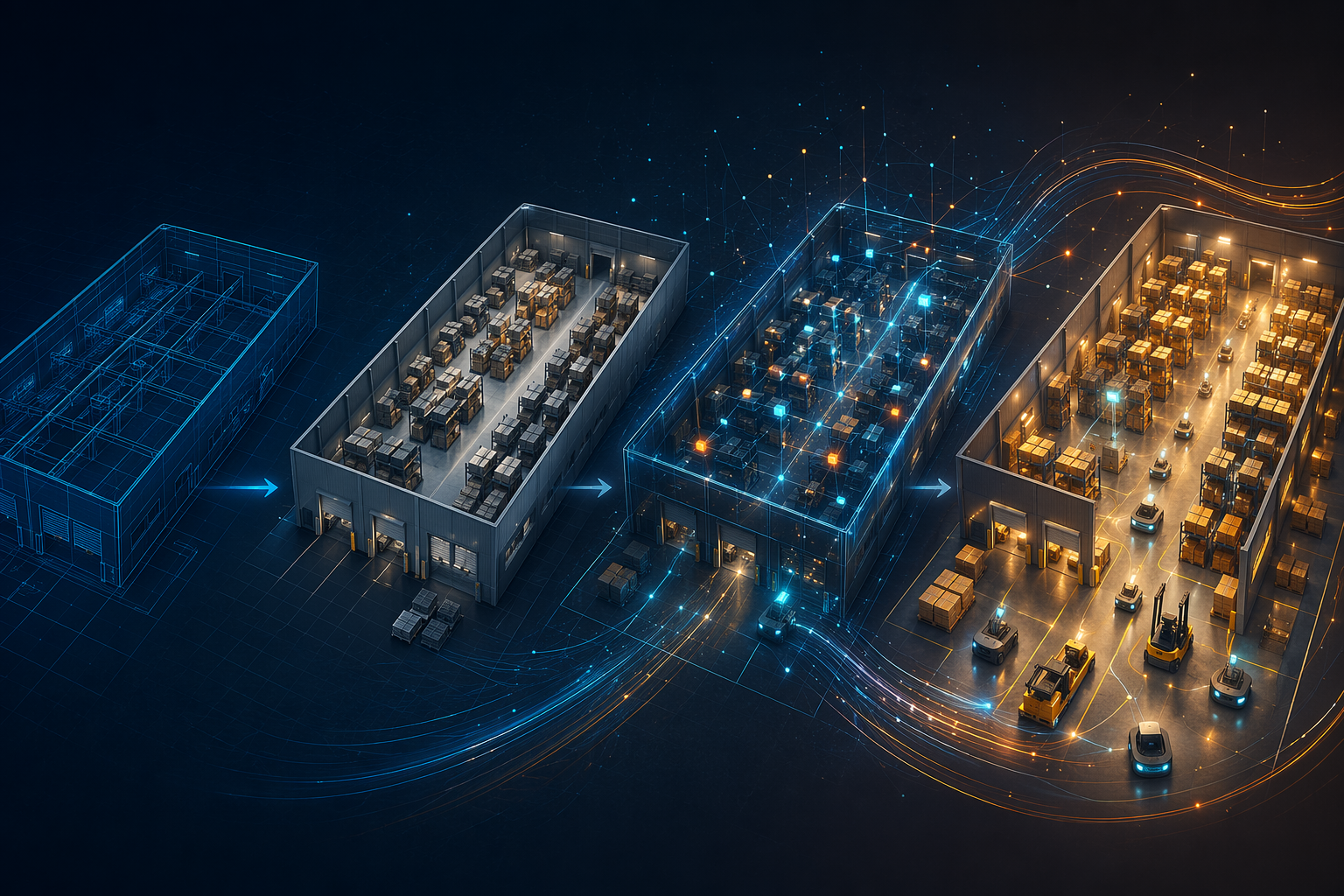
The maturity ladder that makes the forecast operational
In this context, a digital twin is not just a dashboard, a CAD file, or a one-time simulation. A useful supply chain digital twin is a digital representation that becomes progressively more faithful to the physical operation and, at higher maturity, participates in decisions. AWS describes a four-level progression for warehouse digital twins: static CAD model, spatially accurate 3D model, real-time IoT-linked digital twin, and bidirectional control digital twin. [2]
The AWS framework should not be treated as a neutral standard handed down by the industry. AWS is a cloud vendor with a commercial reason to make digital twin adoption legible and investable. Still, the progression is practical because it separates four very different states that often get collapsed into the same executive slide.
| Maturity level | What is represented | What decision it can improve |
|---|---|---|
| Level 1: Static CAD model | Building geometry, fixed assets, rough layout assumptions | Early facility planning and stakeholder alignment |
| Level 2: Spatially accurate 3D model | Racking, aisles, equipment clearances, travel paths, automation zones | Layout validation, slotting logic, robot and conveyor design before construction |
| Level 3: Real-time IoT-linked digital twin | Live inventory, location states, equipment activity, sensor data, operational exceptions | Inventory accuracy, bottleneck visibility, exception management, control-room decisions |
| Level 4: Bidirectional control digital twin | A live model connected to systems that can send instructions back into the operation | Dynamic orchestration of robots, work queues, replenishment, routing, and interventions |
The hard jump is not from Level 1 to Level 2. Most competent warehouse design teams already understand that static drawings need to become buildable spatial models. The larger shift is from a model that helps people approve a design to a model that reflects what the operation is doing now. The strategic leap after that is even bigger: from monitoring the warehouse to controlling parts of it.
Level 2 is where automation mistakes become cheaper
The most expensive automation errors usually look harmless in the conference room. Aisles are slightly too tight for the expected traffic pattern. Induction points are convenient for a drawing, not for peak-hour flow. Charging areas fit the equipment count, but not the recovery pattern. Manual exception handling is assumed to be nearby, then discovered to be across the building.
A Level 2 warehouse digital twin does not make the building autonomous. It makes those assumptions visible while they are still negotiable. Exotec describes digital twin use in warehouse automation projects for layout validation and system design, while Mecalux discusses digital twins in connection with layout analysis, slotting optimization, and warehouse performance modeling. [3][4]
That is the right place for early investment. Before a warehouse leader argues for a higher automation budget, the model should be able to answer more basic questions: where inventory waits, where robots queue, what happens when a mezzanine support column changes a travel path, whether a high-velocity SKU family is placed near the work it actually drives, and how much exception work is being pushed back onto people.
This is also where the digital twin should be compared against simpler tools. Some warehouse problems only need a better slotting report, a revised labor standard, or a WMS configuration change. The case for a twin is stronger when spatial constraints, timing, resource interaction, and automation behavior have to be evaluated together. That distinction is the same discipline behind matching AI technologies to warehouse problems rather than buying the most advanced tool available.
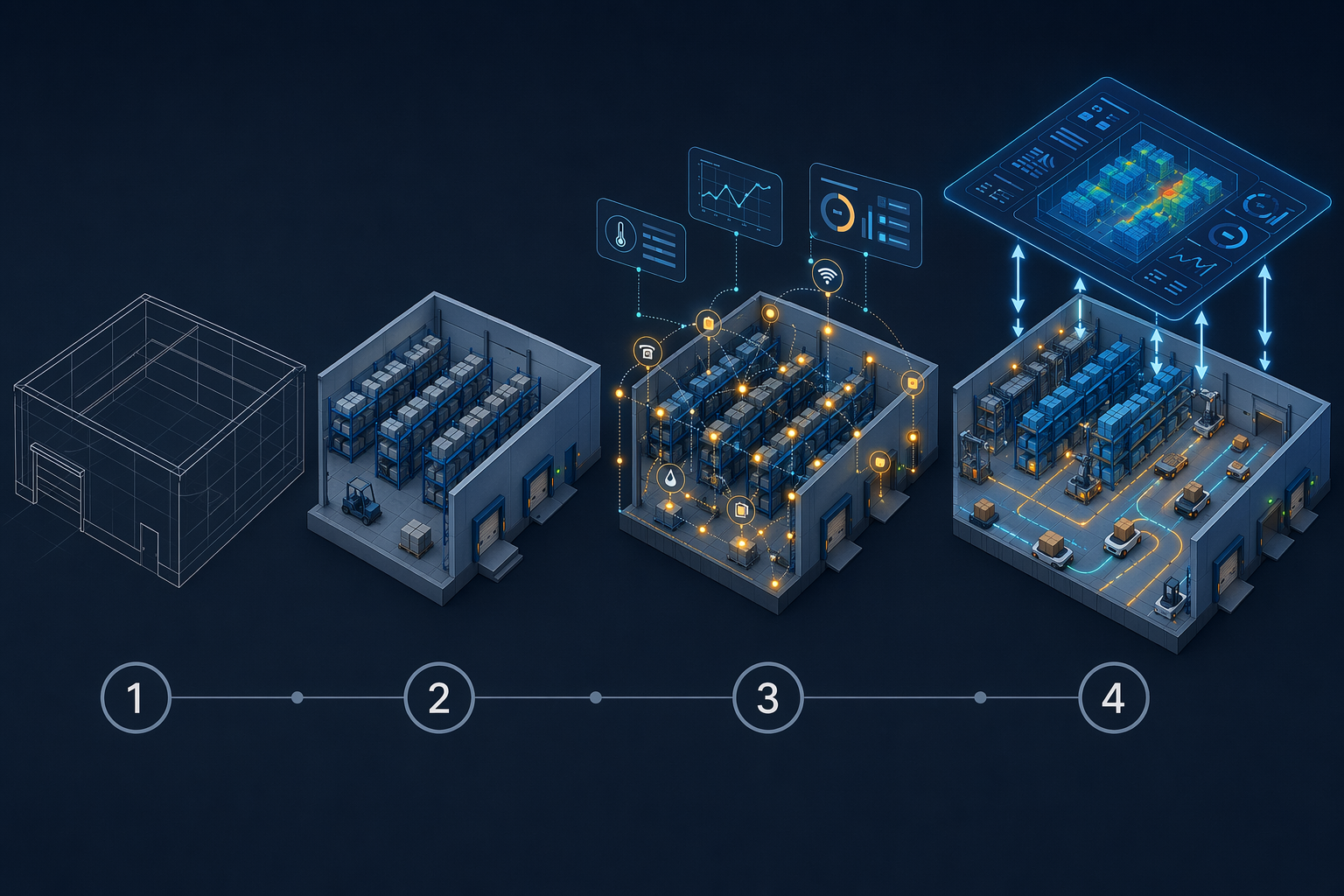
The Level 2 to Level 3 transition changes who can use the model
A spatial model is mainly a design and engineering object. A real-time IoT-linked twin becomes an operating object. That transition changes the audience. The people who care are no longer only the project team, integrator, consultant, or automation vendor. Supervisors, inventory teams, maintenance planners, exception handlers, and control-room staff now depend on whether the digital picture matches the floor.
This is why inventory accuracy cases are more revealing than broad claims about transformation. Dexory reported that Vente-unique.com improved inventory accuracy from 92% to 99.9% within three days using autonomous-scanning robots and an AI-powered digital twin interface. Dexory also reported a 6% accuracy improvement at DB Schenker. [5]
Those are vendor-reported results, not independently audited benchmarks. They should not be copied into a business case as if every site can expect the same movement. Their value is more specific: they show what becomes possible when the twin is no longer a planning artifact and starts acting as a live operational interface. The warehouse team is not waiting for a cycle count report to catch up. It can see mismatches between system inventory and physical reality faster, then decide where to intervene.
That is also where many digital twin programs become less glamorous and more difficult. Level 3 requires data discipline: location data, inventory events, sensor states, equipment telemetry, master data hygiene, and integration with warehouse execution systems. If those inputs are late, incomplete, or semantically inconsistent, the twin becomes another screen people do not trust. For more examples of where production twins are already useful, see these warehouse digital twin use cases.
What Level 3 has to prove
- The model shows the current state of inventory, equipment, and work areas closely enough for operators to act on it.
- The twin exposes operational exceptions rather than smoothing them into averages.
- Data latency is low enough for the decision being made; not every decision requires the same refresh rate.
- The model can survive normal warehouse messiness, including blocked aisles, misplaced stock, equipment downtime, and manual overrides.
- The operating team knows which system is authoritative when the twin, WMS, WES, robot fleet manager, and physical floor disagree.
Level 4 is not better visualization. It is control.
The difference between Level 3 and Level 4 is easy to understate because both may appear on the same control-room display. At Level 3, the twin helps people understand the operation. At Level 4, the twin is connected to systems that can change the operation: dispatching robots, reprioritizing work, adjusting routes, shifting replenishment, or triggering interventions.
That bidirectional layer is where the phrase human-optional begins to have operational meaning. It does not mean humans disappear from the warehouse. It means more routine decisions can be made and executed by software within approved rules, with people supervising, handling exceptions, maintaining assets, and improving the system. A warehouse may still need people on site, but fewer workflows require a person to observe, decide, and trigger the next move.
This is also where edge computing enters the discussion, but it should stay in proportion. Real-time fleet coordination cannot always wait on cloud round trips, especially when safety, congestion, and local routing are involved. Edge infrastructure can help keep control decisions close to the equipment. It is an enabler, not the strategy itself.
The Level 4 investment question is not whether a digital twin can send commands. It is whether the business is ready to let software make bounded operational choices and whether the physical environment was designed so those choices are safe, recoverable, and measurable. That requires simulation before construction, sensing after commissioning, and governance that defines when automation yields to human judgment.
Early ROI signals are useful, but they are not guarantees
The business-case material around digital twins is promising, but much of it comes from vendors or vendor-adjacent sources. Simio reported process digital twin benchmarks including operational cost reductions of 20–30%, throughput increases of 15–23% within the first year, and payback typically under 12–18 months. [6]
Those figures are useful for setting a directional hypothesis. They are not a substitute for a site-specific model of volume volatility, labor constraints, automation scope, integration cost, data readiness, and operating discipline. A CSCO should be more interested in which decisions the twin changes than in whether a generic payback range can be repeated in a board deck. For a broader comparison of digital twin and AI payback claims, see supply chain AI ROI by use case.
Amazon’s Warehouse Automation and Optimization program adds another directional signal. AWS reported that Amazon reduced digital twin build time by 80% using LIDAR scanning in that program. [2]
Again, the caveat matters. This is Amazon reporting on an Amazon program through an AWS channel. It still points to a practical constraint that warehouse engineering teams understand immediately: if creating and maintaining the model is too slow, the twin falls behind the building. Faster capture methods make the maturity ladder more realistic because spatial accuracy can be refreshed rather than treated as a one-time consulting deliverable.
The robot market does not make every warehouse autonomous
The market context supports investment, but it also argues against overextension. Interact Analysis, cited by Open Sky Group, expects only 13% of warehouses to have deployed even one fulfillment AMR by 2030. A separate Interact Analysis forecast cited by Symbotic places the mobile robot market at about $5 billion in 2024, growing to $14 billion by 2030 at a 19% CAGR. [7][8]
Those numbers do not contradict Gartner’s forecast; they clarify it. AMR adoption across the broad warehouse base can remain limited while a much higher share of new developed-market facilities are designed for human-optional operation. Greenfield sites are where physical layout, software architecture, sensor coverage, network design, and automation zones can be specified together. Existing buildings can still benefit from digital twins, but the path to Level 4 control is usually constrained by prior decisions.
Large market-size projections for digital twin and warehouse automation technologies are less important than that design reality. Different forecasts use different scope definitions and methodologies, so they should not be stacked into a single proof point. The operational question is narrower: will the facility being designed now have enough digital representation, sensing, and control architecture to absorb the automation expected later?
What CSCOs should start building now
For a new facility intended to operate with high automation by 2030, the digital twin roadmap should start before construction procurement is treated as settled. The first investment is not the most advanced control layer. It is simulation and spatial accuracy: a Level 2 model strong enough to test layout, storage design, robotic flow, exception paths, charging strategy, maintenance access, and the relationship between automation zones and human work.
The second investment is the Level 3 foundation that many projects defer until too late: sensors, telemetry, event architecture, data governance, and integration design. A warehouse cannot become software-directed if software only sees a partial, delayed, or disputed version of the floor. This is where implementation risk usually hides. The building may look automated, but the data layer still requires people to reconcile reality.
The third investment is control governance. Before a twin can become bidirectional, leaders need to define which decisions can be automated, what constraints the system must obey, when a human must approve a change, and how exceptions are logged. Without that operating model, Level 4 becomes a brittle automation stack that works in demonstrations and degrades under real workload variation. That is the execution gap behind many warehouse AI deployment failures.
- Start with the facility decisions that become expensive to reverse: layout, storage media, automation zones, charging, network coverage, safety areas, and exception workflows.
- Require the Level 2 model to test robotic performance before construction, not after equipment selection.
- Design Level 3 data infrastructure early enough that sensors, telemetry, and system integrations are not retrofitted around a finished building.
- Treat vendor ROI claims as inputs to a local business case, not as imported proof.
- Define the control boundaries for Level 4 before allowing the twin to orchestrate work across robots, labor, inventory, and exceptions.
For greenfield warehouses in developed markets that are aiming at human-optional operations, digital twins are not an optional analytics overlay. They are the pathway from design validation to operational visibility to control. For existing warehouses or lower-automation environments, the same maturity framework is still useful, but Gartner’s 2030 claim should not be stretched beyond the new-build context where the physical and digital operating model can be designed together.
References
- Gartner Says 50% of New Warehouses in Developed Markets Will Be Human-Optional by 2030, Gartner Newsroom, April 2026.
- AWS Supply Chain Blog articles on warehouse digital twin maturity and Warehouse Automation and Optimization, AWS, 2025–2026.
- Exotec insights on warehouse digital twins and automation design, Exotec.
- Mecalux blog on digital twins in warehousing, Mecalux.
- Dexory insights on Vente-unique.com and DB Schenker inventory accuracy, Dexory, 2025.
- Process Digital Twin ROI benchmarks, Simio, 2026.
- Interact Analysis AMR deployment forecast cited by Open Sky Group, Open Sky Group.
- Mobile robot market forecast citing Interact Analysis, Symbotic, 2026.
Comments
Join the discussion with an anonymous comment.