
The useful question after the June 2026 suspension of Anthropic’s Claude Fable 5 and Mythos 5 is not whether the government was right to intervene. For a supply chain leader, the sharper question is simpler: if a model your operation depends on vanished this afternoon, which shipments, forecasts, orders, labor plans, supplier negotiations, or exception workflows would degrade before anyone could explain why?
That is why the incident deserves to be treated as a supply chain wake-up call, not just an AI-safety headline. The models were suspended days after launch, according to ISMS.online’s account of the event, and the uncomfortable operational lesson is that digital suppliers can disappear faster than physical ones can fail.[1] A carrier usually misses pickups before a lane collapses. A component supplier usually shows quality drift, capacity strain, or cash pressure before production is threatened. A frontier model can become unavailable through a regulatory decision, platform action, provider change, or contractual restriction with little time for the planner, warehouse manager, or procurement owner who has to keep work moving.

Graham Pottie, vCISO at ClubCISO, put the risk in the language supply chain teams already understand: “If it disappears and it’s a key supplier with AI built in, it can harm your business.”[1] The phrase “with AI built in” is doing most of the work. The supplier is not always the AI lab on the purchase order. It may be the transportation management system, warehouse platform, visibility product, forecasting application, procurement suite, or managed service that quietly calls an external model underneath the interface.
The Supplier May Be Hidden Inside The System
Procurement teams are accustomed to reviewing software vendors as spend categories: contract term, data protection, service levels, pricing, renewal language. Supply chain risk teams review operational suppliers differently: capacity, substitutability, recovery time, concentration, geography, financial health, regulatory exposure, and the consequences of failure. AI providers now sit awkwardly between those two review habits.
That mismatch matters because many organizations do not know where AI is already embedded. A company may have a direct subscription to a model provider for procurement drafting or analytics. That is the easy case. The harder case is a vendor platform that uses an external model to classify exceptions, prioritize loads, generate forecasts, summarize supplier communications, recommend substitutions, or orchestrate warehouse tasks. The business user sees a feature. The vendor sees a product dependency. The AI provider sees an API customer. The risk owner may see nothing at all until the feature stops working.
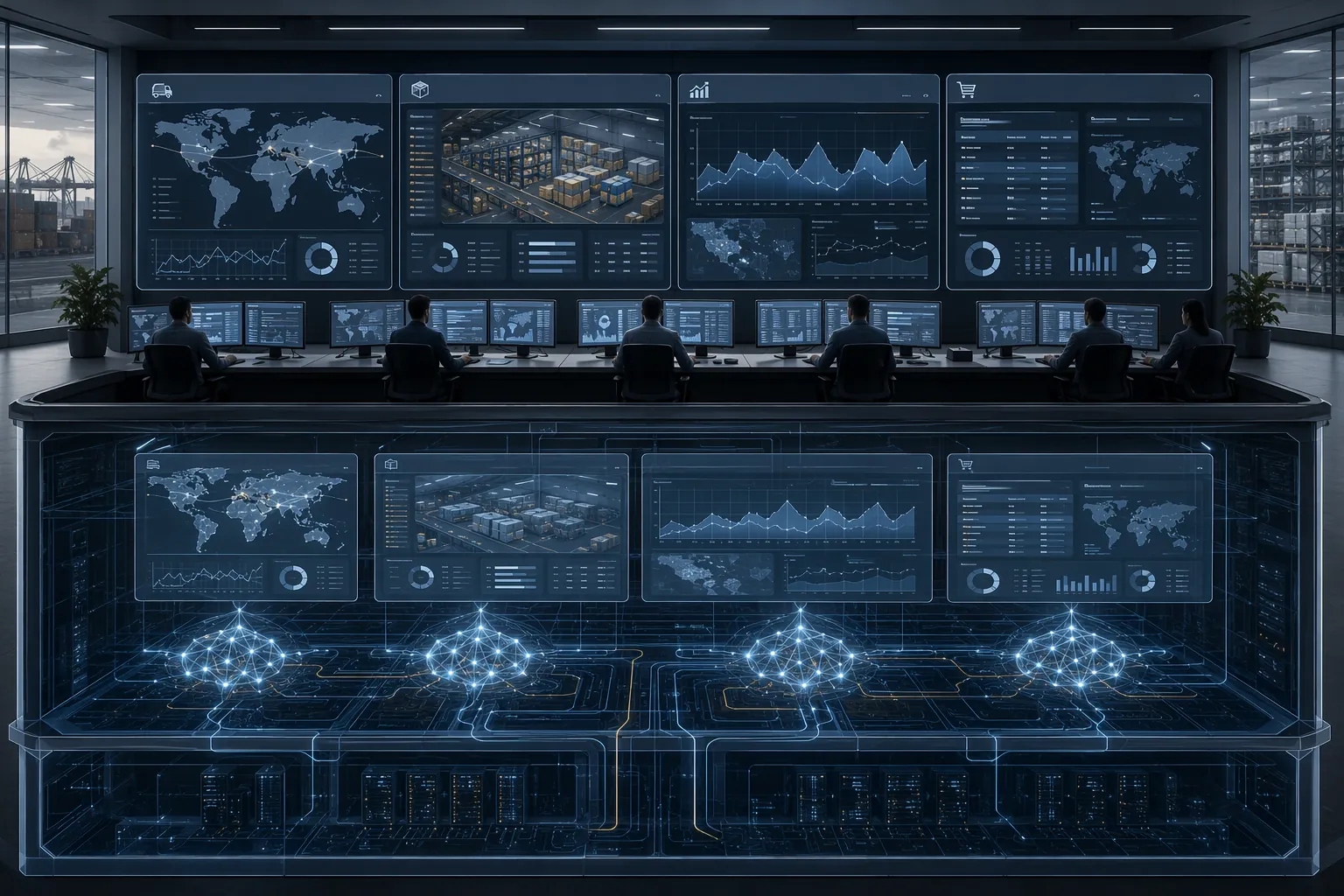
The first inventory question is not “Do we use AI?” That question has become too vague to be useful. The better question is: “Which operational decisions, queues, documents, alerts, or approvals depend on an external model, directly or through another supplier?” The answer usually cuts across system boundaries. A demand planner may depend on a forecasting module. A transportation team may depend on exception prioritization. A warehouse supervisor may depend on task sequencing. A procurement analyst may depend on AI-generated supplier summaries before a sourcing event. These are not equal dependencies, and treating them as equal creates both panic and blind spots.
| AI Use In The Workflow | Dependency Level | Continuity Question |
|---|---|---|
| Model generates optional summaries, drafts, or explanations that a user can ignore | Low to moderate | Can trained staff continue the work manually without delaying execution? |
| Model ranks exceptions, recommends actions, or narrows choices before human review | Moderate to high | Will the team still see the full work queue if ranking or recommendations disappear? |
| Model drives forecasting, routing, allocation, orchestration, or automated decisions | High | What process takes over immediately, and who owns the degradation plan? |
| Model is bundled inside a third-party platform with limited disclosure | Unknown until mapped | Does the vendor disclose model dependencies, substitutes, and change notification rights? |
This distinction is where many AI-risk conversations become too blunt. Not every AI feature deserves a board-level continuity plan. A writing assistant inside a sourcing tool may be useful without being operationally critical. A model that converts noisy exception data into the actual queue used by a control tower is a different creature. If the queue disappears, the organization has not lost convenience. It has lost visibility into what to work next.
The uncomfortable part is that the most important dependencies may not appear in the original buying file. They may have arrived through a product update, an “AI-enhanced” module, a vendor roadmap item, or a customer success configuration. A procurement team may have approved a TMS years ago, while operations later began relying on model-driven route exceptions. The supplier-risk review remains ceremonial because it still describes the old product.
AI Has Become A Layered Supply Chain
The National Security Agency Artificial Intelligence Security Center’s March 2026 guidance, as summarized by Logistics Concepts, frames AI as a layered supply chain spanning data, models, software, infrastructure, hardware, and third-party services.[2] The summary’s central line is worth lingering on: “AI now functions as a supply chain, with weaknesses at any layer capable of disrupting how organizations plan, move, and store goods.”[2]
For supply chain readers, that framing should feel familiar rather than exotic. A finished product depends on raw material, subcomponents, labor, manufacturing capacity, logistics, inspection, and distribution. An AI-enabled workflow depends on training data provenance, model behavior, software integration, cloud hosting, inference infrastructure, access controls, vendor commitments, and sometimes specialized hardware. Failure at one layer can show up as a bad recommendation, a missing feature, a blocked API call, a degraded forecast, or a compliance decision that removes access altogether.
The same guidance summary points to AI Bills of Materials, verified model registries with cryptographic signing, and integrity checks before operational deployment.[2] Those ideas are often discussed as security controls, but they have a plain continuity function: they help an organization know what is running, where it came from, whether it changed, and whether the version in production is the version someone approved.
That does not mean every supply chain team should build a model registry tomorrow. It does mean that a serious AI inventory cannot stop at vendor names. It needs to identify the model or model family where disclosed, the vendor platform using it, the workflow it supports, the decision rights around its outputs, the available substitute, and the owner who accepts the residual risk. Without that map, the organization cannot distinguish a tolerable feature outage from a line-stopping dependency.
For readers who want the deeper technical version of this problem, AI model supply chain risk is the companion issue: model availability is only one failure mode among provenance, compromise, drift, access, and dependency concentration.
Run The Same Questions You Would Run On A Sole-Source Supplier
ISO 27001:2022 is not an AI checklist, and pretending it is one would be lazy. But its supplier relationship and continuity controls give supply chain leaders a useful vocabulary for work they already know how to do. Controls A.5.19 through A.5.22 address information security in supplier relationships, security requirements in supplier agreements, managing and monitoring supplier services, and assessing supplier-service changes.[3] Controls A.5.23, A.5.29, and A.5.30 point toward cloud-service use, information security during disruption, and ICT readiness for business continuity.[3]
Translated into AI-provider due diligence, those controls become less abstract. Supplier agreements should say whether the vendor uses external AI models in operational features, which functions depend on them, what notice is required before model changes, and what happens if a model is suspended or substituted. Monitoring should include more than uptime. It should include material model changes, access restrictions, regulatory actions, security disclosures, and vendor dependency concentration. Change assessment should cover a vendor swapping one model for another just as seriously as a logistics supplier changing subcontractors on a sensitive lane.
- Inventory direct AI providers and AI embedded inside TMS, WMS, visibility, planning, procurement, and control-tower platforms.
- Classify each use by operational consequence: optional assistance, decision support, workflow prioritization, or core execution engine.
- Require vendors to disclose material AI dependencies, change-notification triggers, fallback commitments, and subcontracted model services where contractually possible.
- Assign an internal owner for each critical AI-enabled workflow, not just an IT application owner.
- Test the fallback path before disruption: manual work queue, alternate model, degraded rules engine, vendor-supported bypass, or temporary suspension of automation.
The fallback question is where the conversation becomes real. If an AI model ranks inbound shipment exceptions, can the team revert to a rules-based queue? If a procurement platform summarizes supplier risk signals, can analysts still access the underlying data? If a planning engine uses a model to generate forecast scenarios, can planners run the prior statistical method or a constrained manual cycle? If a warehouse orchestration layer depends on AI sequencing, can supervisors fall back to a stable ruleset without losing task visibility?
The answer may be “yes, with delay.” That is acceptable if the delay is understood and owned. The dangerous answer is “we assume the vendor has it covered.” A vendor continuity plan may protect the vendor’s service. It may not protect the customer’s process, labor model, customer commitments, or regulatory obligations.
Regulatory Availability Risk Is Now Part Of The File
The Anthropic suspension is not the only signal that model availability can become a regulatory and approval issue. ISMS.online also described OpenAI’s GPT-5.6 as facing customer-by-customer government approvals, a status that should be verified for current applicability before any procurement decision relies on it.[1] The important point is narrower than “regulators will shut down AI.” It is that frontier-model access may depend on approvals, use cases, customers, jurisdictions, and changing supervisory expectations.
Defense-adjacent and government-facing supply chains should treat that as an early warning rather than a compliance footnote. Vendor selection is no longer only a contest among accuracy, cost, latency, and integration depth. In some contexts, it also includes whether a model provider can keep serving the customer under applicable approval regimes. Readers working in those environments may want the more specific compliance discussion in NDAA AI vendor selection for defense supply chains.
There is a parallel issue with agentic tools. A model may be replaceable, but the specialized agent skill, integration, workflow memory, or action permission built around it may not be. That is why AI agent skills as vendor risk deserves separate treatment. The dependency is not always the model alone; sometimes it is the operating pattern the organization has trained around the model.
What Should Be Different By Q3 2026
By Q3 2026, a supply chain organization using AI in operational workflows should be able to answer five questions without launching a special investigation.
- Where is AI embedded, including inside third-party platforms the organization did not buy as AI products?
- Which workflows would stop, slow, or lose quality if the model or AI-enabled feature became unavailable?
- Which AI providers or vendor platforms are critical suppliers rather than ordinary software vendors?
- What contractual rights exist for disclosure, notice, substitution, audit, continuity support, and exit?
- What fallback path has been tested, and who is responsible for invoking it?
The discipline is not glamorous. It looks like ownership maps, dependency registers, contract language, recovery procedures, vendor monitoring, and awkward meetings with platform suppliers who would rather describe features than disclose model dependencies. That is exactly why it works. Controls that survive disruption are usually more prosaic than the technologies they govern.
None of this argues for freezing AI adoption in supply chain. Frontier models can improve exception handling, planning analysis, procurement work, and operational responsiveness. But adoption and resilience are different claims. A model can be useful and still be a single point of failure. A vendor can be innovative and still need supplier-risk scrutiny. A platform can deliver efficiency while hiding a dependency the customer must understand.
The Anthropic suspension made the abstract concrete. The next disruption may not involve Anthropic, and it may not involve a public suspension at all. It may be a model substitution, an access restriction, a regional approval issue, a vendor outage, or a bundled feature quietly disabled after a provider decision. Supply chain leaders do not need to become AI alarmists. They do need to classify critical AI providers as suppliers, inventory embedded models, and define fallback paths before the model their operation depends on is the one that disappears.
References
- Anthropic’s Suspension Is a Wake-Up Call for AI Supplier Risk, ISMS.online, https://isms.online/artificial-intelligence/anthropics-suspension-is-a-wake-up-call-for-ai-supplier-risk/
- NSAAI March 2026 guidance summary, Logistics Concepts, https://logistics-concepts.com
- ISO/IEC 27001:2022 Information security, cybersecurity and privacy protection — Information security management systems — Requirements, ISO, 2022, https://www.iso.org/standard/27001
Comments
Join the discussion with an anonymous comment.