
The useful question for 2026 procurement is not whether AMD can “beat” NVIDIA in AI accelerators. It is whether AMD can take enough strategic volume to change a buyer’s supply plan. On that narrower question, the answer is yes, but only inside a hard ceiling: AMD looks increasingly credible as a second source for selected hyperscaler and enterprise programs, while its estimated share of TSMC’s 2026 CoWoS capacity keeps it well short of being a broad replacement.
That ceiling matters because advanced packaging is where AI GPU optionality becomes arithmetic. Morgan Stanley estimates cited by Astute Group put AMD at roughly 105,000 CoWoS wafers in 2026, or about 11% of TSMC’s allocation, compared with NVIDIA at roughly 595,000 wafers, or about 60%.[1] Other allocation reporting puts TSMC’s CoWoS ramp at about 120,000 to 130,000 wafers per month by the end of 2026, up from about 35,000 wafers per month in late 2024.[2] OSAT capacity can relieve part of the pressure, but not erase it: Oplexa cites roughly 40,000 additional wafers per month through ASE/SPIL spillover, with lead times of 26 to 39 weeks.[3]

For a procurement lead, that is the boundary around every other advantage. Better architecture, a stronger HBM plan, and hyperscaler demand all matter, but they do not turn an 11% allocation estimate into NVIDIA-scale supply. They do, however, make AMD much more than a price check. A usable second source does not need to displace the primary supplier everywhere. It needs to be real enough that engineering will qualify it, finance will model it, and the primary supplier knows the buyer has somewhere else to put incremental demand.
The CoWoS Allocation Is the First Constraint, Not the Last Detail
CoWoS has become the practical gate on AI accelerator supply because it sits between available logic wafers and a shippable, HBM-attached GPU module. A buyer can negotiate GPU pricing, press for roadmap commitments, and qualify a second platform, but if the supplier cannot secure advanced packaging slots, the purchase order becomes a queue position rather than a supply plan.
The estimated 2026 split is therefore the most important number for AMD’s supply-chain case. AMD’s roughly 105,000 CoWoS wafers would be meaningful enough to support strategic programs, but small enough that allocation discipline will remain severe. NVIDIA’s estimated 595,000 wafers explain why the default path remains hard to dislodge. Broadcom’s estimated 150,000 wafers, or about 15%, also reminds buyers that AMD is not the only party competing for packaging capacity behind the dominant GPU supplier.[1]
| Supplier or segment | Estimated 2026 TSMC CoWoS wafers | Estimated share | Procurement implication |
|---|---|---|---|
| NVIDIA | About 595,000 | About 60% | Primary supply path remains structurally advantaged |
| Broadcom | About 150,000 | About 15% | Custom silicon competes for the same packaging bottleneck |
| AMD | About 105,000 | About 11% | Credible second-source volume, not broad replacement volume |
| Others including AWS, Marvell, and MediaTek | Remainder | Remainder | Additional pressure on available advanced packaging slots |
These estimates should be treated as directional, not audited capacity statements. They trace to analyst work reproduced across industry outlets, not to supplier-confirmed allocation ledgers. Still, the ratio is too large to ignore. If AMD has roughly one-sixth of NVIDIA’s estimated CoWoS allocation, buyers should not plan as though every NVIDIA-constrained workload can simply be shifted to Instinct.
The useful planning posture is narrower. AMD can matter where a customer has committed engineering resources, has workload fit, and can reserve volume early enough to survive packaging lead times. That is a different conversation from “NVIDIA is constrained, so AMD wins.” It is closer to: “Which part of the accelerator estate can be dual-sourced without creating a worse delivery risk?”
Why the Chiplet Design Still Changes the Supply Conversation
The CoWoS ceiling does not make AMD’s architecture irrelevant. It makes the architecture more important, because any design that improves effective wafer utilization or reduces per-GPU packaging pressure has procurement value. AMD’s Instinct roadmap, disclosed at Computex 2024, continued the company’s chiplet-based approach across the MI300 series and future AI accelerator roadmap.[4]
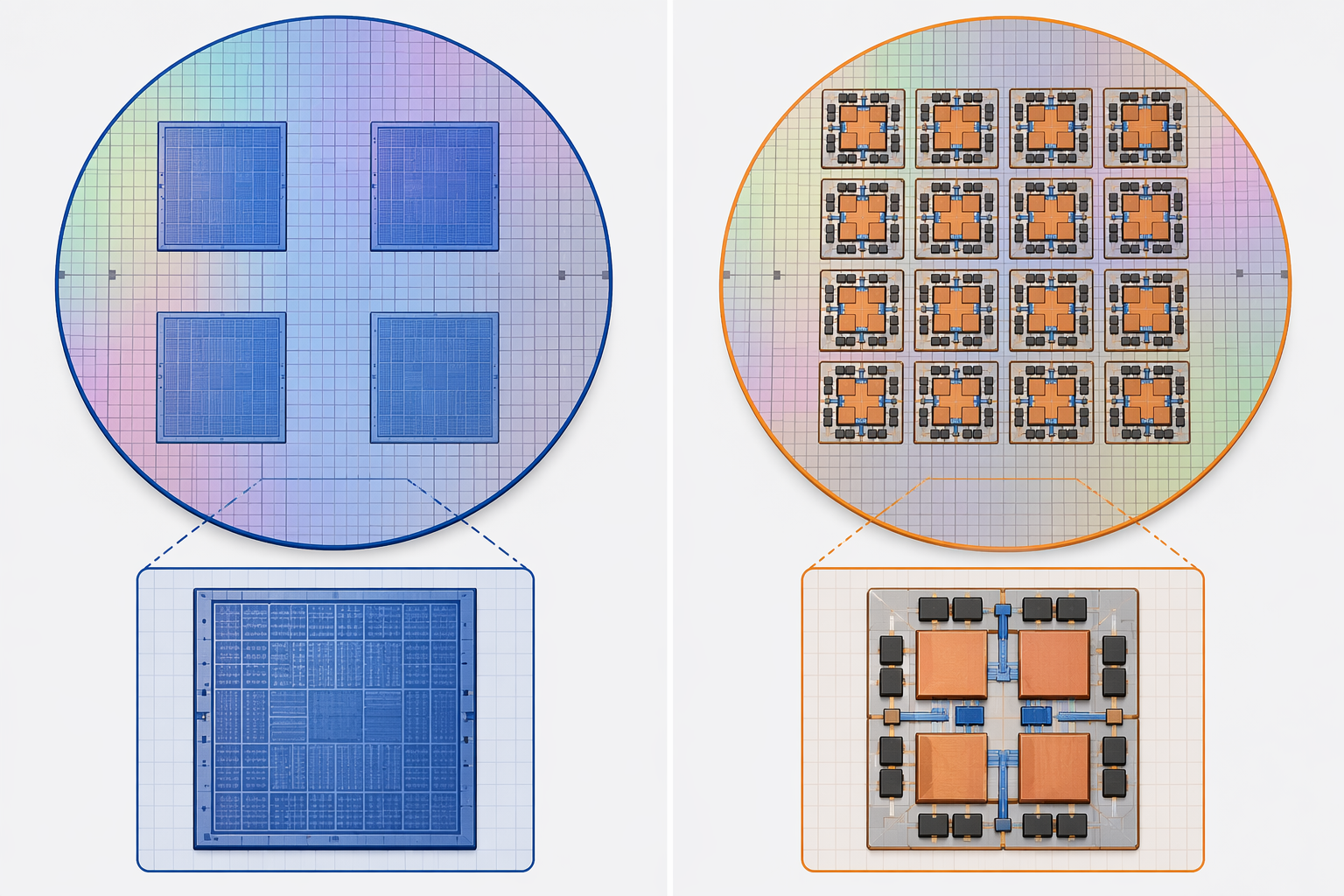
The manufacturing logic is straightforward. A very large monolithic die consumes a large reticle area, and a defect can ruin the whole die. Smaller constituent dies can improve the number of usable die outputs per wafer, because yield loss is isolated across smaller pieces rather than concentrated in one reticle-scale component. That does not mean chiplets make capacity unlimited. They still require advanced packaging, interconnect, substrate capacity, HBM integration, and qualification. But they can improve the economics of each good GPU that reaches the packaging step.
This is where the second-source case gets more serious. If a buyer is trying to diversify away from a dominant supplier, a cheaper quote is not enough. The alternate supplier has to show it can manufacture usable parts with tolerable yield risk, keep the roadmap supplied, and avoid turning every incremental GPU into a fight over scarce package assembly. Chiplets help because the design choice touches cost, yield, and capacity utilization at the same time.
There is also a bargaining implication. A supplier with better effective die economics can sometimes use a smaller absolute capacity position more efficiently. That does not overcome NVIDIA’s much larger allocation, but it can make AMD’s allocation more valuable to a buyer than the headline share alone suggests. A procurement team does not buy percentage points of CoWoS capacity. It buys delivered accelerators, qualified systems, and supportable clusters.
The danger is to overconvert that architectural advantage into assumed supply. Chiplets reduce some manufacturing pain; they do not reserve TSMC packaging lines. The practical buyer will still ask when capacity is booked, which package configurations are qualified, which board partners can ship, and whether the supplier can protect allocation when larger customers pull demand forward.
HBM Multi-Sourcing Is AMD’s Cleanest Resilience Claim
If the chiplet argument is about manufacturing efficiency, the HBM argument is about supplier redundancy. Here AMD has a cleaner claim than most AI accelerator vendors. Samsung and AMD announced in March 2026 an expanded collaboration under which Samsung is positioned as the primary HBM4 supplier for AMD’s MI455X platform, with HBM4 specifications cited at 13 Gbps and 3.3 TB/s.[5] The same supply-chain picture includes SK Hynix continuing as an HBM3E supplier for MI350 and MI355, while Micron is qualified as a third option.[5]

That distinction matters because HBM is not a commodity input that can be swapped casually after a shortage appears. Memory stacks have to be qualified with the accelerator, packaging process, thermal design, firmware, and system platform. A second or third qualified HBM path is useful only if the work has been done before the allocation meeting starts.
AMD’s position is unusual because it has three memory suppliers actively engaged around its merchant AI GPU roadmap. Samsung gives AMD an HBM4 route for MI455X. SK Hynix supports current-generation HBM3E supply for MI350 and MI355. Micron adds a qualified third option rather than a theoretical alternative. The result is not immunity from memory shortages, but it is a more credible continuity story than a single-supplier dependency.
For buyers, the relevant question is not whether one HBM vendor is “best.” It is whether AMD can keep a GPU platform moving if one supplier’s output, pricing, or qualification schedule turns unfavorable. Multi-sourcing gives procurement teams more levers: allocation can be balanced across memory vendors, commercial pressure can be applied without threatening the whole platform, and continuity planning can be tied to named suppliers rather than generic resilience language.
This does not eliminate the packaging bottleneck. HBM stacks still have to meet the GPU inside advanced packages. But HBM multi-sourcing reduces one of the other major single points of failure. In a market where buyers already have too many dependencies on one accelerator supplier, removing even one dependency is commercially meaningful.
Hyperscaler Commitments Show Where AMD Is Already Being Tested
Customer demand should be read after the supply mechanics, not before them. Big names prove little if the manufacturing path cannot support them. In AMD’s case, the hyperscaler activity is still important because it shows sophisticated buyers are willing to spend engineering effort on the second-source thesis.
Oracle is one of the clearest examples. CNBC reported in October 2025 that Oracle planned to deploy 50,000 AMD MI450 GPUs starting in the second half of 2026.[7] Separately, Oracle announced in June 2025 a zettascale AI cluster using 131,000 AMD MI355X GPUs.[8] Those are different commitments and should not be blended into one vague “potential” number. One points to a future MI450 deployment window; the other is a stated MI355X cluster announcement.
Meta’s agreement also has to be separated into committed rollout and upside. AMD and Meta announced a multi-year collaboration around custom MI450-series systems, including a first 1 GW deployment planned for the second half of 2026 and a broader 6 GW agreement.[9] The warrant economics attached to the relationship are contingent on milestones, so they should not be treated as if they were the same thing as delivered GPUs.[9]
OpenAI adds another demand signal, again with the same caveat. CNBC reported a multi-year AMD deal of up to 6 GW, with an initial 1 GW deployment in 2026.[7] The “up to” matters. For supply planning, the initial deployment is firmer than the full long-range potential, and equity-linked upside depends on milestone achievement rather than automatic conversion into volume.
| Customer | Reported or announced AMD AI accelerator commitment | Planning read |
|---|---|---|
| Oracle | 50,000 MI450 GPUs starting H2 2026; separate 131,000 MI355X zettascale cluster announcement | Evidence of serious platform qualification across current and future Instinct generations |
| Meta | Custom MI450 collaboration; first 1 GW planned for H2 2026 within a broader 6 GW agreement | Strategic second-source deployment with milestone-linked upside |
| OpenAI | Multi-year deal up to 6 GW; initial 1 GW deployment in 2026 | Important demand validation, but full volume is contingent rather than immediate |
The common thread is not that every AI workload is moving to AMD. It is that large buyers are carving out enough volume to make AMD operationally real. That is exactly what a second source must do: survive qualification, receive meaningful allocation, and give the customer a live alternative when the primary supplier sets price, delivery, or bundling terms.
Samsung Foundry Optionality Is Useful, but Not a 2026 Answer
The Samsung relationship has another layer beyond HBM: possible foundry services. Futurum Group’s analysis of the March 2026 Samsung-AMD memorandum notes that the language includes “discussions” around foundry services beyond memory.[6] That word should slow the reader down. Discussions are not allocation, not a tape-out schedule, and not a qualified 2026 manufacturing path.
Still, the signal has value. If AMD can eventually add Samsung as a logic-fab option alongside TSMC for some future products or components, it could reduce concentration risk in a way buyers care about. The semiconductor industry rarely builds serious second-source options quickly; design rules, IP, packaging flows, validation, and customer qualification all take time. A long-horizon hedge is worth watching precisely because it is not something procurement can invent in the middle of a shortage.
For 2026 planning, though, this belongs in the optionality column. The capacity case still rests on TSMC logic and CoWoS availability, plus the practical ability to use OSAT spillover where qualified. Treating Samsung foundry discussions as near-term supply would make the same mistake as treating a roadmap slide as booked capacity.
Market Share Explains the Starting Point, Not the Whole Opportunity
AMD is still starting from a small base. Silicon Analysts estimates AMD’s Instinct GPU revenue share at roughly 5% to 7%, with the exact figure depending on how custom silicon such as Google TPU, AWS Trainium, and Broadcom-linked programs are classified against merchant accelerators.[10] That share is useful for scale calibration. It is not, by itself, a verdict on second-source value.
A buyer with a mostly NVIDIA estate does not need AMD to win the whole market before AMD becomes useful. The buyer needs enough deployable AMD volume to shift marginal demand, protect priority workloads, and create negotiating leverage. Small share can still matter if it is concentrated in the right accounts and tied to real delivery.
The opposite is also true. A few high-profile wins do not erase fleet-level inertia. NVIDIA’s installed base, software ecosystem, systems relationships, and engineering familiarity remain formidable. Supply-chain optionality only becomes procurement power when the technical organization can actually operate the alternative platform.
Software Openness Matters Because It Lowers the Cost of Dual-Sourcing
ROCm and open interconnect efforts such as UALink should be judged through that operational lens. Silicon Analysts identifies open standards and ROCm as switching-cost reducers that can support multi-vendor procurement strategies.[11] That does not mean software friction disappears. It means the friction can become manageable enough for some buyers to justify diversification.
This is the part of the sourcing case that can be overclaimed quickly. Procurement cannot simply tell engineering to dual-source a platform that breaks tooling, model performance, observability, or support workflows. But engineering also does not need every workload to move on day one. If open software paths let a buyer identify workloads that can run acceptably on AMD, the supply-chain value becomes real in those lanes.
The best dual-source strategies will probably look uneven. Some training or inference clusters may stay NVIDIA-only because the software penalty is too high. Some new deployments may be designed with AMD in mind from the start. Some capacity may be reserved for customers or internal workloads where price leverage and delivery continuity outweigh the cost of additional platform work. That is not as clean as a one-vendor standard, but it is closer to how resilient supply chains are actually built.
What AMD Can Credibly Deliver as a Second Source
AMD’s strongest 2026–2027 supply-chain case has three parts. First, chiplets improve the manufacturing economics of producing advanced AI GPUs and can make constrained capacity more productive. Second, HBM multi-sourcing gives AMD a named resilience path across Samsung, SK Hynix, and Micron. Third, hyperscaler commitments show that major buyers are willing to qualify and deploy AMD at meaningful scale.
The limiting case is just as clear. Estimated CoWoS allocation keeps AMD in a second-source role. With about 105,000 estimated 2026 CoWoS wafers versus NVIDIA’s roughly 595,000, AMD cannot absorb broad market substitution demand if buyers suddenly decide they want to move large portions of their AI accelerator estates away from NVIDIA.[1] TSMC’s ramp helps the whole market, and OSAT spillover adds relief, but neither changes the relative scale enough to make AMD a near-term replacement.[2][3]
That still leaves a commercially important role. AMD can improve bargaining power, resilience, and targeted allocation for buyers willing to plan around its constraints. The buyer who treats AMD as a cheap substitute will likely be disappointed. The buyer who treats AMD as a qualified second source, reserves capacity early, chooses workloads deliberately, and separates committed supply from contingent upside has a much more credible path.
References
- Advanced packaging demand soars — Astute Group
- Foundry allocation status Q1 2026 — Silicon Analysts
- AI chip packaging bottleneck 2026 — Oplexa
- AMD Unveils Expanded Data Center AI Accelerator Roadmap at Computex 2024 — AMD, June 2, 2024
- Samsung and AMD Expand Strategic Collaboration — Samsung Newsroom, March 2026
- Can AMD Strengthen Both Logic and Memory Supply Chains with Samsung? — Futurum Group, March 2026
- CNBC October 2025 AMD AI chip deal coverage — CNBC, October 2025
- Oracle Announces Zettascale AI Cluster with AMD Instinct MI355X GPUs — Oracle, June 2025
- AMD and Meta Announce Multi-Year AI Infrastructure Collaboration — AMD and Meta, February 2026
- AMD vs NVIDIA AI GPU market share 2026 — Silicon Analysts
- AI data center value chain — Silicon Analysts
Comments
Join the discussion with an anonymous comment.