
By Q3 2026, the practical question for a supply chain leader is no longer whether an AI vendor has a responsible AI statement. The question is whether that vendor can produce evidence when a federal customer, prime contractor, cyber assessor, or critical infrastructure risk committee asks for provenance, model-component visibility, and security controls tied to actual systems. That is where the recent AI supply chain security testimony before Homeland Security starts to matter: not as hearing-room theater, but as the beginning of a paperwork trail that is already showing up in defense procurement.
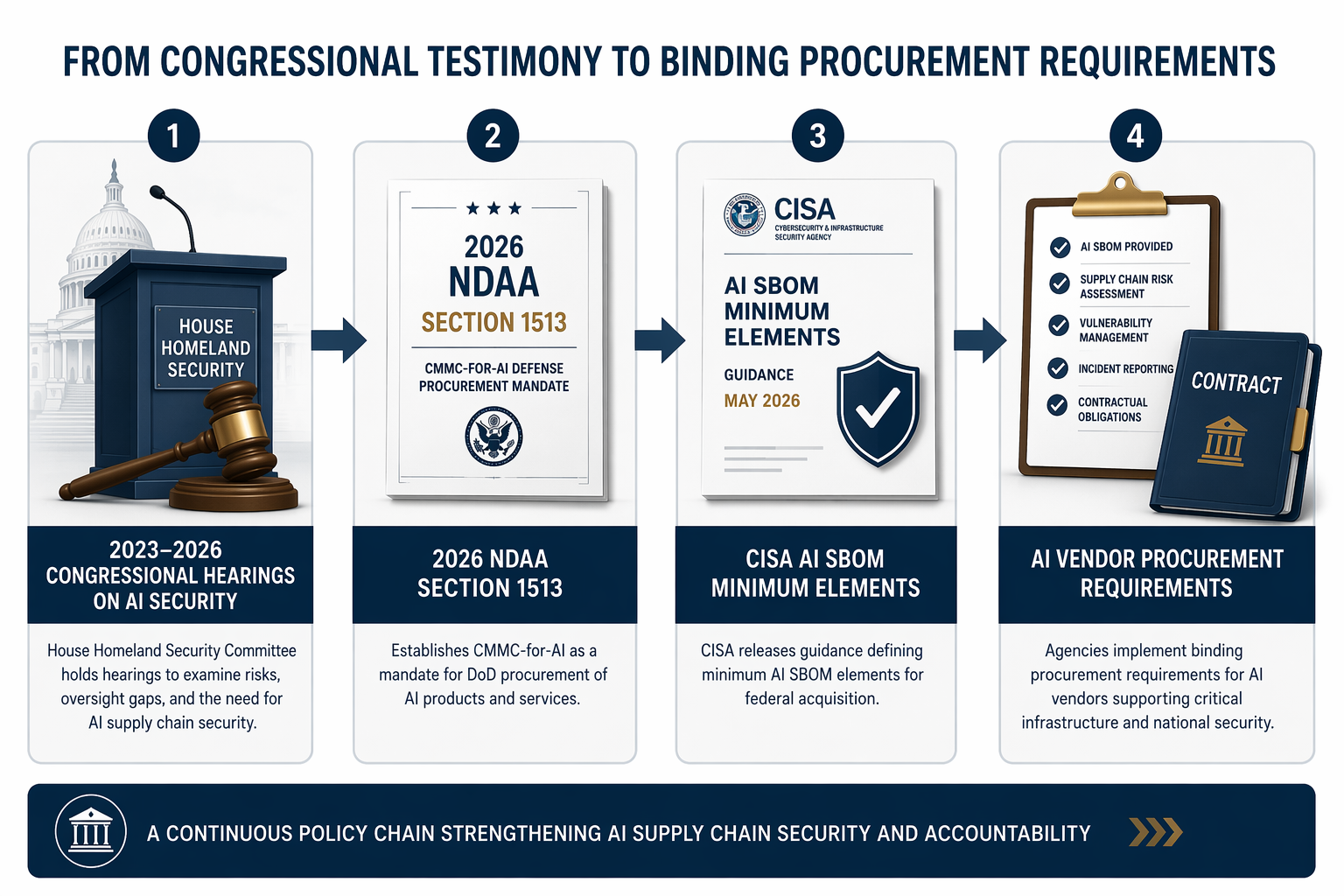
The pressure did not arrive all at once. House Homeland Security hearings in December 2023, May 2024, and June 2026 show a narrowing arc: from broad concern about artificial intelligence and national security, to the role of DHS and CISA in securing AI, to a sharper focus on agentic AI, coding agents, critical infrastructure, and supplier risk. Pillsbury’s account of the June 4, 2026 hearing is especially important because it treats AI coding agents and agentic AI as a distinct cybersecurity and supply chain problem, including the claim that vulnerability patch windows are compressing beyond traditional supplier risk management practices.[1]

That is the point procurement teams should not miss. A collapsed patch window is not a general AI anxiety. It changes due diligence. It affects how a buyer asks whether a vendor knows which models, agents, code-generation tools, training data dependencies, open-source components, and third-party services sit inside the product being sold. It also affects how quickly the vendor can identify exposure when a model, dataset, package, API, or toolchain is later found to be compromised.
The hearing signal has become a procurement signal
The House hearings are best read in sequence. The earlier hearings established that AI security would not be handled only as a laboratory ethics problem or a voluntary governance exercise. The May 2024 House hearing transcript on DHS and CISA’s role in securing AI shows lawmakers pressing on institutional responsibility: which federal agencies have authority, what role CISA should play, and how AI risks intersect with national cyber defense.[2]
The June 2026 hearing sharpened that line of inquiry into operational exposure. Pillsbury’s summary should be treated as a law-firm interpretation rather than a verbatim official transcript, but it is useful because it identifies what lawyers and contractors are likely to pull into risk memos: agentic systems, AI-generated code, critical infrastructure dependency, vulnerability remediation speed, and the limits of conventional supplier risk management.[1]
For a contractor, that distinction matters. A hearing witness can warn that AI increases systemic risk; the compliance burden remains vague. A hearing record and follow-on legal analysis can say that coding agents may create or accelerate exploitable code paths; now the procurement team has to ask whether the vendor can document code provenance, review practices, component lineage, and patch response procedures. The risk moves from policy language into the vendor questionnaire.
| Policy stage | What changed for supply chain teams |
|---|---|
| December 2023 and May 2024 hearings | AI security became a DHS/CISA oversight and critical infrastructure issue, not only a voluntary governance topic. |
| June 4, 2026 hearing | Agentic AI and coding agents were framed as supply chain security risks that can compress remediation timelines. |
| 2026 NDAA | Selected AI security concerns became binding defense procurement obligations, including Section 1513 and Covered AI controls. |
| CISA AI SBOM Minimum Elements | AI transparency gained a practical vocabulary that can be used in audits, questionnaires, and contract exhibits. |
Section 1513 turns AI security into a defense contractor problem
The most direct bridge from testimony to contract obligation is the 2026 National Defense Authorization Act. Crowell & Moring’s analysis of Section 1513 describes a “CMMC-for-AI” mandate that extends defense policy into an AI security framework and requirements for contractors. The analysis specifically flags supply chain vulnerabilities such as data poisoning and adversarial tampering, and it expects the requirements to cascade through defense subcontractors.[3]
This is the point where a voluntary AI governance deck becomes inadequate. CMMC-style thinking is evidence-based. It does not reward a vendor for saying it follows best practices unless the vendor can show controls, scope, inheritance, responsibility, and verification. If Section 1513 is implemented in the direction Crowell describes, AI vendors serving defense programs will need to show how they protect training data, model behavior, development environments, inference workflows, and supply chain dependencies from tampering or compromise.[3]
The requirement is not universal in the way a general commercial standard might be. The binding force described in the Crowell analysis is tied to defense policy and contractors. But defense procurement has a habit of teaching the rest of the market how to write questionnaires. Critical infrastructure operators, federal-adjacent buyers, and primes with mixed portfolios rarely maintain one diligence regime for DoD work and a much weaker one for everything else. Once a control category becomes normal in a federal review, it often migrates into supplier portals and master service agreement exhibits.
That migration is where supply chain teams should spend their attention. The near-term task is not to predict every implementing rule. It is to inventory which AI-enabled planning, procurement, logistics, maintenance, analytics, and coding tools could touch defense data, controlled environments, operational technology, or critical infrastructure decision flows. Those vendors deserve a deeper evidence request than a generic SaaS security review.
Covered AI controls make provenance a contract issue
The 2026 NDAA also brings a second procurement problem: Covered AI. Freshfields’ analysis describes congressional controls on AI acquired by federal agencies, including provenance certification requirements for DeepSeek, High Flyer, and covered-nation AI. It compares the structure to the Section 889 telecom bans, a useful analogy because Section 889 became operational through certifications, representations, flow-downs, and vendor screening rather than through abstract policy concern.[4]
The immediate lesson is not to turn every AI diligence review into a geopolitical essay. The operational question is narrower: can the vendor certify where its covered AI components come from, what it uses directly, what it embeds indirectly, and what its subcontractors or hosted services may call during normal operation? If a vendor cannot answer that at the component level, procurement has no clean way to support a federal certification.
Implementation details remain unresolved in the available materials. Freshfields identifies the direction and the strictness of the controls, but the practical machinery for how vendors certify provenance, how agencies verify those certifications, and how indirect AI dependencies are treated is still a live issue.[4] That uncertainty should not encourage delay. It should encourage buyers to stop accepting “we do not use prohibited tools” as a standalone answer.
A workable procurement file should be able to separate at least four things: the model or AI service the buyer knowingly procures, AI components embedded in the product, third-party AI services the vendor calls, and AI tools used in development or support. Not all of those categories will necessarily receive identical legal treatment. But if they are mixed together in a single assurance statement, the buyer will struggle when a customer asks for a representation tied to a specific prohibition.
CISA’s AI SBOM guidance gives auditors a vocabulary
CISA’s May 2026 AI SBOM Minimum Elements guidance is voluntary, but that does not make it irrelevant. Morgan Lewis describes the guidance, developed with G7 partners in Europe and Asia, as a seven-cluster framework for AI software bills of materials.[5] In procurement terms, that makes it a candidate checklist for what buyers ask vendors to disclose even before a contract clause makes every field mandatory.
The important shift is from “do you have an SBOM?” to “can your SBOM explain the AI system we are actually buying?” A conventional software bill of materials can identify packages and dependencies. AI systems add other questions: what model is being used, whether it has been modified, what data or artifacts shaped it, which external services it relies on, how updates are tracked, and whether the vendor can connect those facts to security controls. CISA’s framework supplies a structure for asking those questions without pretending every AI product has the same architecture.[5]
For vendor-risk teams, the value is not theoretical transparency. It is triage. When a vulnerability, prohibited component, compromised dependency, or model-origin concern appears, the buyer needs to know which deployed products are affected. If the vendor’s AI SBOM exists only as a PDF produced during sales, it will not support that task. If it is maintained as part of release management, incident response, and customer notification, it becomes useful.
This also changes how internal AI governance connects to supplier governance. A company may already have a committee reviewing high-risk AI use cases, and that work still matters. But federally exposed supply chains need the governance process to generate procurement evidence: documented approvals, vendor classifications, required artifacts, exception handling, and escalation triggers. For teams still building that operating model, ChainSignal’s guide to AI governance for supply chain decisions is a useful companion because the new federal pressure makes governance records part of the vendor file, not only an internal policy exercise.
What the NDAA gets right, and what it does not settle
The NDAA is doing something procurement teams understand: it is turning an identified class of risk into eligibility conditions, control expectations, and representations. Manifest Cyber’s discussion of AI security in the FY26 NDAA credits the law for moving AI security into procurement and supply chain practice, while also pointing to unresolved implementation gaps.[6]
Those gaps matter. A mandate can require controls before the market has common evidence formats. A ban can require provenance certification before vendors have mature component lineage systems. An AI SBOM can establish minimum elements before buyers know which fields are material for a particular use case. None of that makes the direction less real. It does mean procurement teams should avoid building a checkbox program that cannot survive the first serious customer audit.
The safest posture is to distinguish three layers. First, binding obligations that apply now or will apply through defense contracts, such as the NDAA provisions analyzed by Crowell and Freshfields.[3][4] Second, voluntary guidance that may become the market’s evidence format, such as CISA’s AI SBOM Minimum Elements.[5] Third, hearing testimony and legal interpretation that signal where oversight and contract clauses are likely to move next, including the June 2026 attention to agentic AI and coding agents.[1]
What to ask AI vendors now
The readiness file should start before the next renewal, not after a contracting officer asks for language. The first pass does not need to solve every legal question. It should identify which AI vendors can produce evidence, which can only produce assurances, and which do not yet understand why the distinction matters.
- AI inventory: identify every vendor product using AI for planning, procurement, logistics, analytics, cybersecurity, software development, customer support, or operational decision support.
- Federal exposure: mark which tools touch DoD programs, federal agency work, critical infrastructure operations, controlled data, or subcontractor workflows.
- AI SBOM readiness: require vendors to explain whether they can map their disclosures to CISA’s AI SBOM Minimum Elements and keep those disclosures current across releases.
- Provenance evidence: ask vendors to document model origin, embedded AI components, third-party AI services, development-time AI tools, and subcontractor dependencies.
- CMMC-for-AI preparation: ask defense-facing vendors how they address AI-specific supply chain vulnerabilities, including data poisoning and adversarial tampering.
- Patch-window procedures: require incident notification and remediation commitments that reflect agentic AI and coding-agent risk, not only conventional SaaS vulnerability management.
Contract language should follow the same evidence trail. Buyers should avoid clauses that merely require “responsible AI” or “secure AI” without defining what the vendor must provide. A stronger clause ties the obligation to maintained AI SBOM materials, provenance certifications, timely notice of material AI component changes, cooperation with federal customer reviews, flow-down obligations for AI subcontractors, and the right to request supporting records when a certification is needed.
The more sensitive the use case, the less acceptable it is for the vendor to answer only at the company level. A general corporate AI policy does not tell a defense prime whether the routing optimizer, predictive maintenance model, sourcing analytics tool, or code assistant in its environment contains a covered dependency. It does not show whether training data can be tampered with, whether model updates are reviewed, or whether a support subcontractor can introduce an AI service the buyer has never approved.
The paperwork trail is the point
The House Homeland Security hearings did not, by themselves, rewrite every AI contract. But they helped define the risk categories that Congress, agencies, law firms, and procurement offices are now translating into requirements. The June 2026 focus on agentic AI and coding agents made the supplier-risk problem more concrete. The 2026 NDAA made parts of the concern binding for defense procurement. CISA’s AI SBOM guidance gave buyers a transparency vocabulary that can be turned into questionnaires, exhibits, and audit requests.
For federally exposed supply chains, that is enough to act. The vendor that can show component lineage, provenance records, AI SBOM discipline, security controls, and contract-ready certifications will be easier to keep in the file. The vendor that offers only a responsible AI slide deck is asking the buyer to carry the risk when the next customer, assessor, or contracting officer asks for evidence.
References
- House Homeland Security Hearing Examines Cybersecurity and Critical Infrastructure Risks of AI, Pillsbury
- Transcript: House Hearing on DHS and CISA's Role in Securing AI, TechPolicy.Press
- CMMC for AI: Defense Policy Law Imposes AI Security Framework and Requirements on Contractors, Crowell & Moring
- AI supply chain and security: Congress mandates strict controls for AI acquired by federal agencies, Freshfields
- US CISA, G7 Partners in Europe and Asia Release Minimum Elements for AI Software Bills of Materials, Morgan Lewis
- AI Security in the FY26 NDAA, Manifest Cyber
Comments
Join the discussion with an anonymous comment.