
The old fallback has lost its shape. Since March 2026, the Strait of Hormuz has not behaved like a stressed corridor; it has behaved like a corridor that planners can no longer count on. Windward recorded only 10 commercial vessel crossings through Hormuz from March 7 to March 11, against a normal pattern of 70 to 80 crossings per day.[1] Crude that would normally move through the Gulf was pushed westward through Saudi Arabia’s East-West Pipeline, with Petroline flows rising to 7 million barrels per day by the end of March from 770,000 barrels per day in January and February.[2] That bought geography: Yanbu on the Red Sea instead of the exposed eastern exit.
Then, on July 20, the Houthis declared a blockade of Bab al-Mandab, the western gate that makes the Yanbu answer work.[3] As of July 23, the operational picture is still forming; a declaration is not the same thing as a measured, sustained closure across every vessel class. But for supply continuity planning, the distinction is already expensive. A route does not have to be fully sealed to become unusable for commitments that require predictable insurance, crew safety, port calls, berth windows, and customer delivery dates.
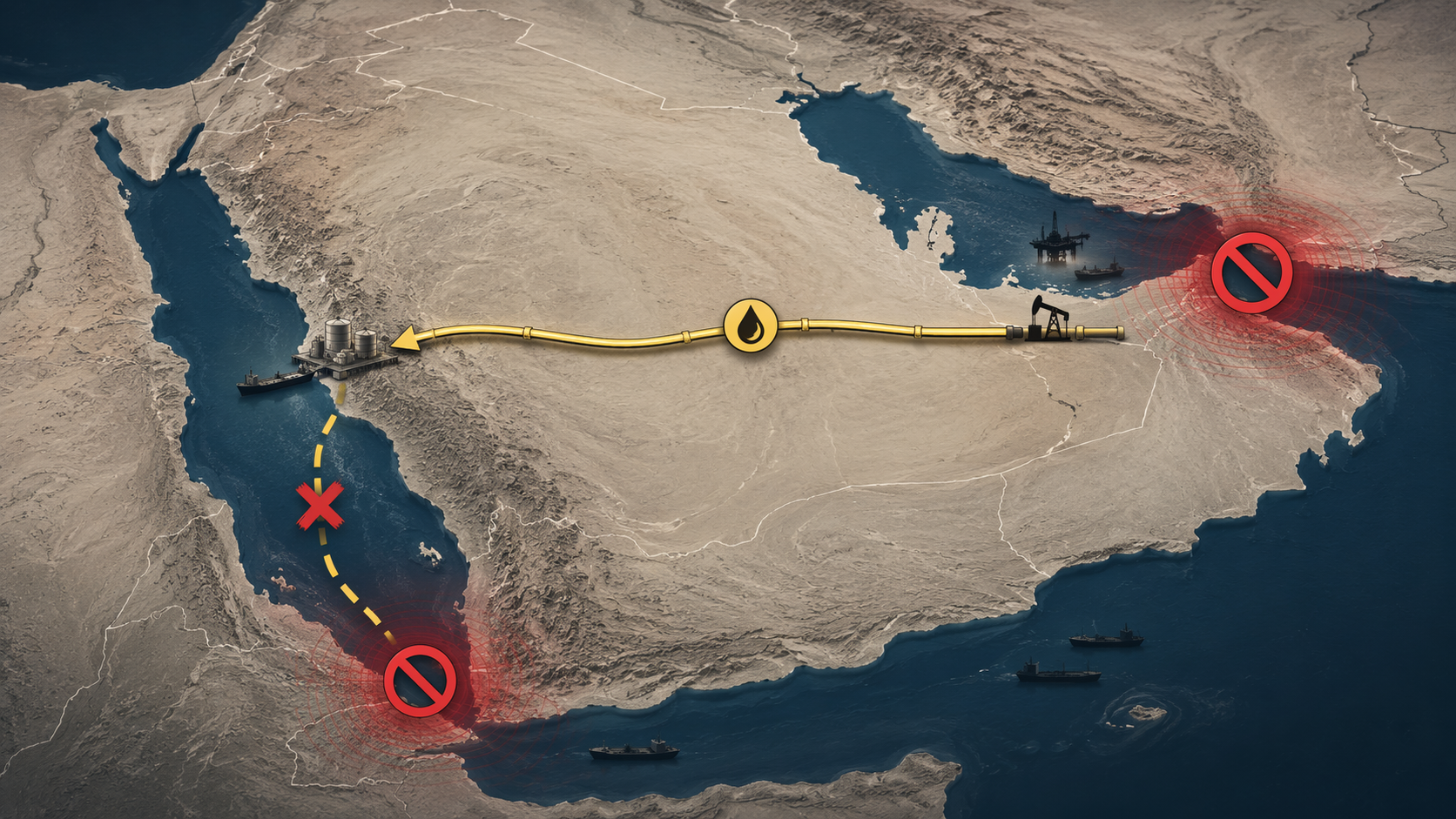
That is the operational core of the AI shipping disruption around the Bab al-Mandab Strait. A single chokepoint disruption still leaves planners with ugly choices: divert around the Cape of Good Hope, absorb longer transit, pay for buffers, resequence orders, and explain the cost. A dual-chokepoint disruption changes the calculation because the escape route from one closure runs into the risk zone of the other.
The Network Is Not Delayed; It Is Losing Handoffs
The first evidence is not a headline. It is the queue. Windward reported roughly 280 bulk carriers stranded or effectively trapped inside the Gulf in March 2026, with the disruption halting about 18% of global iron ore pellet exports and about 10% of primary aluminum exports.[1] Those are not containerized consumer goods that can simply be parceled around the problem. They are industrial inputs tied to plants, contracts, draft restrictions, discharge ports, and production calendars.
The port-level signals point in the same direction. In a single week from March 8 to March 12, Salalah recorded 126 transshipment delay cases and Jebel Ali recorded 52, according to Windward.[1] Those numbers matter because port delay is where the map becomes an exception queue. A cargo plan that still looks intact at lane level can fail when the feeder misses the mother vessel, when a transshipment box waits for the next rotation, or when the receiving distribution center keeps labor scheduled for inventory that is still at sea.
The maritime data also shows why ordinary tracking is insufficient. Windward identified more than 1,650 GPS-disrupted vessels and dark vessel clusters around Hormuz during the March crisis period.[1] Some of that is a security problem. For a shipper, it is also a planning problem: an estimated arrival date built on corrupted location signals can push the wrong purchase order into priority, release scarce safety stock to the wrong market, or leave a plant waiting for material that was never going to clear in time.
The energy exposure gives the disruption a wider blast radius. Al Jazeera, citing energy trade data, reported that simultaneous disruption of Hormuz and Bab al-Mandab would threaten 25% of global oil and gas supply.[2] That figure should be treated as a worst-case framing, not proof that a full combined closure has already occurred. But worst-case exposure changes behavior before the worst case is confirmed. Carriers, insurers, refiners, manufacturers, and retailers start acting on risk thresholds, not on perfect closure statistics.
Red Sea Diversions Were Already Consuming the Buffer
The current Bab al-Mandab declaration is new, so measured vessel-by-vessel impact from this July 2026 event is still emerging. The useful calibration comes from the 2024-2025 Red Sea disruption cycle, when the industry had already tested the Cape diversion playbook at scale. Project44 reported that transit times from Southeast Asia to the U.S. East Coast increased 47%, while transit times to Europe increased 33%, as vessels moved around the Cape of Good Hope.[4] Siemens and Portcast described the Red Sea crisis alone as disrupting $6 billion in weekly trade flows.[5]
Those figures do not automatically transfer one-for-one into July 2026. They do show how little slack was left in the standard answer. If a Red Sea-only crisis lengthened voyages and consumed weekly trade capacity at that scale, a Gulf-plus-Red-Sea crisis is not just “more delay.” It is a different network state, because the plan that protected Gulf flows by sending barrels west now depends on a western exit that is itself contested.
Reuters reported that shipping companies diverted vessels around the Cape of Good Hope after strikes on Iran, confirming that carriers were already treating rerouting as an active operating response, not a theoretical contingency.[6] But Cape routing solves only part of the problem. It can move some container flows away from risk. It does not make stranded Gulf bulk carriers available, does not create immediate tanker capacity in the right basin, and does not tell a manufacturer which customer order should consume the last reliable inbound allocation.
What the Control Tower Has to Recompute
A control tower becomes primary in this scenario only if it does more than display vessels on a map. Visibility by itself is a cleaner way to watch commitments fail. The useful control tower recomputes three things continuously: the expected arrival and risk status of supply, the inventory allocation that follows from that new risk, and the demand signal that determines whether the protected inventory is still protecting the right business.

The maritime layer starts with vessel tracking, AIS behavior, port congestion, and route intent. Windward’s March analysis, for example, tracked a specific VLCC fleet of 27 vessels heading to Yanbu, while also detecting GPS disruption and dark vessel clusters around Hormuz.[1] That kind of intelligence changes the planning object. The planner is no longer asking whether a shipment is “in transit.” The question becomes whether the vessel’s route, signal quality, port path, and security exposure still support the arrival assumption inside the supply plan.
Once that arrival assumption changes, inventory optimization has to move immediately. A Gulf-origin input that was safe to promise yesterday may need to be rationed by plant criticality today. Safety stock held in one region may be less useful than the same units positioned elsewhere. A substitute material may be tolerable for one product family and unacceptable for another. Platforms such as Blue Yonder and o9 sit in this planning layer as examples of the systems companies use to model allocation, safety stock, supply substitution, and service trade-offs; the available evidence does not show a single documented Windward-Blue Yonder-o9 deployment running this exact July 2026 crisis.
Demand sensing is the third leg because scarce inventory should not be protected for stale demand. In a weekly S&OP cadence, a sales forecast can remain politically alive long after the market has moved. During a dual-chokepoint event, that lag becomes material. If a retailer’s demand has softened in one region while a replacement market is still moving, or if a manufacturer’s customer has already reduced production because another input is missing, the control tower has to expose that change before the allocation engine locks inventory into yesterday’s priority.
| Control tower layer | Operational signal | Decision it changes |
|---|---|---|
| Maritime intelligence | Vessel position, AIS anomalies, GPS disruption, dark clusters, port delay | ETA confidence, route risk, carrier escalation, shipment priority |
| Inventory optimization | Available stock, in-transit stock, allocation rules, substitute feasibility | Which plants, customers, and regions receive constrained supply first |
| Demand sensing | Recent orders, consumption changes, market signals, forecast drift | Whether protected inventory still matches current demand |
The sequencing matters. Maritime intelligence does not “solve” the disruption; it invalidates or confirms the assumptions feeding the plan. Inventory optimization does not create supply; it decides where the remaining supply does the least damage. Demand sensing does not make customers patient; it prevents the organization from defending demand that has already moved.
The Exception Queue Becomes the Operating System
In calmer disruptions, exception management can sit beside the planning process. A delayed container, a missed sailing, a closed port, a late supplier confirmation: each can be escalated, patched, and absorbed. In a Hormuz-Bab al-Mandab disruption, exceptions stop being exceptions. They become the operating system.
That changes executive work. The hard question is not whether the company has visibility. It is whether the company can make allocation decisions at the same speed as the maritime picture deteriorates. A supply continuity lead needs to know whether to protect a high-margin customer, a regulated product, a plant with no substitute bill of material, or a region where stockout recovery would take longest. A logistics planner needs to know whether an apparent delay is tolerable or whether the vessel has entered a risk pattern that requires a different commitment. A commercial team needs to stop promising against inventory that the network has already lost in practical terms.
This is where the term “AI control tower” earns or loses its value. If the system only aggregates dashboards, it adds latency under a nicer interface. If it links maritime anomaly detection to inventory policies and live demand signals, it can shorten the handoff between detection and decision. The company still has to choose who is protected first. The control tower makes the consequences visible early enough that the choice is not made accidentally by the first market to place an order.
For readers building the capability rather than buying a label, the useful distinction is functional. A modern control tower needs the ability to sense disruption, interpret business exposure, recommend or trigger planning actions, and track execution. ChainSignal’s guide to AI features in a modern supply chain control tower is a good companion to that architecture discussion, especially where visibility has to connect to planning rather than stop at monitoring.
What AI Cannot Absorb
There are boundaries worth keeping sharp. AI does not reopen Hormuz. It does not make Bab al-Mandab safe. It does not conjure bulk carriers out of the Gulf or make a Cape diversion shorter. It cannot turn a Houthi declaration into a clean probability curve by itself, and it should not be treated as if industry publications and maritime intelligence briefs equal a peer-reviewed evidence base for this exact 2026 dual-chokepoint scenario.
Windward’s maritime intelligence is a strong operational input, especially where AIS behavior, port delays, and vessel clustering are involved. It is also vendor-framed evidence. The same caution applies to AI supply chain claims more broadly: adoption, capability, and return on investment are not the same as proven effectiveness in this specific Bab al-Mandab-Hormuz event. The current article can support a narrower conclusion: under these conditions, a control tower is the most plausible operating mechanism for reconciling the variables fast enough, not proof that any one platform can neutralize the crisis.
The practical test is whether the system changes commitments before the network forces the change. When a vessel’s signal quality degrades, the arrival date should stop feeding the plan as if nothing happened. When Gulf supply becomes trapped, inventory allocation should be recalculated before regional teams consume the same buffer twice. When demand shifts, scarce stock should follow current need rather than the last approved forecast. That is not autonomy in the cinematic sense. It is disciplined replanning under pressure.
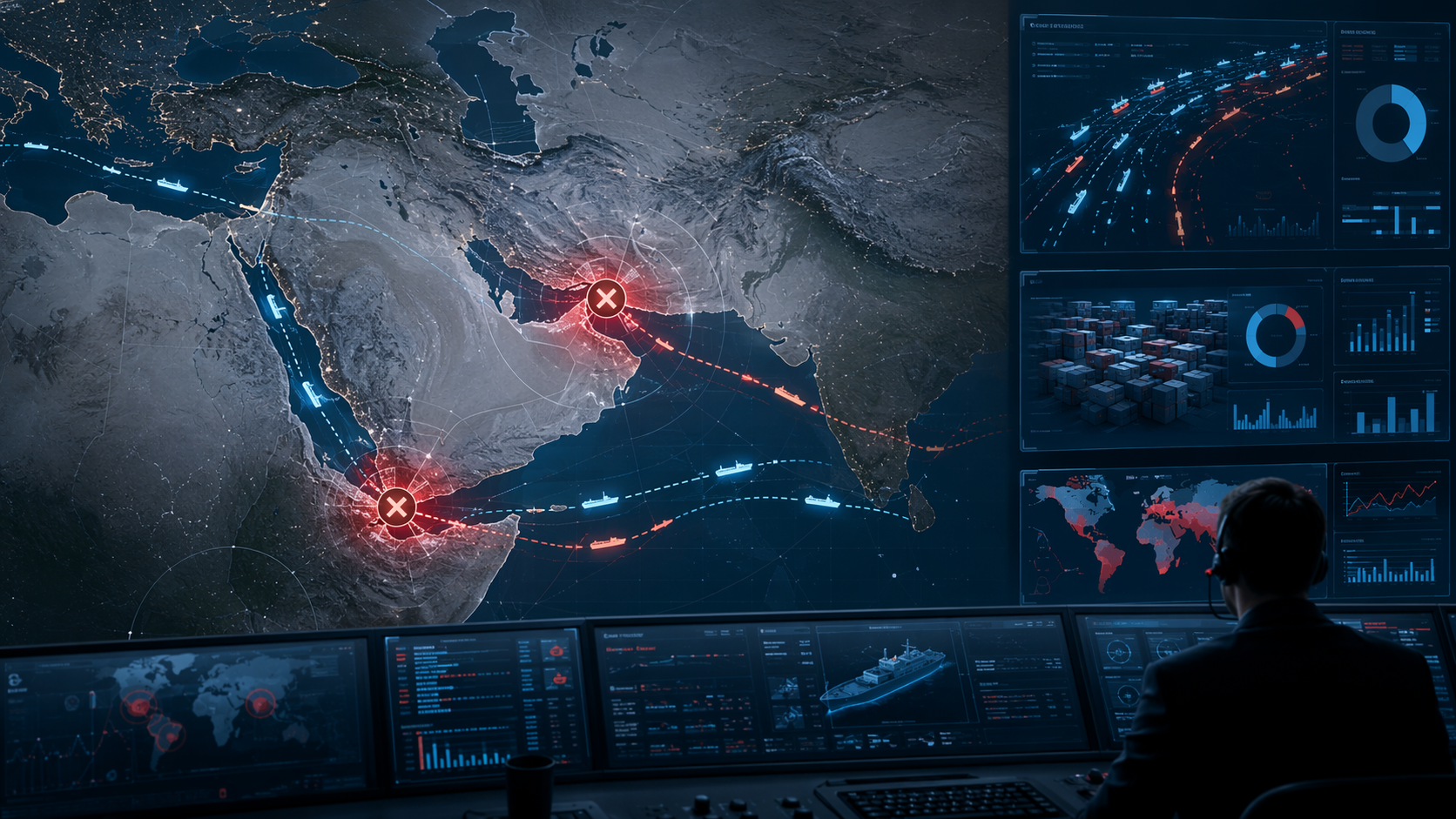
The reason AI control towers have moved to the center of this disruption is not that they are futuristic. It is that the older geometry has run out. When the eastern exit is effectively closed, the western fallback is threatened, and the Cape absorbs only part of the flow, supply continuity becomes a continuous reconciliation problem: maritime uncertainty against inventory scarcity against demand volatility. Spreadsheets and weekly planning cycles were not built for that tempo.
References
- Two Weeks Into the Iran War: A Maritime Intelligence Breakdown — Windward
- Iran threatens Bab al-Mandeb closure: How would that affect world trade? — Al Jazeera
- Amid U.S.-Iran war, Houthis declare blockade of Bab el-Mandeb — NPR
- The Red Sea crisis: Renewed attacks keep shipping at risk — project44
- When sea freight gets smarter: How AI is turning supply chain chaos into competitive advantage — Siemens/Portcast
- Shipping companies divert vessels around Cape of Good Hope after strikes on Iran — Reuters
Comments
Join the discussion with an anonymous comment.