
A conventional supplier-risk dashboard can tell you who sold you a part. It usually cannot tell you whether that part depends on gallium or germanium several tiers upstream, or which contract renewal would turn a hidden material constraint into a sourcing problem. That gap matters because China controls 98% of primary gallium production and 60% of germanium refining, and FP Analytics cites USGS-based estimates that a 30% gallium disruption could reduce US economic output by $600 billion.[1]

Upstream visibility
The first useful layer is not discovery, but mapping. AI can fuse transaction records, supplier hierarchies, material declarations, product attributes, and reporting templates to infer where critical minerals sit inside a finished item. Exiger says its 1Exiger platform uses 10 billion transaction records to connect material composition across supplier tiers,[2] while Z2Data says it ingests CMRT and EMRT submissions from thousands of suppliers to surface hidden dependencies that conventional surveys miss.[3] The point is not that the model sees a mine; it is that it can reconstruct likely mineral exposure from the paperwork and purchase data a procurement team already has, but never joins in one place.
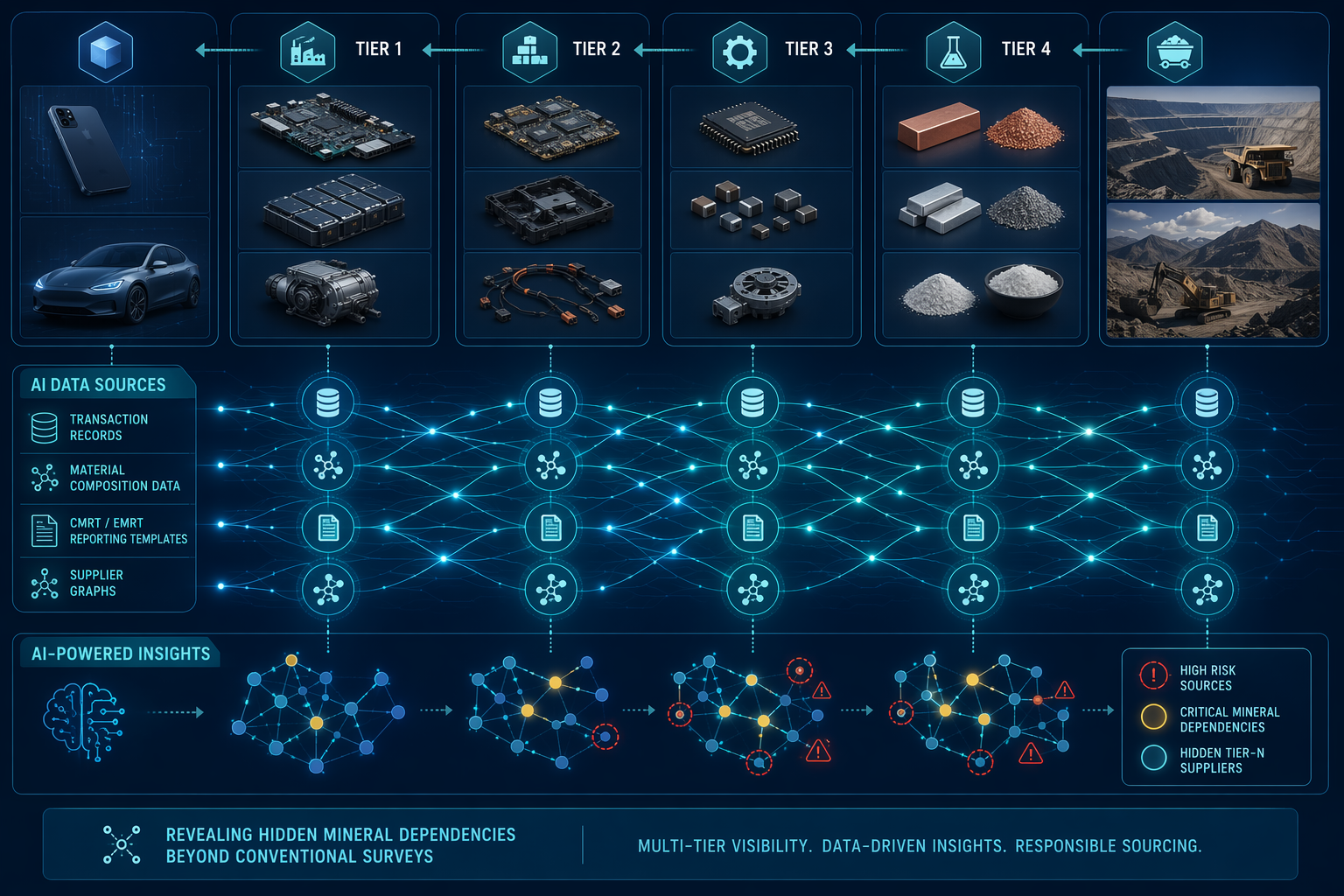
That changes the workflow before a renewal or sourcing review. Instead of asking only whether a supplier is compliant, risk teams can ask which products, plants, and BOM lines appear to depend on the same mineral bottleneck, where alternate sources exist, and which suppliers need follow-up questionnaires or contractual language. In practice, the value is in turning a vague concern about critical minerals into a specific exposure list tied to accounts, SKUs, and tier-two and tier-three relationships.
Midstream monitoring
Visibility still goes stale. Export controls move, sanctions lists expand, ports back up, smelters go offline, and logistics routes get repriced. The midstream layer uses event feeds and policy signals to keep those changes attached to the products and suppliers already mapped. The Atlantic Council's risk framework is useful here because it treats concentration, processing bottlenecks, chokepoints, and policy exposure as separate but connected risk categories rather than one generic critical minerals bucket.[4]
This is the layer where AI looks less dramatic and more operational. The machine does not need to predict the next embargo to be useful. It needs to classify the incoming signal, match it to affected materials or routes, and push an alert before the next planning cadence. That is the difference between a dashboard that describes risk and one that actually changes who gets called, what gets reordered, and which supplier review gets moved up.
Predictive analytics
The third layer is predictive analytics: price volatility, supply availability, and scenario planning. DARPA's CriticalMAAS program and a Charles River Analytics award announcement point to models that combine 70-plus datasets to improve mineral assessments and forecast price or supply behavior.[5][6] That is a meaningful step beyond monitoring, because it can help teams compare a long-term agreement against multiple disruption paths instead of extrapolating from last quarter's spot price. It is also the layer most likely to be oversold. A forecast that is not tied to a buying decision, a contract term, or a substitution threshold is just another chart.
Used well, prediction sharpens procurement timing. It can support when to lock in volume, where to negotiate flex clauses, and which suppliers deserve a second look before a design freeze. Used badly, it becomes a glossy probability score with no owner and no consequence.
Data and cycle constraints
The hard part is not generating a score. It is getting enough multi-tier data for the score to mean anything, and then getting buyers to trust it. Critical mineral exposure sits inside fragmented supplier records, inconsistent declarations, and commercial relationships that were never designed for end-to-end transparency.
The limits are close to the issues discussed in The Limits of AI for Geopolitical Supply Chain Risk: if the workflow cannot show a sourcing manager which supplier, product, or renewal is affected, the model does not matter. Long capital cycles, shared-data gaps, and buyer skepticism all slow the conversion from prediction to action.
For Q3 2026, the investment order is straightforward. Prioritize sub-tier mineral exposure mapping, supplier-risk enrichment, and scenario-ready procurement intelligence first. Treat upstream discovery and fully automated prediction as adjacent bets with longer horizons.
References
- Artificial Intelligence and the Critical Minerals Crunch — FP Analytics — Oct. 2025
- Critical Minerals Supply Chain Intelligence Hub — Exiger
- Three Essential Steps to Building a Critical Minerals SCRM Program — Z2Data
- A US Framework for Assessing Risk in Critical Mineral Supply Chains — Atlantic Council
- Critical Mineral Assessments with AI Support — DARPA
- DARPA Awards $4.5M to Charles River Analytics to Develop AI-Powered Prediction Technology for Critical Minerals Supply Chain — Charles River Analytics
Comments
Join the discussion with an anonymous comment.