
The useful way to read the aviation supply chain crisis is not as one large number, but as a stack of avoidable pressure points. IATA and Oliver Wyman put the 2025 cost impact at approximately $11 billion: about $4.2 billion in delayed fuel savings, $3.1 billion in higher maintenance costs, $2.6 billion in excess engine leasing, and $1.4 billion in extra spares inventory, with rounding and overlap caveats in the underlying estimates.[1][2] That breakdown matters because AI-driven aviation supply chain reforms only deserve funding when they can be tied to one of those buckets.
A delayed aircraft delivery is not just a planning nuisance. It keeps older tails in the schedule, pushes out fuel-efficiency gains, extends maintenance exposure, and forces airlines to lease engines or carry more material than a clean fleet plan would require. The backlog context is just as important: Oliver Wyman and IATA cite a backlog of roughly 17,000 aircraft, equal to about 14 years at current production rates.[1] That is too large to treat as a short procurement cycle that will clear itself.
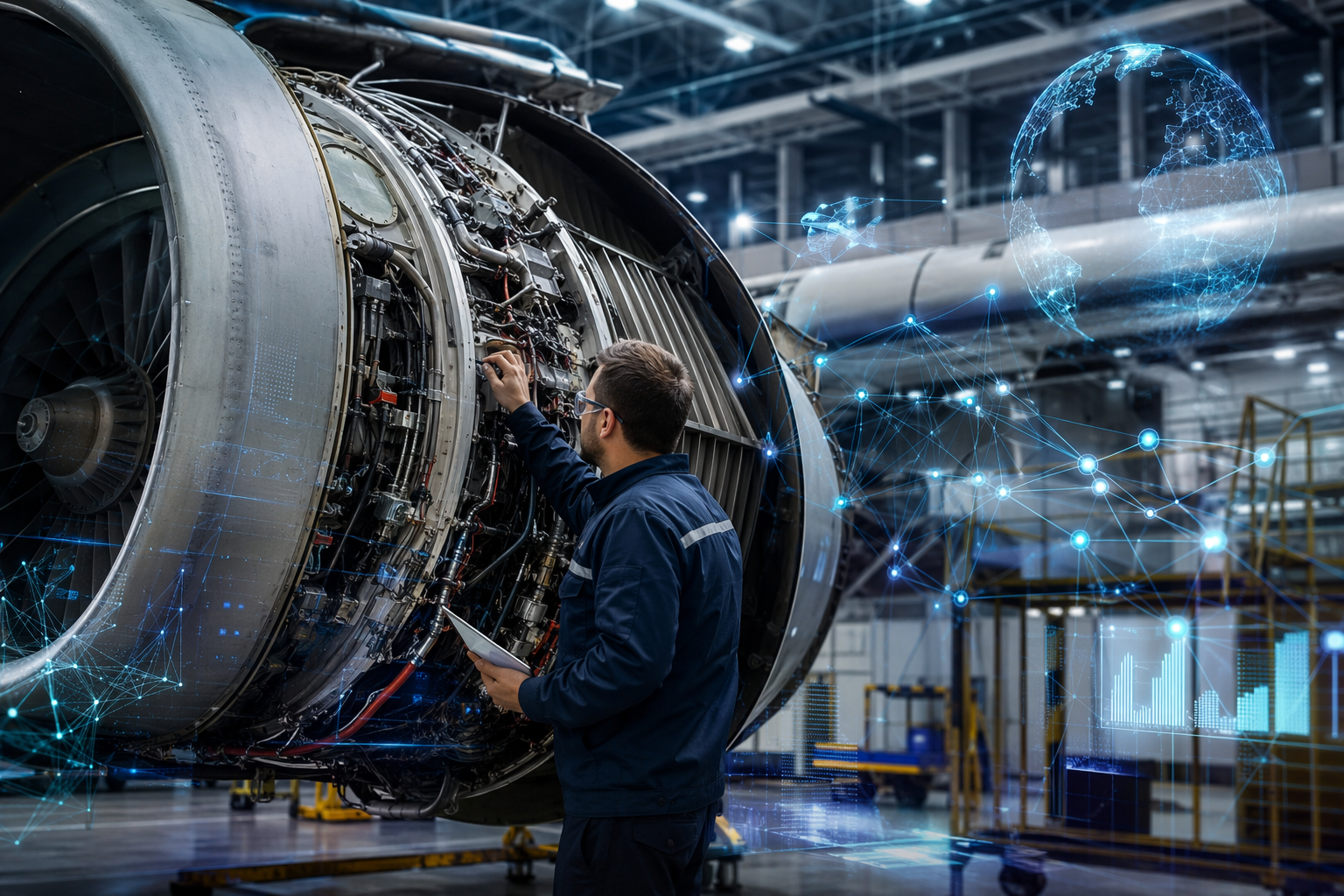
The strongest AI cases in this environment are not generic productivity tools. They are interventions aimed at specific constraints: too much dependence on OEM aftermarket channels, too little visibility into multi-tier suppliers, and too few skilled maintenance hours to absorb all the downstream disruption. Each one reaches a different line of the cost stack.
Start With the Cost Bucket, Not the Model
A forecasting model that improves a dashboard but leaves AOG exposure unchanged is a weak business case. A supplier-risk tool that flags instability too late to qualify an alternate source is also weak. In aviation, the test is operational: did the reform lower spares exposure, shorten maintenance delay, reduce lease dependency, protect technician time, or surface a supplier constraint early enough for someone to act?
| Cost pressure | Likely root cause | AI reform that can plausibly address it |
|---|---|---|
| Delayed fuel savings | Aircraft delivery backlog and older aircraft staying in service | Fleet, maintenance, and material planning models that expose knock-on constraints earlier |
| Higher maintenance costs | Aging assets, parts scarcity, manual troubleshooting, and poor record access | Predictive maintenance, maintenance copilots, records search, and parts-positioning analytics |
| Excess engine leasing | Delivery delays, shop visit uncertainty, and constrained spare engine availability | Engine removal forecasting, lease scenario modeling, and repair-turnaround risk signals |
| Extra spares inventory | OEM dependency, long lead times, and poor demand signals | Demand forecasting, PMA/USM optimization, and inventory risk segmentation |
This is where many aviation AI proposals become too broad. The industry does not need another promise that algorithms will make supply chains smarter. It needs evidence that a deployment can move a cost pool large enough to defend the implementation effort.
OEM Dependency Is the First Constraint to Attack
OEM aftermarket dependency shows up quietly at first: a quoted lead time that does not match the next check package, a repairable that misses its planned return, a rotable pool that looks adequate until one more aircraft is held in service. By the time the issue is visible in the morning call, the options are usually expensive: expedite, lease, borrow, cannibalize, or defer work if the maintenance program allows it.
AI demand forecasting is useful here only when it works below the category level. A fleet-level forecast for “engine material” is not enough. The model has to learn from removals, deferred defects, shop findings, minimum equipment list patterns, utilization changes, tail assignment, vendor turn times, and lead-time drift. The better output is not a prettier forecast; it is an earlier decision on which parts need forward positioning, which repairables need escalation, and which sole-source exposures need an approved alternative before the aircraft is waiting.
A research synthesis reports a 40% improvement in AI demand forecasting accuracy, but that should be treated as a research finding rather than a settled aviation benchmark.[3] Forecast accuracy does not automatically become lower inventory. In an airline materials office, the gain only counts if it changes order timing, repair priority, pooling strategy, or substitution planning.
PMA and USM optimization belong in the same discussion because they are practical pressure valves against OEM pricing and lead-time exposure. IATA reports that 74% of airlines in a member survey use PMA parts to mitigate supply chain challenges, though that figure should not be stretched into a statistically representative adoption rate for all carriers globally.[2] The point is narrower and still important: a large share of responding airlines is already looking beyond OEM-only channels when the approved technical and commercial case supports it.
AI can improve that decision by matching part criticality, eligibility, historical reliability, certification constraints, supplier performance, and total cost. A procurement lead should be able to see where a PMA option is technically usable but commercially marginal, where USM availability changes the reorder point, and where an apparent substitute creates documentation or configuration-control work that wipes out the savings.
The STS Aviation Group example is a useful operating signal. STS describes using AI-driven predictive analytics for MRO inventory and reports a 20% reduction in stock-related costs.[4] That does not prove every MRO or airline will get the same result. It does show the right shape of value: fewer dollars tied up in the wrong stock while service levels remain tied to actual maintenance demand.
An academic review reports predictive-maintenance savings of 12% to 18% in maintenance costs and a 15% to 20% decrease in unplanned downtime.[5] Those ranges should be read as directional evidence, not a promise that an airline can copy and paste the result. Aircraft type, data quality, sensor coverage, maintenance program maturity, and repair-network capacity will decide whether a predicted failure becomes a cheaper planned event or simply a better-documented shortage.
Supplier Fragility Needs More Than a Tier-One Dashboard
The fragile part of the aerospace supply base is often not the supplier on the purchase order. It is a special process shop, a casting source, a raw-material dependency, a tooling bottleneck, or a sub-tier vendor whose capacity has already been sold three times over. Tier-one scorecards miss too much of that.
This is the structural case for AI supplier-risk scoring. The useful systems combine internal performance data with external signals: delivery slippage, financial stress, quality escapes, sanctions exposure, geopolitical disruption, capacity announcements, certification status, and dependency concentration. The output should not be a generic risk color. It should tell procurement which supplier needs a recovery plan, which part family needs a second source, and which contract needs different inventory or allocation terms.
The research synthesis cited in the brief reports supplier default prediction with 89% precision.[3] That is encouraging, but precision is not the same as operational coverage. A model can be precise on suppliers it can see and still miss the sub-tier shop that actually stops the line. For aviation, the hard part is not only scoring risk; it is mapping enough of the network for the score to matter.
EY’s aerospace and defense example gives the scale of the visibility problem. One defense contractor used AI to expand supplier mapping from 15,000 suppliers to 500,000 suppliers.[6] That is not an airline case, and defense supply chains are not identical to commercial aviation. Still, the example is relevant because the dependency pattern is familiar: certified parts, long qualification paths, specialized suppliers, and risk buried below the first contracting layer.
For an airline or OEM, multi-tier mapping changes the conversation. Instead of asking whether a named supplier has shipped late, the team can ask which aircraft programs share the same constrained sub-tier source, which alternate suppliers are already qualified, which ones need engineering approval, and which material buys should be protected before a public disruption becomes a queue. That is structural visibility, not another expediting report.
This is also where internal procurement tools can borrow from adjacent aerospace and defense practice. Supplier-risk methods used for defense contractors are not automatically transferable to airlines, but the scoring logic is useful when the supplier base is specialized, regulated, and hard to replace. The closer the AI model gets to part-number, process, and approval-status reality, the more likely it is to support an actual sourcing decision rather than a quarterly risk review.
The weak version of this reform stops at alerting. The stronger version connects risk to action: approved alternates, qualification lead time, engineering disposition, minimum buy quantities, shelf-life exposure, pooling options, and customer impact. If the buyer cannot do anything before the constraint reaches maintenance control, the alert arrived too late.
Technician Time Has Become a Supply Chain Constraint
Labor shortages are often described separately from supply chain failures, but line maintenance and materials planning know better. A part that arrives late can waste a technician’s shift. A troubleshooting path that takes too long can hold a part request open. A missing record can turn available material into unusable material. Capacity is not only parts on shelves; it is also the licensed time needed to diagnose, document, install, inspect, and release.
McKinsey projects that one-fifth of aviation maintenance technician jobs could be unfilled by 2033.[7] That moves gen AI maintenance support out of the “nice productivity idea” category. If fewer qualified people are available, the industry has to protect expert time from low-value searching, repetitive documentation, and avoidable troubleshooting loops.
The estimates are promising, but the caveat matters. McKinsey says gen AI copilots could reduce technician troubleshooting time by about 35% and unplanned repair time by about 25%, but those projections are inferred from a mining industry case rather than proven aviation deployment results.[7] Aircraft maintenance has certification, safety, records, and human-factors requirements that mining equipment does not mirror.
The mechanism, however, is credible. A maintenance copilot can search aircraft maintenance manuals, fault isolation manuals, service bulletins, engineering orders, prior defects, and maintenance history faster than a technician moving across disconnected systems. It can summarize likely troubleshooting paths, surface required inspections, identify documentation dependencies, and point to similar historical removals. The licensed technician still decides; the tool reduces the time spent finding the evidence.
- Troubleshooting support is valuable when it shortens the path from fault report to probable cause without bypassing approved manuals.
- Records automation is valuable when it reduces time spent reconciling logbooks, work cards, part trace, and compliance evidence.
- Expert capture is valuable when it makes senior technician judgment searchable for recurring faults without pretending the model is the certifying authority.
- Parts integration is valuable when the troubleshooting path connects to availability, interchangeability, and repairable status before a request is released.
This is where aviation-specific proof still has to catch up with the pitch. A gen AI tool that drafts a summary is not the same as one that reduces elapsed maintenance delay. The better pilots will measure time to isolate fault, repeat defects, documentation rework, part-request accuracy, and technician acceptance by shift and station. If those measures do not move, the model is not protecting capacity.
Safety Assurance Has to Be Designed In
AI in aviation supply chains does not escape aviation’s safety culture just because it sits in planning, procurement, or maintenance support. EASA’s first regulatory proposal for artificial intelligence in aviation focuses on trustworthiness and the conditions under which AI can be introduced into aviation systems.[8] FAA roadmap coverage similarly emphasizes guiding principles for AI safety assurance rather than treating AI as ordinary enterprise software.[9]
The practical implication is straightforward. Forecasting and procurement tools still need data lineage, access controls, exception handling, and human accountability. Maintenance copilots need stronger guardrails: approved-source retrieval, version control, explainable references, audit trails, and clear limits on what the tool can recommend. FAA and EASA digitalization discussions in 2026 have kept AI and records modernization close together, which is exactly where maintenance organizations will feel the implementation burden.[10]
None of that makes AI unusable. It does mean aviation leaders should stop evaluating pilots as if the only question is model performance. The implementation case has to include certification impact, records governance, cybersecurity, vendor access, data retention, and the workflow point where a human reviews or rejects the output.
What a Defensible Investment Case Looks Like
The first deployment should not be chosen because it is fashionable or easy to demo. It should be chosen because the cost bucket is large, the operational owner can act on the output, and the data is good enough to support a measurable decision. A narrow inventory optimization pilot on high-value repairables may produce a clearer payback path than a broad “AI control tower” that sees many problems but changes no release decisions.
Forecasting and inventory optimization are closest to measurable cost reduction because they can be tied to stock levels, service levels, expedite spend, repair turnaround, and AOG avoidance. Supplier-risk visibility is strategically important, but it depends on how much multi-tier data the organization can access and whether engineering, quality, and procurement can qualify alternatives in time. Gen AI maintenance support is promising, especially under technician shortage pressure, but the strongest numbers still need aviation-specific operating proof.
That sequencing also helps with ROI discipline. ChainSignal’s analysis of the real timeline for AI supply chain ROI frames payback in a two-to-four-year window, which is a more credible planning horizon than expecting a maintenance or supplier-network transformation to clear in one budget cycle. For procurement-specific business cases, the same discipline applies: measure whether the tool changes sourcing outcomes, working capital, or disruption cost, not whether users opened another dashboard.
A capital-intensive industry can justify AI when it ties the model to a physical constraint. That is the lesson to take from adjacent supply chain cases, whether the comparison is aerospace supplier risk or broader AI procurement ROI. Aviation does not need to borrow another industry’s headline number. It needs to borrow the measurement habit: define the constraint, identify the economic owner, prove the intervention changes a decision, and keep the benefit attached to the P&L line that funded the work.
The right question is no longer whether AI belongs in aviation supply chains. It is which root-cause cost pool the first deployment is disciplined enough to attack: spares inventory, engine leasing, maintenance delay, supplier exposure, or technician time. If the answer is not specific, the business case is not ready.
References
- How to revive aircraft supply chains to accelerate delivery, Oliver Wyman, October 2025.
- Aviation Supply Chain, IATA.
- AI demand forecasting and supplier default prediction research synthesis, LinkedIn.
- AI’s Role in Resolving Aircraft MRO Supply Chain Challenges, STS Aviation Group.
- Predictive maintenance academic review, SSRN.
- How can digital supply chains help manage aerospace risk?, EY.
- The generative AI opportunity in airline maintenance, McKinsey, January 2026.
- EASA’s first regulatory proposal for artificial intelligence in aviation, EASA.
- FAA issues first artificial intelligence roadmap, AIN Online.
- FAA/EASA Conference, ARSA, June 2026.
Comments
Join the discussion with an anonymous comment.