
New York’s AI data center moratorium freezes an estimated 12 GW of interconnection-load requests, with more than 8 GW having entered the queue in 2025 alone, under an executive order signed on July 14, 2026.[1] That is the starting point for understanding the supply chain impact: not a clean subtraction from one state’s development pipeline, but a sudden hold placed on demand that had already been shopping for transformers, switchgear, copper, GPUs, construction crews, utility engineering time, and substation slots.
The 12 GW number needs careful handling. It is interconnection-request volume, not commissioned capacity, and not every queued megawatt would have survived permitting, financing, utility study, equipment procurement, and construction. Still, interconnection requests are not paperwork in isolation. Developers use them to justify early vendor conversations, reserve long-lead equipment where they can, negotiate power positions, and keep construction schedules warm. A freeze does not make that activity vanish. It pushes teams to re-rank sites, redirect capital, and compete harder in markets that already had thin buffers.
The Freeze Lands On Markets That Were Already Rationing Capacity
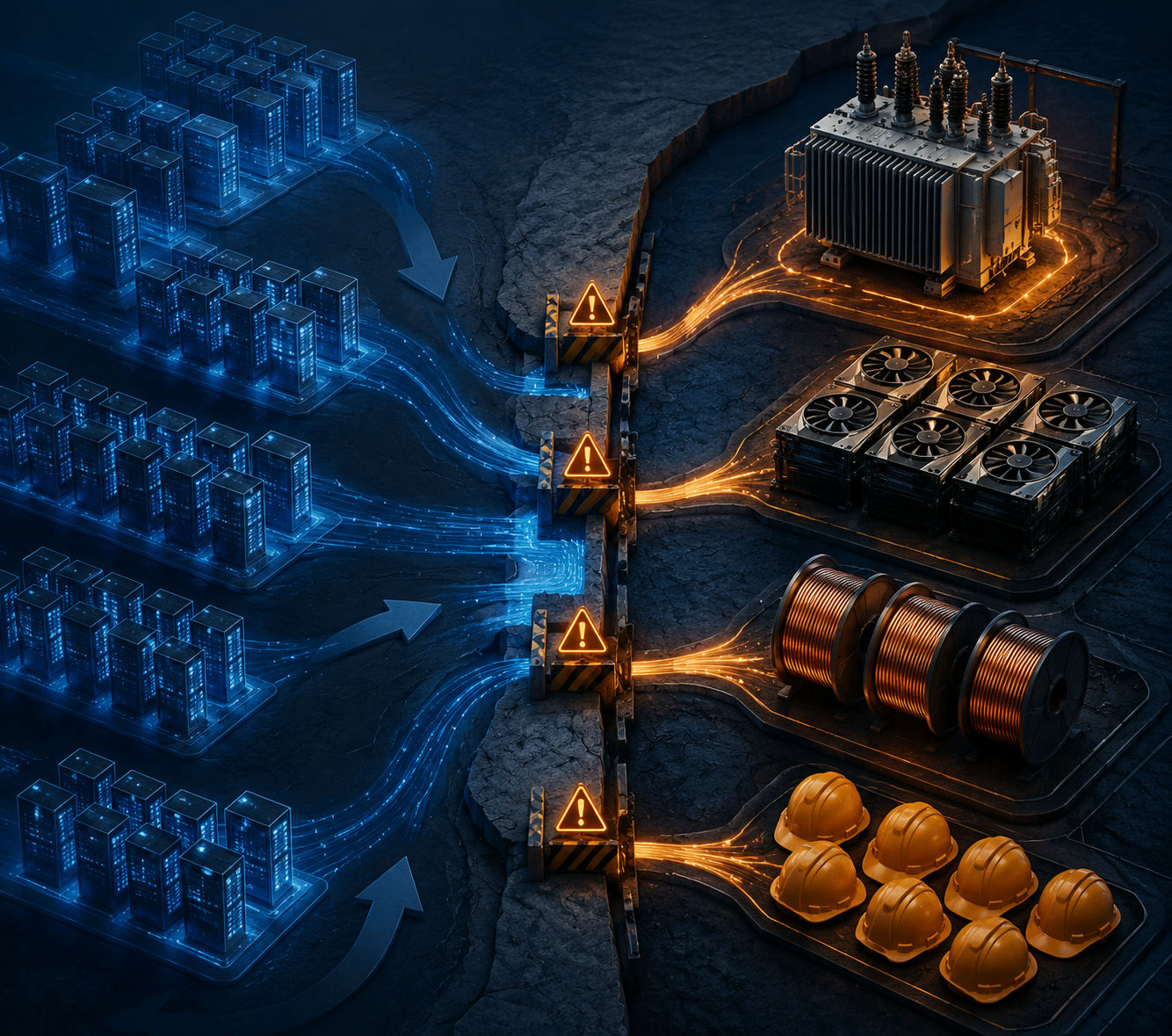
The moratorium matters because the national buildout is already constrained by physical inputs. Copper is expensive and structurally tight. Utility-grade transformers are on 18- to 36-month lead times. GPU availability is limited by semiconductor and high-bandwidth memory allocation. Skilled data center construction labor is being pulled across hyperscale, utility, industrial, and grid projects at once.[2][3]
| Constraint | What The Available Evidence Says | Why It Matters After The Moratorium |
|---|---|---|
| Copper | Copper reached a record $6/lb in January 2026, and BNEF forecasts a 6 million metric ton supply gap by 2035.[2] | Redirected projects still need cabling, busbar, grounding, switchgear content, substations, and grid upgrades. |
| Transformers | Utility-grade transformer lead times are estimated at 18–36 months.[2] | A project that finds land and permits elsewhere can still wait years for substation energization. |
| GPUs | GPU lead times are estimated at 36–52 weeks, with HBM memory already pre-allocated through 2026.[3] | Compute deployment cannot simply move faster because a different state approves the building. |
| Labor | Industry estimates cite a 5-to-1 retiree-to-new-entrant imbalance and data center trade wages 25–30% above norms.[2] | Crews are not sitting idle waiting for New York demand to relocate. |
Those are different bottlenecks, but they share one practical feature: they are schedule setters. A procurement director can sometimes pay a premium for air freight, alternate suppliers, or expediting. That logic works poorly when the constraint is a transformer factory slot, a memory allocation that was already committed, a utility engineering study queue, or a crew base aging out faster than apprentices enter.
Transformers Decide Whether A Permitted Site Can Actually Energize
The transformer shortage is the least forgiving part of the displacement story. A data center can have land control, financing, a customer, civil permits, and a building shell, but it cannot commission the load without substation equipment and utility coordination. Rabobank-cited industry estimates put utility-grade transformer lead times at 18–36 months, a range long enough to override many optimistic development calendars.[2]
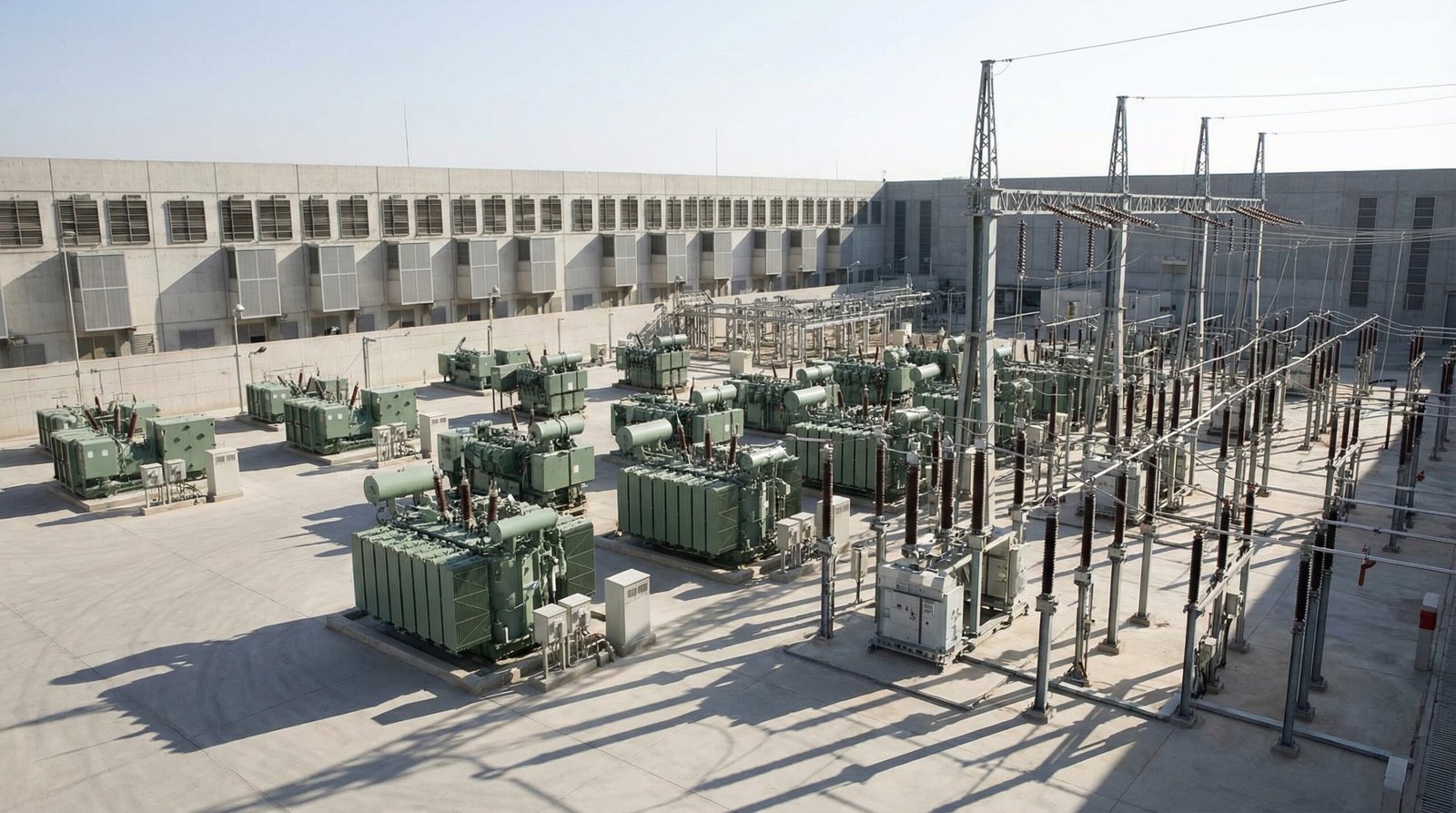
That lead-time window changes the meaning of New York’s frozen queue. If a developer tries to move a project from New York to Pennsylvania, Ohio, Virginia, Texas, or any other active market, the project does not arrive as pure demand for land. It arrives as a claim on the same transformer manufacturers, the same utility procurement teams, and often the same EPC firms already trying to sequence interconnection work for other large loads.
This is why the distinction between interconnection requests and built capacity matters but does not neutralize the impact. Some share of the 12 GW would have dropped out anyway. But even partial displacement can disturb procurement queues when the scarce item has a multi-year lead time. If a developer had been negotiating for a transformer position against a New York site, a pause forces that buyer to decide whether to hold the slot, assign it to another project, resell it, or renegotiate delivery. None of those decisions is free for suppliers or utilities trying to keep factory calendars stable.
The risk is not only that projects start later. It is that the sequence of projects becomes less reliable. Utilities need to know which load will materialize first, manufacturers need firm specifications, and construction teams need energization dates that do not keep sliding. When regulatory uncertainty freezes one large queue, it can make demand signals noisier elsewhere.
GPU Supply Is A Separate Queue, Not A Software Problem
The compute side has its own bottleneck. Omdia estimates cited by Manufacturing Dive put GPU lead times at 36–52 weeks, while high-bandwidth memory was already fully pre-allocated through 2026.[3] That means a developer cannot offset a power-siting delay simply by ordering accelerator hardware later and expecting the market to absorb the change.
For supply chain organizations using AI forecasting, inventory optimization, control towers, warehouse automation, or procurement analytics, this distinction matters. The useful question is not whether the demand for AI is real. It is whether the physical system that turns capital into usable compute has enough slack to handle another scheduling shock. On the evidence available now, the slack is limited on both sides of the building: power infrastructure and compute hardware.
A frozen New York project can create two different behaviors. One buyer may keep GPU allocations attached to a delayed facility, hoping the regulatory path clears before hardware loses economic value. Another may redirect those allocations to a different campus. Either way, the decision affects other customers. If allocations are held, they reduce available near-term supply. If they are redirected, they increase competition in another region’s power and construction market. The moratorium does not have to cancel orders to create planning pressure; it only has to make the original deployment path uncertain.
This is also where data center timing bleeds into AI service pricing. Cloud and AI infrastructure providers price capacity partly around scarcity, utilization, depreciation schedules, and the cost of bringing new clusters online. If more projects miss energization windows while GPU and memory supply remains allocated far in advance, the cost of available compute is less likely to soften quickly. That is a directional supply-chain conclusion, not a precise price forecast.
Copper Is A Pressure Gauge, Not The Whole Story
Copper deserves attention because it appears everywhere in the data center and grid chain: power cables, grounding, busbar, switchgear, transformers, generators, and upstream transmission or distribution upgrades. Rabobank reported copper at a record $6/lb in January 2026, and cited BNEF’s forecast of a 6 million metric ton supply gap by 2035 as data centers, electrification, and renewables compete for the same material.[2]
That does not make the moratorium a copper story by itself. Copper is the pressure gauge. It shows that redirected AI infrastructure demand is entering a market already repricing long-term scarcity. A developer forced to revisit siting assumptions may also be forced to revisit copper-heavy design quantities, utility upgrade contributions, contingency budgets, and escalation clauses. In a looser commodity market, those changes would be inconvenient. In this one, they are harder to absorb quietly.
Copper also links the New York decision to other infrastructure programs. The same metal is needed for renewables, transmission, distribution modernization, industrial electrification, and building electrification. When data center demand moves across state lines, it does not move into an empty procurement lane. It moves into a lane already carrying utility capital plans and energy-transition projects.
Labor Is The Bottleneck That Does Not Fit In A Purchase Order
The labor constraint is easier to undercount because it does not appear as a single line item with a factory delivery date. Industry estimates cited in supply chain analyses point to five workers retiring for every one new entrant, while data center trade wages run 25–30% above broader norms.[2] Premium wages are a useful signal: they show that the sector is already paying to pull electricians, mechanical contractors, commissioning specialists, controls technicians, and project managers into data center work.
A moratorium can change labor demand before a shovel moves. Developers trying to preserve optionality may ask contractors to reprice alternate sites. EPC teams may shift preconstruction staff from New York studies to projects in other states. Utilities may face new interconnection-study pressure where displaced load is refiled. None of that proves every frozen New York project will be rebuilt elsewhere, but it does mean the work of replanning starts immediately.
Labor also compounds equipment delays. A transformer that arrives late can miss its crew window. A crew that moves to another project can leave finished equipment waiting. Commissioning specialists are especially exposed to schedule bunching, because projects often compress delayed work into the same few months once equipment finally appears.
The Regulatory Layer Adds Planning Friction Before It Adds Clarity
New York’s executive order does more than pause projects. It points to a General Environmental Impact Statement process, a Grid Acceleration Fund, a Community Investment Framework, and a push related to sales tax treatment.[1] Foley & Lardner’s legal analysis treats these mechanisms as part of a broader regulatory framework with implications beyond the immediate pause, especially for how developers assess compliance obligations, grid contributions, and project economics.[4]
The community and environmental rationale should not be dismissed as decoration. Large AI data centers can concentrate power demand, water and land-use concerns, noise, backup-generation issues, and local grid impacts in communities that may not receive proportional benefits. A state-level review can be a way to force cumulative-impact analysis rather than letting each project present itself as an isolated load request.
For supply chain planning, however, these mechanisms create new variables before they create certainty. A GEIS process can affect approval timing. A Grid Acceleration Fund can change upfront capital requirements and the sequencing of utility upgrades. A Community Investment Framework can add compliance obligations that must be priced and negotiated. A sales tax repeal, if it advances, could increase equipment procurement costs for developers buying high-value electrical and computing infrastructure.[1][4][5]
Fortune’s reporting on the Grid Acceleration Fund structure highlights the practical issue: if developers must contribute upfront to grid expansion, finance teams need to know how much, when, under what eligibility rules, and whether those payments change the priority or timing of interconnection work.[5] Those details matter for procurement because they determine when a project can responsibly lock equipment, whether purchase orders should be conditional, and how much escalation risk belongs in the budget.
Six days after the order, those answers are not settled. That short window is important. Early reactions can overstate certainty in both directions: developers may imply all 12 GW would have become active capacity, while policy supporters may imply the pause cleanly removes pressure from the grid. The operating reality sits between those claims. The order freezes a large queue and introduces new rules, but the conversion rate from queued load to built capacity remains unknown.
Displaced Demand Does Not Land Evenly
If developers redirect activity, they will not spread it evenly across the country. They will look for power availability, favorable utility tariffs, transmission paths, tax treatment, land, water, fiber, permitting speed, and proximity to existing cloud regions. That sorting process tends to concentrate demand in places already visible to hyperscale buyers. The result can be less a broad national redistribution than a sharper squeeze in a handful of utility territories.
Industry analysts have projected that 30–50% of planned 2026 U.S. data center capacity may slip to 2028, though that remains an estimate rather than confirmed outcome data.[2] The New York moratorium should be read against that backdrop. It is not the original cause of slippage, but it can add another reason for schedules to be revised, particularly where projects were already balancing utility studies, transformer deliveries, and GPU deployment windows.
A redirected project also brings its own uncertainty to the receiving market. Utilities must decide how seriously to treat new interconnection applications if the developer is preserving optionality rather than committing to a site. Suppliers must decide whether a revised purchase order is firm enough to reserve capacity. Contractors must decide whether to hold crews for work that still depends on utility approvals. The receiving market gets demand, but not always clean demand.
What This Means For AI Compute Buyers
For companies buying AI services rather than building data centers, the moratorium is still relevant. Supply chain AI applications depend on available compute somewhere: in a cloud region, a managed AI platform, a private cluster, or a vendor’s infrastructure stack. When power-connected capacity is delayed and GPU supply is pre-allocated, downstream buyers face fewer near-term options and less pricing relief than software procurement teams may expect.
The sensible response is not to assume an immediate compute shortage from this order alone. The better response is to treat AI capacity as an infrastructure dependency with lead times. Procurement teams evaluating AI tools should ask vendors where model training and inference capacity is hosted, whether committed capacity is already secured, what happens if a region is constrained, and whether pricing assumes future capacity additions that could slip.
- Ask whether a vendor’s AI roadmap depends on new data center capacity that is still awaiting energization.
- Separate GPU availability from facility availability; both can delay deployment, and they do not clear on the same calendar.
- Review escalation language in contracts that bundle software, compute, and managed services.
- Treat regional redundancy as a capacity question, not only a resilience or latency question.
- Watch utility-interconnection milestones as closely as product-release announcements.
Those questions are not a substitute for legal or engineering diligence, but they do put the discussion in the right place. AI capacity is no longer only a cloud budget line. It is tied to substation equipment, semiconductor allocation, grid cost-sharing rules, and construction labor markets.
The Caveats Still Matter
The moratorium is significant, but it is still new. It was signed on July 14, 2026, and the framework details around environmental review, grid contributions, community obligations, and tax treatment may change as agencies, developers, utilities, and local stakeholders respond.[1] Supply chain conditions can also shift quickly under tariff volatility and broader geopolitical pressure affecting materials and energy inputs.
The safest conclusion is therefore narrow. New York has frozen a large volume of interconnection demand, not a guaranteed 12 GW of finished data center capacity. But even discounted demand can matter when it is redirected into markets already short of transformers, constrained in GPU and HBM allocation, exposed to copper scarcity, and competing for a limited skilled workforce. The moratorium is less important as an isolated New York development ban than as a demand-displacement shock hitting procurement queues that were already oversubscribed.
References
- Executive Order No. 62, Governor of New York, July 14, 2026, link
- Rabobank supply chain report, Rabobank, link
- Omdia analysis on GPU lead times and semiconductor supply chain constraints, Manufacturing Dive, link
- Legal analysis of New York AI data center regulatory framework, Foley & Lardner, link
- Grid Acceleration Fund reporting, Fortune, link
Comments
Join the discussion with an anonymous comment.