
The wrong way to compare Kinaxis vs o9 vs Blue Yonder AI is to ask which platform has the most advanced roadmap. All three are serious enterprise planning platforms. All three can become expensive, long-cycle transformation programs. And all three can disappoint if the buying team treats vendor capability as a substitute for industry fit, ERP reality, and data readiness.
A better shortlist starts with three filters: what industry problem dominates the business, how fragmented the ERP and execution landscape is, and whether the company has the data engineering maturity to support the planning model it wants. That framing matters more than a feature-by-feature bakeoff, because the implementation burden lands on planning, IT, procurement, and finance long after the executive demo is over.

The Shortlist Matrix
| Decision filter | Blue Yonder tends to fit best when... | Kinaxis tends to fit best when... | o9 tends to fit best when... |
|---|---|---|---|
| Industry vertical | Retail, CPG, and execution-heavy planning are central; POS, replenishment, WMS, TMS, and trade-related signals matter. | Manufacturing response across automotive, electronics, aerospace, or pharma is the main pain point. | The enterprise wants one planning layer across supply, commercial, and financial decisions. |
| ERP and systems landscape | Execution systems and downstream coordination are as important as planning models. | The company has multi-region, multi-ERP complexity and needs fast scenario response. | The company is deliberately building a connected enterprise model rather than only improving planning workflows. |
| Data engineering maturity | A Snowflake-based foundation and execution data integration are attractive. | Strong data work helps, but the platform is comparatively more tolerant of complex ERP environments. | The organization can support a knowledge-graph architecture and sustained data engineering work. |
| Buyer scale | Best evaluated by large enterprises that can fund a multi-year planning and execution transformation. | Best evaluated by large enterprises with enough planning complexity to justify the platform. | Best evaluated by large enterprises ready to fund a strategic AI planning layer. |
| Primary risk | Overbuying if the real need is narrower than integrated planning and execution. | Underestimating change management and planner adoption across regions and business units. | Underestimating the data model, integration, and governance burden behind the ambition. |
Horizon Solutions’ third-party analysis places all three platforms in an enterprise buying class, with estimated three-year total cost of ownership in the $4 million to $15 million-plus range and typical deployment timelines of 12 to 24 months depending on vendor and scope.[1] That is the first hard boundary. A mid-market company looking for better forecasting or inventory planning may admire these platforms and still be buying too much system at too much organizational cost.
Start With The Enterprise Profile, Not The Demo
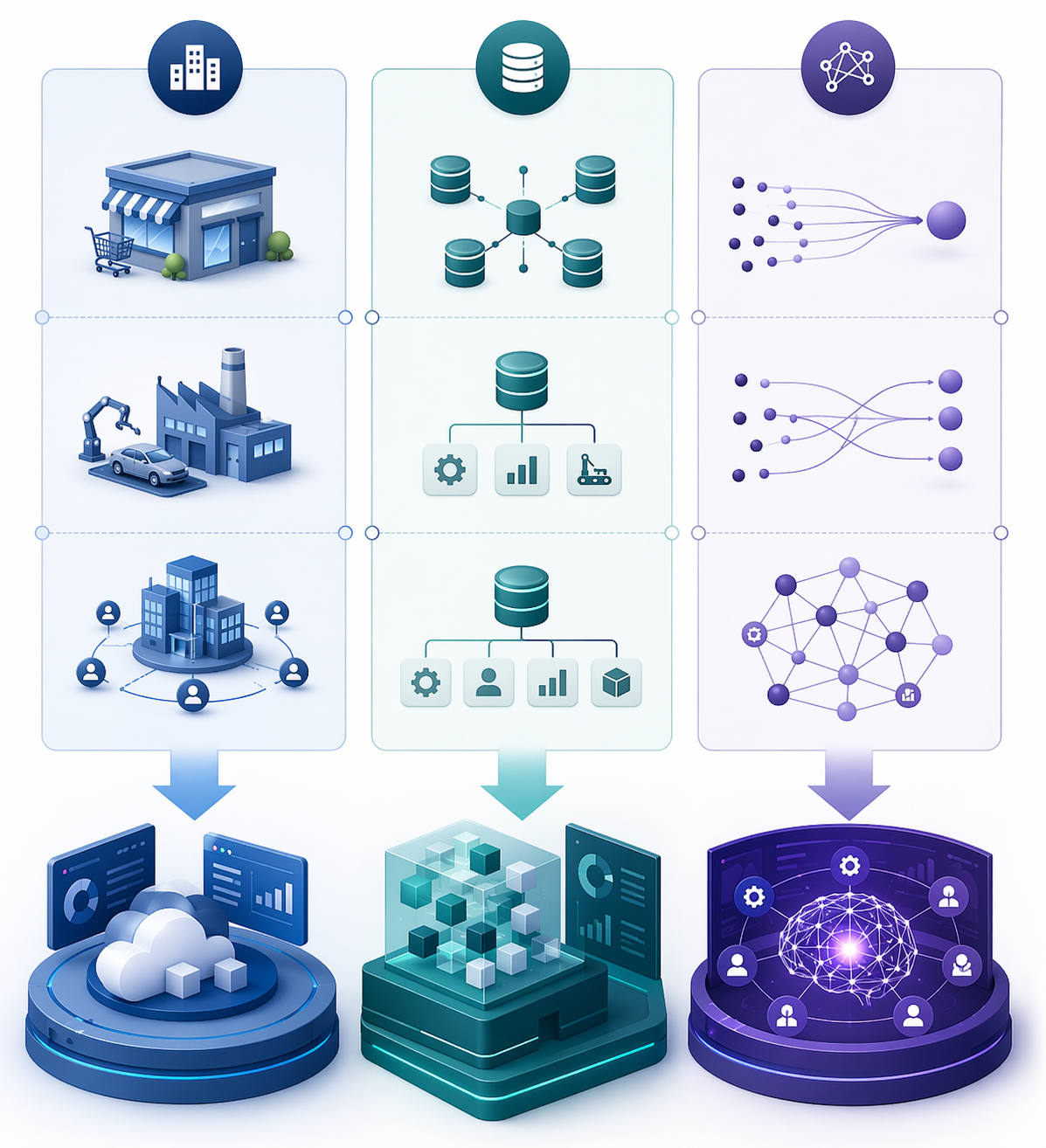
Demos compress the world. A retailer sees a clean exception queue instead of the messy sequence of POS ingestion, allocation decisions, warehouse capacity, carrier constraints, and store execution. A manufacturer sees a scenario simulation without the months of master data arbitration behind it. A commercial planning team sees margin-aware demand shaping before anyone has agreed who owns the inputs.
That is why industry profile is not a cosmetic category in this comparison. It changes what the platform must survive. In a CPG or retail environment, the planning problem is rarely isolated from execution. Store demand signals, promotions, replenishment, warehouse flows, transportation constraints, and service expectations all crowd into the same operating conversation. Blue Yonder belongs high on that shortlist because its center of gravity is closer to that planning-and-execution mesh.
In a global manufacturing environment, the pressure point is different. The company may have several ERP instances, regional planning practices, constrained suppliers, contract manufacturers, and plants that need to understand the consequence of a demand change before the next meeting cycle. Kinaxis becomes more compelling when the buyer needs rapid what-if response across that kind of manufacturing network rather than a primarily retail execution layer.
o9 is a different kind of bet. It is most attractive when the company is not only modernizing supply chain planning but also trying to connect supply, demand, commercial, and financial decisions through a shared AI-enabled planning model. That can be powerful. It also asks more of the enterprise. If the underlying data ownership, semantic modeling, and engineering capacity are weak, the promise becomes a program risk rather than a platform advantage.
Where Blue Yonder Belongs Higher On The List
Blue Yonder is the strongest fit of the three when the buying center is wrestling with execution-heavy planning in retail or CPG. That does not mean it is only a retailer’s platform, but the fit signal is clearest when planning decisions need to stay close to POS signals, replenishment, fulfillment, warehouse management, transportation, and service execution.
This is the kind of environment where a planning platform cannot stop at a better forecast. A forecast that does not translate into feasible replenishment, warehouse flow, or delivery performance leaves the planning director explaining an elegant number that operations could not execute. Blue Yonder’s appeal is that its planning conversation naturally extends into WMS, TMS, and execution coordination contexts.
Its AI positioning also sits closer to operational decision loops. Blue Yonder describes five domain-specific autonomous agents using a SADA loop, and reports Lenovo results that include a 5% forecast accuracy improvement, a 4% on-time delivery improvement, and a 10% increase in delivery accuracy.[2] Those are vendor-reported results from a named case, so they should be treated as evidence that the use case is plausible, not as a transferable business case.
The Snowflake foundation is also relevant for buyers whose planning problem depends on pulling together operational data at scale. Horizon Solutions characterizes Blue Yonder’s Snowflake foundation as a simplifier for integration compared with architectures that place heavier knowledge-modeling demands on the customer.[1] That does not remove the hard work of data governance or systems integration, but it can lower one category of technical friction for execution-heavy enterprises.
Where Kinaxis Becomes The Safer Shortlist Bet
Kinaxis should move up the shortlist when the operating problem is multi-region manufacturing response. The familiar pattern is not glamorous: multiple ERP systems, uneven regional data quality, long supplier lead times, capacity constraints, and planners who need to answer impact questions before the monthly planning process catches up.
That profile shows up often in automotive, electronics, aerospace, and pharma. The value is less about claiming a universal AI advantage and more about compressing the time between disruption, scenario analysis, and decision. If a supplier changes availability, a market plan shifts, or a plant constraint appears, the organization needs to see tradeoffs quickly enough for the answer to still matter.
Horizon Solutions’ analysis treats Kinaxis as relatively resilient in complex ERP landscapes and estimates a 12- to 18-month deployment timeline for Kinaxis enterprise programs.[1] That timing is still long enough to require serious executive sponsorship, planner adoption work, and IT capacity. The point is not that Kinaxis is light. The point is that its fit is strongest when ERP complexity is part of the starting condition rather than an exception the buyer hopes to clean up first.
Kinaxis’s AI story has also become more concrete with Maestro Agents. The company reports early results including 10× planner productivity in a top-10 pharma environment and more than 30 hours per month saved at an electronics manufacturer.[3] Again, those are vendor-reported early adopter outcomes. They are useful as directional signals, especially for planner productivity use cases, but they should not be converted into a guaranteed ROI assumption.
Where o9 Is Worth The Heavier Lift
o9 is the most compelling of the three when the enterprise is intentionally building a cross-functional planning layer. The buyer is not only trying to improve demand planning or supply response; it wants decisions across supply, commercial, and financial planning to share a connected model. In that context, o9’s knowledge graph is not a technical detail. It is the architectural reason to consider the platform.
That same architecture creates the readiness question. Horizon Solutions warns that companies without mature data engineering may extract only 30% to 50% of o9’s platform potential, and it places o9 knowledge graph construction in a 12- to 24-month window.[1] This is the sentence procurement teams should keep in the business case. If the enterprise cannot fund data modeling, integration, governance, and adoption work, o9’s ambition can outrun the organization’s ability to use it.
The market momentum is real enough to matter, though it needs the right label. o9 reported 37% annual recurring revenue growth and more than 30 go-lives in Q3 2025, both self-reported figures from a private company.[4] Those numbers support the view that large enterprises continue to buy and deploy the platform. They do not prove implementation quality for any individual buyer.
o9’s APEX model, announced in March 2026, adds another reason innovation-focused executives pay attention: the company describes it as a neuro-symbolic AI planning model.[5] For an enterprise with mature data engineering and a strategic planning architecture already in motion, that kind of model can be part of the rationale. For a company still debating basic master data ownership, it is a distraction from the first-order constraint.
Gartner Is A Market Signal, Not A Buying Answer
Leader placement in a major analyst report is worth noting because it tells a buying committee that the vendor is not fringe. Kinaxis and o9 both announced Leader positions in the 2026 Gartner Magic Quadrant for supply chain planning solutions.[6][7] That is useful market validation, especially when procurement needs to defend why a vendor belongs in an enterprise RFP.
It should not decide the shortlist by itself. Analyst placement does not know whether your European business unit still runs a different ERP template, whether the demand planning team trusts POS feeds, whether finance will accept the planning hierarchy, or whether IT has enough integration capacity after the warehouse modernization program. Those details decide whether a Leader becomes a working system.
The TCO And Readiness Check Buyers Should Do Before RFP
The most useful number in this comparison is not a subscription price. Vendors rarely make enterprise pricing simple enough for a clean public comparison, and scope changes the answer quickly. The useful planning range is Horizon Solutions’ third-party estimate: $4 million to $15 million-plus over three years for enterprise deployments across these platforms.[1]
That range should force a capacity conversation before the RFP goes out. A company spending at that level is not only buying software. It is allocating scarce transformation capacity: integration teams, data engineering, solution architects, process owners, planning leaders, super users, finance reviewers, procurement support, and executive attention.
| Readiness question | Why it changes the vendor decision |
|---|---|
| Do we have multiple ERP systems that will remain in place for the planning horizon? | If yes, Kinaxis deserves close attention because the platform fit is stronger in multi-ERP manufacturing response scenarios. |
| Is execution coordination the value case, not just planning accuracy? | If yes, Blue Yonder deserves close attention because the strongest fit is in retail, CPG, WMS, TMS, and execution-heavy environments. |
| Can we fund and govern an enterprise knowledge model? | If yes, o9 becomes more credible; if no, the knowledge graph may become the implementation bottleneck. |
| Are planners ready to change how they work? | If no, all three platforms become expensive reporting layers rather than decision systems. |
| Will finance accept a 12- to 24-month deployment path before full value is visible? | If no, the business case should be narrowed or the shortlist should move toward less ambitious alternatives. |
The deployment windows matter because they shape value timing. Horizon Solutions estimates 12 to 18 months for Kinaxis, 12 to 18 months for Blue Yonder, and 12 to 24 months for o9 when knowledge graph construction is in scope.[1] A finance team that expects a clean payback within a few quarters is likely to be disappointed unless the deployment scope is deliberately narrow.
The readiness burden is not equal across the three. o9 asks the most of the enterprise data model because the knowledge graph is central to the value proposition. Kinaxis still needs disciplined master data and integration, but its relative strength is operating in complex ERP manufacturing landscapes. Blue Yonder’s Snowflake foundation can simplify parts of the integration conversation, particularly where execution data is central, but it does not eliminate organizational ownership questions.
What To Do With SAP IBP, RELEX, Logility, OMP, And Arkieva
This comparison is intentionally narrow. SAP IBP, RELEX, Logility, OMP, and Arkieva can all belong in real evaluations depending on ERP strategy, retail specialization, planning maturity, geographic footprint, and budget. Excluding them here does not imply they are weaker choices in general.
The boundary is practical: Kinaxis, o9, and Blue Yonder are being compared as enterprise-grade AI planning platforms for large organizations with complex planning problems. If the company is below enterprise scale, or if the use case is narrower than multi-year planning transformation, the excluded alternatives may deserve earlier attention than any of the three platforms in this article.
A Practical Recommendation Pattern
Choose Blue Yonder as the leading shortlist candidate when the company is a retail, CPG, or execution-heavy enterprise and the value case depends on coordinating planning with POS, replenishment, warehouse, transportation, and delivery performance. Its strongest argument is not that it has AI agents; it is that those agents sit near the operational context where many retail and CPG planning decisions succeed or fail.
Choose Kinaxis as the leading shortlist candidate when the company is a multi-region manufacturer with several ERP systems and a real need for rapid scenario response. The more the pain looks like cross-plant, cross-supplier, cross-region tradeoff management, the more Kinaxis fits the operating problem.
Choose o9 as the leading shortlist candidate when the enterprise has the appetite and maturity to build a strategic AI planning layer across supply, commercial, and financial decisions. That choice needs a strong data engineering function, clear data ownership, and patience for the modeling work behind the knowledge graph.
Choose none of the three as the default first stop for mid-market buyers. Horizon Solutions frames these platforms as best suited to $3 billion-plus enterprises, while companies in the $100 million to $3 billion range typically risk over-purchasing capability at enterprise pricing.[1] For those buyers, a narrower platform that matches the immediate planning problem may be the more responsible shortlist.
References
- Blue Yonder vs Kinaxis and o9 vs Kinaxis analyses, Horizon Solutions
- AI Agents, Blue Yonder
- Kinaxis Maestro Agents launch, Kinaxis
- o9 reports 37% annual recurring revenue growth, o9 Solutions
- o9 APEX AI planning model, o9 Solutions, March 2026
- Kinaxis recognized as a Leader in the 2026 Gartner Magic Quadrant for Supply Chain Planning Solutions, Kinaxis
- Gartner Magic Quadrant, o9 Solutions
Comments
Join the discussion with an anonymous comment.