

In 2026, evaluating AI tools for supply chain management has become harder for a simple reason: almost every vendor now sounds fluent in the same language. Forecasting engines are “agentic.” Dashboards are “copilots.” Exception workflows are “autonomous.” The demo starts with intelligence before anyone has named the planning failure, the data constraint, or the decision owner.
That sameness is not accidental. Gartner forecasts that supply chain management software with agentic AI capabilities will grow to $53 billion in spend by 2030, from less than $2 billion, a market-size estimate broad enough to include SCM software carrying agentic AI capabilities rather than only pure-play AI tools.[1] Meanwhile, reported buyer intent is running ahead of operating discipline: 94% of organizations plan to deploy AI for decision support, while only 23% have a formal AI strategy.[2]
That gap explains the current theater. Vendors have a rational reason to attach AI language to every planning process; buyers have an equally rational reason to distrust the vocabulary. A standard feature matrix—demand sensing, inventory optimization, scenario planning, control tower, supplier risk, AI assistant—does not separate production-grade capability from a polished layer on top of older workflows.

The sharper test is not whether a vendor can say “AI-native.” It is whether planners, merchandisers, schedulers, inventory analysts, and supply chain leaders rely on the model output in daily decisions; whether the architecture can be explained without hand-waving; whether the platform exposes intelligence through usable APIs or emerging interfaces such as MCP; and whether the vendor can answer uncomfortable demo questions without retreating into roadmap language.
Start with evidence the buyer can actually test
A useful AI evaluation does not begin with a vendor category. It begins with evidence types. Some evidence is easy to show and weak: product slides, assistant screenshots, generic claims about machine learning. Some evidence is harder to produce and more useful: production adoption, retraining mechanics, explainability, integration requirements, and references from customers using the AI features rather than only the base planning suite.
| Signal | What to ask | What a weak answer usually sounds like | What a stronger answer usually includes |
|---|---|---|---|
| Production AI adoption | What percentage of customers use AI models in daily planning instead of traditional planning methods? | Most customers have access to it; adoption is growing. | A segmented answer by module, customer type, and planning process, with referenceable users. |
| Model architecture transparency | Which models are used for forecasting, inventory, replenishment, or decision recommendations, and how are they trained? | Our proprietary AI selects the best method automatically. | A clear explanation of model families, data inputs, retraining cadence, and where human overrides enter. |
| Integration burden | Which master data, transaction data, and external signals are required before the AI output is reliable? | We integrate with all major systems. | A candid data-readiness discussion, including failure modes when history, lead times, or item-location data are poor. |
| API and MCP openness | Can AI outputs, recommendations, and scenarios be accessed outside the UI through production APIs or MCP-style interfaces? | The assistant is embedded in our platform. | Documented production interfaces, permissioning, auditability, and examples of external agent or workflow use. |
| Explainability | Can a planner see why the model recommended a change and what assumptions moved? | The model is too advanced to expose every detail. | Driver-level explanations, confidence indicators, exception reasons, and a way to compare model output against baseline logic. |
| Demo behavior | Can you run our messy scenario, with our constraints, without pre-scripted shortcuts? | That would be handled in implementation. | A live or follow-up walkthrough showing configuration choices, data assumptions, and where the system cannot yet automate. |
The first question in that table is usually the most revealing. Not “how many customers own the module?” Not “how many have AI enabled?” The better question is: what percentage of customers use the AI model output in daily planning, and in which workflows? A vendor that cannot distinguish licensed access from operating adoption is asking the buyer to underwrite the implementation risk.
This is also where satisfaction data can help, although it should not be treated as audited deployment telemetry. A Flowlity comparative analysis, cross-referencing G2 review text, reports higher satisfaction scores for several AI-native platforms—Flowlity at 4.9/5, ToolsGroup at about 4.7/5, and o9 at 4.2/5—compared with legacy suite scores such as Blue Yonder at 4.1/5 and Kinaxis at 4.0/5.[3] Those numbers may change, and review populations are not the same as production adoption rates. Still, when satisfaction patterns line up with review language about usability, planning speed, or reliance on AI recommendations, they become worth investigating.

The adoption question vendors would rather answer indirectly
The most important distinction in an AI supply chain shortlist is not whether the product has an AI feature. It is whether the AI feature has crossed into the planner’s normal operating rhythm. That means model output is used to adjust forecasts, set inventory positions, recommend replenishment, prioritize exceptions, simulate scenarios, or trigger follow-up action—not merely shown in a sidebar.
Directional evidence from Flowlity’s competitive analysis suggests an adoption gap: legacy suite vendors such as Blue Yonder, SAP IBP, and Kinaxis market AI features heavily, but review-text analysis and available adoption signals indicate many planners on those platforms still rely on traditional methods.[3] That is not the same as proving that the AI features are ineffective. It means buyers should not infer daily AI usage from suite penetration, brand familiarity, or a roadmap-heavy demo.
In a demo, the adoption thread should be followed until it becomes operational. Ask for three reference customers using the specific AI capability being shown. Ask whether the AI output is advisory or system-driving. Ask which planning decisions still require manual spreadsheet review. Ask how many recommendations are accepted, edited, or rejected. If the answer shifts from production behavior to “our customers are excited about the potential,” that is useful information.
The same question should be asked separately by workflow. A vendor may have meaningful AI adoption in demand forecasting but little in replenishment. Another may automate exception triage but leave inventory policy setting mostly conventional. A third may have a strong assistant interface that answers questions but does not materially alter planning decisions. Those differences matter more than a broad “AI-powered platform” label.
Architecture is not a purity contest, but it changes what can be verified
The AI-native versus AI-layered distinction is useful because it forces a buyer to ask where intelligence actually sits. Is the model part of the planning logic, continuously shaping forecasts, inventory targets, scenarios, and exception priorities? Or is it a later interface layer that summarizes, explains, or recommends around an older planning core?
The distinction should not be turned into a caste system. SAP IBP, Blue Yonder, Kinaxis, and Oracle remain deeply embedded for reasons that are not sentimental: global process standardization, transaction-system alignment, existing integrations, governance, partner ecosystems, and years of organizational muscle memory. Kinaxis’s investment in newer agentic capabilities is a reminder that incumbent architecture can evolve, and that the correct question is not whether a vendor is “legacy” in a pejorative sense. The question is how quickly and safely its AI can act inside the planning process a buyer actually needs to improve.
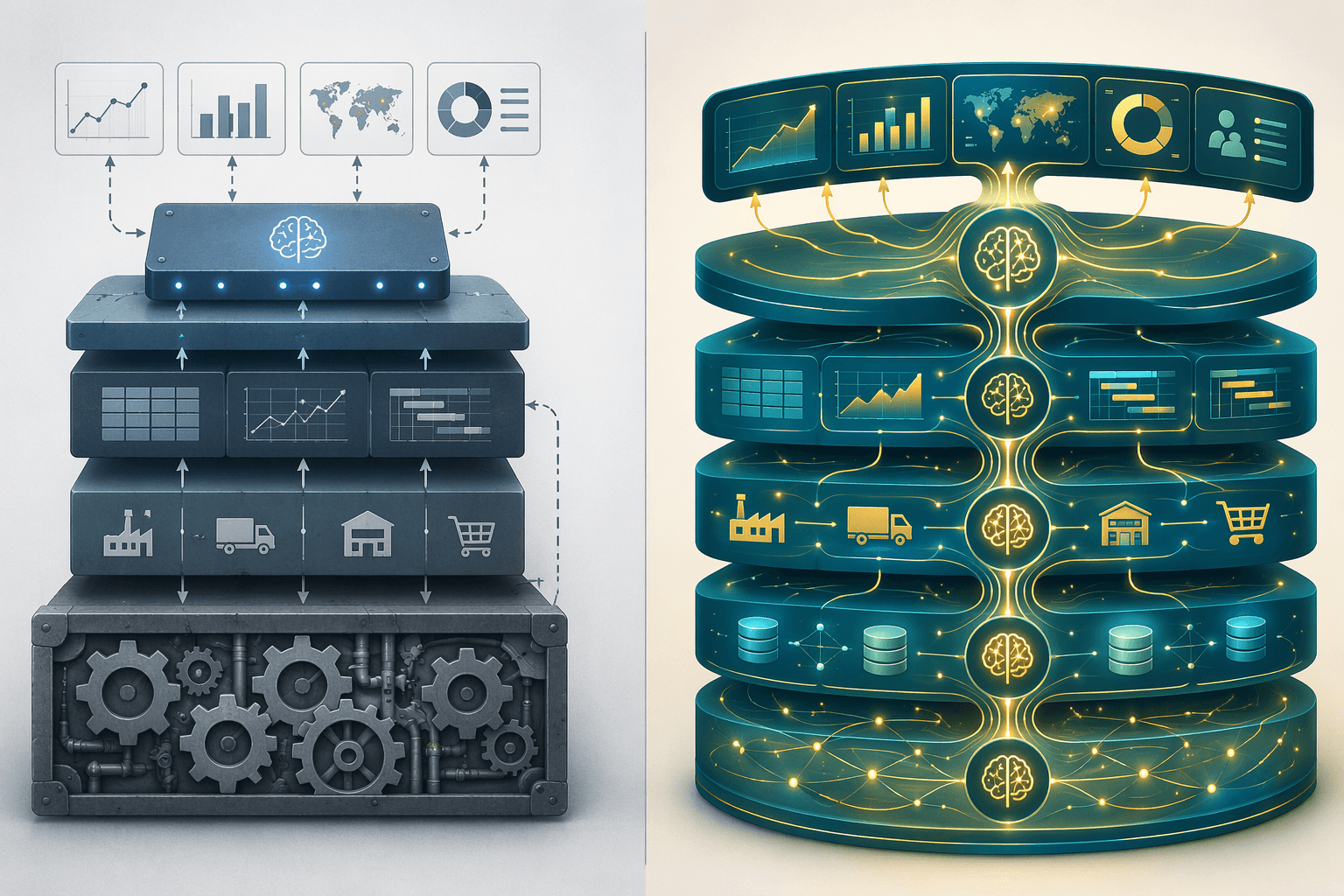
Still, architecture shows up in the demo if the buyer listens for it. A platform built around AI-native planning should be able to explain how models interact with constraints, scenarios, master data, and user overrides. A platform adding AI around an existing planning engine may still be valuable, but the buyer needs to understand whether the AI can change the plan, only explain the plan, or merely help the user navigate the screen.
Three architecture questions cut through a surprising amount of fog:
- Where does the AI recommendation enter the planning workflow: before the plan is generated, during optimization, after exception detection, or only in the user interface?
- What happens when the user rejects a recommendation? Does the model learn from the override, does it store the decision as context, or does the rejection disappear into audit history?
- Can the vendor show the baseline method the AI is improving against, so the buyer can distinguish model value from a normal planning-engine result?
If those questions produce a clean discussion of data flow, model behavior, and planning consequences, the buyer has something to evaluate. If they produce a product manager’s tour of assistant prompts, the architecture may still be developing.
Open interfaces are becoming part of the AI test
For years, supply chain software openness mostly meant APIs, flat-file ingestion, EDI, ERP connectors, and maybe an integration marketplace. In 2026, buyers evaluating AI tools have to add a newer question: can the intelligence be reached from outside the vendor’s own pane of glass?
MCP support is one early signal, not a universal requirement. Flowlity’s comparison reports that Flowlity ships a production MCP server connecting to Claude, ChatGPT, and Copilot; SAP has announced platform-level MCP support but not yet in IBP; and Blue Yonder, Kinaxis, and o9 offered only proprietary embedded AI interfaces as of April 2026.[3] Because this area is moving quickly, any MCP claim should be verified at the time of evaluation and tested in a production-like workflow, not accepted from an announcement slide.
The practical issue is not fashionable interface architecture. It is whether planners, analysts, and adjacent systems can use model output where decisions actually happen. If a procurement workflow, S&OP packet, warehouse labor plan, supplier-risk process, or executive scenario review needs the AI recommendation, can that recommendation travel with permissions, context, and auditability? Or does it stay trapped inside a proprietary assistant that only works after a user logs into the vendor UI?
The API discussion should be equally specific. Ask whether recommendations, confidence scores, scenario inputs, exception reasons, and user decisions are exposed through documented endpoints. Ask whether the integration is read-only or can trigger planning actions. Ask how identity, access control, and audit logs work when external tools call the platform. The more agentic the claim, the more boring and precise the interface discussion should become.
Black-box sophistication is usually a weak answer
Supply chain planning does not need every algorithm exposed like a graduate seminar. It does need enough explainability for a planner to defend a decision when the forecast changes, inventory moves, service risk rises, or procurement timing shifts. “The AI found a pattern” is not sufficient when the consequence is a production miss, an expedited shipment, or excess working capital.
Buyer guides from Viewpoint Analysis and Deposco both emphasize evaluation questions around fit, integration, visibility, and operational proof rather than accepting generic AI claims.[4][5] Combined with the warning signs surfaced in the Flowlity comparison, the pattern is consistent: vague model descriptions, little evidence of customer production use, black-box recommendations, and unclear data requirements are not minor demo defects. They are implementation-risk signals.[3][4][5]
A credible vendor does not need to reveal proprietary source code. It should be able to explain the model’s operating boundary. For example: which demand signals are used; how promotion, seasonality, intermittency, and new-product behavior are handled; whether retraining is continuous or batch; how often models are monitored; what happens when data quality drops; and which planner actions feed future recommendations.
Retraining deserves special attention because it separates static analytics from adaptive planning. A vendor may say the model “learns continuously,” but the buyer needs to know what that means. Does it update after every transaction, after a daily batch, after a planning cycle, or only during a managed model refresh? Who approves the change? Can the customer compare old and new model behavior before rollout? If a demand planner cannot tell why the recommendation changed between cycles, trust will move back to the spreadsheet.
What the current vendor pattern suggests—and what it does not prove
The current market evidence points in a direction rather than delivering a final ranking. AI-native platforms such as o9, Flowlity, RELEX, ToolsGroup, and Aera Technology tend to present themselves around model-driven planning, autonomous decisions, or decision intelligence. Incumbent suites such as SAP IBP, Blue Yonder, Kinaxis, and Oracle tend to carry broader enterprise planning footprints while adding AI features into established product families. That split is real enough to structure a shortlist, but not clean enough to select a vendor by category alone.
The satisfaction scores cited earlier give AI-native tools an advantage in the available comparative snapshot, especially for Flowlity and ToolsGroup.[3] The adoption-gap claim also deserves attention because it matches what many evaluators see in demos: a mature planning system at the center, with AI presented as a new interface, assistant, or exception layer around it. But the underlying adoption evidence comes from a vendor-authored competitive analysis cross-referenced with review text, not from a neutral audited deployment census. It should shape the questions, not end the investigation.
That distinction matters because the wrong conclusion would be easy. It would be lazy to say that every incumbent suite is AI-washed or that every AI-native platform is automatically better. A global manufacturer running SAP-centered planning across regions may accept slower AI evolution in exchange for governance, integration continuity, and process control. A mid-market company with fragmented planning and limited tolerance for long implementation cycles may benefit more from a focused AI-native platform if it can absorb the required data work.
The better conclusion is narrower and more useful: AI-native vendors should be asked to prove scale, integration depth, and enterprise controls; incumbent vendors should be asked to prove that AI is changing planning behavior in production rather than decorating an existing suite. Both can pass. Both can fail.
ROI benchmarks justify the scrutiny, not the purchase
There is enough value on the table to take the category seriously. McKinsey benchmarks cited in the available 2026 supply chain AI statistics and comparative materials indicate that AI-enabled distribution operations can achieve 5–20% logistics cost reduction, 20–30% inventory reduction, and 5–15% procurement spend reduction.[2][3] Those ranges explain why finance teams keep asking about AI-enabled planning. They do not guarantee that a selected platform will deliver the same outcome in a different data environment, network design, planning culture, or operating model.
The ROI conversation should therefore be tied back to the specific workflow under evaluation. If the target is inventory reduction, ask how the model changes safety stock, service-level tradeoffs, lead-time assumptions, and exception handling. If the target is logistics cost, ask whether the platform influences distribution decisions or merely reports on them. If the target is procurement spend, ask where supplier, price, demand, and risk signals meet in the decision process.
A vendor that can only map benchmark ranges to a generic business case is not yet demonstrating value. A vendor that can show the decision step being shortened, automated, challenged, or improved is closer to proving the point.
Fit still decides the shortlist
Once the AI-washing filters are in place, the shortlist still has to match the operating environment. The right question is not “which platform has the most AI?” It is “which platform can make better decisions in this organization without creating a governance, integration, or adoption failure?”
| Buyer profile | What to prioritize | What to be careful about |
|---|---|---|
| Large enterprise with standardized planning processes | Governance, global template fit, ERP integration, role-based controls, auditability, and proven adoption at comparable scale. | Do not accept an incumbent’s AI roadmap as production proof; ask for live customer references using the specific AI capability. |
| Mid-market organization with brittle spreadsheet-heavy planning | Time to value, implementation scope, planner usability, data-readiness requirements, and ability to improve a narrow workflow first. | Do not assume an AI-native tool removes data cleanup, change management, or integration work. |
| SAP-first environment | Compatibility with SAP master data, process governance, planning calendar, identity controls, and downstream execution handoffs. | Do not let SAP alignment prevent comparison against focused AI-native platforms where planning pain is severe. |
| Platform-agnostic or best-of-breed environment | Open APIs, MCP-style accessibility where relevant, composability, and ability to exchange recommendations with surrounding systems. | Do not underestimate the ownership burden of stitching together multiple specialized tools. |
| Planning-heavy organization | Forecast accuracy, inventory policy, scenario modeling, explainability, and planner adoption of recommendations. | Do not overvalue a conversational assistant if the underlying planning model remains conventional. |
| Execution-heavy organization | Exception prioritization, decision latency, connection to warehouse, transportation, order, or supplier workflows, and closed-loop action tracking. | Do not buy planning intelligence that cannot reach execution decisions fast enough to matter. |
For enterprise buyers, the hard part is often not finding sophisticated AI claims. It is finding a vendor that can survive architecture review, security review, data-governance review, regional process variation, and finance scrutiny while still improving planner behavior. For mid-market buyers, the hard part is avoiding overbuilt platforms whose AI power is real but locked behind implementation complexity the organization cannot absorb.
SAP-first organizations have a different problem. Their center of gravity is already chosen. The AI evaluation becomes a make-or-extend decision: stay within the suite and demand proof of production AI adoption, or add a specialized platform where the planning gap is large enough to justify another integration layer. Platform-agnostic organizations have more freedom, but also fewer excuses if they fail to define the system of record, decision rights, and integration contract.
Run the demo like an implementation preview
The most efficient way to expose AI-washing is to stop letting the vendor demo only its preferred path. A good demo script should include the buyer’s actual planning friction: intermittent demand, unreliable supplier lead times, capacity constraints, substitution rules, promotion effects, new-product uncertainty, late purchase orders, or whatever else breaks the weekly process.
The buyer does not need to make the demo adversarial. The tone can be straightforward: “Show us how the model handles this, what data it needs, what the planner sees, what action the system recommends, and what happens if the planner disagrees.” A serious vendor should welcome that conversation because it moves the evaluation away from generic AI language and toward fit.
- Ask for one workflow from data ingestion to recommendation to user decision to audit trail.
- Ask for the same workflow with bad or missing data, not only the clean version.
- Ask which part is generally available, which part is configured, and which part is roadmap.
- Ask whether the AI output is accessible through APIs or MCP-style interfaces in production.
- Ask for references who use the AI capability in the same planning domain, not just the same vendor suite.
- Ask what customers tried to automate and then pulled back into human review.
That last question is underrated. Every real planning environment has boundaries. A vendor that can say where automation works, where human approval remains necessary, and where the model should not be trusted yet is often more credible than one claiming seamless autonomy across the whole supply chain.
A usable standard for 2026
The supply chain AI market is too noisy for buyers to rely on vocabulary, and too fast-moving for any vendor judgment to stay fixed for long. As of Q2 2026, the most reliable evaluation standard is still practical: privilege production adoption, architectural transparency, and openness over demo language.
That standard does not produce a universal winner. It produces a better shortlist. AI-native platforms may deserve closer attention when they can show daily model use, transparent retraining, open interfaces, and strong satisfaction signals. Incumbent suites may remain the right choice when their governance, integration depth, and operating fit outweigh the slower path to embedded AI. The buyer’s job is to make each vendor prove where its intelligence actually works, who uses it, how it connects, and what happens when the model is wrong.
References
- Gartner Forecasts Supply Chain Management Software with Agentic AI Will Grow to $53 Billion in Spend by 2030 — Gartner, April 2026
- Supply Chain AI Statistics: 18+ Statistics You Should Know for 2026 — Open Sky Group
- Best AI Supply Chain Software: 2026 Comparison — Flowlity
- Supply Chain AI Software Options 2026: Our Buyer Guide — Viewpoint Analysis
- 2026 Best AI-powered Supply Chain Platforms: A Buyer's Guide — Deposco
Comments
Join the discussion with an anonymous comment.